| ABOUT US | ARCHIVES | LINKS | RSS FEED | MONDAYS | |

3quarksdaily

An Eclectic Digest of Science, Art and Literature

« New York’s Empire State of Mind: The Colonization of ‘Up’ Part I | Main | As Special as Everybody Else »

February 21, 2011

TUNISIAN PROSTITUTES AND THE SPECTRE OF CEAUSESCU: FIRST THOUGHTS ON THE NASCENT ARAB REVOLUTIONS

by Jeff Strabone

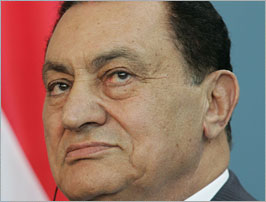
One way that novels and films differ from the real world is that events that mark the end of a narrative fiction tend to be just the beginning in the non-fictional world. Case in point: revolutions. A revolution is never the end of the story in real life. If the razzle-dazzle of mass protest, the minting of fresh martyrs, and the deposition of decades-fattened tyrants are the marks of a real revolution—one that Mubarak 1 permanently alters the material conditions in the lives of societies and nations—then revolution is mere prologue to the messier story of laws being rewritten and power redistributed. If the people left standing after a revolution are lucky, their story will quickly turn to the boring, non-narratable prose of parliamentary debates and trade agreements devoid of drama and conflict. (See Central Europe, 1990–2011.)
What, then, will be the story of the Arab revolts in 2011? It is too soon to know even what genre of tale will be told. In lieu of predicting what will happen next, I offer instead some first thoughts on the exciting events so far and what they will mean for the Arab states, the United States, and Israel.

1. Show us the money

One of the first things that the free citizens of Egypt and other kleptocracies will have to do is audit the government's accounts and get back the money stolen from the state. Estimates of the loot from the Mubaraks' thirty-year crime wave range as high as a surely exaggerated $70 billion. Even if the true amount is one-tenth of that, there is still a massive amount of public revenue to be reclaimed.

However high or low, the money will not be easy to track nor to get back. As the New York Times for February 18 reminds us, Egypt faces another economic complication: the military.

The Egyptian military defends the country, but it also runs day care centers and beach resorts. Its divisions make television sets, jeeps, washing machines, wooden furniture and olive oil, as well as bottled water under a brand reportedly named after a general's daughter, Safi.

In countries like Egypt, Pakistan, and Iran, the military operates its own 'gated economy'. A republic is only civilian-ruled to the extent that the military lacks its own independent bases of political and economic power. Even if every last Mubarak-pilfered gineih were returned, the larger problem of extricating the military from the economy would remain. For the fifty years since U.S. President Eisenhower gave a name to the military-industrial complex, Americans have struggled to minimise its influence over their government. The Egyptians would be blessed to be facing such a comparatively simple problem as that.

2. Israel's stake in Egypt's future

The top two recipients of U.S. aid for the past thirty years have been have been Israel and Egypt. Israel's annual gift has ranged from $2.3 to $3.1 billion a year over the last decade, Egypt's from $1.5 to $2.0 billion. Without the many billions to Israel over the years, their republic might not have endured for the past 62 years. Without the many billions to Egypt, Israel would not have had a friend at its southwestern border. Looked at starkly, the U.S. has paid Mubarak to be Israel's friend at the cost of the livelihoods of the 80 million Egyptians whose hopes and aspirations he stifled for the past thirty years. This is a depressing calculus of human suffering, and that's without factoring in the suffering of the Palestinians.

It's safe to say that no democratically-elected successor in Egypt will be as Israel-friendly as Mubarak was. Why does this prospect alarm Israel? Israel has depended on Egypt for at least two things whose terms are likely to change: border security at Gaza and energy supply.

Israel's blockade of Gaza since 2007 continues to produce suffering on an epic scale, as measured by its 70 percent poverty rate (CIA), its 65 percent infant anemia rate, (WHO), the pitifully low 60 percent of its population whose homes are connected to sewage systems (ICRC), and so on. This blockade would not be enforceable without Egypt's assistance.

Nor would Israel be able to meet its energy needs without the Arish-Ashkelon Pipeline from Egypt. A special Israel-devoted branch of the Arab Gas Pipeline, it supplies 40 percent of Israel's natural gas. As reported by Forbes on February 5, the pipeline has been disrupted by a mysterious explosion. Coincidence?

Israel's greatest fear about a democratic Egypt may be that Mubarak's successor—Pan-Arabist, Islamist, or whatever—could threaten to end the blockade and turn off the gas until Israel allows the Palestinians to form their own sovereign state.

(Yes, Israel has recently discovered large natural-gas fields, named Tamar and Leviathan, but neither is operational yet.)

3. Bahrain: international war brewing?

The big hot spot this week has been Bahrain. Bahrain is one of only three states with a Shia majority, the others being perennial hot spots Iran and Iraq. And now that Iraq is, however non-functionally, a democratic republic, Bahrain remains the only Shia-majority country ruled on a discriminatory basis by a Sunni minority. Bahrain is also home to the U.S. Naval Forces Central Command and the U.S. Navy's Fifth Fleet, the maritime cops of the Persian Gulf and counterweight to Iran.Naval central command logo

Because of the Saudi royal family's antipathy towards Shias, Bahrain has the potential to become a regional war. The Saudis' expression of support for Bahrain's Sunni-minority rulers, as reported by The Washington Post for February 20, may already be a barely veiled threat of military intervention against Shia revolt. A Saudi invasion would be bad, to put it concisely.

Whatever one makes of President Obama's performance as world leader so far, every Shia Bahraini should say al-hamdulillah that Shiaphobe Dick Cheney is not calling the shots anymore. Expect the neocon hawks to squawk to high heaven if Shias come to power in Bahrain. It will make fearmongering about Egypt's Muslim Brotherhood look like a mime show by comparison.

4. At long last, Palestinian flower power?

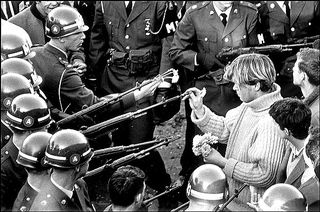
I have been saying for years, not entirely facetiously, that the Palestinians' main problem is that they lack a great rock band or a hippie movement. What do I mean by that? Whatever one may think of Israel's policies, the Palestinian cause—human rights and democratic participation in a republic that recognises them as citizens—has always been a just cause. And yet, the Palestinians have always been their own worst enemies: corrupt leaders, internal schisms, and, of course, the bad P.R. that comes from violent actions against innocent civilians. (There's even an opera about it.) One does not have to be a pacifist to see that the Palestinians' tactics over the decades have hurt themselves more than anyone.Flowers in rifles

The question—the challenge, really—that the success of non-violence in Tunisia and Egypt lays down for the Palestinians is, Will they finally wake the hell up and realise that non-violence can work for them, too? As long as the homemade rockets of Hamas terrify Israelis across the border, Israel will be able to frame its military response, whether one deems it disproportionate or not, as retaliation.

It's as if Hamas is playing by some outdated guerilla calculus that provoking crackdowns from one's enemy will engender more popular resistance. I tend to believe that such tactics just get more people needlessly killed on all sides and sets back the development of viable political and social institutions. And in a post-9/11 world, any non-state actor caught throwing a stone, be it the first stone or the thousandth, risks total warfare under the guise of counterinsurgency. (See recent events in Sri Lanka, as ably recounted by Jon Lee Anderson in the New Yorker for January 17, 2011.)

The success of the first intifada in 1987 in restoring the Palestinians' cause to a global audience was due to the images of boys being shot at and their bones broken by the Israel military. With the rules of the game changing around them, the last best chance the Palestinians have would be to put flowers in the barrels of the IDF's rifles and sing 'Imagine' or 'Let It Be' or 'Give Peace a Chance' in Arabic. The al-Aqsa Martyrs' Brigades would have to make way for Gandhi- and MLK-inspired peace brigades.

5. Et tu, U.S.?

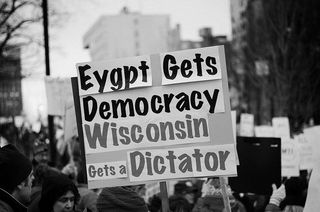
Could events in the Arab countries spark campaigns for justice here in the States? Labour revolts in Wisconsin and Ohio, shocking in and of themselves, have even more shockingly been invoking Egypt in their rhetoric and signage. Still, I would not get my hopes up too high. Mass, sustained civil disobedience at the corporate headquarters of insurance 'providers' and banks and petrol companies remains a long way off. Instead, Koch-funded campaigns continue to succeed at electing Republican governors who then refuse federal money to build high-speed rail networks . (See Wisconsin, Ohio, Florida, and more to come. Special shoutout to New Jersey.)Wisconsin Egypt

When Americans begin to thirst for health care, re-pedestrianised cities, and the return of usury laws with the same fervor that Egyptians have shown in clamouring for democracy and the rule of law, only then will we know the revolution is here.

6. Gay rights as sign

The coming constitutional showdown between human law and divine law in the revolutionary Arab states may turn on the question of gay rights and sexual freedom generally. On paper, Islam is no more homophobic than Christianity or Judaism. (See Leviticus 20.13). The different outcomes in the various parts of the world have more to do with the relative political strength of those who want the state to perform a moral-policing role. In the U.S., even Supreme Court justices believe that the individual has no constitutional protections against a crazed majority who would legislate against sexual freedom. (See Antonin Scalia's dissent in Lawrence v. Texas, 539 U.S. 558 (2003).)

The New York Times for February 20, 2011, in a sign of things to come, reports on the Tunisian military's action to defend brothels from the mob:

The second phase of Tunisia's revolution played out in this city's ancient medina last week as military helicopters circled and security forces rushed to carry out an unusual mission: protecting the city's brothels.

Police officers dispersed a group of rock-throwing protesters who streamed into a warren of alleyways lined with bordellos shouting, 'God is great!' and 'No to brothels in a Muslim country!'

Let us wish the Tunisian prostitutes well.

7. Who will play Ceausescu in this story?

If 2011 is the 1989 of the Arab world, who will be its Ceausescu? Nicolae Ceausescu, for those of you too young to remember, was the intractable communist dictator of Romania from 1964 to 1989. After peaceful regime changes in Poland, Hungary, Bulgaria, Czechoslovakia, and East Germany, the world turned its eyes to Romania, but the self-styled Genius of the Carpathians was not going out like that. He instead turned his guns on his own people, only to have the guns turned back on him and his wife on December 25.Ceausescu stamps

At this point, Muammar Qaddafi, dictator of Libya, looks poised to play that role. Reports and rumours leaking out of Libya this week speak of planeloads of mercenaries flown in from elsewhere in Africa, snipers aiming at funerals, and machine guns in the streets. A man who creates his own calendar upon coming to power cannot be expected to leave without a fight.

And who better to play the Ceausescu role? Aside from the well-publicized pain and suffering this madman has caused, from the dancefloor of the La Belle discothèque in Berlin to the skies over Lockerbie, Scotland, let us not forget that Charles Taylor of Liberia (currently on trial in the Hague for war crimes and crimes against humanity) and Foday Sankoh of Sierra Leone got their training in Libya. Of all the dictators currently in power, he has ruled the longest, since 1969, and, when we factor in his role in the wars in West Africa in the 1990s, may have the most blood on his hands. May he get all that he has coming to him.

And may all the peoples of the world live free with leaders of their own choosing and with easy access to medical care as every human being deserves. Let's hope that something close to that awaits us all in this life.

Posted by Jeff Strabone at 12:05 AM | Permalink

Comments

Amen.

Posted by: 42 | Feb 21, 2011 1:36:21 PM

6. Gay rights as sign

We really are the canary in the coal mine.

Posted by: BobN | Feb 21, 2011 3:28:32 PM

This article repeats an argument that has been made regularly in the past few weeks: "Looked at starkly, the U.S. has paid Mubarak to be Israel's friend at the cost of the livelihoods of the 80 million Egyptians whose hopes and aspirations he stifled for the past thirty years."

This suggests that were it not for US support, there would have been no Mubarak regime in Egypt. Considering Qaddafi, Assad, and all the other Arab autocrats, monarchs, and dictators who did not receive $1.5 billion a year from the US, on what basis was Mubarak's survival dependent on US aid? Considering the 25 years of military-based autocratic rule in Egypt before we started our aid, why is US aid the cause for the lack of democracy?

It's far more likely that Egyptians were going to suffer through military autocracy regardless, and the only question was whether their military received an additional $1.5 billion a year in aid to be at peace with Israel or not.

If you want to call the US hypocritical for allying with repressive regimes, be my guest. But don't stretch the case to make it America's fault that Egyptians were repressed. For if it is America's fault, then you must support some action to end America's blame for dictatorships. What is that action? Do you want America to embargo every dictatorship? How about refuse to have any diplomatic relations with the regimes? How about invade to create democracy?

Once we start getting down to brass tacks, it turns out that everyone supports...the status quo, of holding our nose and working with dictators.

Of course, some will protest by rewriting history to allow a magical solution where the US applies leverage to force Egypt to democratize. Unfortunately, it's a fantasy. To believe that the US could simply require Egypt to democratize by withholding aid, you must also believe that the US could have bought Libyan democracy with $1.5 billion in aid, and Syrian democracy with another $1.5 billion in aid, etc. But of course, if you're the long-running despot of a regime, you will not give up your own power to gain aid.

So, the US had two choices. Peace between a despotic Egypt and Israel, or a state of war between a despotic Egypt and Israel. Given the option, I prefer the former.

Posted by: Josh | Feb 21, 2011 5:42:26 PM

Response to Josh:

It is false to say that 'the US had two choices. Peace between a despotic Egypt and Israel, or a state of war between a despotic Egypt and Israel.' If those were the only choices, I would agree with Josh that the former would be far preferable. But there were other choices possible. The U.S.-enforced regional security arrangment that has prevailed in that part of the world for the past thirty years has been madness. It has utterly failed to advance U.S. security interests. Had the U.S. used the leverage of its billions of dollars to push the parties in conflict towards resolution—to be clear, I am talking about the Israelis and the Palestinians—perhaps the billions to Egypt would not have been necessary.

Posted by: Jeff Strabone | Feb 21, 2011 8:04:47 PM

A long article proving a lot of confusion in the history and the interpretation of Middle East politics, USA aid and even Eastern Europe history.
Only to point some facts: Sadat turned from Soviet Union aid (that helped Nasser and Sadat, both military dictators) after his "victory" over Israel in Atonement Day War( in fact after losing the war, but making believe his people that was a victory). Then Egypt was in a very bad economic situation with riots over the food prices and huge military debts.
The penury of Gaza is due to the fact that Gaza has no natural resources, that the Gaza population under Hamas rule lost the extraordinary work market in Israel (that is afraid of terror attacks by the workers from Gaza) and the extraordinary density of population.(no birth control in a population with a density same Hong Kong without the heights). This poverty has correlations with the blockade, that is an blockade for arms, guns and explosives mostly. To say: "Israel's blockade of Gaza since 2007 continues to produce suffering on an epic scale, as measured by its 70 percent poverty rate (CIA), its 65 percent infant anemia rate, (WHO), the pitifully low 60 percent of its population whose homes are connected to sewage systems (ICRC), and so on. This blockade would not be enforceable without Egypt's assistance."...Is not only demagogic correlation but also a logical fallacy:
Confusing Cause and Effect
A and B regularly occur together.
Therefore A is the cause of B.
The opening of blockade of Egypt by Mubarak successor will trigger a new army operation in Gaza and the occupation of Egyptian frontier of the Palestinian side by Israeli Army. More innocents will die.
The Gas Jordan Pipe explosion was caused by Sinai Bedouins and was against the Egyptian state police and army; the Bedouins, with large opium crops, with drug, guns and illegal Sudanese refugees traffic to Israel are now in an open civil "war" with Egyptian order forces. The supply to Jordan and Israel ceased. The supply of gas to Israel is "only" 2 bill $/year, to Jordan is much bigger...All lost this year...
Ceausescu fall was probably orchestrated by KGB and the Romanian Security Forces on direct order of Gorbachev; anyway Ceausescu didn't "turn his guns on his own people" but on the Hungarian minority that manifested against the arrest of a nationalistic priest and less than 100 were killed before "revolution" The 1000 victims of the revolution were mostly people shot dead by mistake in the turmoil of the events. Ceausescu was executed on the spot by a "tribunal" of his former collaborators and henchmen that were afraid that in a regular trial Ceausescu will speak about their crimes too.
The power in Romania was taken by the same crime collaborators that helped Ceausescu in his 24 years of absolute tyrannical rule.
If someone will compare Mubarak rule with this of Ceausescu, Egypt will appear as a great democracy. As Nasser and Ceausescu today,Mubarak also will be regretted by his people. As a rule, a revolution produce a lifespan (at least) of poverty and of economic crisis.

Posted by: Mirel | Feb 22, 2011 9:07:55 AM

Also author said:
"I have been saying for years, not entirely facetiously, that the Palestinians' main problem is that they lack a great rock band or a hippie movement." Any such Palestinian "Peace Now" will be stopped with bullets by Hamas AND Fatah militants; also it is impossible due to the Palestinian education (from kindergarten to university) of hate and vengeance.

Posted by: Mirel | Feb 22, 2011 9:15:34 AM

No Palestinian rock bands? No Palestinian hippies? You're talking to the wrong people -- if Palestinians hadn't invented Humous, hippies all over the world would have starved to death by now. Please educate yourself before you pronounce.

Folk music?: Sabreen. Marcel Khalifeh. Gibran Trio.

Hip-hop: Dam. Nomads. The Philistines. Iron Sheik. And the incredible Shadia Mansour.

Hippy poetry: Tamim Barghouti. Suheir Hammad.

Posted by: Ananas | Feb 22, 2011 9:28:39 AM

Jeff - My point was that it is unfair to blame the US for Egyptian repression, since Egypt was repressive before US aid, and since repressive regimes are the norm in the region regardless of American aid, friendliness, or opposition.

You have responded that the US could have spent its aid money differently to achieve a broader regional peace.

That's an interesting hypothetical, but completely unrelated. Broader regional peace is not the same as democracy in Egypt.

When I said that the choices were peace with despotic Egypt or war with despotic Egypt, my intent wasn't to arbitrarily limit the options to aid or no aid, but to show that no matter what path you took with Egypt in 1979, you had to deal with a despotic state. Even under your hypothetical scenario, the US would be restructuring its aid to create peace between Israel...and despotic states.

Posted by: Josh | Feb 22, 2011 10:51:51 AM

Jeff said:
"Had the U.S. used the leverage of its billions of dollars to push the parties in conflict towards resolution—to be clear, I am talking about the Israelis and the Palestinians—perhaps the billions to Egypt would not have been necessary."
This leverage was used in camp David 2000 by president Clinton,( ready to pay the bill) where Israel was ready to split Jerusalem and to recognise an Palestinian state over mostly all (97%) the revendicated territories with one enclave and dismantling most of the settlements.
http://en.wikipedia.org/wiki/2000_Camp_David_Summit#Clinton_Parameters
Arafat refused in his dream of having one Palestine over all the territories including annihilation of Israel and ROR, destroying our (Palestinian and Israeli) dream of Peace for our and maybe future generations; as a matter of fact destroyed the Israeli Peace Movement. The Right Wing Israeli Government of today is a direct result of Camp David failure and the rockets lanced against our towns AFTER the retreat from Gaza and AFTER the evacuation by force of settlers and the demolition of settlements and their homes.
...
Egypt is one state and (was ) another conflict and Palestine is other state and different conflict. Syria is also a different conflict (over Lebanon Hesbollah and Golan Heights) Some demagogic rulers as Erdogan from faraway Turkey put all in the same pot as searching for a scapegoat and leadership over the Islamic world. One conflict doesn't solve the other and the Arab states of the region are not even interested in solving the conflicts or the refugees problems. BTW the Palestinian refugees have status of "refugees" after 60 years as no other nation of the world.

Posted by: Mirel | Feb 22, 2011 1:50:04 PM

Post a comment


Subscribe to this blog's feed  

PayAnywhere with iphone credit card swiper

Android Tablet

Bluetooth Headset

2013 New Style Dresses

Compare Car Rental Prices

DHgate.com Wholesale

3QD on Facebook

3QD on Kindle

3QD by Daily Email

Receive all blogposts at the same time every day.

Enter your Email:


Preview 3QD Email

3QD on Twitter

Miscellany

Lijit Search

AddThis Social Bookmark Button

Add to Google

Recent Comments

Raza Husain on Race Is Not Biology

Raza Husain on Race Is Not Biology

Josef Stern on REFLECTIONS ON WOOLWICH

Colette on POETRY IN TRANSLATION: CORDOBA

Dana on A young Houston couple is planning to give away $4 billion—but only to projects that prove they are worth it. Can they redefine the world of philanthropy?

omar on REFLECTIONS ON WOOLWICH

Dredd on REFLECTIONS ON WOOLWICH

omar on Race Is Not Biology

prasad on Race Is Not Biology

JF on REFLECTIONS ON WOOLWICH

Sundar on REFLECTIONS ON WOOLWICH

omar on REFLECTIONS ON WOOLWICH

musafir on Loneliness, isolation and desperate yearning

carlos on The Gut-Wrenching Science Behind the World’s Hottest Peppers

Dredd on A young Houston couple is planning to give away $4 billion—but only to projects that prove they are worth it. Can they redefine the world of philanthropy?

Dredd on Why Rational People Buy Into Conspiracy Theories

JonJ on Daniel Dennett's seven tools for thinking

JonJ on Race Is Not Biology

omar on Race Is Not Biology

omar on Race Is Not Biology

Dredd on Race Is Not Biology

Dredd on Race Is Not Biology

allsmiles on A Mother, a Son and a Wife

sverson on Race Is Not Biology

carlos on Daniel Dennett's seven tools for thinking

Acclaim For 3QD


"I couldn't tear myself away from 3 Quarks Daily, to the point of neglecting my work. Congratulations on this superb site."—Steven Pinker, Johnstone Professor of Psychology, Harvard University.

"I have placed 3 Quarks Daily at the head of my list of web bookmarks."—Richard Dawkins, Charles Simonyi Professor of the Public Understanding of Science at Oxford University.

"Just wanted you to know I’m one of many who reads and enjoys 3 Quarks....almost daily."—David Byrne, musician, former lead-singer of the Talking Heads, artist, intellectual.

Read more here.

The 3QD Prizes

Subscribe to this blog's feed