
By Maniza Naqvi
“With such love, oh beloved, at this time, the memory of you has placed its hand on my heart’s visage/ A sensation, still, though now it is the morning of separation, set the day of exile, arrived reunion’s night.”
Is qadr piyaar sey, eh, jan e jahan rakha hai/Dil ke rukhsaar par is wakht teri yad nay hath.
Yun guma ho tha hai garchey hai abhi subhay firaq/Dhal, gaya hijr ka din ah bhi gayee wasal ki raat.
And in this moment as I write this piece which is meant to be about this photograph and about the immortality and intensity of poetry and poets, I search for Ami’s gentle touch. Ami with her perfection in relating her understanding of meanings, her precision of thought, her clarity of language and her passion for prose filled my life with poetry. My understanding of Urdu poetry was through Ami and my father. Ami recited poetry to me and helped me read it in my mother tongue—she explained and translated the difficult vocabulary and gave meaning to its detailed and often culturally specific symbolism and context of my motherland. With Ami’s help I read and understood a handful of shers contained in Faiz Ahmed Faiz’s book of poetry called Nuskhaye Wafa, on the inside cover of our copy of the book I had scrawled in pencil my own alternative title:—“A Prisoners and Exiles Guide to Survival.” One of my favorite poems or ghazals of Faiz begins with:
Merey dil merey musafir, Huwa pir sey hokum sazir key watan badar hon hum tum.
My heart, my traveler, Once again we are ordered into exile you and I.
It is this photograph of Faiz Ahmed Faiz that I want to write about. But in this moment I cannot see it through any other lens then that of the sorrow and loss of Ami, my mother whose intekal or transition from this life occurred January 17, 2011.
The struggle with the sorrow of separation offers up many companions helping to transform it into a journey towards reunion. None of them make the separation easier. The poetry that I’ve always read as being about the sorrow for the motherland and being political now takes on a different and larger meaning for me of loss and the endurance needed for acceptance. The endurance to bear change. Death is for those who live on, for those who pass, they pass on.
Magar guzarnay walon key din guzartey hein–Terey firaq mein yun subh o sham kartey hain
But for those who can pass them, days do pass–In separation from you, days turn to nights.
Ami had pointed out the references to other poerts, in this verse for example, as we read it together, to poets such as Ghalib that I would not have understood ever on my own. For Ghalib sorrow was to be embraced as a way to understand the universe:
Aha ko chiyey ik umr asr honei thuk —Kon jeeta hai teri zolf key sir hone thuk..
Aha– Sorrow wants a lifetime to take affect—but who lives that long for that moment so perfect.
I double checked the meaning of Aha with Abu. And then we discussed a similar verse of Ghalib:
Gham e hasti ko Asad kis sey ho joz marg ilaj/ Shama her rung mein jalti hey sahar honey thuk
Sorrow of life, Asad, save by death only cured/The candle in all its colors burns till dawn glows.
I remember the exact moment in which Ami had recited a particular verse from Ghalib and explained its meaning in Urdu to me and then from that I had translated it with her into English. It was after reading the draft of the prologue for my first novel Mass Transit. I used the verse in the novel. Ami recited:—
Meri tamir mein muzmir hey ik soorat kharabi ki—hayola barkey khirman ka hye khooney garm dehkan ka
“Ami what does muzmir mean—and hoyala barkey kirman ka—-and khooney garm dehkan, —– yielded the following translation:
Inherent in my creation is the seed of my own destruction, the passion of my creative endeavor creates instead the force which strikes me down.
We talked about how idealism and poetry are the essential ingredients for a forward movement-for hope and for passion. Art and poetry as solace—a source of hope—and sorrow–the best form of resistance against the hopelessness and tyranny of the paralysis of grief, pain and occupation. It is idealism and often poetry that wells up the energy the force that brings change. Idealism never takes advantage or even sees an opportune moment and poetry if it rings true if it resonates can only be the opposite of having any advantage or power other than the advantage and power of innocence and idealism. And therefore within itself it holds its own destruction.
Perhaps the distance between the power of poetry in politics and the reality of misuse of its power by politicians cannot be measured for it is so large and the trajectory from one to the other so inevitable that it is unfathomable.
Ami and I talked about how there are those who are never idealists and who are never poets—who do take advantage of those who are. And about those who do take advantage of idealism and idealists and wreak havoc. They kill and they murder and often times the change that begins to take shape in the voices and muscles and energy of the idealists and which actually overthrows a despotic order—is quickly taken advantage of by the non-poets. Examples of that abound throughout history and in more recent times and now the danger exists again that this advantage taking might occur after the passion in the streets of Egypt subsides.
But for lovers of freedom this constant disappointment matters not as Faiz Ahmed Faiz wrote through his poetry which Ami and I read together—me haltingly—mangling the words of my mother tongue—Ami, cringing at my accent and pronunciation of Urdu—“Arey Fir aqh!!” Firak nahin!! Oh please it is pronounced Firaqh!!! Not Firak!! Teray firak mein dil buru nahi kartey!” I would remind Ami of Faiz sahib’s provenance. Ami explained the meaning of the words and the verse in Urdu to me and together we translated and converted it to English
Yun hi hamesha ulajthi rahi hey zulm sey kalq/Na unki rasm na’ee hai, na apni reeth na’ee
Yun hee hamesha khila e hain hum ne ag mein phul/Na unki har na’ee hai na apni jeet na’ee
Isi sabab sey falak Ka gila nahin kartey/Teray firak mein dil buru nahi kartey
In just this way has humanity tangled with tyranny always/Nor are their traditions new and nor are our beliefs new/In just this way always have we bloomed flowers from fire /Nor is their defeat new nor is our victory new/This is the reasoning by which I do not complain about my fate/ A separation from you—- is not a disheartened state.
Ami became ill while I was away in Addis attending meetings, workshops and conferences on poverty. I asked my father recently what the word Ghariban in Persian and Urdu meant—was it poverty? He said yes but—it means those who are wandering as refugees full of grief in the wilderness–in sorrow—inconsolable—desolate.
And now to the photograph. While in Addis I received an email from Pakistan from Salima Hashmi who was struggling with hope. She had recently visited the jail where her father had been imprisoned for his editorials and poems.
“I take refuge in my father's poetry. I recently went to Sahiwal jail and saw his cell which I once visited as a child accompanied by my sister. They had got it all painted up in my honour. But a cell is a cell even if spruced up with a plaque outside which says 'Qamra Faiz Ahmed Faiz'. Anyhow, it was an emotional visit for me and I rethought many things in my life. As I stood in that cell and looked into the dark passage that led to the latrine, I shed a few quiet tears. In memory of his pain and for all those who suffer on behalf of others. There is so much sorrow around one here that one's own sadness recedes in intensity. I am learning to cope with the mantle of despair and the persistence of hope….which rekindles itself every day. I MUST come to Ethiopia, Aba loved it!”
I wrote back: “You express yourself so beautiful, “the mantle of despair and persistence of hope” It seems to be the only way to be human. This is anything but despondent.”
Then she told me much to my delight: “Aba was in Ethiopia for meetings of the Afro Asian Writers Association in 1979.”
“Really? Your father was here? When, where? Tell me–I'll go search for his trace here and report back.”
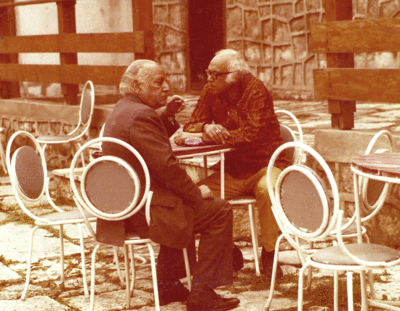
She wrote back: “More than once I believe. His great friend the South African writer Alex La Guma (read here, and here) who lived in exile in London was with him, because there is a photo of them sitting having a drink in some roadside cafe! “
Salima wrote to me “Alex Laguma lived very near where Shoaib and I lived, Muswell Hill, in North London[from 1966 to 1969]. Earlier[1962-1964] my parents lived in Finchley also North London. This was when he and aba became good friends……..writers in exile. Both were very active in the Afro-Asian Writers Association. My mother and I would go to the protest sit-ins outside South Africa House in Trafalgar Square These were also the years of Aba’s friendships with other writers, Louis Aragon, Louis McNeice and those in Africa and Asia. His was very close to Nazim Hikmet (here and here) as you know they met in Moscow. My father told me that Nazim would often wonder how they would bring his body down from the tiny flat he lived in, in case he dies there..He was very tall and in fact they had to lower it in a truss when that eventually happened. My father was there and grieved bitterly for his friend.
I wrote back asking her if I could get a copy of the photograph. She immediately had it sent to me.
I note with amusement that Faiz Sahib is dressed “properly” suit and tie and dress shoes, normal as Abu—my Dad would for say a conference for the Left Forum—or as many colleagues would do in Addis for any conference.
February 12, 2011 marked the 100 birth anniversary of the poet Faiz Ahmed Faiz. And so I set to the task of finding traces of Faiz and his poetry in Addis Ababa–figuring out where the photograph was taken. Was it in this alley or that—at this address or that—could anyone tell me—where this might be– I talked to strangers—this person and that—colleagues and friends—could anyone provide me with the traces of Faiz Ahmed Faiz.
Calling out from street to street/Turning towards one land and another to find some trace /Of any soul mate/In strange lands asking every stranger/The way to my house—/Turning days to nights talking, Sometimes asking this one, sometimes that one/ What should I tell you, what a terrible things is the night of Sorrow/But this too would have been a blessing had I mattered/If dying would have been just once, what would it have mattered.
Den galii galii sadaayen/Karen rukh nagar nagar kaa ke suraag koi paayen /Kisii yaar-e-naamaabar kaa/Har ek ajanabii se puuchhen/Jo pataa thaa apane ghar kaa Sar-e-kuu-e-naashanaayaan/ Hamen din se raat karanaa Kabhii is se baat karanaa / Kabhii us se baat karanaamere/ tumhen kya kahun k kya hai shab-e-gam buri bala hai/hamain ye bhi tha ganimat/jo koi shumar hota/hamain kya bura tha marna agar ek bar hota.
I repeat this poem to my father—and he says Wah!! Wonderful—yes here Faiz uses Mir Taqi Mir and Ghalib beautifully: Mir says: Terey dar pa is bahaney/ Humein din sey rath kerna, Kabhi is sey bath kerna kabhi us sey bath kerna, This was just an excuse to remain at your door day and night/Sometimes talking to this one, Sometimes talking to that one. And Ghalib of course said: tumhen kya kahun k kya hai shab-e-gam buri bala hai/hamain/ hamain kya bura tha marna agar ek bar hota/ What should I tell you, what a terrible things is the night of Sorrow /If dying would have been just once, what would it have mattered.”
I asked everyone I could think of who might know at which café in Addis in 1979 this photograph might have been taken. Since 1979 and even just in the last five years so much had changed in the city. There was a huge chance that if the cafe had been in the center of the city then it had been razed to the ground along with so many other structures like the homes of the poor —to make way for so much of the new high rise construction underway in the city for five star hotels and the offices of business corporations and development agencies. Each alley turned—brought to mind verse after verse of Faiz. I learned not much more about the photograph but more about Ethiopian coffees Sidamo, Harrar, Limu, Kaffa, Gimbi, Yerga Cheffe: Arabica, highland, washed and unwashed: oval shaped or pointed ends—round—brownish to brown—grayish blue-to bluish—to green to greenish—with fair to light to medium acidity. All I know is that the more cups of this superb stuff I consumed it made me poetic in Addis.
“Are you sure this is Addis” I wrote back to Salima, “I can’t find any reference to an Afro Asian Writers Association’s conference in 1979 in Addis. I can find references to Accountants conferences, development conferences, food security conferences, education conferences, African Union Conferences but not an Afro-Asian Writers Association conference. ….”
Salima contacted her friend Mila who sent back a scanned copy of a letter from Faiz that mentioned the Executive Committee meeting in Addis in 1979 and the General Conference of the Writers Association in Luanda, Angola also held in 1979.
“Who is Mila?” I asked.
“Dr Ludmila Vassilieva, is a scholar of Urdu literature at the Academy of Arts and Sciences in Moscow, Russia. Her PhD was on Hali. She was a close friend of Faiz Ahmed Faiz and a scholar of his works. She worked for Moscow radio in the past, was interpreter to Faiz Ahmed Faiz and many other writers, poets and luminaries from both India and Pakistan. She has written an important biography of Faiz, which is now available in Urdu and was published by OUP Pakistan.” Salima said when removing my ignorance on Dr Vassileva: “Wonderful woman loved by all….is now rather unwell….I adore her.”
“What is the Urdu publication called”?
“Parvarish e Loh o Qalam Faiz Hiyat aur Takhleeqat.”
Not too long ago I would have picked up the phone and asked Ami what Takleeqat meant. Instead, I was reduced to exposing my ignorance and I asked Salima.
She patiently wrote back: Nurturing the Pen and Tablet. Life and works of Faiz
I skyped my father “Faiz’s verse: Loh-e Qalam used by Ludmilla for Faiz’s title. “Matey Lohey Qalam chin gaeey tho kya key koney jigar mey dibo dee hain unglian mein nein. No matter, if the ink, pen and tablet have been snatched for I have dipped my fingers into my bleeding heart. Was this verse inspired by Ghalib too?”
Abu said, “Well I would think it is inspired by Ghalib, who said:
“Liktey rahee junoon ki hikayat koon chakan/Harchand is mein hath humarey kalum hu-ay.”
We kept writing of our passion in blood dripping stories, Of course then our hands bled/were cut.
“The word for cut-off or chopped and pen is the same in Urdu—Kalum and so this is how Ghalib uses the word”
“What would be the English equivalent?”
“I don’t know.” My father says “We’ll keep thinking about it.”
Salima emailed back a scanned copy of a letter from that period written by Faiz Ahmed Faiz mentioning the Executive Committees meeting in Addis in 1979 and the Sixth General Conference of the Afro Asian Writers Association in Luanda Anglo in 1979 as well. I wrote back to Salima: “Are you sure this photograph wasn’t taken in Luanda, Angola?”
I consulted people spread far and wide and close—from Tblisi to Addis to Washington DC—Ethiopians and others who might know: “Can you please tell me which café or place is this in Addis?” I heard back with responses such as “I know this wall in the background—the grotto—I feel like I’ve touched it in Addis! Who are these people? Your relatives? Or, “Friends of yours?” Or, “Wow! What a lovely photograph of two gentlemen having a smoke!”
Finally, I was able to confirm that indeed, the photograph of Faiz Ahmed Faiz and Alex La Guma was at a road side café in Addis in 1979. They were there to attend an organizational meeting of the Executive Committee of the Afro-Asian Writers Association. Changes in the editorial establishment and venue for the Afro Asia magazine were among the issues that were discussed with other writers and poets at that meeting by these two in exile from their homeland.
When I showed this photograph to Ethiopian friends they politely wondered why Faiz Ahmed Faiz or Alex La Guma would have come to Addis in 1979—it would have had to have been a State sponsored event—because no other event would have been allowed. Addis was several years deep by 1979 under a Marxist government presided over by a military dictator—Mengitsu of the Derg. The word Derg in the language, Ge'ez means “committee” or “council”, and it was the word used for the Coordinating Committee of the Armed Forces, Police, and Territorial Army, a committee of military officers which ruled Ethiopia from 1974 until 1987. It was a dreadful period for so many and a hopeful period for those who benefited. When the context of the photograph is viewed with the hindsight of time the reactions are many. Mine of being delighted that Faiz Sahib my favorite poet had been in Addis, attended a meeting sat in cafes.
Some of the people I asked wondered, what were these poets doing in Addis in 1979? In that, the homeland, of so many, exiles. Did they think they were in the cradle of idealism in a country that had overthrown an emperor and now had a Soviet backed regime? Did the poets and writers think that it was a hopeful time that would bring development and change for Ethiopia? Lift its people out of poverty and famine? Did the poets think that now all would be well and Ethiopia would have food security? Or were they as much a part of the geo-politics and choosing of sides-this bloc or that—no matter what the costs to actual human lives? It is a question I think that remains valid to this day and asked of foreigners to this day on the streets of Addis and in its cafes.
To me, this photograph outside the context of that moment when it was taken, now through the prism of hindsight seems as though the expressions on Faiz’s and La Guma’s faces show concern. Perhaps taking measure of the distance between the power of poetry and the reality of misuse of its power by politicians and the inevitable trajectory between them. A poet and writer-both communist—adhering to the Soviet Bloc—looking past each other in different directions East and West—both wearing expressions of worry, anxiety or concern. Or perhaps their just waiting for their macchiatos to arrive and have only a few minutes left of the coffee break before the next session of the conference is to begin.
The empty chairs around them, seem to create a silent music, with their swirls and circles as though words and universes in play, in motion— in journey. As if, the two are waiting for missing companions, to join them.
They, Faiz Ahmed Faiz and La Guma, too were writing about a love that never would be taken for granted by its presence, deepened and a presence felt every day by absence–and a fidelity strengthened by separation. These were writers that belonged to the world—Alex La Guma exiled because of the Apartheid in South Africa, Faiz Ahmed Faiz and Hikmet Nazim because of the military dictatorships of Pakistan and Turkey—living and traveling from London to Moscow, to Beirut, to Cairo, to Delhi, to Addis, Luanda and so on, inspiring movements around the globe though their poetry emanated out of an intense passion, homesickness and pain for the poverty and occupation of their homelands: Faiz Ahmed Faiz was buried in his beloved country — And Hikmet Nazim and Alex La Guma were not. Nazim was buried not in Turkey but Moscow. Alex La Guma was buried in Cuba.
Of Alex La Guma’s widow Salima wrote: My mother and I had a most poignant meeting with his widow in Moscow, when we visited after my father's death. My mother and her, both having lost their husbands, who were comrades, just wept into one another's arms.
On my mother’s passing Salima wrote back about mothers—after all this time– how to this day she reaches for things to take home to her mother.
I know how that feels now. I too find myself reaching: I phone my brother who I know is at my parents home having dinner with my dad. I am too used to picking up the phone to do this. And I cannot break the habit of asking Ami about this or that.
“Can you find a book of Faiz’s poetry—it must be lying on the corner table near the window or look on the corner table near phone, under the lamp, near the heater-next to Abu’s desk—near the blue upholstered chair—“
I don’t say the words: Where Ami used to sit and read.
“Okay found it!”
“Can you tell me the title exactly….”
“Nuska hai Wafa” he reads in Urdu.
Can you ask Abu the exact meaning of the title. Does the word Nuska mean prescriptions?
I hear him ask, “Abu what does Nuska hai Wafa mean? Does it mean Prescriptions for Loyality”
I hear Abu in the background laughing in exasperation “Not Nuska hai Wafa—-it is Nuskhaye —plural—means treatise or compilations.”
A discussion begins on the other end—my brother says to me “Go with Prescriptions”. We hang up.
I call back “How about remedies, recipes”
He communicates this to my father. “No! My father protests “ No! Nuskhaye does not mean prescriptions, no not, recipes.”
I can hear that a discussion like playing charades had begun in the back ground of trying to find the meaning of the word. Is it remedies? No. Alchemies?—No. Archives?—Or recipes? No. Consolidation? No. Is it this–is it that? No.
My brother says “Go with Declarations.” We hang up.
He calls back: “How about declarations? Declarations of loyalty?”
He asks my dad “Abu how about Declarations of loyalty?”
“No” says my father “it can be treatise, compilations.”
My brother says “Go with declarations.” We hang up.
I call back and ask “How about anthologies because there are translations by Faiz of Hikmet Nazim and others in there as well—“
He asks Abu—“How about anthologies—there are translations by Faiz in this book as well …”
“No” says my father—“We have to see this title in the context of Ghalib’s couplet from where it originates. And in this case Nuskhaye Wafa comes from Ghalib—the title can’t just be translated for its word meaning—it has to be understood in the context of how Ghalib uses it.Ghalib’s verse is
“Taleef e nuskhahey waafa kar raha ta mein/ Majnon e kyal abhi fard, fard ta
I was compiling my expressions of fidelity/ But my synthesis of thought was this thesis and that.
My brother says “Okay this is the best we can do for now. Expressions of Fidelity.”
“So then we settle for Expressions—And Wafa? “Loyalty? Faith? Devotion?
He asks, “Wafa Abu? —He repeats it louder: “Wafa! Loyalty or Faith or Devotion?”
Abu says, “Fidelity”
I say “Okay so Expressions of Fidelity.”