
February 25, 2011
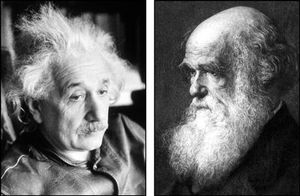
Einstein and Darwin: A tale of two theories
One scientist came up with a new way of explaining how biology works. A generation later, the other one came up with a new way of explaining how physics works. Today, after a century of scrutiny, both explanations still pretty much hold up. But in popular culture, physicist Albert Einstein is idolized, while biologist Charles Darwin's legacy is clouded with controversy. Why do Darwin's theories on the origin of species, put forth in 1859, hold a status so different from that of Einstein's theories on relativity, published between 1905 and 1916? Astrophysicist Neil deGrasse Tyson, director of New York's Hayden Planetarium and co-author of the book "Origins: Fourteen Billion Years of Cosmic Evolution," reflected on that question during a recent interview at the University of Washington.
Here's an edited question-and-answer transcript of the interview:
MSNBC: Einstein and Darwin seem to hold two different places in our society. One is virtually a pop culture icon, while some people almost want to take down the other guy's statues. Why is that we have two different approaches to these people, even though they developed theories that are in very similar states of evidence?
Neil deGrasse Tyson: While they were both scientists, Einstein was the first very public scientist who was visibly active in social causes as well as political causes. I don’t know that the same was true with Darwin. I know he was well known in his day. I know his book, "On the Origin of Species," was a best seller. But I don’t know that he was active in politics, influencing governments. I don’t know that he was approached by a sovereign nation and was asked to be its president, as Einstein was with the new state of Israel, for example.
More here.
Posted by Azra Raza at 08:21 AM | Permalink


Comments
I think Tyson's statements about Einstein and Darwin are quite on target coming from a fellow scientist (although I'm not sure about his statement about chemistry being less precisely predictive than physics -- isn't chemistry essentially a branch of physics?). But I would explain the differing reactions of the general American public to these geniuses and their theories in a rather different way.
Einstein's relativity theories are so hard for the average person to understand that most people don't even try. They just give old Al credit for being tremendously smart. And at the same time, they don't have any relevance to what the average person thinks about herself and the world. None of us travels at a speed close to that of light, or hangs around black holes, so we can go on about our business without coming to grips with relativity.
Evolution is a very different matter. It is quite easy for anyone of average intelligence to image being descended from apes, or ape-like animals -- no complicated tensor calculus involved there. And most people of average intelligence hate the idea passionately. Animals are assumed not to have souls, while we do, so it is believed. So where do these godless "evolutionists" get off saying that apes somehow turned into humans, without God injecting souls into them?
If the theory of evolution is correct, it seems to be saying that we are basically just grubby animals. On top of that, the details of how the brain evolved to have such human capabilities as language and abstract thought are still not known, so there is a gap there that God can snuggle into.
Scientifically, the objectors to the theory of evolution don't have a leg to stand on, but image-wise biologists still have a big battle to fight to win over the popular mind.
Posted by: JonJ | Feb 25, 2011 5:29:02 PM
"image" should be "imagine"
Posted by: JonJ | Feb 25, 2011 5:30:16 PM
Check back again in a few centuries to see where Darwin's legacy stands with the masses, I say. Galileo, like Darwin, revealed truths which deeply offended the sensitive feelings of the powerful religious figures of his day and, more unacceptably, directly threatened their perceived reputation as purportedly all-knowing. Those same churches today have largely acquiesced to Galileo; I predict they will do the same with Darwin.
Posted by: melior | Feb 26, 2011 8:56:45 AM
Post a comment