
| ABOUT US | ARCHIVES | LINKS | RSS FEED | MONDAYS | |

3quarksdaily

An Eclectic Digest of Science, Art and Literature

« Can Egypt Be Turkey? | Main | Monday Poem »

February 28, 2011

Did viruses invent DNA?

by George Wilkinson

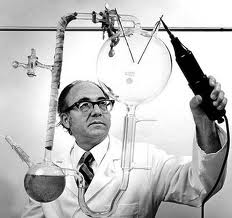
ImagesCA8M6TEC Cells across the tree of life are built with very similar components: A wall to keep everything in, DNA which stores the genome, and RNA and protein which take care of the mechanics and metabolism. These components are heavily interdependent, and it is an ongoing puzzle how the modern cell emerged from the prebiotic chemistry of early earth. (See Wikipedia here ). There are two major approaches to try to bridge this gap. The first is to try to synthesize biotic compounds from a soup of plausible precurors, as in Miller and Urey’s “lightning experiment.” [Miller shown performing the experiment in photo on the right.] The converse approach is to scrutinize living organisms for hints of their ancestors, specifically the Last Universal Cellular Ancestor (LUCA).

RNA was likely to be among the very first of the modern information polymer classes to emerge, because RNAs can do the jobs of genome storage (now done mainly by DNA) and enzymatic action (now done mainly by protein). Proteins might have come second, and DNA last. So how did DNA take over the job of genome storage?

There are some clues from comparative genomics that the DNA world developed subsequent to LUCA. The handling of RNA (transcription, translation) is similar among all the major domains of life, suggesting that these tools were present in the common ancestor of all present-day cells and diverged subsequently in archaea, bacteria, and eukaryotes. In contrast, the means of handling and copying DNA vary quite a bit, with, for example, the major bacterial DNA processing enzymes lacking archaeal/eukaryotic homologs. DNA polymerases (the copying enzymes) in the various domains of life are in each case more closely related to viral proteins than to comparable proteins from the other domains of life. These data, and recent appreciation of the life-like capabilities of giant viruses, have led some researchers to an  interesting suggestion:  DNA as a genomic storage compound originated in viruses as a way of evading the defenses of ancient cells.

According to this view, ancient viruses, as with the ones today, could only make copies of themselves by succesfully infecting a host. So they become engines of innovation, using every possible dodge to get their genetic payload inside the host cell. In an early, RNA-protein world, there would not be enzymes to degrade DNA, so a virus encoded by DNA would have a big survival advantage.  This suggests a scenario in which a clever parasite brings along DNA plus the means of copying DNA-- a different parasite at least for bacteria and archaea/eukaryotes-- and hijacks the cell's existing interpretation equipment. The symbiosis of virus plus RNA/protein cell eventually resulted in the modern arrangement of DNA, RNA and protein.

With this topic it is important to realize that the ideas are very speculative and contentious. The attraction of this idea- that the parasite-prey relationship is a very old evolutionary engine- actually also makes trouble because modern day parasites and prey, especially in the microbial world, exchange and exapt whole genetic modules. There is thus even a middle view, in which two-way “technology transfers” between viruses and canonical cellular life will have completely obscured DNA's origins.

Posted by George Wilkinson at 12:15 AM | Permalink

Comments

When mimivirus was shown to encode aminoacyl-tRNA synthetases, many more biologists became open to this kind of speculation. It's an exciting time.

Posted by: Ken Pidcock | Feb 28, 2011 9:55:18 AM

Post a comment


Subscribe to this blog's feed  

PayAnywhere with iphone credit card swiper

Android Tablet

Bluetooth Headset

2013 New Style Dresses

Compare Car Rental Prices

DHgate.com Wholesale

3QD on Facebook

3QD on Kindle

3QD by Daily Email

Receive all blogposts at the same time every day.

Enter your Email:


Preview 3QD Email

3QD on Twitter

Miscellany

Lijit Search

AddThis Social Bookmark Button

Add to Google

Recent Comments

mirel on If Only We Had A Leader Like Chavez, Who Solved Real Problems -- Instead Of Debating Fake Ones Like The Deficit

araldo on Here’s how to change the world

Elatia Harris on Here’s how to change the world

Sundar on Here’s how to change the world

araldo on Here’s how to change the world

prasad on Here’s how to change the world

araldo on Thursday Poem

Raza Husain on Here’s how to change the world

prasad on Here’s how to change the world

Raza Husain on Here’s how to change the world

prasad on Here’s how to change the world

Jim Sanders on the hudson review

Ian Kaplan on Stephen Wolfram: Dropping In on Gottfried Leibniz

Sundar on Here’s how to change the world

sjg on The First New Atheist? Kierkegaard

billy on Obama must Make Fighting Climate Change National Project, or Die the death of a thousand Scandals

Raza Husain on How do Finnish kids excel without rote learning and standardized testing?

Raza Husain on If Only We Had A Leader Like Chavez, Who Solved Real Problems -- Instead Of Debating Fake Ones Like The Deficit

DAS on Obama must Make Fighting Climate Change National Project, or Die the death of a thousand Scandals

czrpb on The case against empathy

Jesse M. on The case against empathy

Khader on Mourning (in)formation of Palestinian Collective Memory: A Mythopoetic Reclamation of Palestine, Part I

Dredd on Obama must Make Fighting Climate Change National Project, or Die the death of a thousand Scandals

waqnis on Thursday Poem

Dredd on Here’s how to change the world

Acclaim For 3QD


"I couldn't tear myself away from 3 Quarks Daily, to the point of neglecting my work. Congratulations on this superb site."—Steven Pinker, Johnstone Professor of Psychology, Harvard University.

"I have placed 3 Quarks Daily at the head of my list of web bookmarks."—Richard Dawkins, Charles Simonyi Professor of the Public Understanding of Science at Oxford University.

"Just wanted you to know I’m one of many who reads and enjoys 3 Quarks....almost daily."—David Byrne, musician, former lead-singer of the Talking Heads, artist, intellectual.

Read more here.

The 3QD Prizes

Subscribe to this blog's feed