| ABOUT US | ARCHIVES | LINKS | RSS FEED | MONDAYS | |

3quarksdaily

An Eclectic Digest of Science, Art and Literature

« Where Is Cairo’s Winter Palace? | Main | perceptions »

February 07, 2011

Decolonizing My Mind

by Namit Arora

DecolonizingMind The modern era of European colonialism began in the Americas with bands of adventurers seeking El Dorado. It evolved into predatory monopolies like the East India Company and ended with European states exerting direct control over the economic and political life of the colonies. Alongside came great developments in the art of controlling the natives, through military, political, and cultural means. Let’s look at some cultural means of controlling the natives, particularly through language.

When it comes to colonial quests, military might is what breaches the metaphorical Gates of Damascus. Regime change follows. Thereafter, the most efficient and durable means of colonial control happens via culture. Culture holds the keys to how a group sees itself and knows its place in the world. As Ngugi wa Thiong’o—acclaimed Kenyan novelist, professor, and author of Decolonizing the Mind—has pointed out, ‘Economic and political control can never be complete or effective without mental control. To control a people’s culture is to control their tools of self-definition in relationship to others.’ [1]

When done right, the native comes to elevate and mimic his master’s ways, to see his own culture as inferior, and to look down on his past as ‘a wasteland of non-achievement’. He begins to defer to the colonizer’s ideas on fundamental things like beauty, art, and politics. In time, he begins to understand himself and his culture through the eyes of the colonizer—using the latter’s concepts, categories, and judgments. Before too long, he turns into a proxy for his master: colonialism with a native face.

How does the colonizer gain such control? The easiest method is to actively spread his language among the natives, and to simultaneously denigrate the language of the natives as crude and unfit for proper education. It is amazing how much mileage this delivers. Make the colonizer’s language the lingua franca of imperial administration, accord prestige and upward mobility to those who learn it in colonial schools, and before too long, there is a feeding frenzy among a native minority. Such has been the way of the great colonialists of history: the Arabs in the 7-8th centuries, the British and the French in the 19th, the Russians with the Baltic States in the 20th. Ngugi writes,

For colonialism this involved two aspects of the same process: the destruction or the deliberate undervaluing of a people’s culture, their art, dances, religions, history, geography, education, orature, and literature, and the conscious elevation of the language of the colonizer. The domination of a people’s language by the language of the colonizing nations was crucial to the domination of the mental universe of the colonized.
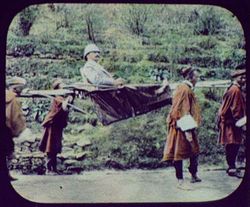
Colonialism1 Take colonial India. A great debate ensued in 1830s Britain on the choice of an official language of colonial administration and education. Making the winning case for English over Sanskrit, Persian, and others, Thomas B. Macaulay—a member of the Supreme Council of India—observed that Indian languages ‘contain neither literary nor scientific information, and are, moreover, so poor and rude that, until they are enriched from some other quarter, it will not be easy to translate any valuable work into them.’ He admitted that he did not know any Indian languages but had nevertheless reached ‘a correct estimate of their value.’ Citing the Orientalists of his day, he said, ‘I have never found one among them who could deny that a single shelf of a good European library was worth the whole native literature of India and Arabia.’ Therefore, concluded Macaulay, ‘we have to educate a people who cannot at present be educated by means of their mother tongue. We must teach them some foreign language.’ [2]

Language is not a neutral vessel for conveying the ideas, beliefs, and values that constitute culture. Nor is it a mere tool for describing the world as it truly is—no language can be said to describe the world as it truly is. To use a language—any language—is to interpret the world in a particular way. Shared ways of seeing, or culture, emerge through the shared use of language. In other words, culture is organically intertwined with language, evolving together to create a unique collective sensibility. No wonder language is so central to our identity and why so many political divisions have linguistic borders. Indeed, language profoundly shapes the way its incoming speakers think (this may be partly why it makes sense to speak of an ‘Anglophone culture’), an idea that now finds support among cognitive scientists. Bilingual folks think differently when they immerse themselves in different languages. [3]

Colonial Languages and African Literature

In the late 19th and 20th century Africa, colonial regimes began mandating the exclusive use of European languages in missionary and state supported schools. The language of an African child’s formal education soon became foreign, writes Ngugi. ‘The language of books he read was foreign. The language of his conceptualization was foreign. Thought, in him, took the visible form of a foreign language.’ In Kenya, Ngugi himself studied every subject in English at school but spoke Gikuyu at home—a language spoken by more people than speakers of Danish or Croatian. ‘There was often not the slightest relationship between [English], and the world of his immediate environment in the family and the community.’ Indeed, it was even worse:

One of the most humiliating experiences was to be caught speaking [Gikuyu] in the vicinity of the school. The culprit was given corporal punishment — three to five strokes of the cane on bare buttocks — or was made to carry a metal plate around his neck with inscriptions such as I AM STUPID or I AM A DONKEY. Sometimes the culprits were fined money they could hardly afford. And how did the teachers catch the culprits? A button was initially given to one pupil who was supposed to hand it over to whoever was caught speaking his mother tongue. Whoever had the button at the end of the day would sing who had given it to him and the ensuing process would bring out all the culprits of the day. The children were turned into witch-hunters and in the process were being taught the lucrative value of being a traitor to one’s immediate community.

Ngugi, born into a large peasant family, was baptised James Ngugi and educated in English, a language that evolved in a very different culture. It was used to convey different ideas of self, individual, community, nature, time, beauty, loyalty, respect, kinship terms, humor, idioms, gender roles, animals, and so much else. Moreover, it was alien to the language-world of Ngugi’s daily life in Kenya—of the streets, boyhood fights, swear words, commerce, labor, family, love, food, festivals, geography, plants, etc. Not only that, his own language was ‘associated in his impressionable mind with low status, humiliation, corporal punishment, slow-footed intelligence’ and worse. If the bullet was the means of physical subjugation, writes Ngugi, language was the means of spiritual subjugation of the African child, resulting ‘in the dissociation of the sensibility of that child from his natural and social environment, what we might call colonial alienation.’ [7]

What then to make of literature written in European languages by Africans? What does it mean to write a realistic novel in which African peasants and factory workers speak English or French? Can a writer, his formal education entirely in English, capture in it the tenor and rhythms of ordinary African life? What tradition of the English language novel does the African writer look up to? Ngugi argues for classifying their work— including that of talented writers like Achebe, Soyinka, Armah, Ousmane, and others—not as African literature but as Afro-European literature, i.e., ‘literature written by Africans in European languages.’
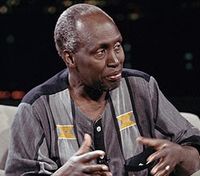
Ngugi After all, says Ngugi, such writers are products of a hybrid culture of a small African minority, one marked by ‘colonial alienation’. Meanwhile, Europeans—unable to relate as easily to literature in native tongues (and even in translation)—are instinctively drawn to European language works from Africa, which seem to them African flavors of their own language-worlds. Add the impact of modern economics, global media, publishing, and the scholarship industry in the West, and soon, a lot of people start equating European-language works with African literature (squeezing the life out of indigenous literary forms). Ngugi challenges this equation. African literature, he argues, can only be written in languages with long and organic roots in African culture. A colonial language largely external to it cannot adequately express the local ways of being—to believe that it can is to erroneously see language as a mere tool and vessel of culture, interchangeable with any other language.

So where did this viewpoint lead Ngugi? Though he wrote his early literary works in English, he now writes only in Gikuyu (and then translates into English). He abandoned English in mid-career, soon after his great polemic, Decolonizing the Mind, came out in 1986. He recounts in it a story from his early career, when he attended the African Writers Conference in Kampala, which invited only authors writing in English. ‘What is African Literature?’ was a much debated question at the conference, about which he wrote:

The fact is that all of us who opted for European languages—the conference participants and the generation that followed them—accepted that fatalistic logic [of the unassailable position of English in our literature] to a greater of lesser degree. We were guided by it and the only question which preoccupied us was how best to make the borrowed tongues carry the weight of our African experience by, for instance, making them ‘prey’ on African proverbs and other peculiarities of African speech and folklore.

English and Indian Literature
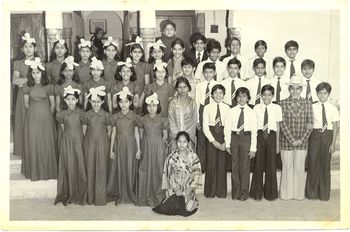
Convent-school-picture Ngugi’s experience in Kenya will resonate with many Indians. I myself grew up in the Hindi belt, in the central Indian city of Gwalior. Though I went to an English medium school run by Carmelite nuns, I only spoke Hindi at home and in my neighborhood until I left home for college. In the classroom—except in the Hindi class—I too was required to speak only English. Failure to comply meant public embarrassment. Though English had little relevance to my everyday life, I recall how parents in our neighborhood—of middleclass professionals in a textile factory—took pride in their children’s English skills, but none ever for Hindi. English had become a class marker; one used it to distinguish oneself from the riff-raff. Even today it is spoken by a small minority and floats atop a host of indigenous mother tongues. [4]

By the time I went to school, English had already acquired enormous practical benefits. Like a goddess, it offered new visions to converts like me, opened new doors, gave me access to a more dominant culture and a global economy where English proficiency is an undeniable asset. But my point here is neither about the benefits of English, nor to lament the course of history—who knows what an alternate history might have been? Rather it is to recall the politics surrounding the arrival and the spread of English in the colonies, to reflect on the reach and the world of the Indian writer in English, and—for the sake of a more complete accounting—to consider the costs that our attitude to English and its parent culture continues to extract from us. Following Ngugi on African writing, should we not also wonder whether Indian writing in English qualifies as Indian or as Indo-European literature (i.e., literature written by Indians in a European language), with Indian literature referring only to works in languages with long and pervasive roots in Indian cultures?

Such reflection also illuminates many contemporary trends in the Subcontinent. For instance, the deeply ingrained hierarchies of language and literary culture that Indian elites, including myself, subscribe to even sixty years after independence. Oh, how we crave Anglo-American recognition for our writing on India and let it drive our sense of literary merit! If target markets and economics explained all, the Danes and the Dutch, quite proficient in English, would have similar attitudes. There is something else going on with the Indian literati—it is as if we accord a higher caste to the British and subconsciously elevate and mimic their literary culture. It is one thing to admire and be inspired by other literary cultures, but our attitude is one of deference, lacking the self-confidence of equals. We are far from achieving intellectual independence. Nothing like a Booker prize, reviews, endorsements, and fat book deals in the Anglophone West to turn our heads. Indian novels that ‘make it’ abroad are then taken seriously in India—not vice-versa. Do we grant the same cachet to books that win Sahitya Akademi or Jnanpith awards? Or crave translations of our best non-English books? And we haven’t even looked at the terrain of popular culture.

But wait, says a part of me, how can it be otherwise? The culture that brought us English and came to dominate us had greater power tied to its claim to greater knowledge. So long as this relationship holds in our minds, and we look up to that culture for our self-definition and direction, much else will remain too, including our writers’ insecurities and our elites’ colonial mindsets. I too am caught in its vortex. As an individual, perhaps the best approach to decolonizing my own mind—short of the radical choice Ngugi made for himself—is to be acutely aware of my predicament, interrogate my own linguistic and cultural hierarchies, and invite others to do the same.

__________________________
Notes:

  1. ‘Decolonizing the Mind’, by Ngugi wa Thiong’o, Heinemann, 1986. All other quotes in this article that are not otherwise attributed come from this book.
  2. On Empire and Education, Thomas Babington Macaulay, 1833.
  3. Here are three articles that relate experimental work in this area: Change languages, shift responses, Lost in Translation, and How does language shape the way we think?
  4. The image shows the author in 6-7th grade c. 1980, after a school performance inspired by Wordsworth in which the girls dressed as ‘daffodils’. Most boys didn’t participate and are in their regular school uniforms.

More writing by Namit Arora?

Posted by Namit Arora at 12:30 AM | Permalink

Comments

I wish I could put words on paper or on the net so easily.

As always, great piece of writing and conveys my sentiments exactly.

I wrote a post on a related note sometime ago at
http://2paisa.wordpress.com/2010/08/12/the-funeral/

Posted by: Vanguard | Feb 7, 2011 3:16:31 PM

Why is this in English?

Posted by: Philosopher's Beard | Feb 8, 2011 11:25:34 AM

A wonderful essay, Namit. But, ouch!

Posted by: Elatia Harris | Feb 8, 2011 11:46:10 AM

Excellent article!

I think I can see parallels of what you say when comparing mainland China and Hong Kong.

Though HK's colonization wasn't as thorough as India's or Africa's, I can definitely see a type of elitism that is given to English and especially English-language works.

Whereas in mainland China, English is more seen of as a very useful business tool. One that many Chinese would love to know fluently but the language itself is not put on on pedestal.

In fact many American-born Chinese who go to China but can't speak the language are often made fun of. And likewise, when a foreigner speaks Chinese, many of them are impressed that they could learn such a complex language :)

Especially because many, many Chinese people will always tout their 4 great classical novels whenever discussing literature.

* * *

Of course like I mentioned above, English is still regarded as something that is extremely important as a business language so many Chinese are eager to learn it.

Posted by: JJ | Feb 8, 2011 9:15:30 PM

PB,
An odd question. This is in English because that is the language I write in. Should that prevent me from exploring how I came to do so, how my attitude to it has been shaped by colonial experience, what I may have gained and lost in the process, how language relates to culture, and more?

Posted by: Namit | Feb 9, 2011 1:00:50 AM

"the best approach to decolonizing my own mind—short of the radical choice Ngugi made for himself—is to be acutely aware of my predicament, interrogate my own linguistic and cultural hierarchies, and invite others to do the same."

You carry on in English. It is a great language for modern communication. As your reply recognises, that utility is a separate issue from how it came to be so.

But this was what I was trying to point to as a problem in your piece. To be awfully blunt, it rather resembled a subjective meandering than critical examination - i.e. a real interrogation. This is particularly apparent when you shift from Ngugi to yourself. Ngugi raised hard questions and tried to answer them - at great cost to himself. You raise such questions seemingly only to raise awareness of the possibility of reflecting on them.

There is a difference between "exploring" the feelings one happens to have and deciding what feelings one ought to have. I do not think it is particularly admirable to wallow in the identity of a victim and its associated passivity - "how can it be otherwise?", nor to encourage that in others. Particularly absurd given your own obvious abilities and accomplishments.

PS Wouldn't "colonizers" with a "z" be the American English kind?

Posted by: Philosopher's Beard | Feb 10, 2011 7:48:16 PM

PB, you appear to be having trouble with the idea a highly accomplished person could have the kinds of doubts and anxieties about victimhood that Namit writes of. What he describes rings very true to me -- as a woman who was a girl in highly transitional times, I know a thing or two about how hard it is, fighting the enemy when he has outposts in your head. Not to produce a ream of trite analogies about how getting free of colonization, within, corresponds to feminist imperatives, but, absolute radicalism can feel like a foxhole. Not wanting to live in one is not the same as lack of rigor.

Also, could I trouble you to make your points without being personally offensive?

Posted by: Elatia Harris | Feb 11, 2011 12:41:28 AM

"Also, could I trouble you to make your points without being personally offensive?"

I tried to keep things abstract in my comment, but I could hardly avoid being personal - and thus to your mind offensive - because of the personal nature of the original post. When someone tells me 'Life is very hard' I just have to ask, 'As compared to what?'

My underlying problem with this type of writing is that I don't find other people's subjective experiences very interesting: although they feel special to the person involved, they are rarely as unique or significant to the wider world as they think. (However this is hardly the last word on this issue since some people, including you and other commenters, do seem to find them important exactly because of that resonance).

Posted by: Philosopher's Beard | Feb 11, 2011 4:42:36 AM

PB, you write:

Ngugi raised hard questions and tried to answer them - at great cost to himself. You raise such questions seemingly only to raise awareness ...

Yes, that is indeed what I tried to do but you see it as a failing. The truth is that I'm not signed up to advocate Ngugi-like responses to others, whatever his personal cost calculus (which I don't know). I'm signed up to raise awareness of how countless Indians like me arrived at our linguistic present, and its impact on our literary culture. Ngugi's response is of course striking, given how much he himself helped raise such awareness. It may inspire some; others, as Elatia notes, may see it as a foxhole—it's not clear to what extent one can or should, through sheer willing, undo the past and reclaim another linguistic and cultural identity. For some, a few ships have left the harbor.

Another analogy is with the "back to Africa" movement that some African-Americans entertained in the 19th century. Imagine an African-American writer focused on raising awareness and reflecting on the particular predicament of African-Americans. Would you have held it against the writer that he failed to advocate a return to Africa? Raising awareness, I submit, has to be the first and often the only step. Thereafter, we have to be open to embracing a plurality of responses.

I do not think it is particularly admirable to wallow in the identity of a victim and its associated passivity - "how can it be otherwise?", nor [is it admirable] to encourage that in others.

I'm not sure where you are picking this up. There is nothing passive about raising awareness; it is usually an act of resistance and/or self-discovery. Further, you lift "how can it be otherwise?" and mangle its context. For individuals, the whole point of raising awareness is that we can move to a better place. But it would be foolish to say that a system's effects can be undone by an individual's will. Some pathologies are integral to the system itself, whether capitalism, colonialism, patriarchy, communism, theocracy, etc. "How can it be otherwise?" is meant to suggest that the macro phenomenon I describe is a result of and is inherent to colonialism itself.

Posted by: Namit | Feb 12, 2011 2:37:59 AM

To answer in a changed context the question, that all-important-litmus-for-authenticity, that the author has asked elsewhere, viz. "What would Tagore have said?", perhaps we can look at what Rabindranath did say:

Keho nahi jane kar ahwane
Kato manusher dhara
Duurbaar srote elo kotha hote
Samudre holo hara
Hethai Arya, hetha Anarya
Hethai Dravid Cheen
Saka-Hun-dal Pathan Moghul
Ek dehe holo leen
Paschime aaji khuliachhe dwar
Setha hothey sabey aaney upahar
Dibe aar nibe, milabe milibe,
Jabe na phire
Ei Bharater mahamanaber sagar teere

No one knows at whose call
Came so many currents of men
Like raging torrents, from points unkown
Yielding themselves unto the Ocean.
Here were Aryan, Un-Aryan,
Here they of Dravid, China
Scythian-Hun hordes, Pathan and Moghul
In one corps, embodied, thence.
The West today opens her gates
Great gifts are appearing whence
Give, and take-thou; Unite, and mix thou;
Never go back
From the shores of the Ocean of the Great Human that is Bharat.

In India, the 'Angrezi Hatao' camp are familiar for also championing a whole gamut of issues intended to return Mother India to some pristine state that is not only pre-Angrezi but also simultaneously pre-Ghazni. The Jan Sangh in 1963 launched a violent agitation for abolishing English not only for official use, but also for shop signs, street signs and even car number plates. The primary spearheads were Ram Manohar Lohia and Atal Behari Vajpayee (today the good work is carried on by the Shiv Sena). It so happened that the Tamils viewed this as a Hindi imperialism, launching the most violent counter-agitation that the DMK had managed till then, resulting in immolations, police-firings-500-dead, and general paralysis. As a result, English colonialization of the mind survived; this was fortunate for Vajpayee, since he was able to trumpet the advantages of English speaking BPO night clerks when advertising, a generation later, his India Shining.

The inadvertent consequence of leaping-to-decolonize-minds, then, is that the leapers tend to land in atavistic pre-colonial tribalisms; witness the Uzbek and the Kyrgyz, briefly united in their desire to do away with Russian as an official language, now at each others' throats. Also witness Pakistan, where after 60 years of sharia-this and mohajir-that the Sindhis, when forced to find a way to get the Talib-hugging general out, were forced to ally with lawyers and and a Punjabi chief justice representing English Law in order to find a basis for running a contemporary society. 'Decolonize', and in comes the Qazi with his hidayat, and the sarpanch holding his nose about the achhoot.

I read that a Dalit community in Banka are building a black granite temple dedicated to the Goddess English, modeled after the Statue of Liberty, holding pen and that most colonial of documents, the constitution. Ambedkar compared English to the milk of the lioness, there is unlikely to be sympathy for decolonization there.

There is another aspect. James Ngugi's Gikuyu itself is a very new language -- its parents in the Bantu language-family started spreading from Nigeria/Cameroon hardly 2000 years ago, and ancestors of the Gikuyu arrived in Kenya during the great Bantu migrations of 1200-1600 AD. How many dialects, systems of organizing, systems of thinking (of forgotten peoples like the Gumba) were obliterated by the process of develoment of Gikuyu?

The trick, it seems to me, is in being able to practice Tagore's dibe ar nibe, milabe milibe, jabe na phire. Especially jabe na phire: decolonize yourself if you feel you must, but don't go backwards, greasing the skids for the atavisms that usually follow.

DRD.

Posted by: DRD | Feb 16, 2011 4:20:14 PM

Compelling support for the Sapir-Wharf hypothesis!

I must say, I love the quote:
"He admitted that he did not know any Indian languages but had nevertheless reached ‘a correct estimate of their value'."

Posted by: DotComma | Feb 17, 2011 4:01:37 AM

I think this is very well written and works as propaganda (that is NOT a demerit). But the last sentence "is to be acutely aware of my predicament, interrogate my own linguistic and cultural hierarchies, and invite others to do the same." makes me wary. Such naive determination could lead one to actually start interrogating and once you do that, you have to be careful. What if you end up interrogating the categories of European predators and native victims? what might that do to the definition of "the other"? The entire paradigm may be opened up for re-valuation. Dont let your guard down....interrogate, but stick to the rules of the club. Outside the club, there is much confusion.

Posted by: omar | Feb 17, 2011 12:51:14 PM

DRD,

Welcome to 3QD. I don't recall seeing you here before and hope you’ll stick around.

I can’t emphasize enough that Decolonizing ≠ ‘Angrezi hatao’ [Eliminate English]. Your comment seems almost entirely tangential to anything I said or implied.

Was it unclear in my essay (perhaps it was, given your comment) that the decolonizing I speak of is more about not looking to another literary culture for validation of your own, not devaluing speakers of your mother tongue because it is not the colonial language, not letting others define your sense of worth, not erecting new class hierarchies based on language use, etc.?

Decolonizing is as far apart from linguistic chauvinism as feminism is from man-hatred. We can’t mix them up; nor is the latter a consequence of the former in either case.

Speaking of Ngugi, it’s not like he stopped using English, or advocates that. Far from it (search youtube for his interviews). He stopped writing his creative works in it, and translates them from Gikuyu to English. Tagore too wrote his poetry in the common man’s language and then translated some into English. More crucially, Ngugi’s work is about decolonizing in the sense above, language propagation and acquisition in the colonial context, and the limits of an elite-colonial language as a medium of literary expression in Africa. I have said more on this in a comment on my other blog.

Your last para does appeal to me with one exception. I’d scratch out some text as follows: ‘decolonize yourself if you feel you must’. I say it is always good to decolonize oneself!

Posted by: Namit | Feb 17, 2011 5:20:59 PM

DRD:
Nice to see someone from Parabaas here. It has been a favorite site and source of mine from way back when Samir first launched it.

Posted by: Ruchira | Feb 17, 2011 9:23:18 PM

Having already surfeited themselves with the intellectual riches of western modernity, some decadent elite academicians began to entertain the delusion that their native cultures could provide social as well as existential alternatives to modernity. This belief sprang more from wounded cultural pride than from any grasp of reality as it existed outside the university. Thus was born the discourse of postcolonial studies.

While postcolonial discourse makes for excellent and lively drawing-room chatter among the well-heeled and super-educated, it can also, unfortunately, be utilized in highly reactionary political projects, as explicated by Meera Nanda here. Similar critiques from a Pakistani perspective have appeared on this site, notably by Pervez Hoodbhoy.

Any embrace of modernity necessarily entails significant repudiations of the native culture. And every postcolonial theorist will, in his or her personal life, affirm the values of modernity - in particular, those that are not to be found in the native culture (for example, gender-equality, secularism, the idea of an individualized, autonomous citizen, etc). In other words, the entire endeavour of "decolonizing" is poisoned by an inaugural act of bad-faith. The point is, you never want to (or indeed even feasibly can!) decolonize fully. You just want to have your cake and eat it too.

The point, Namit, is that what is at stake here is much more than the mere validation of one's "literary culture." People like Chandra Bhan Prasad (who is behind the "Goddess English" movement) possess the simple clarity that the indigenous culture sucks at a very fundamental level, and that there can be no alternative to Modernity . One must applaud such clarity wherever one finds it.

Posted by: M73 | Feb 18, 2011 8:42:40 AM

M73, Humans being the mysterious creatures they are, I dont expect us to be rational or consistent. And if rich bankers can fly around exploring new resorts and dispensing their wisdom to anyone who will listen, why not postcolonial thinkers? Do they not have the right to a large carbon footprint? Are rightwingers properly grateful to all sources of their well being? then why should poco professors be expected to express proper gratitude to the sources of their arugula binges?
But being human, I have an irrational and perhaps pointless irritation at the smug belief that saying clever things is the same as having useful insights..insights denied those who fail to read history as currently fashionable in Hampshire college...this, unfortunately, sometimes sets me off...

Posted by: omar | Feb 18, 2011 12:52:23 PM

M73,

I certainly won't defend the entire field of post-colonial studies for I don't like all that I've seen in it. That said, I wouldn't characterize it as you did in your opening para. Consider the discourse that preceded post-colonial studies and what "grasp of reality" it had! The challenges thrown up by works like Said's Orientalism were not merely a result of wounded cultural pride; or if they were, they still managed to raise substantive questions about truth in scholarship on the Orient (and more generally, the relationship between knowledge and power, a wider human problem). This of course had to happen in an academic setting because that's what informed (and still informs) so many ideas in history, journalism, cinema, op-eds, public policy, international relations, etc. I think the voices of post-colonial studies, despite some excesses, have greatly punctured a range of orthodoxies, prejudices, and self-serving blindnesses (including within post-colonial societies, with folks like Fanon), and scholarship today is more diverse, dynamic, and richer than it was 60 years ago.

If post-colonial studies inadvertently gives strength to cultural reactionaries—and inadvertent it is; no scholar I've read supports the reactionary projects of the Hindu right; on the contrary, folks like Ashis Nandy strongly criticize them—recall that the discourse that preceded post-colonial studies provided rather direct justifications for projects of the right: imperialism, white man's burden, racism and race-based cultural theories, economic domination in the name of progress, and so on. As with science, post-colonial studies can hardly be blamed for the misuse it is put to by others.

I have followed CB Prasad for some time. He is one of a long line of Dalits that have resisted the oppression of their communities using whatever tactics they have at hand. All power to him but his approach—advocating English to Dalits so they can escape oppression by improving their economic lot via the new jobs created by globalization—should perhaps be seen not as an embrace of your idea of western modernity but as a tactic of resistance (the Indian elites have used English to bolster their own place in the social hierarchy). Such tactics are commonplace—in gender relations, in labor laws, in social/ environmental justice—and, like the idea of a 'goddess English', have local drivers and flavors. Not surprisingly, most Dalit resistance, articulated in vernacular tongues, gets no notice by this same elite (western or Indian). For obvious reasons, Prasad shows up in NYT far more often than others but I'd be careful drawing overly broad conclusions based on one approach, one among many. As we see in other parts of Asia, there are manifestly different ways to be modern, many ways to affect change, and no single destination in history that inspires (or need inspire) everyone.

Posted by: Namit | Feb 18, 2011 2:43:33 PM

Omar: I hear ya.

Namit:

Thank you for your thoughtful and nuanced reply.

Agreed, postcolonialism provided a dialectical corrective to the sometimes oppressive dominant discourse of the time. An alternative argument could be made that we in India would have been much better off had the "tough medicine" of the Western Enlightenment been shoved all the way down our throats, instead of just half-way, as it stood at the time of Independence. Let's not forget that both India and Pakistan were founded by Macaulay's children. Whatever semblance of sanity obtains in those countries (as of Feb 2011) owes in no small measure to that fact.

One the things CB Prasad is at pains to point out is that Macaulay was NOT a racist. In fact, he had great respect for the intellectual caliber of the natives he had encountered. Macaulay just believed in the superiority of western civilization. I don't know about you, but I find nothing controversial in that position. After all, wasn't India's adoption of an entirely "western" constitution a tacit acknowledgement of the same?

Which brings me to Fanon - the invocation of whose name does as much to burnish the credibility of the postcolonial intellectual as Gandhi's does to our scoundrel politicians. I don't think Fanon fits in very well with the South Asian context, even though some of his theorizations (esp, the "three stages" of national culture) are among the most insightful I've come across. The aspect of racism is highly significant in Fanon's struggle and it is important make an analytic separation between that and cultural colonization - which (in my opinion) turns out for the best in the long run, if the hegemonic culture happens to be a bearer of modernity.

Also, CB Prasad is not just a one-off example. Many Dalit groups have adopted the same tactic, even in states where nativist linguistic chauvinism is on a high.

I disagree with your assertion that there are "manifestly different ways to be modern." As far as I know, there are only two ways of being modern: in good faith, and in bad faith.

Posted by: M73 | Feb 18, 2011 11:52:21 PM

M73, we have a couple of comments on this at http://www.brownpundits.com/2011/02/18/genes-in-the-desisphere/

Your comments would be most welcome.

Posted by: omar | Feb 19, 2011 12:50:16 AM

M73,

I disagree with your assertion that there are "manifestly different ways to be modern." As far as I know, there are only two ways of being modern: in good faith, and in bad faith.

You mean the Japanese, a modern people as I see them, are living in bad faith? The trouble, M73, is that you have setup a narrow definition of modernity that is designed to exclude—if a people do not adhere to a certain idea of western modernity, they are either pre-modern or living in bad faith! What is this if not an instance of mental colonization (note, I'm not saying I'm invulnerable to it myself)?

The question is: who are we to advocate such a narrow ideal of modernity for all cultures (to you worth achieving even by shoving it down throats)? Instead, why not push for the kind of change in the world that responds to the contemporary needs and aspirations of people, to their demands for justice and freedom, etc.? Why not support progressive aspirations, causes, and struggles (which exist in all cultures), and the means of achieving them—however close or not the results track to western modernity? Why put the cart before the horse? False divisions are what fuel the 'clash of civilizations' ideology—that cultures are separable between rational/irrational, sane/insane, etc. Finally, western modernity arose out of a specific historical experience—the notion that a culture, without the same historical experience, can be forced top-down to produce the best outcomes of another culture seems to me neither smart, nor in tune with historical change or human nature.

Posted by: Namit | Feb 20, 2011 3:07:12 PM

Omar:

Thank you for the invite. That gene story fascinates me deeply.


Namit:

I believe I'm working with a reasonably wide definition of what a "modern" person is. Sure, one can live in any part of the world and be modern. Ambedkar was probably the least confused about what modernity meant. Nehru lost none of his modernity even after his radical sartorial makeover. Gandhi too was amazingly modern, even though his appearance and habits may have been those of a devout Hindu. The Mahatma was heretical on many points, notably on the practice of untouchability and on the Bhagavad Gita's idea of the righteous war. There are many current-day Indians (and I'm sure you're one of them) who are almost as modern as our founding fathers. These days I have my hopes up for Nitish Kumar.

But definitions are useless unless they exclude some things. Here are some of the things (I believe) a definition of "being modern" should automatically exclude:
a) subscribing to the validity of the caste system (or a feudal social order) and treating other people according to those assumptions.
b) not letting your children marry outside your community.
c) believing that the imperatives of your religious beliefs can override another person's (modern) constitutional rights in some instances.

I'm no expert on the Japanese people, but I can tell you with total confidence that just based on these 3 negative criteria (which I think are quite conservative, for a definition of modernity), that there is a massive modernity deficit in the subcontinent, especially among the highly educated ones who glibly think of themselves as "modern." It is this bad-faith I was drawing your attention to.

You ask, "who are we to advocate...?" - well, that's classical postcolonial move isn't it? It's like Jesus telling the lynch mob "let him cast the first stone..." No doubt, a disarming rhetorical move that's useful in many contexts but unfortunately also a recipe for political paralysis. You can use this move in the face of just about any horror/holocaust/genocide that's taking place in the world and you'd still win the argument. I think that only a thoroughgoing pacifist (like Gandhi, as explained here [Ctrl-F "Gandhi's pacifism"]) can make this argument in good-faith and with integrity - and we know that most people aren't Gandhi. If shit was happening to us, we'd sure as hell want the UN or whoever else to intervene - violently, if necessary - and save our asses.

I can see the political wisdom of what you're saying. If I'm getting the subtext right, you're saying "don't needlessly provoke people by challenging their non-progressive practices. Tactically indulge their cultural vanities and tolerate all the premodern nonsense till someday these people become modern, because progressive aspirations do exist in all cultures." Yes, that's probably what's most politic, even though your optimism about there being a progressive trend in all cultures might end up being misplaced. All I'm saying is, at least in academic discourse, let's keep things honest and call spades spades.

Posted by: M73 | Feb 21, 2011 12:38:17 AM

The problem with a lot of fasionable Western anti-colonial discourse (that is also repeated by many "non-western people" educated in the West) is that it is so obviously inconsistent in its application of judgments (e.g. the same tricks used to stereotype Europeans are almost never used in the other direction, where "nuance" rules, or the "who are we to judge" attitude is totally one-sided, or history is read even more selectively than the colonialists used to read it, or blame is shifted so far in one direction that human beings are divided into harmless agency-less victims and vicious but intelligent victimizers, and that too along mostly racial lines, etc) that it only makes sense as propaganda.
Which may be OK. Causes need propaganda. Maybe some of the people involved are working for this or that political cause that needs this propaganda to support it. But the next step in that sequence is even more problematic: most (many?) of the practitioners dont seem to KNOW that they are indulging in sophisticated propaganda, not "objective scholarship". THAT somehow bothers me more...if they dont even know that, then how much can we trust their judgment?

Posted by: omar | Feb 21, 2011 10:27:42 AM

M73,

Thanks for keeping this civil and substantive. I agree that in global terms, there is a large modernity deficit in the Subcontinent. I wrote four articles on related topics last year: The Blight of Hindustan, On Caste Privilege, The Dance of Indian Democracy, and Joothan: A Dalit's Life.

Yes, the modernity deficit exists even among the educated elite—a poignant reminder that the spread of modernity requires a fundamental shift in consciousness that can take time, cannot be forced, may require other socioeconomic factors to change first, or may sometimes be not worth pursuing and better left alone for plural diversity. In fact, modernity is a continuum around the world. Even with a working definition of modernity like the one you have provided for India, it's not always clear when a man can be deemed modern or not. For the most part, there are more and less modern people, each with some ideas that are relatively more modern than his other ideas. For e.g., is a father not relatively modern for believing that unlike his sister who didn't, his daughter ought to attend college and hold a job while still marrying within her caste?

Further, Ambedkar, Nehru, and Gandhi were modern in an Indian context, just as many Japanese are in theirs—they had different ways of overcoming objectionable aspects of their traditions, all without following a "playbook of modernity". These Indians may even seem regressive/traditional using other yardsticks of modernity, say, of attitudes on sex/cohabitation, feminism, homosexuality, etc. My point was: is it not better to simply support progressive ideas already in play in society—with caste, patriarchy, inequality, etc.—and let the culture go where it will, and not be deemed inferior for its failure to track to a preconceived "western modernity" (as in Japan)?

In addition, not all forces that are sane or conducive to modernizing change in India have come from abroad—it is a colonized mind that tends to disregard the notably Indian forms of cultural pluralism, tolerance (what Sen has called "swikriti"), charity, kindness to strangers, religious syncretism, the idea of individual spiritual quests, etc., that I'd say have been in the progressive flank for a long time.

I admit I didn't understand your second-last para. I'm not sure what my question—"who are we to advocate such a narrow ideal of modernity for all cultures?"—has to do with horror/ holocaust/ genocide and the UN. I only asked on what grounds can we justify shoving an a priori idea of western modernity down throats, without factoring in the hopes and aspirations of a people, whose readiness and cooperation are prerequisites for change. It may well be "a postcolonial move" (does that make it wrong?) but, above all, I think it is a practical and moral question. However, the subtext you attribute to me in the last para is almost close enough, for which I thank you.

What does this have to do with decolonizing the mind? I think a key attribute of being modern is to cultivate an autonomous being, who longs to participate in a creative, self-confident literary culture that does not feverishly seek external validation or erect new hierarchies around language (which Ambedkar may well have despised). If our literati and elites do not start to decolonize (detox?) and become more rounded modern individuals, can you hope much for the rest?

Posted by: Namit | Feb 21, 2011 4:16:30 PM

Fascinating discussion so far, it brings to mind this post and discussion on Accidental Blogger that went on about 3 years ago, where we discussed dying languages and the desirability or plausibility of preserving/reviving them.

Posted by: Sujatha | Feb 21, 2011 5:33:24 PM

Namit:

On the matter of tactics, we seem to be on the same page. But on matters of principle, I still see an unacknowledged contradiction between what you say in support of decolonization and what you say in support of modernization. It must be acknowledged that to decolonize is to perforce lose some of your modernity - there is a genuine trade-off to be made here. If all you're talking about is some harmless pride in one's native literary culture, I have no problems with that. But the game of "decolonization" is much more pernicious than that, as I have tried to point out in my earlier comments.

Yes, there have been indigenous reform movements (the Bhakti movements, for example) but these were religious in character and had little to do with what we understand as modernity - of which the autonomous individual and a secular, scientific orientation (with a system of "desacralized" knowledge and jurisprudence) are constitutive.

I probably got carried away by the UN analogy :) I was just trying to show that the "who are we to advocate..." argument can be used successfully even in the boundary condition of a genocide. In the postcolonial context, this argument is used to preempt any top-down attempt to impose a western standard (say gender-equality) on the native culture. By the way, having lived in a country like India - all of whose modernity derives from top-down constitutional imposition - I don't think we should be scoffing at top-down attempts per se.

Posted by: M73 | Feb 21, 2011 10:18:00 PM

M73,

It must be acknowledged that to decolonize is to perforce lose some of your modernity

Ah, this may be a/the source of our disagreement. I reject the above; let me explain once again.

The idea of decolonization (as approached in this essay) is not to abandon modernity, nor to shrink into linguistic chauvinism or Vedic science. It does not mean sacrificing one's openness to influences from around the world—indeed, one should use the best ideas from anywhere. The question is: how? I cited the Dutch and the Danes, and the fairly modern East Asians not colonized by Europeans, who do not exhibit the deference, insecurity, inferiority complex, look-to-Britain/U.S.-for-validation-and-yardsticks that the Indians do. Unlike the former, the Indians accord a privileged status to English, turning it into a pivotal marker of a class hierarchy that is robustly alive and well. Speakers of English look down on others, are commonly seen as more sophisticated, and command greater respect, attention, awe, etc. If this is not a sign of still colonized minds, I don't know what is (see related comment by JJ above). Also look at urban pop culture and what/how it mimics. The pathology lies in this postcolonial mindset.

In other words, to become a more modern, autonomous individual, one has to actively try to decolonize. Just as to become more modern, women have to try and undo some of the patriarchal programming of their minds. See what I mean? To decolonize is to also begin to see the politics of the received categories we so unselfconsciously use to understand and judge ourselves, and to explore ways of moving beyond them and seeing things afresh. Where else should this start if not with the Indian literary/cultural elites (like me)?

Posted by: Namit | Feb 22, 2011 12:15:57 AM

Gee, what a great thread -- none of that "Here on Monday, gone by Tuesday" syndrome for this one!

I am reminded of a story Elaine Pagels tells. When she first began graduate study, long before the days of her fame, she focused on the Paleo-Christian era from a deep desire to get to the simple and authentic roots of a highly contradictory religion that, in her view, two millennia had done much to distort and overlay -- and undermine. What she found instead was tremendous complexity, that the early church was the confluence of so many ideas from the Axial Age and long before, in so many different versions, that the simplicity and directness she had hoped to find were merely presumptive. In examining any era, we are always looking at turbulence and cross currents; history is both tide and undertow.

I wonder if our energies are best spent trying to get back to some state that "would have been, if only..." If only men had not been bigger than women, basing dominion over women on that, codifying this dominion into religion? If only nations that could subjugate other peoples, based on technology and other kinds of might, had had the decency to hold off? I believe that self-reclamation -- perhaps a kind of decolonization -- is a complex and lifelong struggle, one that involves a legacy to younger people, who will have their own struggles that we do not choose for them. Maybe the nature of "the authentic" is for every person seeking authenticity to determine for himself. I mean -- for herself!

Posted by: Elatia Harris | Feb 22, 2011 11:00:48 AM

Namit,

I read your article but not the chain of comments, so apologies if I am repeating what is already discussed. But when we say that from the time of Macaulay onwards, educated elite Indians sadly started to consider English to be superior to their mother tongues, we must remember that for all worldly purposes, in some three hundred odd years preceding colonial rule, in entire North, West and East India (and in many parts of South India as well) the language used was Persian. The language used by the Hindu liturgy and Hindu scholars was Sanskrit for ages. But neither Sanskrit not Persian was spoken at home by any Indian (there may be rare instances where brothers or father and son would speak amongst themselves in Persian mixed with what we call Hindostani or Sanskrit mixed with the mother tongue, but certainly not when talk involved a female member). The language of the masses was termed 'Prakrita' (literally, rustic, commonplace, vulgar) as opposed to the language of the elites which was termed 'Sanskrita' (literally, refined) few centuries before the Christin Era. Sanskrit remained virtually unchanged well over two thousand years. But the various forms of Prakrits of North India evolved with age and gave birth to Assamese, Bengali, Oriya, Maithili, Magahi, Nepali, Bhojpuri, Khariboli, Brajbhasha, Mewadi, Punjabi, Gujarati and Marathi along with a few others. Till the middle of the nineteenth century C.E., these languages were indeed inferior to Sanskrit, Persian, Arabic, Greek, Latin, Italian, French, German, Spanish or English though not in poetry or lyrical compositions or in the caustic proverbs, but due to the absence of any legal, scientific, epistemological, or technical literature written in these languages. Language remodelling started north of the Vindhyas with Bengali choosing a heavy reliance on Sanskrit and English. It was followed by similar attempts in Marathi, Hindi and Gujarati much later in the Colonial rule. Obviously the heavily Perso-Arabic-injected Indian language which is Urdu had developed as a great language for formal expression (though not used to write technical documents in Science or Law or Philosophy) much before Bengali was refined by the Bengal Renaissance leaders. The situation in the South was much better as terms similar to 'Prakrita' though applied to Tamil, Kannada, Telugu as well in certain ages by the Brahmin scholars, many of the scholars were composing at least some formal works in Tamil or Kannada or Telugu. Still, by far, concerning scientific, philosophical, legal and technical use, these languages were nowhere near Sanskrit, Persian, Arabic, East Asian or European languages. This makes the situation in India very complex with regards to the use of a foreign language. What further makes things really unmanageable is that we have at least twenty five languages spoken in India and to choose some of them leaving the others would be injustice. We should have a local language for use in legal, business, technical or scientific proceedings and in primary as well as higher education. But should be choose in each state the local language and make as many states at least as there are languages?

As a Bengali who grew up in an environment with nationalist fervour speaking Bengali very proudly and reading Bengali literature exclusively to the complete abandonment of English literature (I told my parents that fond as I am of literary works depicting nature in a pictorial way, I can read English literature only after I am shown how nature feels like in the part of the world where English is the native language) during entire childhood even while studying in an English medium school, I found it difficult to express my views without a sound knowledge of a language which has wider scope than Bengali once I left my hometown Calcutta. Since in this age of globalization, one has to leave one's hometown and travel to other parts of one's country or abroad, it becomes essential to make ourselves at home in some of the widely understood languages. Honestly, as long as I was confined within Bengal, I was proud about Bengali, hated English and thought that we Indians should always express ourselves in the Indian way using an Indian language and I persisted with this idea even during my five-year long stay in the US but as soon as I went to some other part of the Indian subcontinent, I saw the sheer practical difficulty to implement this view and am forced to sadly admit that English should be our vehicle of expression whenever we are writing to someone outside our mother tongue zone to retain some gravity in our thoughts. I studied Sanskrit, Vedic, Pali, Prakrit, and am studying German now. I intend to learn Persian, Ancient Greek, Latin, French, Italian, Spanish, Russian, Tamil, Kannada, Arabic and Mandarin Chinese if time would at all allow me to do so. All this just to get exposed to thoughts from all times expressed in these languages and to come out of the essentially English way of thinking. But when it comes to expressing myself to fellow non-Bengali Indians or majority of non-Indians on something complex or deep and beyond the realm of emotions, I feel I need to use English only.

Still, elevating English language and culture over our languages and cultures would be suicidal for our own self-development and the only way we can avoid doing so is by remaining thoroughly bilingual in every aspect in life i.e. by practising to think, speak and write in English and in our mother tongue in equal proportions and trying to further enrich our mother tongues.

Posted by: Anonymous | Mar 16, 2011 6:41:31 AM

Post a comment


Subscribe to this blog's feed  

PayAnywhere with iphone credit card swiper

Android Tablet

Bluetooth Headset

2013 New Style Dresses

Compare Car Rental Prices

DHgate.com Wholesale

3QD on Facebook

3QD on Kindle

3QD by Daily Email

Receive all blogposts at the same time every day.

Enter your Email:


Preview 3QD Email

3QD on Twitter

Miscellany

Lijit Search

AddThis Social Bookmark Button

Add to Google

Recent Comments

Joe on Digging Up Bones or, The Labyrinths beneath Our Feet

JonJ on The Beautiful German Language

cpfaff on Passionate About The Actor's Art: an interview with Michael Howard

Sumiran on Sunday Poem

Ethan on Getting Smarter

Pacificklaus on NORTH KOREA’S NERVE WAR

Félix E. F. Larocca, MD on POETRY IN TRANSLATION: CORDOBA

Shane on That's not music – that's just noise!

seth edenbaum on Habermas, Adorno, Politics

Raza Husain on If Only We Had A Leader Like Chavez, Who Solved Real Problems -- Instead Of Debating Fake Ones Like The Deficit

Raza Husain on Think About Nature

Raza Husain on Getting Smarter

johnnyred on Getting Smarter

Lou on Throwing away ancient wisdom, painting with sound and staying awake: a conversation with radio dramatist and ZBS Foundation president Thomas Lopez

Sundar on If Only We Had A Leader Like Chavez, Who Solved Real Problems -- Instead Of Debating Fake Ones Like The Deficit

flowers rainbows on Lift up your voices: The century-long battle for women's freedom

mr.ed on wagner in new york?

mirel on Here’s how to change the world

mirel on If Only We Had A Leader Like Chavez, Who Solved Real Problems -- Instead Of Debating Fake Ones Like The Deficit

X on Getting Smarter

Ross Williams on Getting Smarter

oroboe on Lennon's "Imagine" and McCartney/Wings' "Band on the Run" overlaid: One way of reuniting (some of) the Beatles

Richard H. Randall on Obama must Make Fighting Climate Change National Project, or Die the death of a thousand Scandals

waqnis on Thursday Poem

seth edenbaum on The First New Atheist? Kierkegaard

Acclaim For 3QD


"I couldn't tear myself away from 3 Quarks Daily, to the point of neglecting my work. Congratulations on this superb site."—Steven Pinker, Johnstone Professor of Psychology, Harvard University.

"I have placed 3 Quarks Daily at the head of my list of web bookmarks."—Richard Dawkins, Charles Simonyi Professor of the Public Understanding of Science at Oxford University.

"Just wanted you to know I’m one of many who reads and enjoys 3 Quarks....almost daily."—David Byrne, musician, former lead-singer of the Talking Heads, artist, intellectual.

Read more here.

The 3QD Prizes

Subscribe to this blog's feed