
The play is set in New York in the 80s, in the shadow of Koch and Reagan and AIDS, and I read it first in the shadow of terrorism and Bush and Iraq, and then the scene came to mind again recently when I was listening to a show on the radio about American exceptionalism. The discussion among the panel was, as seems fairly typical for this show, careful and nuanced and balanced, but there developed in the end the general consensus that American exceptionalism was, has been, might still be and could be again a good thing.
“De Tocqueville’s America” was the phrase that kept coming up, part of the frequent nods to the founding mythology of the country (immigrants, freedom, republic), to the journey of America, the perfecting of the union, what seemed a sort of moral Manifest Destiny. The argument was that America at its founding represented something that was, indeed, exceptional, and a return to that idea, that kind of exceptionalism, would be good, would be worth striving for. The thing though about Manifest Destinies is that there is always a cost, there are always Indians, and American exceptionalism in the eighteenth century or to de Tocqueville might have meant one thing but it has become something else now. At the very least, it has developed a darker tinge, stains that a simple return to the past cannot whitewash.
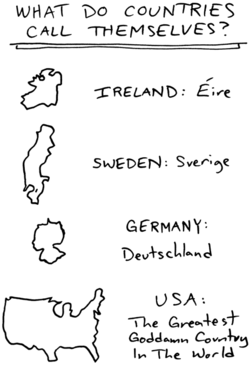
Like most phrases of its sort, “American exceptionalism” probably means different things to different people, but it seems safe to say that in many parts of the world, it is no longer the particular phrase that calls to mind immigrants, freedom, republics; it has acquired a sense of might making right, our way or the highway, with us or against us, no apologies. It has acquired in other words the Indians, the casualties, the costs. At home, too, that Tocquevillean glow is tarnished. The moderator of the show talked about how every politician running for office now is required to not just wear a flag pin, but also pay continuous homage to the unique greatness of the nation, like a poet forced to compose endless panegyrics. The cycle continues even after election: America must be the biggest, the best, the greatest; America must have the most, do the most; America must lead, for its sake and the world’s. The politicians have to say it because it seems we want to hear it, to feed a hunger in our culture that seems at this point insatiable.
Of course every country has its version of exceptionalism, as far as I know. Every nation, like every other group or community (take your pick: universities with rival schools, religious or ethnic groups, political ideologues of varying stripes, cat people and dog people, Manhattan or Brooklyn), is for some reason special, uniquely chosen or blessed, sometimes just better than the neighbors, and maybe it is true that every imagined community needs something of this. Countries are ideas more than anything else, and ideas cannot exist without someone to believe in them.
This belief has to be balanced, though, with the simultaneous acknowledgement that each nation is just one among many, a member of a community of equals, and that there is no reason for any one to be considered, in this sense, above or below the rest. On the show, they cited France as a once-“great” nation that lost its “greatness” and then didn’t know what to do with itself afterward. I understood where they were coming from but the problem escaped me. Is it so bad to be, for lack of a better phrase, just one of us? (Around the first time I read Angels in America, I had a friend, daughter of two psychiatrists and stepdaughter of a third, who claimed to have been raised with the mantra, “You’re special, just like everybody else.” This always seemed to me a reasonable way for individuals to get through life, and it might make sense for nations, too.)
In many ways it would be unfair to say that “America” has lost sight of its unexceptionalism; our culture, after all, accepts and embraces things from elsewhere, from Harry Potter to yoga and anime to Armani. Politically, though, it seems like we haven’t. We still maintain the reflexive belief that under all circumstances, America is first, comes first, will always be first. This isn’t anymore, if it ever was, a neutral condition. Because of America’s size and strength (which are undeniably “great” and even “exceptional”), it has become something malign. It’s as if we in America view the world through glasses skewed to show everything else smaller, weaker, less-than. And if you walk with bad glasses, you will eventually, trip.
Arundhati Roy, in a speech in New York, offered a “historical dredging” of September 11ths as a way “to say to the citizens of America, in the gentlest, most human way: welcome to the world.” That was a particularly painful moment and a painful welcome, but to take her point in a far more general context: There are no Manifest Destinies, moral or otherwise, and to act, to continue to act, as if there were would be not only arrogant but dangerous. Just ask the Indians.