
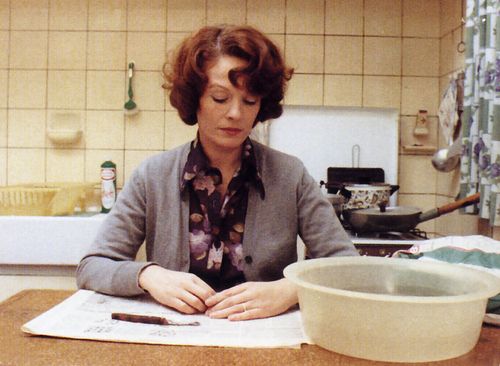
“No good movie is too long,” Roger Ebert once wrote, “and no bad movie is short enough.” Oh, how my inner cinephile regrets bringing up the 201-minute length of Jeanne Dielman, 23 quai du Commerce, 1080 Bruxelles so early in the discussion, it supports that dictum so well! Later revised to “All good films are the right length,” the line now applies to the film that much more directly. I'll sound higher-flown but surely even more accurate when I claim that the form of all good movies closely fits their substance. Here we have one of the closest form-substance matches ever made.
The title may have already given this away, but those three-and-change hours don't serve a labyrinthine plot, an ensemble of dozens, or any particular historical sweep; we get a widow, her son, three days in mid-1970s Brussels, and the preparations for those days' three dinners. Already we hit the fearsome wall this film raises against critics: having watched (and perhaps loved) it, you want to insist that, against the implication of all possible summaries, it's not boring. Yet that insistence sounds, to the rightfully skeptical reader, like too much protestation. What's more, you feel all the while that the very impulse to deliberately highlight non-boringness trivializes the many fascinating (and actually relevant) qualities of a picture so richly non-boring on every level. It's like making a big deal out of the fact that it was shot with a camera; sure, it's true, but it's also part of the work's very nature.
Generally speaking, no serious viewer considers boredom a function of length. After all, many boring movies clock in around 90 minutes, and often they're filled with event after tiresome event. Neither, then, can a serious viewer consider boredom a function of happenings. Let's not even start on all the turgid “epics” the annals of cinema history offer us. I would submit that boredom is actually the result of a form-substance mismatch; it's the unpleasant sensation of those two aspects of a film grinding away at one another, rattling, vibrating, putting out that awful burning-rubber smell. Hence the dullness of so many films adapted from other media — literature especially — as well as those conceived first and foremost as screenplays. When the material can't properly engage all the creative bandwidth cinema has to offer, something's bound to burn out. Usually, it's the audience.
Having said that, I'll tell you what happens in Jeanne Dielman. Bear with me. The titular widow's precisely scheduled days have her cooking breakfast, polishing shoes, buying ingredients, preparing impressively bland dinners out of those ingredients, eating those dinners in near-silence with her son Sylvain, reading letters from relatives in Canada, and unfolding and refolding the sofa bed. Each afternoon, she makes the time to let a different man in the front door, take him into the bedroom, and not come out until the sun sets. It's not altogether clear at first what's going on with that last bit, though Jeanne does drop a few bills into a jar on the dining table after each visit.
“A-ha,” you might say to yourself as the first day ends. “The loss of her husband has forced this poor single mother into prostitution!” To be sure, nothing in the film refutes that interpretation, but almost everything in the film hints at a deeper, stranger, far less identifiable depravity. If you're looking for indicators of homes in chaos, mothers selling sex would seem promising, yet Jeanne, whose face at certain angles looks like a death mask of domestic efficiency, could hardly have regimented her household further. Each weeknight has its dinner — Wednesdays are veal — from which there can be no deviation. Jeanne and Sylvain step out of the apartment and into town at the same time every evening. That cleanliness reigns goes without saying; even right after seeing a “client,” Jeanne takes a bath that would do an obsessive-compulsive proud.
But somewhere between day two and three, a certain happening puts Jeanne off her game. It knocks her formerly rigid timing out of whack: she sends Sylvain off to school way too early, she shows up in town before the shops open and has to stand around in front of closed shutters, and she boils the potatoes too long. (At the suggestion that she use them to make mashed potatoes instead, she laments that it's not the night for those.) At this point, we've seen quite a few extended, unblinking, methodical shots of Jeanne's routines. We know something's going wrong, perhaps badly. No train speeding toward a tied-down maiden or finger trembling over the ICBM launch button ever created so much suspense, since we're pretty much guaranteed the girl won't get sliced in half and humanity won't perish in a forest of mushroom clouds. Chantal Akerman, by contrast, guarantees us nothing; we're not even sure what the worst-case scenario is.
Film scholars sometimes point to Jeanne Dielman as a towering example of cinematic feminism, but why? True, for almost all of those 201 minutes, a woman is central in the frame, but that doesn't seem sufficient to merit the accolades. The film hangs together with nary an adult man among the main characters, but then again, so many teen comedies could say the same. It may be that Jeanne operates her household with apparent strength and efficiency without leaning on a husband, but is her financial reliance on that stream of sketchy-looking middle-aged guys she takes into the bedroom much better? In the end, after witnessing Jeanne's least predictable act and spending seven minutes staring at that indescribable expression on her face as she ponders it, you come up against obstacles to constructing any obvious feminist argument.
Though it may or may not serve feminist ends, the psychosexual discomfort the movie creates grows large and runs rampant. This is deployed with that sharpest tool in the Francophone cultural shed, well-placed ambiguity. We get a general idea of what Jeanne does behind closed doors, but we remain uncertain how outré a suite of services this middle-aged, somewhat dowdy woman has to offer to earn a living wage. We can't fathom why Sylvain looks about a decade too old to still be in school, let alone to still be so tightly pressed under his mother's thumb. We see that Jeanne and Sylvain leave the apartment every night, but we never see why. We spend at least an hour and a half in the company of a blue light shining in through the window that endlessly rotates slowly down, then quickly back up again. What is it? It's never identified. Why is it there? Because, somehow, the film couldn't exist without it.
Some viewers might argue that we don't need to see Jeanne make and re-make her cup of coffee, rejecting each after the first taste, or that we don't need to see her prepare every slice of veal for battering, or that we don't need to see the entire solemn dinners that take place in her household from start to finish. I argue that we do need to see all these things, and more besides. To show three seconds of Jeanne fastidiously running a chamois over Sylvain's shoes, scrubbing away at her own body, or sitting motionlessly in the living room as her perception of time falls back into alignment — to cut when audiences declare that they “get it” — wouldn't abbreviate the film. It would destroy the film.
Jeanne Dielman understands what all the best works of cinema do: implication and occurrence are two different things. Where so many mediocre films deal in visual shorthand that merely suggests to us that certain events have happened, this one has its events actually take place. That this builds their importance far beyond any quick-cut battle for the very future of humanity might point toward an answer to the feminist question: these are domestic duties we're watching, and the film treats them with a gravity that somehow goes beyond aesthetics. You could call its story tragic, but just by existing it demonstrates an artistic fact that's sadder than anything going on in its content. By letting its content dictate its form — or rather, by letting its content and form exist in symbiosis — the film achieves what most films could if they did the same. But almost no film does.
All feedback welcome at colinjmarshall at gmail.