
Stories are important. They help us frame who we are, personally, culturally, professionally, morally. When we call up a friend and tell our latest love woes, we're telling a story; when we go for a job interview, we tell the story of our career so far. There are many types of stories, but one kind is a story that creates and shares a vision of the future, aiming to inspire people to follow the storyteller. As Steve Denning quotes in his book, The Leader's Guide to Storytelling, “Winning leaders create and use future stories to help people break away from the familiar present and venture boldly ahead to create a better future…they help others understand why and what they must do to get there.” Denning gives examples of some of the most powerful uses of future storytelling, Martin Luther King's, “I have a dream” speech and Winston Churchill's, “We shall fight them on the beaches.”
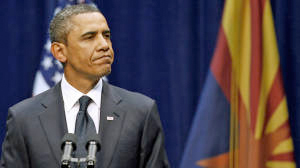
I listened to President Obama's speech on Wednesday night in Arizona; it was inspiring, moving, and heartfelt as he wove the victims' stories into a compelling narrative. He told the story of the 9-year old victim, Christine Taylor Green, urging the American people to envision a different kind of future, a future where “…our democracy is as good as Christina imagined it. I want America to be as good as she imagined it.” It was a powerful speech that, while seeming to sidestep partisan politics, instead urging all sides to abandon “the usual plane of point scoring and pettiness that drifts away in the next news cycle”, extremely effectively scored huge political points – of course. Obama was presidential, an inspirational leader.
This speech was a vivid reminder of why people voted for him in 2008. Yet, what really struck me was this thought: clearly, this man knows how to use storytelling to inspire and lead, so why didn't he do a better job of this selling healthcare and TARP (amongst other, wildly unpopular policies). Don't get me wrong, I know he tried, but somehow he seemed to never manage to strike the same notes that he did the other day. And he should have been able to.
As Denning points out when talking about Churchill's speech, it wasn't a detailed speech; in fact, he claims that “part of the strength of the speech lies in its very lack of specificity. If Churchill had spelled out in detail how the British people were going to fight, then he would have been in considerable difficulty, because it was impossible to say in June 1940 how the war would unfold.” Instead of details that would have likely been disproved anyway, Churchill “painted a set of evocative word pictures of the future.” By effectively and passionately evoking a picture of a brighter future, the listeners were transported in their minds to that future without getting bogged down in the logistical details that might make it easy refute the likelihood of such a future. Obama should have painted such a picture, told such a story. Rather than getting weighed down trying to explain the tortuously complicated policy details and talking about the possibly refutable figures of dollars and cents spent and saved, he should instead have left those details for other to fill in, or not. Republicans told some very simple stories, filled with graphic, scary imagery. Stories of death panels: granny's right to life was going to be evaluated by a panel of bureaucrats. Like any “good” story, this one was immediately and repeatedly retold. It was a story that took on a life of its own and became almost impossible to refute – certainly a list of facts, figures and policy details couldn't even begin to compete.
But where was Obama's compelling story? Where was his simple tale that would speak to the best in the American people, or what they think is the best? I don't claim to know exactly what form that story might have taken. But I do know that, listening to his speech on Wednesday, it should have sounded something like that. It should have had the same power, the same passion, and the same simple message. It should have been a story that took people beyond considerations of whatever sacrifice they might or might not have to endure. It should have transported the American people, or at the very least the almost 53% of voters who voted for him in 2008, to a place of shared purpose, shared vision for the future of the country and shared sacrifice. Perhaps even the greatest story, told with the greatest skill couldn't have won over some people, but it might have helped the Democrats take back control of the debate, and the news cycle.
But wait. The healthcare reform debate isn't over, in fact it's about to start all over again. It's not too late to build on the goodwill and sense of true leadership that Obama engendered the other night. In fact, in less than two weeks, he has a State of the Union speech to give. Proper use of storytelling techniques is a skill, but one that Obama has shown that he can be a master of, sometimes. I hope he uses his storytelling talents to lead us beyond the partisan politics, beyond the fear and disinformation and beyond the talk show rhetoric.
In 1962, John F. Kennedy announced to the American people a dramatic and ambitious goal, to send a man to the moon by the end of the decade. His use of future storytelling brought the American people along with him, despite the enormous expenditure and effort involved, “We choose to go to the moon. We choose to go to the moon in this decade and do the other things, not because they are easy, but because they are hard, because that goal will serve to organize and measure the best of our energies and skills, because that challenge is one that we are willing to accept, one we are unwilling to postpone, and one which we intend to win, and the others, too.” This could be Obama’s man to the moon moment.