
Justin E. H. Smith
The Internet, it seems, is destroying everything. In the aftermath of its Shiva-like arrival, the rest of the world now appears shabby, neglected, left over.
It has destroyed or is in the process of destroying long-familiar objects: TVs, stereos, telephones, newspapers, musical instruments, clocks, books. It is also destroying institutions: stores, universities, banks, happy hours, travel agencies. Teleconferencing is increasingly obviating the need for travel; Wikipedia is now vastly superior to anything Diderot could have imagined (and unlike the Encyclopédie, Jimmy Wales's creation is perpetually improvable). As a friend recently put it to me: to denounce Wikipedia is like denouncing the Enlightenment. Nay more: Wikipedia is the Enlightenment realized, for better or worse.
The Internet has concentrated once widely dispersed aspects of a human life into one and the same little machine: work, friendship, commerce, creativity, eros. As someone sharply put it a few years ago in an article in Slate or something like that: our work machines and our porn machines are now the same machines. This is, in short, an exceptional moment in history, next to which 19th-century anxieties about the railroad or the automated loom seem frivolous. Looms and cotton gins and similar apparatuses each only did one thing; the Internet does everything.
It is the nuclear option for human culture, unleashed, evidently, without any reflection upon its long-term consequences. I am one of its victims, caught in the initial blast wave. Nothing is the same anymore, not reading, not friendship, not thinking, not love. In my symptoms, however, I resemble more the casualty of an opium war than of a nuclear war: I sit in my dark den and hit the 'refresh' button all day and night. When I go out, I take a portable dose in my pocket, in the form of a pocket-sized screen. You might see me hitting 'refresh' as I'm crossing the street. You might feel an urge to honk.
A few years ago I saw an image in a newspaper of a camp for South Korean teenagers, sent there by their parents in the hope of breaking them of their Internet addiction. It showed them in the middle of a soccer field, wearing helmets, looking terrified. I know exactly how they felt. Sometimes as I'm walking down the street hitting 'refresh', I am made abruptly aware of the intrusion of physical reality, of midsized physical objects in motion, and I wish my body were better protected from them. I wish they would go away. They belong to a sputtering, wheezing world of rusty old buggies and abandoned factories. They have no place in 2011.
Of course, their world is not the world, and it never was all that was meant by 'reality'. Theirs is only the human social world, the world we've built up by art and artifice, the world of nature transformed for our vain and largely illusory purposes. If then there is a certain respect in which it makes sense to say that the Internet does not change everything, it is that human social reality was always virtual anyway. I do not mean this in some obfuscating Baudrillardian sense, but rather as a corollary to a thoroughgoing naturalism: human institutions only exist because they appear to humans to exist; nature is entirely indifferent to them. And tools and vehicles only are what they are because people make the uses of them that they do.
Consider the institution of friendship. Every time I hear someone say that Facebook 'friendship' should be understood in scare quotes, or that Facebook interaction is not real social interaction, I feel like asking in reply: What makes you think real-world friendships are real? Have you not often felt some sort of amical rapport with a person with whom you interact face-to-face, only to find that in the long run it comes to nothing? How exactly was that fleeting sensation any more real than the discovery and exploration of shared interests and sensibilities with a 'friend' one knows only through the mediation of a social-networking site?
The world of face-to-face interaction is growing rusty, slipping into the past with the books and the clocks. But lo: there's something left over, something that can't be further virtualized by transferring it to the Internet because it was never virtual to begin with. I have in mind nature, now often described metonymically as 'meat', but in fact also including vegetables, water, air, rocks, and the celestial bodies. What is really falling away are only the artefacts: social reality is discarding its crutch-objects and its transitional institutions, leaving nothing but a void between meatspace and screenspace, between nature and what is left of the social. At least for now, however, there are still those artefactual jalopies coughing out fumes, blighting an otherwise pristine landscape of trees and air and rocks, ruining things for those of us meat-beings that would prefer to have it one way or the other: plainly natural, or wholly virtual.
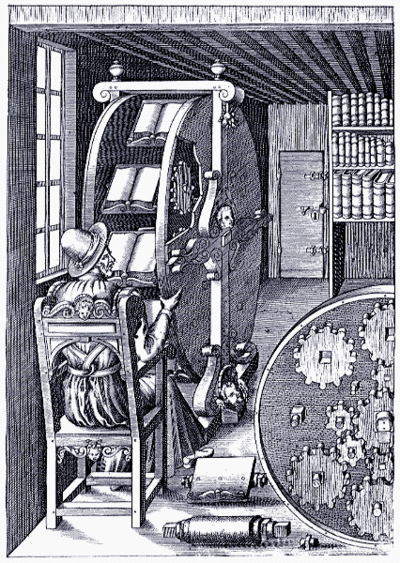
Today the Internet is in fact doing what the most grandiose claims about the book maintained that that humble object could do: duplicate the world, provide a perfect reflection of the order of nature (which properly understood was itself a book). In this respect the Internet is not really a machine or engine, even if things that clearly are contribute to its genealogy. It is not like those things that transform nature by hydraulics and pyrotechnics and so on. It does not require you to wear a helmet. Its history may be traced back in part to Agostino Ramelli's book-wheel (pictured above), one of the 'diverse and artifactitious machines' described in his 1588 book of that name, but in order to understand its power (destructive and otherwise), one would be mistaken in concentrating on the mechanics of it. One would do better to trace it back far further, to holy scripture, to runes and oracle bones, to the discovery of the possibility of reproducing the world through manipulation of signs.
Whether, then, you see the world destroyed by the Internet as a world worth losing has much to do with whether you take the machine or the book as the epitome of human endeavor– that is, whether you think humans are here to transform nature, or rather to comprehend and perhaps to appreciate it. I belong squarely in the latter camp, and while I may look now like a fiend and a victim, crouched in front of my screen, I can't help but think that what I am doing here is something fundamentally human, and even that it is the culmination of what humans have been striving imperfectly to do for a very long time.
—
For an extensive archive of Justin Smith's writing, please visit www.jehsmith.com.
To follow him on Facebook, click here.