
| ABOUT US | ARCHIVES | LINKS | RSS FEED | MONDAYS | |

3quarksdaily

An Eclectic Digest of Science, Art and Literature

« Spacemusic new and old | Main | Watching Star Plus in Lahore »

January 24, 2011

No Time for Wisdom

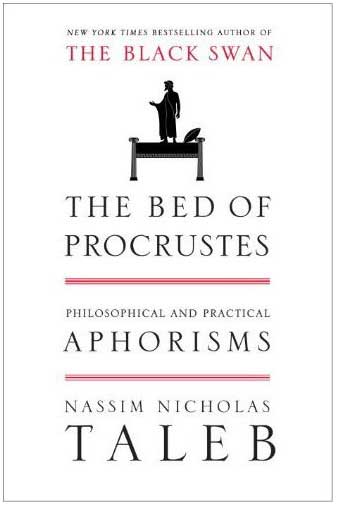
BedOfProcrustes It’s been roughly 20 years since I’ve purchased a book with the intention of gaining insight into life lived wisely. Like nearly everyone else, nearly all of the time, I have read for other reasons: as an engaging diversion, to reinforce things I already believed, to further my knowledge relevant to my career, to get some concrete piece of practical information, etc. 

And so it was when I bought Nassim Nicolas Taleb’s latest book, Bed of Procrustes. Since it is a book of aphorisms from the iconoclastic ex-financier, I expected to grab some zingers on the misuse of statistics and economic theory. What I found, to my embarrassment, was a man focused on the problem of wisdom. Not “wisdom” with respect to predicting the future in financial contexts, but wisdom in something close to the classic sense of a well-lived life--a contemporary version of the Aristotelian megalopsychos. And to be clear: I was embarrassed for myself, not for Taleb.

The aphorism as an art form has been malnourished, humbled and neglected long enough that today it lives a life on the margins. In public media, the aphorism is replaced by the soundbite or the slogan: one meant for evanescent consumption and the other meant to preclude thought rather than stimulate it. Where the transmission of aphorisms survives, it is often reduced to the conveyance of a clever or uplifting saying. For millions of managers and executives, their most frequent contact is probably their daily industry newsletter from SmartBrief, where at the bottom of the list of stories every day is an out-of-context bon mot from a philosopher, statesman, famous wit, or business “thought leader.” (Example: “The difference between getting somewhere and nowhere is the courage to make an early start. The fellow who sits still and does just what he is told will never be told to do big things."--Charles Schwab, entrepreneur)

Given this background, Taleb’s book, with all its crabby scorn, is a welcome effort. It is more than an attempt to rehabilitate the aphorism in the service of a well-lived life. It is also part of Taleb’s self-conscious rejection of common presumptions about knowledge (self-knowledge, business knowledge, academic knowledge) and value (the value of work, qualities of greatness).

The left holds that because markets are stupid models should be smart; the right believes that because models are stupid markets should be smart. Alas, it never hit both sides that both markets and models are very stupid.

The weak shows his strength and hides his weaknesses; the magnificent exhibits his weaknesses like ornaments.

As with Nietzsche, embracing the encapsulated form of the aphorism expresses an attitude towards knowledge of the human condition: as much a rejection of helpless formal systems in philosophy as of false precision in social science. At the same time, an aphorism is itself a bed of Procrustes. It cuts the observable complexity down to a kernel that can be more easily digested and retransmitted. Many of the best aphorisms also contain metaphors; they falsify when taken literally and break down if pushed too hard.

It’s not surprising that aphorisms so often fall flat and that so few have mastered the form. Given the disuse the form has also fallen into, it’s also not surprising that Taleb struggles with it at times. He can’t resist explaining some of his aphorisms with footnotes (always a mistake). He frames some as universal generalizations that really need to be qualified (even the charity of a sympathetic reader has its limits). He makes excessive use of certain terms that have a special meaning to him (“sucker” and “nerd,” for example) but when taken in aphoristic form come across as saying more about him than about our shared world. And, of course, everyone will find some that seem flat out wrong (Atheism treats the dead as unborn, really? Is that what you think an atheist’s world is like?).

Plenty of people offer advice on how to live better. Very little of it could be said to be offered in the pursuit of wisdom. Instead, the goal is likely to be expertise, factual knowledge, or practical tips on how to get ahead. Or, it may be a “wisdom” which each person gets to define for him- or herself: individualistic self-actualization or personal wisdom, not practical wisdom in the classical sense.

The energy of commerce and public discourse is around knowledge, conviction, and passion. I am inundated with literally hundreds of emails a day. I barely have time in my job to keep up with the knowledge I’m expected to acquire and tasks to discharge. In any case, what I am expected to know are facts and procedures. Who has time for wisdom? Can you show a Return on Investment for that?

In politics, Stephen Colbert’s joke is us: the political stage is for the loudest advocates of truths regarded as self-evident to the faithful, strongly felt. Wisdom is for old men who have retired from office and only feel free to speak their minds once their former colleagues feel free to safely ignore them.

The mass media are becoming media of mass participation: reality shows, television news and radio going to the “street” to get the usually uninformed opinions of passerby. Both as a matter of socialization and principle, there is less space today in the popular conception for a wisdom that stands against technical knowledge on the one hand, and poorly informed conviction and passion on the other.

On the matter of principle: If key components of wisdom are the ability to control the passions and reliably judge when general relationships will hold or fail to hold in particular cases (as for Aristotle and Taleb), then the more sophisticated use of statistical methods should in principle crowd out the need for it, as we get better and better at identifying all the patterns there are to be found, measure framing effects and so on. But if the statistical project of understanding and predicting the social world has severe limitations due to, among other things, the contingency in human action, then the call for wisdom will not be squeezed out by scientific knowledge.

Posted by Jonathan Halvorson at 12:10 AM | Permalink

Comments

A commendable analysis with fair criticism, judging from an excerpt from the book I found. In addition to "malnourished, humbled and neglected" I might add 'put down', as when an author I admire was faulted for the aphorisms she sprinkled throughout her latest book. Among the samples on Amazon.com there is much that should appeal to everyone. I am beginning to discover Montaigne and cannot avoid comparing Taleb's wisdom to his. Some of Taleb's aphorisms could benefit from reconsideration and word-smithing. Anything more than a sentence, however compound, begins to lose its impact; qualifiers and explanations, parenthetical or otherwise, defeat the intent of the form. As with haiku, there ought to be a law.
Still, it is to Taleb's credit that some of his aphorisms struck home.
- You never win an argument until they attack your person - cf. the Dalrymple brouhaha reported on these pages.
- Using, as an excuse, others' failure of common sense is in itself a failure of common sense
- You remember emails you sent that were unanswered better than emails you didn't answer
- You are alive in inverse proportion to the density of clichés in your writing
- It is a waste of emotions to answer critics; better to stay in print long after they are dead
- ... a verbally incontinent person: he talks more and more as fewer and fewer people listen
- It's much harder to write a book review for a book you've never read than for a book you haven't read
- Some people are funny only when they try to be serious
- Procrastination is the soul rebelling against entrapment
- Modernity's punishment is to make us both age prematurely and live longer
- To bankrupt a fool, give him information
- The person you are most afraid to contradict is yourself
Etc.
There are too many clunkers to cite. They too have a life of their own and are worth reading.

Posted by: narayan | Jan 24, 2011 11:06:55 AM

- ... a verbally incontinent person: he talks more and more as fewer and fewer people listen

How about "The more you talk, the fewer listen"

Posted by: J. Hawkins | Jan 24, 2011 11:12:52 AM

I goofed!
- It's much harder to write a book review for a book you've read than for a book you haven't read

Posted by: narayan | Jan 24, 2011 4:36:58 PM

he ain't no Rochefoucauld, that's fo' sho'

Posted by: nick | Jan 26, 2011 5:24:08 PM

Post a comment


Subscribe to this blog's feed  

PayAnywhere with iphone credit card swiper

Android Tablet

Bluetooth Headset

2013 New Style Dresses

Compare Car Rental Prices

DHgate.com Wholesale

3QD on Facebook

3QD on Kindle

3QD by Daily Email

Receive all blogposts at the same time every day.

Enter your Email:


Preview 3QD Email

3QD on Twitter

Miscellany

Lijit Search

AddThis Social Bookmark Button

Add to Google

Recent Comments

Raza Husain on Think About Nature

Raza Husain on Getting Smarter

johnnyred on Getting Smarter

Lou on Throwing away ancient wisdom, painting with sound and staying awake: a conversation with radio dramatist and ZBS Foundation president Thomas Lopez

Sundar on If Only We Had A Leader Like Chavez, Who Solved Real Problems -- Instead Of Debating Fake Ones Like The Deficit

flowers rainbows on Lift up your voices: The century-long battle for women's freedom

mr.ed on wagner in new york?

mirel on Here’s how to change the world

mirel on If Only We Had A Leader Like Chavez, Who Solved Real Problems -- Instead Of Debating Fake Ones Like The Deficit

X on Getting Smarter

Ross Williams on Getting Smarter

oroboe on Lennon's "Imagine" and McCartney/Wings' "Band on the Run" overlaid: One way of reuniting (some of) the Beatles

Richard H. Randall on Obama must Make Fighting Climate Change National Project, or Die the death of a thousand Scandals

seth edenbaum on The First New Atheist? Kierkegaard

waqnis on Mortify Our Wolves

nogodrod on KFC smugglers bring buckets of chicken through Gaza tunnels

waqnis on Here’s how to change the world

Fernando on Mortify Our Wolves

seth edenbaum on The case against empathy

Dredd on Mortify Our Wolves

Max on Here’s how to change the world

Rohana on Mortify Our Wolves

Raza Husain on If Only We Had A Leader Like Chavez, Who Solved Real Problems -- Instead Of Debating Fake Ones Like The Deficit

mirel on If Only We Had A Leader Like Chavez, Who Solved Real Problems -- Instead Of Debating Fake Ones Like The Deficit

araldo on Here’s how to change the world

Acclaim For 3QD


"I couldn't tear myself away from 3 Quarks Daily, to the point of neglecting my work. Congratulations on this superb site."—Steven Pinker, Johnstone Professor of Psychology, Harvard University.

"I have placed 3 Quarks Daily at the head of my list of web bookmarks."—Richard Dawkins, Charles Simonyi Professor of the Public Understanding of Science at Oxford University.

"Just wanted you to know I’m one of many who reads and enjoys 3 Quarks....almost daily."—David Byrne, musician, former lead-singer of the Talking Heads, artist, intellectual.

Read more here.

The 3QD Prizes

Subscribe to this blog's feed