
| ABOUT US | ARCHIVES | LINKS | RSS FEED | MONDAYS | |

3quarksdaily

An Eclectic Digest of Science, Art and Literature

« The Ultimate Obit – The periodic table | Main | The Nobleness of Life is to do Thus »

January 24, 2011

For Reasons of Their Own

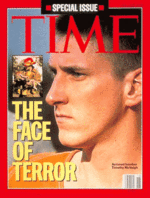
Mcveigh_time

There has been much concern in the American media about Jared Loughner’s sanity, lots of talk about the fact we cannot comprehend the mind behind that cold face, talk followed by overextended attempts to mine that mind’s deepest veins. “If you think what happened in Tuscon is incomprehensible…” a 60 Minutes piece from last week began, keep watching, we’ll help you comprehend. Is Loughner “disturbed enough to be found guilty but insane?” the New York Times mulled in the Magazine last weekend. The answer is yes, they hint.

But no one is calling Loughner a terrorist.

In May 1995, Time had a terrorist on the cover: Timothy McVeigh was shown with the caption, “The Face of Terror.” Time’s lede for another story on McVeigh is also pretty clear in its framing:

Terrorists succeed by remaining faceless. Their very anonymity allows them to move unnoticed among and around the people they plan, for reasons of their own, to maim or murder. But terrorists also occasionally get caught, although often, alas, after they have done their worst. And then the sight of their faces only deepens the mystery of their actions.

Like McVeigh, Loughner targeted a symbol of government power, and hurt innocent people. Like McVeigh, Loughner had a complicated relationship with the military and, like McVeigh, he apparently had a deep mistrust of the United States government. Jared Loughner, like Timothy McVeigh, “had reasons of his own,” which are and always will be inaccessible to the rest of us.

But we called McVeigh a terrorist. Why isn’t Loughner a terrorist? Has America redefined its criteria for who can be one?

This is not to say Loughner’s actions weren’t swept up into other people’s political frameworks. To be sure, after the shooting, there was a flurry of conversation about politics. Or rather, “politics.” David Brooks argued that mainstream coverage overemphasized possible political motivations, with all the talk of Sarah Palin’s map and the “violent rhetoric of the Tea Party.” Brooks describes  “a news media that is psychologically ill informed but politically inflamed, so it naturally leads toward political explanations.” Brooks is right in his diagnosis, but I see the opposite symptom: the media may be psychologically ill informed, but that hasn’t stopped them from attempting to psychologize Loughner to the nth degree.

Moreover, such an excavation of Loughner’s mind as those extended by the Times and 60 Minutes seems to be a privilege the media only affords, in 2011, to some violent men. Men who are called terrorists are ascribed political, ideological motivations. Loughner’s mental illness does not preclude such motivations – but our media’s language does, dismissing his admittedly confused political logic as the babble of a madman.

There is a rich body of academic literature examining the psychology of terrorism. Jeff Victorof notes that though there is a lack of consensus on what defines terrorism,

“two common elements are usually found in contemporary definitions: (1) that terrorism involves aggression against non-combatants and (2) that the terrorist action in itself is not expected by its perpetrator to accomplish a political goal but instead to influence a target audience and change that audience’s behavior in a way that will serve the interests of the terrorist”  (Victoroff, 2005).

By this definition, at least, McVeigh was a terrorist and so was Loughner: the latter’s YouTube videos and writings, incoherent as they are, indicate he wanted to influence the opinions of others, to wake us up to whatever it was he imagined we needed waking up to. (Or more aptly, given Loughner’s alleged interest in lucid dreaming, to come join him in his dream world.)

Loughner himself was concerned, is concerned, with whether the scarlet T applies to him – though whether he wants it to is unclear:

"If I define terrorist, then a terrorist is a person who employs terror or terrorism, especially as a political weapon. I define terrorist," he wrote. "If you call me a terrorist then the argument to call me a terrorist is ad hominem. You call me a terrorist." 

But he is not being called a terrorist. Could it be that there are some people, who do terrible things, to whom psychology is granted, and there are others, who do terrible things, to whom psychology denied?

The New York Times and 60 Minutes have decided Loughner is mad: their stories, among countless others, track his “well worn path to madness,” as the latter puts it: surveying his garbled writings, interviewing his former friends’ who speak about when he started acting a bit weird, then more than a bit. The programme then speaks with two Secret Service experts on assassins whose interviews with everyone from Hinkley to Sirhan Sirhan indicate “It was not politics, it was madness.” In some ways, isn't this safer, this madman who is not a terrorist?

In their way, the Times makes a nod toward balance, setting up a binary opposition: when it comes to Loughner, they say, there are “those who see premeditation” and “those who suspect he is insane, and therefore a step removed from being responsible for his actions…” Are the insane unable to plan? Do only terrorists plan? Is he a terrorist, or is he mad? The word terrorist remains unspoken: apparently, it could never apply here, not now.

The media’s concern with sanity or insanity, and its quickness to find for the latter, indicates a reluctance to view terrorism as psychological, and, to flip things around, a reluctance to view a troubled young  white American with no religious ties as a terrorist. In 1995, this was not a distinction we made so easily.

My concern here is ultimately about semantics: what will we call Jared Loughner, rather than, why did he do what he did. The latter may not be answerable. The 60 Minutes interview closes with Loughner’s longhaired friend, the one with the headband, being pushed by the interviewer to elucidate Loughner’s confused beliefs. The friend says this is exactly the conversation Loughner would want: “[us] to question why and not be given an answer.”

Posted by Jen Paton at 12:55 AM | Permalink

Comments

A strained effort. Loughner seems like a straight-up psychotic, from what we know thus far, which wasn't true of McVeigh or of Mohammed Atta or Khalid Sheikh Mohammed.

Posted by: Anderson | Jan 24, 2011 6:57:18 AM

You may be right - about my straining, about Loughner's "psychosis"- but what I'm trying to point at is a divide in our national discussion between 'being a terrorist' and 'being insane', and also to ask why only certain violent actors have the benefit of the doubt that the media's psychologizing brings.

It isn't as if 'madness' is a concrete, unshifting category, and neither is 'terrorist.'

Posted by: Jen Paton | Jan 24, 2011 7:34:29 AM

I believe you've very helpfully exposed a habitual-- and unconvincing--strain within mainstream media coverage. I'll add "religion" to the mix as a category never rightly deployed as concrete or unshifting. You can never step in the same one twice. Deep thanks for your analysis.

Posted by: David Dark | Jan 24, 2011 11:15:46 AM

I've heard terrorism described as a three part act. It is an act of violence intended to strike fear in a third party. Insanity, legally, is the inability to distinguish between right and wrong. They are certainly not mutually exclusive. Did we pin "terrorist" on the military base shooter last year because he was Muslim? No doubt. Is it important how we refer to these people? Very.

Posted by: crsteussy | Jan 24, 2011 1:47:56 PM

A pathetic bit of defensiveness on the part of america for its racial profiling of terrorism into white christian outlier nutters and anyone else. A good way to keep your distance, right? That person, he was crazy, but those brown-skinned muslims, they are out to get us.

As if anyone who commits suicide bombings is sane.

Posted by: anon | Jan 24, 2011 1:51:24 PM

Anon,

Actually, McVeigh is as waspish as they come, and no one says he was crazy.

Posted by: J. Hawkins | Jan 24, 2011 3:22:36 PM

Anon, Loughner is an atheist and McVeigh was an ex-Catholic who became an agnostic. Not sure what your point about Christianity is. Can you explain?

Posted by: Steve | Jan 24, 2011 5:16:19 PM

You seem to have forgotten that McVeigh was a part of a conspiracy. Has there been any evidences so far that Loughner anything but a disturbed lone wolf?

See also: unibomber

Posted by: Tony Comstock | Jan 24, 2011 5:44:02 PM

It's worth remembering that McViegh was actually part of a small conspiracy, and had some connections to a larger militia movement that at least had a comprehensible agenda. Whereas it's almost impossible to imagine anyone going along with Loughner's addled linguistic-based paranoia. John Hinckly would seem to be better comparison.

Posted by: Edward | Jan 24, 2011 5:51:02 PM

Steve - they come from that tradition, just like Muslim terrorists come from pretty extreme sects, but nobody bothers to make those distinctions - i.e. you don't call people just like yourself terrorists when those people go off the deep end.

Posted by: anon | Jan 24, 2011 11:35:27 PM

A false dichotomy?
It seems to me that Loughner's actions are both psychotic AND political. He shot his congresswoman, not his vet or baker. Politics is often psychotic, and psychosis is often political - but if america were to make this admission, they would have to shut much of their politics down.

Posted by: Mike Cope | Jan 25, 2011 1:27:54 AM

It is high time, that Sarah Palin and the Tea Party are made responsible and be taken to court for inducement to Murder, again displayed very openly in the wikileak saga.

Posted by: mica hubertus mick | Jan 25, 2011 4:35:11 AM

Great post, Jen. I've discussed it here:

http://bu.tt/ecz

Posted by: Cynthia Haven | Jan 25, 2011 11:18:22 PM

It is the easy availability of guns that make unbalanced individuals such a threat. Here's an interesting article on the real reasons behind this tragedy: http://www.relentlessdefense.com/post-detail.php?id=618

Posted by: Ronin | Jan 27, 2011 11:45:52 AM

Heeey(( I want too that my face was posted on a cover of PEOPLE!! How could I do it?

Posted by: custom paper | Apr 15, 2011 3:08:11 AM

Post a comment


Subscribe to this blog's feed  

PayAnywhere with iphone credit card swiper

Android Tablet

Bluetooth Headset

2013 New Style Dresses

Compare Car Rental Prices

DHgate.com Wholesale

3QD on Facebook

3QD on Kindle

3QD by Daily Email

Receive all blogposts at the same time every day.

Enter your Email:


Preview 3QD Email

3QD on Twitter

Miscellany

Lijit Search

AddThis Social Bookmark Button

Add to Google

Recent Comments

Raza Husain on Is the Brain No Different From a Light Switch? The Uncomfortable Ideas of the Philosopher Daniel Dennett

Dana on germ houses

musafir on Tuesday Poem

soubriquet on Tuesday Poem

Eli on Unknown Mathematician Proves Elusive Property of Prime Numbers

Jim on Tuesday Poem

Josef Stern on Unknown Mathematician Proves Elusive Property of Prime Numbers

Shelley on Is the Brain No Different From a Light Switch? The Uncomfortable Ideas of the Philosopher Daniel Dennett

Bill on The Beautiful German Language

Eleutheria on The Bystander Effect in Medical Care. Why Do I Have So Many Doctors Not Taking Care of Me?

Eleutheria on Tuesday Poem

Raza Husain on the culture animal

musafir on The Bystander Effect in Medical Care. Why Do I Have So Many Doctors Not Taking Care of Me?

KRS on Tuesday Poem

Félix E. F. Larocca, MD on Tuesday Poem

LWR on Tuesday Poem

Joss on Tuesday Poem

LWR on POETRY IN TRANSLATION: CORDOBA

Rashid on Aftermath: Pakistan Elections 2013

Yoann on The Bystander Effect in Medical Care. Why Do I Have So Many Doctors Not Taking Care of Me?

Dave Ranning on Aftermath: Pakistan Elections 2013

sadhana on Aftermath: Pakistan Elections 2013

Carol Westbrook on The Bystander Effect in Medical Care. Why Do I Have So Many Doctors Not Taking Care of Me?

Ken Bryant on Aftermath: Pakistan Elections 2013

Umer Vakil on POETRY IN TRANSLATION: CORDOBA

Acclaim For 3QD


"I couldn't tear myself away from 3 Quarks Daily, to the point of neglecting my work. Congratulations on this superb site."—Steven Pinker, Johnstone Professor of Psychology, Harvard University.

"I have placed 3 Quarks Daily at the head of my list of web bookmarks."—Richard Dawkins, Charles Simonyi Professor of the Public Understanding of Science at Oxford University.

"Just wanted you to know I’m one of many who reads and enjoys 3 Quarks....almost daily."—David Byrne, musician, former lead-singer of the Talking Heads, artist, intellectual.

Read more here.

The 3QD Prizes

Subscribe to this blog's feed