
| ABOUT US | ARCHIVES | LINKS | RSS FEED | MONDAYS | |

3quarksdaily

An Eclectic Digest of Science, Art and Literature

« Growing things in Gaza | Main | On Clues, Screws, and the True »

January 10, 2011

Follow the Money Trail...

Book Review: It’s Our Turn to Eat: The Story of a Kenyan Whistleblower, Michela Wrong (HarperCollins, 354pp, 2009)

by Edward B. Rackley
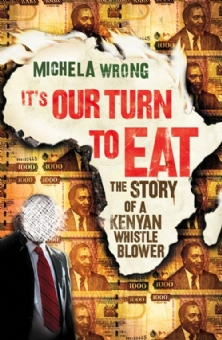
Untitled A fast-moving tale of intrigue, deception and murder, It’s Our Turn to Eat follows conflicted patriot John Githongo into battle with a $1 billion USD corruption scheme directed by co-workers in Kenyan President Mwai Kibaki’s administration. The arc of events leading to his exile in Britain, the barrage of threats by Kenyan security agents and Githongo’s prodigal return are recast through the lens of classical tragedy, but with a single, telling anomaly: there’s no redemption, no glory. This is the real world, not Hollywood.

Returning in 2007 after two years in hiding, Githongo watches Kenya plunge into a fratricidal abyss following botched national elections. Waves of inter-ethnic violence push Kenya to the brink, with much of the bloodshed fomented by political elites, six of whom are now wanted by the International Criminal Court. That political violence between ethnic communities was not caused by tribalism, as many outside observers believe, but was a direct result of state-sponsored corruption is the deep water current in this book.

Michela Wrong has written two previous accounts of visionary leaders gone mad; the first on Mobutu, ‘Le Roi du Zaire’ (In the Footsteps of Mr. Kurtz: Living on the Brink of Disaster in Mobutu’s Congo), the second on post-independence Eritrea (I Didn’t Do It for You: How the World Betrayed a Small African Nation). How the poorest pay the price for their country’s corrupt leadership is a recurring theme, but It’s Our Turn to Eat stands above her previous work thanks to the author’s friendship with the protagonist and proximity to his plight. Wrong risked her own safety by sheltering Githongo when he first landed in England.

The result is a distinctly personal portrayal of Githongo’s psychological makeup and his inner conflict between principle and belonging, Kenyan citizen and Kikuyu brother, as the scams reveal themselves and relations with Kibaki, initially an advocate of accountability, grow tenuous and distant. Readers will visualize a film adaptation of this thriller that, unlike John LeCarre’s The Constant Gardener, casts Africans as crusaders risking life and limb to reset the course of wayward leaders.

Githongo’s principled resistance reads at first like a dream-come-true for practitioners like myself who work in public sector reform, demand-driven accountability and anti-corruption in developing countries. The portrait of Githongo the man is fascinating and helps answer the perennial question – “Who in this country can lead real reform?” But by the end of the story, we see Githongo alone, tilting at windmills and abandoned by the global aid industry that initially championed his cause.

The closing chapters are devoted to teasing out the motivations behind donor silence, a passivity that Wrong, along with most average Kenyans, finds indistinguishable from complicity. And what of local opposition to corruption and tribalism’s destructiveness, why its seeming absence from the national psyche? Wrong has answers to that question too.

Several salient lessons emerge from Githongo’s efforts to rescue Kenyan politics from itself. First, and capital, is the clear causal link between elite corruption and popular violence. ‘Turns at the trough’ may be standard political culture and as familiar as the daily petty corruption seen on the street, but it fuels grievance and inter-ethnic hostilities, which ultimately erupt in mass violence with a ‘political’ face. For donor governments and aid practitioners to discount corruption as ‘aberrant local behavior’ or, worse, pardon it in the spirit of cultural relativism, is to accelerate the march towards conflict.

However impossible to assess as a counter-factual, one wonders if the vicious side of tribalism would still exist were grand corruption not common practice. Githongo considers tribalism itself a form of corruption, a betrayal of the foundational ideals of modern statehood.

Second, Githongo may be a remarkable pioneer and role model, but he’s no black swan. In oxygen-deprived, cronyistic regimes ‘governance’ cannot transform itself in the absence of individual reformers like Githongo, whose wide exposure and relationships with diverse international institutions helped shape his vision and convince him that his risks were warranted to bring about change. In my field work I regularly see national staff move up the ladder into national politics, local administrations and media prominence. We do a poor job of maintaining contact with these people, cultivating relations that extend beyond the life of a contract, despite the fact that many of us have long histories in these countries.

Third, foreign aid is constantly under fire, and those who deliver it must be able to explain it through deed and word. The percentage of foreign aid in a country’s budget, even in Kenya (3%), is too small to wield significant leverage over politicians’ errant behavior. We can’t expect much there, nor should our local colleagues and beneficiaries. But stoic silence in the face of such scandals only digs deeper the grave of western hypocrisy and perceived collusion with corrupt leaders. I encounter conspiracy theories and disinformation regularly in the field, widely held beliefs that place the US or the 'international community' among the core reasons for a given country’s crisis. Perceptions create reality, and to ignore these urban myths in our interactions with local media, colleagues and officials is tantamount to whistling-in-the-dark.

Closer to home, parallels with the Githongo story abound, particularly in light of the current Wikileaks affair. Julian Assange and John Githongo, both accused of treason and espionage, operate with the conviction that transparency leads to justice, that disclosure is an underutilized weapon against entrenched, self-serving power. Both are driven by a strong desire for retribution for the deceptions committed by an elite few against a trusting, dependent majority. Githongo had evidence of state-sponsored criminal activity leading directly to the president; Assange has the ‘dirty laundry’ of classified diplomatic cables—embarrassing to some but well short of legal evidence of wrongdoing.

As a campaign for accountability, Wikileaks has yet to effect any temporary or lasting change. Githongo’s disclosure achieved the resignation of three ministers in two weeks, although the ‘way things are done here’ continues. Unlike Assange, Githongo is no utopian. The realism of his démarche falls squarely in the ‘rule of law’ camp. Privy to insider information on multiple no-bid government awards to fictitious companies held by Kibaki’s cronies, he patiently accumulated evidence, crying foul only when his legal case was solid. Assange’s tactic is to bully political elites with the threat that their secrets will be made public, a reversal of the Orwellian eye, and somehow society will be made just. This is fantasy and self-glorification.

In Githongo’s dashed hopes, Kenya gained a national role model for honest government. But the country’s failure to support him means the ‘our turn to eat’ concept of public service continues apace. The fact that the book is not available in Kenya says much about the state of free speech and access to information in country. In this regard Wrong’s book serves an important end, censored or not.

As for Githongo’s struggle, Wrong believes he was “proven correct in the most terrible way. [He] recognized graft's potential to destabilize and destroy a society.” Ultimately, she argues, “the public's sense of unfairness, caused by the very abuses the donors were determined to ignore, eventually bloodied the machetes in Kenya.”

Posted by Edward Rackley at 12:55 AM | Permalink

Comments

Great book review. I'm glad to see writing of this quality in 3 Quarks.

I don't find much equality between Julian Assange, Wikileaks and Mr. Githongo. To me, equating Assange and Githongo diminishes the courage and patriotism of Githongo. Githongo published information about corruption in Kenya in a very directed attempt to foment reform. Wikileaks publishes confidential material with the idea, if there is one, that transparency is always good. But there is no particular objective other than this nebulous belief. Wikileaks has no particular objective.

Posted by: Ian Kaplan | Jan 10, 2011 3:40:36 PM

thanks. i very much agree with you on assange, a glorified hacker. i tried to find out if they ever worked together when wikileaks was involved in software encryption for kenyan human rights orgs, but found no leads. their trajectories and ideals are only cosmetically similar, i agree.

Posted by: ed rackley | Jan 10, 2011 3:47:10 PM

What happened to your Dad's comment? I liked it.

Now don't start trying to delete my comments!

Posted by: Abbas Raza | Jan 10, 2011 5:28:06 PM

i was too slow on the draw to escape your eagle eye Abbas! i find my father's comments embarrassing for the usual reasons. that one particularly. he means well, but i dont need a cheerleader. actually, i recall now your sister knows my father, funny world.

Posted by: ed rackley | Jan 10, 2011 5:45:36 PM

Kazi Njema

Asante sana

Posted by: mawazo | Jan 11, 2011 1:00:27 AM

i have read the review several times and have started to read the book as a result. i am proud of my son's years in africa as well as his writing skills. hopefully his insight and message on corruption will be explored and applied to other countries as well. we are certainly not free of such activities in our own country.

Posted by: charles rackley | Jan 11, 2011 8:47:17 AM

I think you're being rather unfair to Wikileaks. How is it "bullying" to release information about the actions of the government? E.g. massive illegal corruption by the Kenyan political elite as detailed in the Kroll report published by Wikileaks in 2007? See the Guardian story here: http://www.guardian.co.uk/world/2007/aug/31/kenya.topstories3

Posted by: Philosopher's Beard | Jan 11, 2011 11:46:13 AM

i preferred their MO when they did things like that -- curating discrete bits of information that trigger reform or that prove criminal intent. in the Kenya example you cite, Kroll already did the research, and Wiki helped make it more widely available, that's all. i dont see any added value with their current approach, the colossal 'information dumps', for lack of a better term.

Posted by: ed rackley | Jan 11, 2011 11:57:12 AM

What's with the gratuitious wikileaks bashing? Assange & Co., are doing heroic work, risking life and limb and the results are palpable and coming in every day as the cables expose bad doers and their bad deeds, including lottsa ngos. People who knee-jerk bash wikileaks usually have something to hide.

Posted by: Peter Byrne | Jan 11, 2011 7:46:19 PM

excellent review. I particularly valued your capture of Wrong’s analysis concerning the continuum of corruption eventually leading conflict. On one side, one could say 'bring it on' because in the context of citizens’ impotence, apathy, acceptance and collusion of corruption, only escalated conflict seems to shake up the venality and cupidity of these regimes. Alas, it is not the case. The result of the Kenyan experience appears to have only taught the power-elite to share the looting a bit more…not with other tribes and throughout the socioeconomic spectrum of the country but with the narrow band of elite from the different powerful blocks. Enemies have been bought off and the snouts are all feeding happily. Is this about to happen in Cote d’Ivoire? Democracy and the people have been duped again. Today in Kenya, extraordinarily, the same shameless elite that Githongo wrote about, ( plus new additions to their club) will discuss how to withdraw from the ICC (Rome Statute) and put aside around 60 million USD of taxpayers money to defend the six ICC-named inductees. As you correctly write...there is no pleasant Hollywood ending, but paradoxically this kind of elite confederacy may secure the ‘peace’ in Kenya that will save the 2012 election from new violence. So, is this African ‘real-politic’ today? An Africanised hybrid of nascent political consensus-making? Will this multi-ethnic, high level ‘eating’ together become the precursor to more equitable and transparent democracy in the future…or more violent conflict as inequalities rise?

Posted by: C. Horwood | Jan 12, 2011 4:05:04 AM

Thanks, Ed - I enjoyed the review (as I've enjoyed all your writing, admittedly from the shadows). I do agree with some, though, that the Assange-Githongo tie is tenuous... not birds of a feather, in my mind.

Posted by: Paul Goodman | Jan 18, 2011 10:07:24 PM

Post a comment


Subscribe to this blog's feed  

PayAnywhere with iphone credit card swiper

Android Tablet

Bluetooth Headset

2013 New Style Dresses

Compare Car Rental Prices

DHgate.com Wholesale

3QD on Facebook

3QD on Kindle

3QD by Daily Email

Receive all blogposts at the same time every day.

Enter your Email:


Preview 3QD Email

3QD on Twitter

Miscellany

Lijit Search

AddThis Social Bookmark Button

Add to Google

Recent Comments

Raza Husain on the culture animal

Chris on Positive Failure - a review of "The Power" by Rhonda Byrne

DAS on Why is Europe so Messed Up? An Illuminating History

DAS on Is the Brain No Different From a Light Switch? The Uncomfortable Ideas of the Philosopher Daniel Dennett

DAS on the culture animal

Raza Husain on Unknown Mathematician Proves Elusive Property of Prime Numbers

Dredd on NORTH KOREA’S NERVE WAR

Dredd on Unknown Mathematician Proves Elusive Property of Prime Numbers

Raza Husain on Is the Brain No Different From a Light Switch? The Uncomfortable Ideas of the Philosopher Daniel Dennett

Dana on germ houses

musafir on Tuesday Poem

soubriquet on Tuesday Poem

Eli on Unknown Mathematician Proves Elusive Property of Prime Numbers

Jim on Tuesday Poem

Josef Stern on Unknown Mathematician Proves Elusive Property of Prime Numbers

Shelley on Is the Brain No Different From a Light Switch? The Uncomfortable Ideas of the Philosopher Daniel Dennett

Bill on The Beautiful German Language

Eleutheria on The Bystander Effect in Medical Care. Why Do I Have So Many Doctors Not Taking Care of Me?

Eleutheria on Tuesday Poem

Raza Husain on the culture animal

musafir on The Bystander Effect in Medical Care. Why Do I Have So Many Doctors Not Taking Care of Me?

KRS on Tuesday Poem

Félix E. F. Larocca, MD on Tuesday Poem

LWR on Tuesday Poem

Joss on Tuesday Poem

Acclaim For 3QD


"I couldn't tear myself away from 3 Quarks Daily, to the point of neglecting my work. Congratulations on this superb site."—Steven Pinker, Johnstone Professor of Psychology, Harvard University.

"I have placed 3 Quarks Daily at the head of my list of web bookmarks."—Richard Dawkins, Charles Simonyi Professor of the Public Understanding of Science at Oxford University.

"Just wanted you to know I’m one of many who reads and enjoys 3 Quarks....almost daily."—David Byrne, musician, former lead-singer of the Talking Heads, artist, intellectual.

Read more here.

The 3QD Prizes

Subscribe to this blog's feed