
By Tolu Ogunlesi
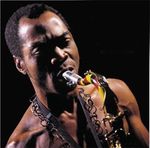
There were only two Nigerians in TIME Magazine’s ’60 Years of Heroes’ special issue in 2006: Writer Chinua Achebe and musician Fela Anikulapo Kuti. Apart from being artists both men were politicians too – drawn, when democracy beckoned in the late 1970s, onto that treacherous terrain by the prospects of providing an alternative to that god-awful brand of leadership Nigeria throws up with the constancy of clockwork.
Last November, I encountered both men in the United Kingdom – Fela as a reincarnated being in a National Theatre Musical (the Musical first opened on Broadway, earlier in 2010), and Achebe in flesh at Cambridge University, at a lecture he delivered in honour of Audrey Richards, the founder of the University’s Centre of African Studies.
I have written about my Achebe encounter elsewhere. Here is where I will pay my tributes to Fela, arguably the greatest musician to ever come out of Nigeria.
On the National Theatre stage in London, Fela came alive. But only just – in my opinion as a Nigerian speaker of pidgin, the corrupted version of English that served as the universal solvent for Fela’s lyrics and philosophy.
The “Fela” onstage clearly didn’t speak pidgin, he merely learnt it for the performance. And so his awkward handling of it kept getting in the – er, my – way. Fela’s pidgin (in which he delivered his trademark yabis – stinging verbal attacks on the political class, business elite and religious leaders) was as crucial to his persona as his saxophone was. Using a non-native pidgin speaker to play Fela was for me the equivalent of putting a violin in the maestro's hands.
But it was an ambitious performance, the kind one hardly ever sees in Nigeria – detailed costuming and stage set-up, and the accompanying band combined to (re)create a convincing setting. The scene in which Fela’s ‘Kalakuta Republic’ base is invaded is so well done you feel like you were a fleeing bystander on that horrible February day. Hundreds of soldiers stormed the premises on February 18, 1977, brutalising Fela’s band members, dancers and hangers-on.
By the time the soldiers were done, Kalakuta lay in ruins, and Fela's much-beloved mother, Funmilayo – the first Nigerian woman to drive a car, a woman who had left a revolt that deposed and popular monarch in the 1940s and, in defiance of the colonial authorities, visited the Soviet Union and China in the 1950s – lay dying. The soldiers had thrown her out of an upstairs window. She would die soon after.
Watching the musical one would be confused regarding exactly when, during Fela’s life, Funmilayo died. From the beginning of the show she is a ghostly presence, floating on screens mounted on either side of the stage, communing with her son in a voice that appears to come from Somewhere Beyond. This makes it seem as though she died before his career kicked off. And then when she dies, towards the end of the musical (after the invasion of Kalakuta) she is transformed into an opera singer and thrust into the faces of the audience. This baffling bit – which goes on for too long – is the weakest part of the musical, and (for anyone who has read about Fela’s life, and his mother's), the most puzzling.
It is striking how much of a significant role women played in Fela’s life – for one whose songs were unashamedly chauvinistic. From his mother (after her death she became a guardian angel and matron saint of sorts) to his dancers, twenty-seven of whom he married on impulse in 1978 (he divorced them all in the same manner a few years later), to Sandra Iszadore, the African-American woman who introduced him to the Black Power movement and philosophy in 1969, launching his detour into what would later crystallise as 'Afrobeat'.
In the face of accusations that his dancers/back-up singers were “misguided girls, underaged prostitutes [and] dope-smoking whores”, Fela stuck to his defence: “These women are my Queens, they are my family.”
The musical provides moving insight into the early days of the future legend – his artistic frustrations as he experimented with varying genres of music. Everywhere across West Africa that Fela’s music (highlife back then) took him in those early days the Sierra Leonean Geraldo Pino – an African James Brown of sorts – had already captured the hearts of the public.
Seeing Fela become a global phenomenon now – with sold-out shows from New York to London, planned biopics and biographies, a growing list of musicians crediting him as a major influence, and the rising profile of Afrobeat across the world – it is easy to forget that until his death he remained miles away from the mainstream, a sex-and-weed-loving assembler of angry anthems who attracted mostly disaffected, marijuana-loving fans, as well as moral outrage from many Nigerians, and harassment from the succession of mindless dictators who lorded it over the country.
Like most of Nigeria’s greatest artists – his cousin Nobel laureate Wole Soyinka, Chinua Achebe – he suffered more than he benefited from his country. To his credit were several trials (not less than 200 court appearances), stints in jail, and beatings; when he attempted to run for President, his party, Movement of the People (founded by him) was denied registration.
The audiences laughing out loud in London and New York at Fela’s antics – swallowing a wrap of marijuana meant to be used by the police as evidence against him in court (“Never let good 'igbo' go to waste”); asking for the hands of his ‘girls’ in marriage; expounding on the art of wriggling the waist and buttocks to the precision of a clock’s hand movements (“African Central Time – some people call it clock but we call it yansh”); teaching his call-and-response chants – would never have been found at any of the weed-infested places where Fela hung out when he was alive.
I wonder what he would think of this posthumous Fame in the Capitalist Enclaves of New York and London: this “Felasophy for Pidgin-Challenged, Trouble-Averse People.” He might have loved it. But the irony stands still, a man who created music with little concern for commercial appeal, or awards, now being feted in an award-winning Broadway musical.
At the end of it all he succumbed to an invisible enemy: the virus that causes AIDS. It is said that until his death from complications of AIDS he refused to acknowledge that he was ill, despite the significant body wastage and the skin infections. He refused orthodox medical treatment as well. After all, didn’t “Anikulapo-Kuti” (he was born Fela Ransome-Kuti, but changed his name around 1970) mean “One who has Death in his pouch; One who cannot die”)?
Fela was a deeply flawed man. A tyrant in his own way, who fought Nigeria’s band of ruling tyrants wholeheartedly, a Philosopher whose philosophies sometimes only managed to skim the surface, it is not hard to imagine he would have made an awful President, had he been elected. The Time profile describes him as “compulsive and rebellious, a kind of gifted and outspoken teenager who never quite grew up.”
But he was a great artist, the sort of genius that shows up perhaps once every few generations.
He was Priest (High Priest of the Religion of Afrobeat) and Prophet, Voice and Conscience, Stand-Up Comedian and Activist, Band-Leader and Speaker of Truth to Commissioned and non-Commissioned 'Zombies'. He set to music the deepest yearnings and questions of his generation and the ones to follow – questions regarding justice and equity and fairness and good governance. He came with enough contradictions to fill a million saxophones, enough talent to keep his fire burning, for all eternity.
*Image courtesy: worldmusic.nationalgeographic.com