
If the summer solstice falls on the longest day, why doesn't it also coincide with the earliest sunrise and the latest sunset?
Rebecca Jenkins in ABC News [Australia]:
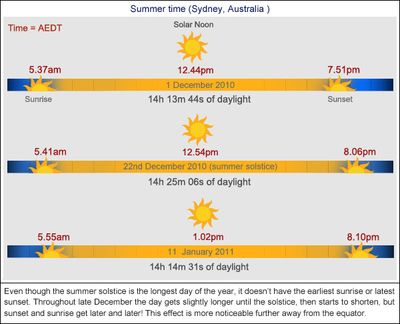
As a rule the sun isn't a very reliable time keeper, Watson points out, mainly because the Earth orbits the sun in an elliptical pattern, running faster when it is closest to the sun in January and slower when it is furthest away from the sun in July.
“It's slightly faster in [the Southern Hemisphere] summer than in our winter,” says Watson.
This quirk means that the length of a solar day — the time between two solar noons (when the sun is at the highest point in the sky) — is not always the 24 hours we measure on a clock. It's about 20 seconds longer in January and around 40 seconds shorter in July.
But while the solar day is getting longer during December and into January, the clock still only registers 24 hours. The difference between actual solar time and clock time changes by about 30 seconds every day, Watson explains. And that extra time effectively delays the following sunrise according to our clocks.
At the same time, the Earth's axial tilt means we are getting a few seconds more daylight every day in the Southern Hemisphere in the lead up to summer solstice, but this has a small effect on the sunset and sunrise times compared with the much larger difference between solar time and clock time.
The earliest sunrise occurs before the Earth hits its speedy orbit during December. And while the number of actual daylight hours starts getting shorter after the solstice, sunset is still delayed by the solar/clock time difference until the Earth's solar orbit starts slowing down again in January.
It is this effect that leads to the staggering of the earliest sunrise, the solstice and the latest sunset.
More here.