
| ABOUT US | ARCHIVES | LINKS | RSS FEED | MONDAYS | |

3quarksdaily

An Eclectic Digest of Science, Art and Literature

« Cuban medics in Haiti put the world to shame | Main | The Thirty Years' Reform »

December 27, 2010

Reflections on the Density of City Life

I: Reflectvertising in Tokyo’s Liquid Desert
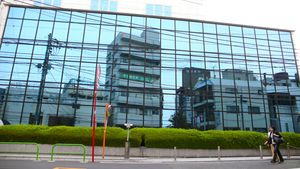
The white neon apple, visible all the way down Chuo Avenue, Reflectvertizing_ginza makes finding the Ginza Apple Store deceptively easy. I say ‘deceptively’ because it’s not until you’re about to enter that you realize you've been chasing after a reflection, a perfect double emblazoned on the frosted glass of the Matsuya Department store directly across the street. Tokyo’s upturned desert of glass preserves, from its former days as sand, the ability to proliferate mirages and fata morgana, sends wanderers deeper and deeper into the wild.

Restaurant reflectvertisements are slung around Tokyo's street-corners, billboard reflections dragged over the curved surfaces of its slow-moving
taxi cabs. Storefront neon sloshes about like oil in narrow waterways, luring then repelling, tempting then deterring. Looking out over this liquid Sahara, it’s hard to say whether reflectvertisements fall more on the side of visiting or intruding, hanging out or loitering. What can be said is that this economy of intangible light operates very differently from the economy of invisible air over which radio, television, and cellular companies bid so ravenously. And while all things may not pass amicably between reflectvertising neighbors in Tokyo, more notable than the tallying of strife is the mood of the city excited by all this uneven thrumming.
However much dictionaries may want us to think of reflections as “the throwing back by a body or surface of light, heat, or sound, without absorbing it” I can’t help but feel Reflectvertizing_street that while reflections may bounce coldly off individual surfaces in Tokyo, taken together, they soak throughly into the warm skin of the city.
II: The Relative Pressures of City Life

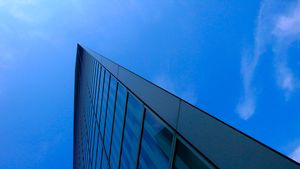
Whenever I happen to lay my hand against the side of a skyscraper in Tokyo or New York, I wonder why it is that these structures don’t get hot from all the millions of pounds of vertical pressure coursing down through them. Where does it all go? As it passes into the streets, through nut vendors, and out the exhaust pipes of busses, might it be possible to follow it into subway tunnels or trace it up elevator shafts back to the top floors of office buildings? City smells, city sounds, and so many of
the city’s weighty little annoyances push us along the same stress-strain curve as its towering buildings, at every turn making trial of our tensile strength. When late for a business meeting, wouldn't we do better to measure the long wait for an elevator in pascals rather than in seconds, with a barometer rather than with a wristwatch? We Razor_thin_building_shiodome inhabitants of megacities are little Titans, miniature Atlases, each hefting a little of the city's load on our aching shoulders.
When I was a child, I’d greet my father at the door, and, tired after a hard day’s work, he’d always make me the same deal. “I'll give you a piggyback ride to the kitchen,” he’d say, “but only if you carry this heavy briefcase for me.” Giving out a groan as he dropped his burden into my extended hand, and then, lifting me up onto his back, he’d march about, play-acting an unfettered lightness of being. I have a sneaking suspicion that the logic of city life turns on a similar principle; that the city carries our freight upon its shoulders as long as we bear a small measure of its upon ours. Despite common sense telling us all this heavy-lifting ought to result in more, not less, cumulative pressure, what keeps the operation moving, both for my father and for the city, is not a diminishing of pressure, but the inverse; its amplification, spiked with a communal ecstasy over the senselessness of it all.

III. Post-gravity Architecture
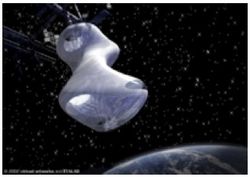
We are such devohttp://www.tate.org.uk/space/etalab.htmtees of the earth that if it weren't for gravity holding us to it, we'd surely invent something else to. In 2003 the Tate Museum held a design contest with post-gravity architecture as its theme. The challenge the submissions posed to gravity, however, was slight. Nearly every one looked like the kind of pond organisms you'd find under a microscope. For these folks, the architecture of post-gravity amounted to little more than an architecture of un-wet water.
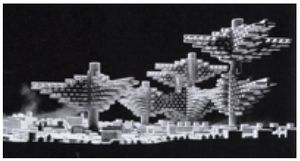
Maybe we’ve had it all wrong about how gravity holds us to the surface of the planet. If by ‘post-gravity’ we were to mean re-working gravity by working through (and then beyond) our presumptions about it, then I think we would find that post-gravity has already long been at work in our global cities. Take for example the dialogue with gravity initiated in Arata Isozaki's 1962 tree-like concept-city, “clusters in the air.” Yes, Isozaki's buildings hover high above the earth, but not without at the same time stretching long arms back down to the ground, as if to grab a fistful of dirt as a souvenir, as if to remind itself of the feel of still-hot-asphalt after sunset. Or what about the disembodied walking legs of Peter Eisenman's unbuilt Möebis Strip, the Koolhaas
CCTV building in Shanghai, the Edo-Tokyo Museum, or any of a dozen other structures that look as though they’re ready to walk Arata_isozaki_clusters off at any moment? Architectures of departure such as these allow us to leave the earth, not through outright disavowal of it, but by running tests on an increasingly fine connection to it. Perhaps our ultimate escape from earth is to be effected not in the blunt refusal of gravity, but in light dismissals, something akin to the way a woman at a party drives off an unwelcome approach by holding onto her end of the conversation just firmly enough so as not to appear rude.
IV: The Primordial Foundations of the City
If the city weren’t being continually laced and relaced by filaments of light and threads of tension, would http://www.Dodgergirl.tumblr.com ‘city life’ exist at all? A friend asked me recently if I had any idea why pigeons are so numerous in big cities. My guess - perhaps a common one - was that these birds must be endowed with remarkably tolerant stomachs (we don’t call them 'feathered rats' and 'gutter birds' for nothing, right)? Turns out that our city pigeons are properly called ‘rock pigeons,’ a name belying their cliff-dwelling heritage. When the outcroppings upon which pigeons once lived were cut into slabs, ferried downstream, and piled back up into apartment blocks and office buildings, the dumb birds probably never so much as noticed. What’s it to them, anyway? For pigeons, what distinguishes a cliff’s edge and a building’s ledge is a difference that makes no difference at all. For pigeons, we might say, the city never happened. 
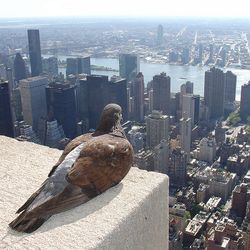
While these birds may not ever think about the city, a city without pigeons is almost unthinkable. We move parallel to pigeons when we build our own little nests on stony heights and when we scrabble about for what crumbs we can get. Liquid_omotesando If we recoil at the very thought of eating this bird, then we are properly observing dietary taboos, bringing our dealings with pigeons closer to what has long been investigated by anthropologists as totemic practices. The pigeon is our totem, city life’s animal spirit. We move along with the pigeon and mimic it down to its primordial indifference to distinctions. To a pigeon, to look at a rock face and a concrete façade is to look at one and the same thing. For us, the cityscape of reflections is as tangible as a city of things; our anxieties weigh on us as heavily as an armful of groceries. We can't shake these pressures of city life. And even in that brief moment when, after an interminable wait, the elevator doors slide open, the pressure cascades off our shoulders, and we're overcome by weightlessness - even in this moment, we can be sure that our freedom from the city's gravity will hold only until the doors slide open again on the ground floor and we are shoved right back into the thick of city life.
Posted by ryan sayre at 12:05 AM | Permalink

Comments

Post a comment


Subscribe to this blog's feed  

PayAnywhere with iphone credit card swiper

Android Tablet

Bluetooth Headset

2013 New Style Dresses

Compare Car Rental Prices

DHgate.com Wholesale

3QD on Facebook

3QD on Kindle

3QD by Daily Email

Receive all blogposts at the same time every day.

Enter your Email:


Preview 3QD Email

3QD on Twitter

Miscellany

Lijit Search

AddThis Social Bookmark Button

Add to Google

Recent Comments

Eleutheria on Positive Failure - a review of "The Power" by Rhonda Byrne

Eleutheria on Positive Failure - a review of "The Power" by Rhonda Byrne

Matt on The Science Mystique

Eleutheria on Why is Europe so Messed Up? An Illuminating History

Elatia Harris on I am dust and ashes and full of sin

PeteChapman on I am dust and ashes and full of sin

Raza Husain on the culture animal

Chris on Positive Failure - a review of "The Power" by Rhonda Byrne

DAS on Why is Europe so Messed Up? An Illuminating History

DAS on Is the Brain No Different From a Light Switch? The Uncomfortable Ideas of the Philosopher Daniel Dennett

DAS on the culture animal

Raza Husain on Unknown Mathematician Proves Elusive Property of Prime Numbers

Dredd on NORTH KOREA’S NERVE WAR

Dredd on Unknown Mathematician Proves Elusive Property of Prime Numbers

Raza Husain on Is the Brain No Different From a Light Switch? The Uncomfortable Ideas of the Philosopher Daniel Dennett

Dana on germ houses

musafir on Tuesday Poem

soubriquet on Tuesday Poem

Eli on Unknown Mathematician Proves Elusive Property of Prime Numbers

Jim on Tuesday Poem

Josef Stern on Unknown Mathematician Proves Elusive Property of Prime Numbers

Shelley on Is the Brain No Different From a Light Switch? The Uncomfortable Ideas of the Philosopher Daniel Dennett

Bill on The Beautiful German Language

Eleutheria on The Bystander Effect in Medical Care. Why Do I Have So Many Doctors Not Taking Care of Me?

Eleutheria on Tuesday Poem

Acclaim For 3QD


"I couldn't tear myself away from 3 Quarks Daily, to the point of neglecting my work. Congratulations on this superb site."—Steven Pinker, Johnstone Professor of Psychology, Harvard University.

"I have placed 3 Quarks Daily at the head of my list of web bookmarks."—Richard Dawkins, Charles Simonyi Professor of the Public Understanding of Science at Oxford University.

"Just wanted you to know I’m one of many who reads and enjoys 3 Quarks....almost daily."—David Byrne, musician, former lead-singer of the Talking Heads, artist, intellectual.

Read more here.

The 3QD Prizes

Subscribe to this blog's feed