
| ABOUT US | ARCHIVES | LINKS | RSS FEED | MONDAYS | |

3quarksdaily

An Eclectic Digest of Science, Art and Literature

« Redoing Student-Teacher Evaluations with Teacher-Student Evaluations, A Modest Proposal | Main | A Question of Character »

December 31, 2010

Televising The Drug War

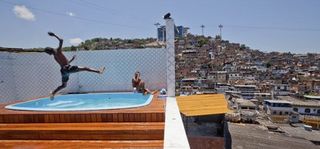
GettyImages_107190581_jpg_470x276_q85 Lilia M. Schwarcz over at the NYRB blog:

[T]he drug war in Rio does not explain the rapid spread of the public fear that has become a central theme in national and international depictions of the country. Movies such as News from a Personal War (João Salles, 1999), Central Station (Walter Salles, 1998), City of God (Fernando Meirelles’s 2002 movie based on Paulo Lins’s 1997 book), and the recent Elite Squad 1 and 2 (José Padilha, 2007 and 2010)—the latter, by the way, has become the biggest box-office success in the history of Brazilian cinema—have had an impact both at home and abroad, and have ensured that the subject of violence is never far from the lips of Brazilians. The more recent movies, in particular, which seem to be produced as quickly as TV series, seek to shock audiences with their graphic depictions of turf wars between drug gangs in the favelas, places ordinary Brazilians would not imagine visiting.

These movies, each with their own aesthetic of violence, are immediately exported, disseminating a feeling of fear and terror that fires the foreign imagination and troubles the local population. For those wishing to get a bit closer to the ground, there is a growing industry of “favela tours” that promise visitors the “thrill” of going into a real favela and finding out what life is like there and experiencing the danger first-hand—all in precise, measured doses, of course.

There is also the endless TV coverage of the chaos in the favelas. In recent days, we have been confronted with a veritable avalanche of images of the anti-drug offensive, a 24/7 reality show, with audiences glued to their front-row seats in their living-rooms, ignoring the evidence of the relatively peaceful streets outside. While Rio’s northern zone was experiencing something like a military invasion, in the south, life went on as normal, apart from hotels and restaurants, whose doors remained cautiously shut—just in case.

Most of this reality show leaves no room for nuance or interpretation: the good guys are on one side and the bandits on the other. I’m not defending drug-trafficking or the violence practiced by its participants—it is certainly true that gang warfare and the wars between the police and the traffickers have become an increasingly worrying and invasive part of everyday life in our major cities. But the prevailing black-and-white logic—according to which the drug trade is exclusive to favela life and doesn’t have implications for the police, politicians, or the population as a whole—is nonsense. It is now clear that drug-trafficking has been as omnipresent among certain corrupt police squads as it has in the favelas.

The trouble is that the ugly reality lives right next door; this is particularly ironic given a long history in Rio of attempts to segregate the poor from the rich.

Posted by Robin Varghese at 03:46 PM | Permalink

Comments

Post a comment


Subscribe to this blog's feed  

PayAnywhere with iphone credit card swiper

Android Tablet

Bluetooth Headset

2013 New Style Dresses

Compare Car Rental Prices

DHgate.com Wholesale

3QD on Facebook

3QD on Kindle

3QD by Daily Email

Receive all blogposts at the same time every day.

Enter your Email:


Preview 3QD Email

3QD on Twitter

Miscellany

Lijit Search

AddThis Social Bookmark Button

Add to Google

Recent Comments

LWR on POETRY IN TRANSLATION: CORDOBA

Rashid on Aftermath: Pakistan Elections 2013

Yoann on The Bystander Effect in Medical Care. Why Do I Have So Many Doctors Not Taking Care of Me?

Dave Ranning on Aftermath: Pakistan Elections 2013

sadhana on Aftermath: Pakistan Elections 2013

Carol Westbrook on The Bystander Effect in Medical Care. Why Do I Have So Many Doctors Not Taking Care of Me?

Ken Bryant on Aftermath: Pakistan Elections 2013

Umer Vakil on POETRY IN TRANSLATION: CORDOBA

Kabir on Aftermath: Pakistan Elections 2013

Nina on White Indians

Nina on White Indians

Dave Ranning on If Only We Had A Leader Like Chavez, Who Solved Real Problems -- Instead Of Debating Fake Ones Like The Deficit

Mohammed Hassanali on Aftermath: Pakistan Elections 2013

musafir on Aftermath: Pakistan Elections 2013

Maniza on Aftermath: Pakistan Elections 2013

Ellen Perry on The Bystander Effect in Medical Care. Why Do I Have So Many Doctors Not Taking Care of Me?

waqnis on The Bystander Effect in Medical Care. Why Do I Have So Many Doctors Not Taking Care of Me?

Norman Costa on The Bystander Effect in Medical Care. Why Do I Have So Many Doctors Not Taking Care of Me?

Hannah Carlton on POETRY IN TRANSLATION: CORDOBA

Joe on Digging Up Bones or, The Labyrinths beneath Our Feet

JonJ on The Beautiful German Language

cpfaff on Passionate About The Actor's Art: an interview with Michael Howard

Sumiran on Sunday Poem

Ethan on Getting Smarter

Pacificklaus on NORTH KOREA’S NERVE WAR

Acclaim For 3QD


"I couldn't tear myself away from 3 Quarks Daily, to the point of neglecting my work. Congratulations on this superb site."—Steven Pinker, Johnstone Professor of Psychology, Harvard University.

"I have placed 3 Quarks Daily at the head of my list of web bookmarks."—Richard Dawkins, Charles Simonyi Professor of the Public Understanding of Science at Oxford University.

"Just wanted you to know I’m one of many who reads and enjoys 3 Quarks....almost daily."—David Byrne, musician, former lead-singer of the Talking Heads, artist, intellectual.

Read more here.

The 3QD Prizes

Subscribe to this blog's feed