
December 30, 2010
Political Views 'Hard-Wired' Into Your Brain
Richard Alleyne in The Telegraph:
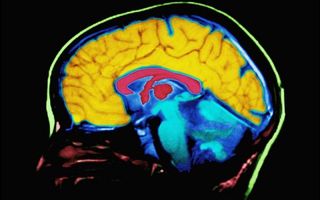
Scientists have found that people with conservative views have brains with larger amygdalas, almond shaped areas in the centre of the brain often associated with anxiety and emotions.
On the otherhand, they have a smaller anterior cingulate, an area at the front of the brain associated with courage and looking on the bright side of life.
The "exciting" correlation was found by scientists at University College London who scanned the brains of two members of parliament and a number of students.
They found that the size of the two areas of the brain directly related to the political views of the volunteers.
However as they were all adults it was hard to say whether their brains had been born that way or had developed through experience.
Prof Geraint Rees, who led the research, said: "We were very surprised to find that there was an area of the brain that we could predict political attitude.
Posted by Robin Varghese at 03:03 PM | Permalink


Comments
Larger amygdalas have also been associated with broader social networks: http://www.3quarksdaily.com/3quarksdaily/2010/12/amygdala-at-the-centre-of-your-social-network.html. Does this mean that conservatives are more anxious, but also more socially adept?
In any event, the problem with all of these brain studies is that they only show correlation, and do not venture to answer the causation question.
Posted by: James | Dec 30, 2010 3:26:05 PM
Interesting to compare this with this post linking to a study suggesting a larger amygdala is associated with a larger social network, and this post (link to full story in that post seems to be down, but another copy can be found here) discussing a theory about political beliefs by evolutionary psychologist Jacob Vigil...here's the most relevant section of the story:
His thesis, in a nutshell: Conservatives, being more oriented toward dominance, tend to acquire a larger group of friends and associates than liberals. They are more sensitive to potential threats because there are more people in their orbit, and thus the danger of their being hurt by a duplicitous person is greater. Liberals, being more inward-oriented, have smaller, tighter social groups and thus feel less threatened, which in turn allows them to be more open to unfamiliar experiences.
To Vigil, conservatives’ outward orientation and liberals’ inward stance reflect a basic duality of human nature. “Humans are highly dependent upon one another biologically,” he notes. To foster the good will of others, he argues, we “advertise” either trustworthiness or competence.
...
Vigil contends people who go through childhood, adolescence and early adulthood without serious obstacles are more competency-oriented; they’ve discovered they have the ability to influence the lives of others. They advertise this capacity, which makes them desirable not only as potential mates, but also as potential friends or business associates. Thus they acquire a larger social sphere.
On the other hand, those who have experienced numerous setbacks (illness, injury, an unstable home environment, etc.) are less likely to work their way into such a dominating position. To advertise their desirability as friends or associates, they take a different route, emphasizing their ability to care for, and about, others.
“The size of our social network limits the amount of time we can spend with folk,” Vigil points out. “If we have a big social network, it limits our interactions to short-term relationships. We have finite time and resources. If we have fewer social partners, it frees up our time to establish more continuous types of relationships.
“The basic idea is that folks who have small social spheres are going to be demonstrating more trust cues, and those who have bigger social spheres, more capacity cues.” Liberals, in other words, are demonstrating trustworthiness as a way of attracting the social support they need, while conservatives are demonstrating power for the exact same reason.
Posted by: Jesse M. | Dec 30, 2010 3:40:13 PM
in one of the studies one of the scientists used one of those instruments to peer into the ear of a conservative.
"What do you see?" asked the conservative.
"The wall." said the scientist.
Alternate ending:
"Columnar basalt formations." said the scientist.
Posted by: odysseus14 | Dec 30, 2010 6:47:39 PM
Neurobabble (as Tyler Burge put it) has truly jumped the shark.
Posted by: Jonathan | Dec 30, 2010 9:43:23 PM
Neurobabble (as Tyler Burge put it) has truly jumped the shark.
Tyler Burge was criticizing the idea that findings about brain scans and anatomy could qualify as explanations for behavior. If someone said that this finding about brain reasons explained political preferences that would be silly, but to argue that there isn't scientific value in studying these sorts of biological correlates of behavior (and that to do so is 'jumping the shark') is equally silly. Of course this is a new finding and may not hold up, but you have no basis for being confident that it won't.
Posted by: Jesse M. | Dec 30, 2010 11:27:10 PM
"Of course this is a new finding and may not hold up, but you have no basis for being confident that it won't."
Past performance is no guarantee of future results, but science has a bad track record in this sphere.
Posted by: Carlos | Dec 31, 2010 12:17:43 PM
I don't see how the article is about the neurocorrelates of behavior, unless you include having a political ideology as a behavior. The point seems to be to suggest via neuroimaging that ideology might be innate or "hard wired." And here it is I think "babble" on Burge's terms, insofar as there are plenty of other more reliably scientific ways of getting at what influences political choices than the relative size of the fear and optimism center of your brain.
Posted by: Jonathan | Dec 31, 2010 1:33:18 PM
I don't see how the article is about the neurocorrelates of behavior, unless you include having a political ideology as a behavior.
It's not important whether you call it a "behavior" or a trait that influences a range of different behaviors--for example, even if you don't think widely-used psychological traits like introversion or homosexuality or openness to experience should be called "behaviors", would you object in the same way to a study that found these traits were correlated to the size of certain anatomical features in the brain?
The point seems to be to suggest via neuroimaging that ideology might be innate or "hard wired."
I don't see any such claim in the article, which was just about an interesting correlation. In fact in the section of the article quoted in the post there is a sentence that specifically disavows the idea that this should lead us to conclude political orientation is hardwired: "However as they were all adults it was hard to say whether their brains had been born that way or had developed through experience."
And here it is I think "babble" on Burge's terms, insofar as there are plenty of other more reliably scientific ways of getting at what influences political choices than the relative size of the fear and optimism center of your brain.
But again, there is no claim that amygdala size somehow "explains" political orientation, even if there is an inference that the correlation may imply some causal relation (though of course even here we should be cautious since 'correlation is not causation', it might be that if we controlled for some other factor the correlation would disappear). Burge was not objecting to the suggestion that there might be some causal relation between brain differences and behavioral differences, just to the idea that discovering such a relation counts as an "explanation" for the behavioral differences.
Posted by: Jesse M. | Dec 31, 2010 3:39:41 PM
Whoops, I failed to note that the title of the article itself is "Political Views 'Hard-Wired' Into Your Brain". So I agree the title is bad science journalism (sometimes I think these titles are not actually written by the person who writes the article), but the article itself is more cautious.
Posted by: Jesse M. | Dec 31, 2010 3:42:30 PM
Yes, as does the subtitle "Tories may be born not made, claims a study .... " and the connection drawn near the end to the so-called "Liberal Gene." So while the scientist interviewed hedges some, the article itself tilts heavily in the nativist direction. And again, while the scientists themselves might have a sophisticated sense of how far neuroscience should go to explaining behavior, the whole point of these sorts of articles seems to be of the "neuroscience explains" model. I have no principled objection to correlating neuroimaging with behaviors or traits, so far as is it goes. I just don't think it goes that far. The importance of such studies seems to me to be widely disproportionate to the amount attention they get.
Posted by: Jonathan | Dec 31, 2010 3:52:35 PM
Post a comment