
I live in a town of about 10,000 in the Midwest. The largest employer in the town is a pork processing facility that handles more than 9,000 hogs per day (the similarity of those two numbers is a bit disturbing). About a mile to the north is the plant's own sewage treatment facility to handle the voluminous waste of newly-processed and about-to-be-processed pigs. Across the highway, to the south of the plant, is a supermarket, and when the wind blows from the north, the complex aroma of viscera and feces is unavoidable as you walk towards the front door to shop. When bacon and hams are being smoked, hickory provides a more pleasing “finish” to the olfactory experience.
Recently, I was scanning the frozen meat section at the market when I happened across a package of pork chitterlings or “chitlins”: Pig intestines. What was astonishing about this particular package was that it was conspicuously labelled as being a “Product of Denmark”. After suppressing immediate thoughts of Shakespearean puns relating to “Hamlet” and “something being rotten in Denmark,” I gasped: Here I was literally across the street from a slaughterhouse and the chitlins came from half-way around the world?! Where were our local chitlins being sent? Did geography no longer matter?

This is not the first time I've been faced with the paradoxes of our industrial agricultural system. I once remember stopping at a grove-side fruit stand in Florida only to be offered bottled orange juice that contained something like “a reconstituted concentrate of a mixture of juices from Florida, California, & Brasil.” So much for fresh squeezed.
My great uncle, on my dad's side, was a citrus grower in central Florida for many years. When he started his grove just after WWII, oranges were still picked when ripe, shipped, and eaten. Soon thereafter, concentrate technology was developed. Fresh orange juice would be boiled down to a syrup, separated into its constituents, precisely reassembled to maintain quality control, and frozen for easy storage and transport (McPhee 1967). The concentrate could then be reconstituted and consumed at any time in the following year(s). Seasonality was no longer an issue for citrus sales, and production was scaled up to supply juice to make enough concentrate for an entire year for a huge national/international population.
My other great uncle, (on my mom’s side), served in a logistics unit during WWII. When Roosevelt set up a meeting with Churchill on a ship in the Atlantic in the months before we were drawn into the war, he wanted to serve ice cream. Roosevelt claimed he wanted to serve all-American fare but my uncle was convinced it was a not-so-subtle way of demonstrating to Churchill that the U.S. could deliver anything, anytime, anywhere on the planet. My great uncle was tasked with making sure there was ice cream to serve. They packed the ice cream into metal canisters that could be carried like munitions in airplane bomb bays. Unfortunately the air in the ice cream expanded at altitude and it leaked all over. After several trial runs they were able to pack the ice cream in so tight as to squeeze out most of the air and then seal the canisters. It worked: Churchill’s delegation was served ice cream and it made enough of an impact on them that his bodyguard commented on it in a draft of his memoirs (Borgwardt 2005). After the war, my great uncle enjoyed a successful career managing supply chains for garment manufacturers.
This was the Greatest Generation's legacy to us. They survived the Great Depression only to have to defeat fascism in the Atlantic and Pacific theaters. As they returned to civilian life, they made absolutely certain that their children, the baby-boomers, would never suffer hunger or want for anything. Roosevelt's vision of anything, anytime, anywhere was channeled into civilian goods, and in the subsequent decades we have elevated this expectation to a high art or perhaps even a pathological obsession. The global merchant marine fleet has nearly doubled in the last 30 years. The tonnage of vessels idled by the current recession just around the port of Singapore is about 41 million tons, which is about equivalent to entire world's merchant marine fleet in 1918, but only about 4% of today's fleet (Bradshear 2009)!
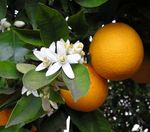
After a deep freeze in the late 1980's wiped out many citrus groves in central Florida, the University of Florida Agricultural Extension Service did some quick work to figure out other possible crops that could be grown instead of citrus or while newly replanted groves matured to the point that they would produce. One promising candidate was blueberries. The idea was that they were relatively frost-resistant, and that if all went well, there would be a two week long window in the spring during which central Florida blueberry growers could effectively corner the global market and demand a premium price. It seemed like an incredible long shot to successfully grow and ship during that window, but this was apparently what the global marketplace demanded and air transport could provide. My great Uncle planted a few test rows and grew some large (thumb-sized!) and tasty blueberries, but his heart was in cultivating citrus and he replanted the trees that had been lost. As he entered his 80's, these new trees began to produce and affirmed his life's work with sweet-smelling blossoms and brightly colored fruits. Whenever I visited, if it was in season, he would give me a box of citrus that made the best fresh orange juice I've ever tasted.
The system we have created is spectacularly efficient by some criteria and incredibly wasteful by others. At the pork plant in my town, only about 250 lbs. of unrecoverable tissue is incinerated every day. This is the equivalent of one hog out of 9,000 or 99.98% efficiency! The rest of the pig is utilized: “Everything but the squeal” as the saying goes. This efficiency is in marked contrast to the energy expenditure required to ship frozen chitlins half-way around the world, or concentrate and freeze orange juice, or air freight blueberries anywhere. I don't have enough information at hand to make this calculation but my gut instinct (no pun intended) is that energy involved in packing and shipping exceeds the caloric value of the food. We are in effect, eating oil. One prominently cited source estimates that it now takes 10 calories of fossil fuel energy to produce 1 calorie of food using modern industrial agricultural techniques. This is exactly the opposite of subsistence agriculture in which 1 calorie of human input results in 10 calories of food production (Pimentel, 2008). We have been released from hard agricultural labor, but at what cost, and for how long?
We have also obliterated the notion of seasonality and locality for much, if not all of our food. My dad, who was born in 1938, used to recall the unadulterated joy of receiving an orange in his stocking for Christmas when he was a kid. Citrus was something rare; for special occasions that also happened to fall within the season of availability. As I write this just prior to the winter solstice, I can easily purchase citrus flown in from South America or South Africa (again, the energy to get it to me likely exceeds the energy value of the food itself). Does having something available all the time render it unremarkable, no matter how wonderful it is? Have we reduced oranges from being really special to truly mundane in just a generation or two?
Consumer demand (stoked by marketing) is such that we expect full delivery of just about anything we can imagine; seasonality and distance from source to consumer be damned. This is one of the factors that results in Americans allocating about 20% of our fossil fuel consumption to growing and distributing food.
I imagine a future archaeologist/paleontologist looking through my town’s landfill: From the strata representing the 21st Century he/she will find Danish chitlin packaging sandwiched between copies of the Wall Street Journal and Reason Magazine, see from newspapers that we were in the midst of fighting a multi-trillion dollar war for oil, while the Northwest Passage thawed open for the first time in recorded history. He or she will then find the foundations of a pork processing plant within a couple miles of the landfill and wonder what we were thinking.
What else have we lost by not being aware of when things are in season and where they are from? I think of the words of Ecclesiastes III from the King James Version of the Bible (which was memorably set to music by Pete Seeger in “Turn!, Turn!, Turn!” in 1952 and later covered by the Byrds in 1965):
3:1 To every thing there is a season, and a time to every purpose under the heaven:
3:2 A time to be born, and a time to die; a time to plant, and a time to pluck up that which is planted;
We have inverted Ecclesiastes to “For everything there is no season, it's always time to consume everything under the heaven.” This reversal is especially apparent to me as Christmas approaches. Many Biblical scholars believe that Jesus was not born in December. Early Christians likely moved the celebration of the birth to more nearly coincide with the Winter Solstice celebrations that pagans already celebrated, coopting the existing meme rather than outright banning or replacing it.
The word solstice is derived from the Latin sol and sistere which mean “sun stands still,” because the apparent seasonal movement of the sun stops just before it reverses direction. The summer and winter solstices mark the longest and shortest days of the year respectively and both are recognized and celebrated by people around the world. In the northern hemisphere the winter solstice is the nadir of heat and light. Our pineal glands track these short days and long nights and direct us to sleep more and conserve energy. In extreme cases, we may even suffer seasonal affective disorder (sometimes I wonder if Christmas lights, luminarias, and Hanukkah candles are as much a form of self-medication for SAD as symbols of celebration).

Twenty-first Century North American culture runs exactly counter to these impulses. We are out shopping for gifts at 3am on Black Friday, furiously engaging in commerce and feasting while the rest of the natural world is approaching a state of suspended animation. In doing so, we have lost the restraint and humility that come with understanding of the who, what, when, where, how, or why of true seasonality and its resultant food production. In practicing restraint, I mean simply that just because we can do something (like fly jumbo-jets full of oranges between hemispheres) doesn’t mean we should. In practicing humility, I refer to the idea that we are a part of a biogeochemical entity (the earth) much larger than ourselves, and that our purchases have costs beyond merely what we pay at the market.
I am not suggesting that we eschew citrus to the point of getting scurvy or that we completely deny ourselves the full bounty of the global economy, or even that we forgo Christmas gift giving, merely that we cut back a bit, while recognizing the true costs of what we are doing. We need to reclaim and reinhabit the winter solstice; honoring its dual nature by living within the limitations dictated by long nights while celebrating the promise of longer days ahead.
If, in fact, there is a season for everything, then we should more fully embrace, enjoy, and appreciate things when they are available rather than demand poor simulacra at all times (though I still don’t think I’m going to try chitlins, no matter how fresh they are).
References
Elizabeth Borgwardt. 2005. A New Deal for the World: America's Vision for Human Rights. Belknap Press.
Keith Bradshear. 2009. Ships Tread Water, Waiting for Cargo. New York Times. May 13.
John McPhee. 1967. Oranges. Farrar, Straus and Giroux.
David & Marcia H. Pimentel (Eds.) 2008. Food, Energy, and Society, third ed. CRC Press.