
November 15, 2010
Waging War on Christmas, to Save Thanksgiving
Weeks before Halloween, Christmas decorations started appearing around town. At the local department stores, mannequins of witches and zombies were crowded by Santa’s elves. The Christmas season has, it seems, overcome Halloween. Halloween is a charming holiday, so this is lamentable to some degree. But given the relatively stable interest children have in candy and play-acting, Halloween is not in danger of extinction. The constantly-expanding Christmas season does not threaten to undermine its spirit.
Sadly, the same cannot be said for Thanksgiving. When pitted against the aggressive encroachment of Christmas and the corresponding shopping season, Thanksgiving, our most humane and decent holiday, doesn’t stand a chance.
Unlike Halloween, Thanksgiving is a holiday of human significance. Though it is occasioned by the mythology of Pilgrims and Wampanoag Indians, the point of Thanksgiving is not that of rehearsing or commemorating that original event. In this respect, Thanksgiving differs crucially from other holidays. The Thanksgiving gathering is not a means to some other end, such as memorializing the signing of a document (July 4th), observing an ancient liberation (Passover), celebrating the birth of a god (Christmas), or honoring the bravery and sacrifice of soldiers in war (Veterans Day). The point of Thanksgiving is rather to gather with loved ones, to reaffirm social bonds, to enjoy company, and to appreciate the goods one has. To be sure, the Thanksgiving celebration is focused on a meal, typically involving large portions of turkey and cranberries. Still, the details of the meal are ultimately incidental. The aim of the Thanksgiving gathering is not to eat, but to be a gathering. The coming of people together is the point-- and the whole point-- of Thanksgiving.
Consequently, Thanksgiving is the least commercialized major holiday. There are no special items to purchase, no material obligations, and no gift-exchanging. Since the point is to come together with loved ones, there is no need for commercial items to mediate the relations between people. We gather on Thanksgiving in order to be in each other’s company.
Christmas is different. It is suffused with its two myths, one of the North Pole and the other of the North Star. Neither myth is particularly inspiring. Consider: Santa is a man of miraculous ability. He is morally omniscient, he produces a copious amount of toys, and he distributes them across the globe with astounding speed and accuracy. But, alas, Santa is not a good man. He delivers presents to children when his powers could be used, instead, for redressing injustice and suffering. Why doesn’t he deliver desperately needed supplies-- food, medicine, clean water, comfort-- to those most needy? He knows how to travel to all of the world’s households in a single night. Why won’t Santa share this technology? He claims to be concerned with rewarding those who are good and punishing those who are bad, and yet he spies on children, even as they sleep. How contemptible.
The North Star myth fares no better. Jesus’ birth occasions Herod’s slaughter of Bethlehem’s innocent first born boys under two years of age. Thanks to an angel’s warning, the Holy Family skips town. What of the other families who didn’t get the warning? Tough luck. So much for “love your neighbor.”
Jesus grows up to be a shoddy moral exemplar. He heals the blind, but offers no cure for blindness. He treats the sick, but he offers no preventative measures against sickness. He could have introduced the practice of hand-washing to human society, but didn’t bother. He gets angry at money changers in the temple, but it is for money-changing in the temple, not for dishonest business practices. All this while women are subjugated, men are enslaved, innocent people are starving, and children are abused. On top of this, if Mark is to be believed, Jesus promises that those who do not follow him will burn with “unquenchable fire.” Disagreeing with Jesus warrants unending torture. How utterly contemptible.
The Christmas myths are morally horrid. That’s not the worst of it, though. They are overwhelming, suffocating. The way in which Christmas is celebrated overpowers the genuine human contact the holiday might otherwise occasion. Presents are the focus of Christmas, and the days, weeks and, now, months leading up to Christmas are consumed with travails of procuring gifts. That is, Christmas is focused on want. People gather, but for the sake of exchanging gifts, providing material items to satisfy wants. Accordingly, we must make lists of the things we want others to buy for us. In fact, not to tell loved ones explicitly what one wants for Christmas is to place a heavy burden on them-- they must now try to figure out what to buy. To avoid the hassle, many elect simply to exchange gift certificates. In the end, we’re simply funding each other’s shopping; it’s all just money-changing.
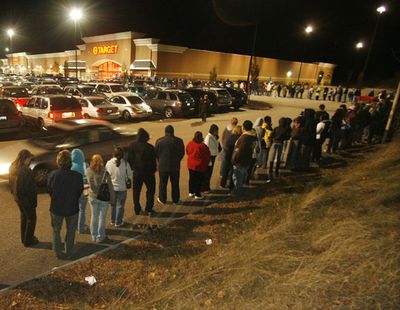
Given its focus on acquisition, it should come as no surprise that the Christmas season is constantly, and aggressively, expanding. The Christmas shopping season now begins at 12:01 a.m. on the Friday following Thanksgiving. A long weekend which could be spent enjoying the company of family and friends is claimed for bustling and angry crowds, long lines in shopping malls, disputes over parking spaces, and unavoidable traffic jams. Within a few hours at most, one wants only to be alone, to get away from other people. The spirit of Thanksgiving is destroyed by Christmas.
There is an overabundance of opportunity throughout the year to hassle with strangers in shopping malls. We have plenty of opportunity in our lives to gain increased appreciation for the Sartrean dictum that “hell is other people.” And every day we are constantly bombarded with commercial reminders of the things that we want and of the ways in which what we have is not sufficient. Christmas heightens these phenomena, engendering discontent. Thanksgiving, by contrast, provides a weekend escape from all of this. It counsels us to sit back, relax, appreciate what we have, and spend time with the ones we love. On Thanksgiving, we appreciate what we have, and acknowledge the ways we are indebted to others. Our families and friends are imperfect, but they nonetheless are ours; they are unique, idiosyncratic, and irreplaceable. Unlike Christmas, which is fixated on the new and the disposable, Thanksgiving calls us to appreciate the durable and the familiar. In order to preserve this civilized oasis that is Thanksgiving, we must wage war on Christmas and all of its madness.
We recommend that the war should be waged on the following two fronts:
First, stay home on Thanksgiving weekend. Do not shop on “Black Friday.” Sleep in instead. Spend time with your family; relax, eat leftovers, have a drink, watch a movie, take a walk. The shopping malls will survive, the sales will continue, the shelves will remain stocked. You have plenty of time.
No doubt some will dispute that last claim. They will say that time is short, and that they need the long Thanksgiving weekend in order make a dent in their Christmas shopping list. Hence the second front of our war on Christmas:
Second, rethink gift-giving. It is a simple and lamentable fact that the percentage of the Christmas gifts you receive that are useless to you is pretty high. Yes, it’s the thought that counts. But if it’s the thought that counts, then it is perfectly acceptable for people to exchange the kind of gift that cannot be purchased in a store, namely, the gift of time. Tell the adults on your Christmas list that this year you’re giving them the gift of free time; you are releasing them from the obligation to buy for you a gift, and you are encouraging them to spend in some other way the time they would otherwise spend at the mall purchasing a material gift for you. Offer to make time in January for a long and relaxed lunch date (and then make good on the offer). For friends with children, offer to babysit so that they may have time for themselves or for each other. For far-away friends and relatives, resolve to write letters; real letters, with details and thoughts just for them, with questions and occasions for beginning ongoing conversation.
These proposals are hardly militant, though widespread adoption of them would result in a decisive blow against the aggressiveness of Christmas, thereby saving Thanksgiving. Waging a war on Christmas in this way might also have an additional benefit, namely, that of saving Christmas from itself. A more humane, civilized, and sane version of Christmas, one more like Thanksgiving, might even be worth celebrating.
Posted by Scott F. Aikin and Robert B. Talisse at 12:58 AM | Permalink


Comments
I opted out of Christmas seven or eight years ago and I can scarcely describe how much an improvement it has made to the season for me. It took a few years before friends and family truly accepted my stance: "No, really, I am not participating in any gift exchange. Yes, really, I am serious." But now a few of those friends have noticed the benefits and are considering joining in this self-imposed abstinence, too. My biggest concern at the end of the year is maximizing the number of geographically scattered loved ones I can visit with, a task I am happy to engage in and one that guarantees reward that can't be purchased at a mall.
Posted by: Bryan | Nov 15, 2010 9:46:06 AM
My family and I have really changed our Christmas tradition by electing to go skiing!! This came courtesy of the example of our Jewish friends and the experience has been wonderful for me. Just the time away and the luxury of a few days outdoors doing something we love is beautiful. We do exchange gifts, but in a very low key " a shopping bag of simple things in the trunk of the car with the ski boots" kind of way.
Posted by: Jack | Nov 15, 2010 11:54:07 AM
This article was so promising until the "here we go again trashing religious beliefs" discussion. I am politically liberal; I strive to downplay the materialism of the shopping-center-Christmas. What I'm tired of is the default argument so many writers fall to these days: religion is bad; people who try to model their lives on the good example of a historical figure, Jesus, are rubes or idiots; blah, blah, blah. The arguments here supporting the family element of thanksgiving and bemoaning the materialism of the secular Christmas are strong, but why you have to trash people's spiritual beliefs in making these arguments is beyond me.
Posted by: MC | Nov 15, 2010 12:40:54 PM
MC: Which article did you read? The argument here is that the consequences of the supposedly exemplary moral actions by Jesus are less than morally exemplary. There is nothing against "people's spiritual beliefs"--there is a challenge to the model of morality that follows from the stories that are told about Jesus. Since this is exactly what Christians are supposed to do--draw moral conclusions from the exemplary actions of Christ--either the stories need to be rethought, or our moral commitments do. There is no trashing of beliefs here. There is the respect a philosopher, and one would hope any interlocutor, should show to ANY sincerely presented statement: engage it and tease out the consequences. When those consequences seem to be both undesirable from a wide variety of viewpoints, it would be nice to hear them clarified--do we just disagree, or is there more to be said? When those consequences are undesirable from the very viewpoint being engaged (and Aikin and Talisse provide a pretty good case for internal incoherence, or at least tension, here), then it's a good opportunity for that position to be clarified.
Sharply presented problems with a position is not a trashing, uncomfortable though they may be to address.
Posted by: mmdetritus | Nov 15, 2010 2:25:04 PM
This is an article that manages to be nasty, mean spirited, and poorly researched.
The story of Santa's origins go back to the 19th century, and are hardly mythological. The story of the Christmas star, as presented here, is simply wrong. What ever the star was, or wasn't, it almost certainly wasn't the North Star. When Christmas is celebrated as a religious holiday, the reading does not involve the Star of Bethlehem, but rather the announcement of the angels to the shepherds.
If the author objects to the amount of gift giving, and the general commercialization of the holiday, then by all means do so, but the general purpose trashing of Jesus or Santa have nothing to do with the objection. Christians object to the commercialization, too. The holiday as currently celebrated has nothing to do with Christianity.
So how about something less mean spirited and nasty. How about something with a little bit of research. How was Christmas celebrated in the past, before the rush of commercialization brought about by the industrial revolution? Had the authors done so, they might have found a holiday that stressed family get-togethers, concern for the poor (which was wrong, I know, because the people who practiced it did not eliminate poverty), and rather too much drinking. Not perfect, but despite their imperfections, the celebrations of Christmas past might help bring balance to today.
Posted by: Peter Besenbruch | Nov 15, 2010 3:07:49 PM
This author displays such a profound lack of understanding regarding the Christian religion that it completely undermines the rest of the article (the spirit of which I happen to agree with). Christians do not follow Christ because he was a moral teacher or a moral example. The snotty, condescending tone of this tripe reminds me of a petulant child, and I will now put it out of my mind forever.
Posted by: JP | Nov 15, 2010 3:13:19 PM
"Halloween is a charming holiday, so this is lamentable to some degree"
Halloween is charming as long as it involves cute kids collecting candy; not so charming when 6 foot 2 teenagers smash your solar lights and steal your mailbox. I've never liked Halloween. What's so attractive about skeletons and graveyards? Even Christmas is better than that.
Posted by: J. Hawkins | Nov 15, 2010 3:28:18 PM
"There is no trashing of beliefs here. There is the respect a philosopher, and one would hope any interlocutor, should show to ANY sincerely presented statement: engage it and tease out the consequences."
Well not really
"Disagreeing with Jesus warrants unending torture. How utterly contemptible."
That is not a sincerely presented statement. A sincere interlocutor might inquire what the concept of an immortal soul implies for those who reject salvation and refuse a heavenly solace rather than suggest that the one holding out his hand in rescue is choosing that those who refuse should suffer the consequences.
Posted by: Carlos | Nov 15, 2010 4:22:35 PM
As an atheist who is also an environmentalist, I generally appreciate the message here. I would have included a note regarding the environmental wastefulness of the exchange of christmas gifts - not to mention all of bloody wrapping paper - but appreciate the message. I think society as a whole is more oriented around the shopping centre, and loathe it. If we're going to continue celebrating Christmas, a religious institution of dubious merit in and of itself, perhaps we could make it about things that matter - not another half ton of plastic gadgetry.
Posted by: Georgia | Nov 15, 2010 6:41:32 PM
If you take a look at the 15 paragraphs of this essay, you can see that there are 3 devoted to the anti-Christian default argument. Twelve other paragraphs deal with what I agree is the main problem here: an excuse for a gigantic spending spree in the name of a now largely secular holiday. So, if the problem is the gimme, gimme, gimme of the season, then focus on the crass commercialization of the secular Christmas and leave the religious element out of it. If we want to save Thanksgiving, a holiday that originated in a celebration thanking God for the earth's bounty (by the way), stick to the point made in the other 12 paragraphs and save the cheap shots for something else.
Posted by: MC | Nov 15, 2010 7:14:32 PM
This is spot-on regarding Thanksgiving, the significance of which makes it to my mind the best of all the US holidays. The idea is to be grateful for one's fortunes, and to celebrate them with friends and family. If you must give a gift over christmas, why not something like a charitable contribution in the recipient's name? A holiday in which you remember the misfortunes of others may be a nice complement to one in which you appreciate the goods in your own life. (Not that you should do something about others' misfortunes only once a year, of course.)
Posted by: Allen C | Nov 15, 2010 8:14:04 PM
Oh, and regarding the picture: Really?!
Nothing against Target, but what could that store have that would be worth waiting in that line??
Posted by: Allen C | Nov 15, 2010 8:36:36 PM
I can't believe that 3QD would allow a couple of religious illiterates to express their views on the subject of Christianity - or any other religion. Would you allow an uneducated person to publish an article dealing with a scientific subject? Where's the intellectual rigor? Certainly not in this juvenile article. The writers are contemptible, and so is your decision to publish them.
Posted by: Punditius | Nov 15, 2010 10:25:08 PM
And now I read that you have taken on these two dopes as columnists? The bottom just fell out of your credibility. No point in bothering with this site anymore.
Posted by: Punditius | Nov 15, 2010 10:37:35 PM
Truly, the evidently infinite capacity of christians to feign victimhood never ceases to amaze me.
Posted by: Bryan | Nov 15, 2010 10:39:20 PM
Hi Punditus,
Good job! One problem, though. The authors express no views on the subject of Christianity, or any other religion. The article is not about religion at all - it's about Christmas and how it's celebrated. You just don't like what they say about Jesus, so, rather than prove that what they say is untrue, you simply call them names. Very rigorous of you.
Posted by: stiv | Nov 15, 2010 10:44:03 PM
Stiv, the take down of Christianity here would be hard for any mere mortal to miss. I hope you use your powers for good not evil.
Posted by: Carlos | Nov 16, 2010 5:10:56 AM
Look at those people patiently waiting in a very long line. They are practicing the true religion in America - consumerism. And Target is their temple.
Posted by: J. Hawkins | Nov 16, 2010 10:31:26 AM
And the holiest day of the year is Nov 26th. A day of financial atonement for the ceremonial gluttony and football of the day before.
"Why is this day unlike any other day, daddy?" "I put on 5 pounds!"
Posted by: Carlos | Nov 16, 2010 10:45:45 AM
The title of the article, at least, is about saving Thanksgiving. So, let's not talk of holidays before or after but discuss ways to celebrate giving thanks. Would we be more thankful if there were "things" to purchase to honor the holiday? If buying would help us express our bounty and gratefulness, I guess we should demand more things to buy. If gratefulness is a state of mind, let's spend time honoring that and sharing ways to do that honoring.
Posted by: Trish Presnall | Nov 16, 2010 11:29:30 AM
Isn't "gratefulness" an abject state of mind?. And isn't it essentially a religious concept? I would prefer we feel a little compassion for those who may be unemployed or homeless. And maybe we should feel a little anger at those financiers whose machinations made them suffer.
Posted by: J.Hawkins | Nov 16, 2010 3:07:01 PM
"Isn't "gratefulness" an abject state of mind?"
Only in the same sense that ungratefulness is an exalted one. Of course many people do translate that gratitude into charity and compassion. ("...70% of Americans Plan to Give During the Holidays, Survey Finds ......") Jesus would even have us feel compassion to the banksters...yikes, there's a spiritual work for you.
Posted by: Carlos | Nov 16, 2010 4:45:25 PM
I love love love the heathen aspects of Christmas, or rather, Yule. The decorated tree, the lights, the big meal at the winter solstice, and so on.
The gifts thing is a bit crappy, but there's a simple solution: cards. You can make them if you're cheap, or buy them if you're lazy. You can write a lot in them or just a little. Every time some family member asks "what do you want for Christmas" I ask them to send me just a card. It's an accepted alternative that avoids most of the problems while keeping most of the benefits and purpose.
Posted by: Sagredo | Nov 17, 2010 12:25:04 AM
For me, it is the winter solstice celebration and the return of the sun is well worth celebrating. We pretty much limit gift giving to children. The big meal with friends and family is the best thing about it. O, I forgot - getting ten days off work isn't so shabby either.
Posted by: J.Hawkins | Nov 17, 2010 10:00:04 AM
A nice reminder of how Thanksgiving is really everyone's favorite holiday. When our children were young, visiting my father, whom they adored, brought me more joy than anything else.
I can't say I share the authors' revulsion toward the Christmas myth, though. I find it pretty cool, and don't mind celebrating it. A god who is the sole source of creative force in the universe, who has been engaged in a covenant with a small group of humans, decides to expand this relationship to all of humanity, and so becomes incarnate. (Why? Who knows why gods do what they do.) And the god is not just going to impersonate a person, they're going to become a person, including being born. Now, there's a cool myth.
It's the other end of the story, with the whole suicide by cop thing, that's disturbing.
Posted by: Ken Pidcock | Nov 17, 2010 9:46:25 PM
"Disagreeing with Jesus warrants unending torture. How utterly contemptible."
Carlos wrote: "That is not a sincerely presented statement. A sincere interlocutor might inquire what the concept of an immortal soul implies for those who reject salvation and refuse a heavenly solace rather than suggest that the one holding out his hand in rescue is choosing that those who refuse should suffer the consequences".
Many of us don't reject "salvation"; we reject the idea of jesus as somehow being the purveyor of salvation, basedon his words and actions as reported by christians. The arrogant christian view, of course, is that there is no other possibility than jesus being the vehicle of salvation. Thi seems to many of us to be unlikely in the extreme.
Posted by: sailor1031 | Nov 18, 2010 12:42:51 PM
It's not arrogant to simply believe in something wholeheartedly. Other than that minor pejorative though, your opinion is offered very inoffensively. What a breath of fresh air, thanks!
Posted by: Carlos | Nov 18, 2010 1:46:33 PM
What of the other families who didn’t get the warning? Tough luck.
Highly recommend reading Saramago's The Gospel According to Jesus Christ which deals with just this question (among others).
Posted by: The Modesto Kid | Nov 22, 2010 12:34:26 PM
Post a comment