
| ABOUT US | ARCHIVES | LINKS | RSS FEED | MONDAYS | |

3quarksdaily

An Eclectic Digest of Science, Art and Literature

« Going places, seeing things, writing back | Main | Light and Time: James Turrell at Gagosian and Christian Marclay's The Clock at White Cube, Masons's Yard. »

November 08, 2010

Free-Market Moloch? Paying to Make Red Lights Turn Green

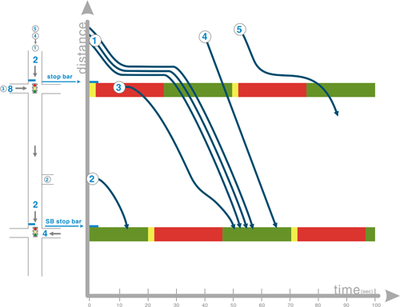
Traffic timespace diagramI saw this on Twitter a while back, posted by someone who was attending the Wolfram Data Summit: "Data future vision: you're at a red light and can pay for it to go green."  Like a fragment from some lost Sumerian tablet, this cryptic comment is all we have.  But it's enough.

Paying for a red light to go green is the sort of thing economist Tyler Cowen and blogging partner Alex Tabarrok (their blog is Marginal Revolution) like to file under a category called "markets in everything." This seems to have been just a passing thought, but it lodged in my head and wouldn't leave.  At first it seemed like the perfect example of the future as a technolibertarian nightmare - the future I fear and dread the most.  Then I gave it a second thought, and a third.

And then, after much thought, I made up my mind.  Yeah, it's a technolibertarian nightmare - although it's not nearly as big a change from today's reality as it first seemed.  But then again, isn't that the problem?

How would something like this actually work?  Would drivers buy something like an EZ-Pass that automatically provided preferential treatment at every traffic light?  Would a prepaid device be sold with the car itself, perhaps included as a standard feature on larger, more conspicuously-consuming vehicles like Cadillac Escalades?  Those ideas don't seem very imaginative - and they're not true to the original, shamanic vision: "you're at a red light and can pay for it to go green."  That seems to describe what economists and marketing types call a "point of sale" decision, not a premeditated bulk purchase.

Most people would probably want a point of sale system, anyway.  There are times when it's worth money to get a green light - for some people, there are times it's worth the risk of running a red light - and there are other times when they'd rather wait.  

So you'd need an electronic network that links cars and traffic lights.  That's easy, since the network of things is well on its way.  Better yet, why not have a link between the traffic light and the driver's thoughts?  That's on its way, too, thanks to microchip implants and other new technologies that originally designed to control prosthetic limbs. Throw in a mechanism like PayPal that handles each transaction, and you've got your green light payment system.

What if I'm in a hurry and want to pay, but the same is true for the guy approaching in the other direction? Will it be a competitive bidding process?  Then costs could vary dramatically depending on the wealth of the parties.  Since my regular driving route takes me through downtown Beverly Hills, I'd probably lose most of my bids, causing my driving time to go up.

Competitive bidding would make the process even more complicated. There would be a lot of back-and-forth data traffic, with the light itself as the hub communicating with all the parties -- and the drivers probably glaring at each other across the intersection.

Would drivers be able to band together and form purchasing alliances?  After all, if a driver behind me or facing me added to my bid, we'd both benefit, and there would be more revenue for the "light." But to execute this process successfully, the traffic light would have to become a kind of "digital auctioneer," able to accept competing offers, encourage higher bids, and choose the right time to end the sale and execute the transaction.  The light would become a robot intermediary, one that might be perceived as a form of artificial intelligence.

And this would be a powerful robot intelligence, albeit one with a small sphere of influence.  That's a major shift in the way these devices have been presented to the public.  "Intelligent" robot devices are usually portrayed as subservient tools performing service roles of various kinds for their human masters(1). But our Intelligent Traffic Light would be an authority AI, invested with all the power of the state.  You offer it something, and it then waits to see if it has a better offer from another human before proceeding.  It's "free" to "refuse" your offer, and if you proceed anyway you will be punished (after being recorded by its cameras).

That's a shift in the human/machine balance of power that might disturb a few people - and would piss off a lot of them.  It's a role reversal:  In some metaphorical sense, it would become the brain and we would become its prosthetic limbs.  The intersection would be its domain now, not ours.

Come to think of it, libertarians may not like this idea any more than I do.

Robin Hanson thinks about this stuff a lot, but I couldn't find any citations from him on the topic of - well, what would you call it?  I suppose if I were writing a paper about it I could call it something like "Green Light e-Purchasing: Authority-Figure Robots as Economic Actors in a Technologically-Enabled Nanoeconomic Environment."  (The "nano" in "nanoeconomic(2) environment" would represent both the small physical dimensions of the traffic intersection and the brief duration of the transaction.) 

But I don't plan to write an academic paper, as fun as that sounds (and it does), so the idea needs another name.  My anti-authoritarian streak wants me to call it "Automated Corruptible Officials:  Little Traffic Light Robots That Rich Guys Can Bribe."  Except that, like so many political transactions, this corruption would be perfectly legal.  Corruption can be legal,of course.  Merriam-Webster's first definition of the word is "an impairment of integrity, virtue, or moral principle."

Which gets us to the heart of the matter:  Would this data future vision (I still don't quite get the italics) lack in integrity, virtue, or moral principle?  Would it be wrong?  My sense of fairness (or is it just a biologically-hardwired inequality aversion?) says yes. Why should the wealthier among us - who already enjoy so many advantages - get another way to spend their excess riches to make life easier for themselves and worse for everybody else?  The public as a whole - that is to say, we - built the streets. We hire the police.  We would even build and manage these "smart" traffic lights (or subcontract them to private companies - but it would be done with our collective authority.)  Why, this idea is grossly unfair, undemocratic, unreasonable ...

... And completely consistent with the way things are done today.  We finance mass transportation (some would say we grossly under-finance it), but those with cars pay for greater ease of travel.  We pay for the roads and highways, but some travel on them in greater luxury than others (while some never use them at all.)  Many highways and bridges collect tolls, charging amounts that are insignificant for a few and a burden for many others. Great Britain has the National Health Service, but if somebody doesn't like the wait times they can join a private insurance scheme like BUPA or pay for their own care out of pocket.

But there's a difference:  These examples are not direct, immediate zero-sum exchanges.  Everybody waits in line to pay the toll (or pays the same amount but uses an EZ-Pass or its equivalent).  Sure, there is always some competition for resources, so in some sense these transactions affect others.  But the green-light effect would be immediate and undiluted:  People going in one direction would sit and wait - in that very spot, in real time -  whenever the people going in the other direction had more money to spend.

If my inequality aversion is triggered - peaceful guy that I am - then other people will have more severe and even violent reactions.  

Consider New York City:  What would happen at rush hour when a stream of traffic going uptown toward the well-to-do suburbs of Westchester County crossed another stream headed to the less-wealthy neighborhoods of Queens. Would the Queens-bound drivers have to wait until late in the evening, when the last of the Westchesterites has left town?

How long would it take New Yorkers to successfully vandalize a traffic-blocking, offer-weighing, driver-judging, money-extracting, traffic-delaying electronic monster, a red-and-green eyed Moloch sacrificing their time to the wealth of others?  I'd give it 48 hours, tops.

That said, the green-light exchange would be an interesting - and rare - exercise in the so-called "free market" (a process that's rarely free and where the parties rarely have equal access to information). Both cars at the traffic light would pretty much know all there is to know about the transaction.  We'd quickly learn the "real market value" of a green light be at different intersections, at different times, in different cities all around the world. The lights would generate a gold mine of data that would probably surprise us.

But they'd wreak havoc on the already-struggling art of traffic control, and the nascent field of Traffic Flow Theory would be shot to hell.  Elegant models like the "time-space diagram for one way street operation" shown above, developed for the U.S. Department of Transportation, would become useless.  They'd drown under an ocean of new variables like driver economic status, geographic distribution of income, and group dynamics.   

Then there's the social question:  How much should be "for sale" in a society with such grossly inequitable distributions of income - inequities that are themselves usually generated and reinforced by the engines of government? As with highway tolls (or gasoline taxes, or any other regressive tax), amounts that are insignificant to the few are burdensome to the many.  How much should the well-to-do be able to inconvenience their economic lessers for what is to them a mere pittance?  

You can take the idea as far as you like: If you can pay to turn red lights green, why not pay to hit pedestrians with your car, too?  The traffic light could manage the transaction, restricting it to only those pedestrians who are willing to be struck - for the right price, of course.  They're out there.  After all, some people already get hit by cars so they can file an insurance claim.

Of course, nobody would take our traffic light e-market that far (we hope). But, as Robin Hanson points out, robotic workers will take on an increasing number of cognitive jobs currently performed by humans.  If "robot traffic lights" can be paid off- er, "employed to facilitate a market in reduced waiting times" - what about robot doctors? After all, nobody likes to sit in the waiting room.  How about digital schoolteachers?  Imagine: I throw the "learning module" a few bucks and my kid gets tutored before yours. The there's the supermarket.  If I just transmit a few cents to the robo-teller I'll be pulling into my driveway while you're still standing in line watching your ice cream melt. 

 Some people would say that the solution lies in finding the right balance between publicly provided necessities and private resources:  Mass transit vs. private automobiles.  Toll roads vs. surface streets.  But life is a human right, and time is a dimension of life.  Time is the real commodity for sale at our traffic light. The light is selling the time of all the drivers, and it's awarding it to the highest bidder. Is human time fungible?  Can I sell you my waiting time at a green light - either actively, through a direct transaction, or indirectly by being unwilling to pay?  Those are the same ways I "sell" you my time during a television commercial or at work, or when I use "free" software like Google.

Let's take our thought experiment out to the farther future, to the age of the proposed Singularity. (Some of us remain agnostic about the idea, but this is a thought experiment.)If people upload their "consciousness" to a computer, should the wealthy be able to purchase more storage space and faster processing time for their "minds" than the poor resident of the same central processing unit?  There's a sci-fi story to be written there. (I think one has been, actually, although I can't think of it right now.  Maybe if I paid for a few more processing cycles ...)   

Meanwhile, in the traffic-infested present, the city of London charges a congestion fee for use of its roads during the busy daytime hours. That's not so different from the "green light" proposal. The process id managed by a private company, and it was introduced under Ken Livingstone, the leftist mayor they once called "Red Ken." There's a school of libertarian thought that says the government ought to get out of the public-thoroughfare business altogether and turn it over to the private sector.    We're living in the world of "road socialism," some libertarians say.  A free-market model for green lights might be exciting to them. 

But the privatization of college loans in the United States was a disaster, and  privatization programs for schools and prisons have led to scandals, inefficiencies, and cost overruns.  "Red" Ken's congestion scheme has its troubles, too.  And there's the communitarian question:  How will we continue to have shared experiences as nations and societies, how will we remain a common people, if new technologies eradicate those experiences we all share in common?  

What won't change is human nature. If they start charging for green lights, people will find ways to avoid paying.  Here's one way:  Find a Cadillac Escalade and follow it.  He'll pay for all the green lights and you'll get the benefits for free. Of course, that means you'll have to go wherever he wants to go. If that isn't a metaphor for the world we already live in, then what is?

_____________________

(1) Except for military applications, of course - but readers and viewers of the popular media never imagine these devices might be used against them.  Nor are they supposed to ...

(2) Papers have been published on something called "nanoeconomics," but they use the word to refer to the economic impact of nanotechnology.  I object!  As "macroeconomics" is economics on a large-scale, shouldn't "nanoeconomics" be extremely small-scale economics?  Shouldn't the prefix refer to the word itself, not the commodity being traded? Sadly, there is no National Registry of Neologisms where I can file a complaint, nor is there a free market where I can bid on the word and buy it from those who I believe have misused it.  So there is neither a statist nor a libertarian solution.

Posted by Richard Eskow at 12:10 AM | Permalink

Comments

Do the losers get a cut of the profits? I think this would actually be popular. Also, the high bidder should be marked out some way, so everyone can see who maketh the wheels to roll. And, inevitably, there would come to be a "mayor" of each light. Maybe the selected ringtone of the winner would play when the light changed.
You're right, we're so close to this already that it is very easy to riff on.

Posted by: Douglas Hill | Nov 8, 2010 3:23:28 PM

"Do the losers get a cut of the profits?" That's a good idea - although hardly libertarian. I mean, what would John Galt do?

I love the ringtone idea. And why not rack up points with every successful bid? And then you could redeem the points for ... what, exactly? Any suggestions?

Posted by: Richard Eskow | Nov 8, 2010 3:54:38 PM

"Sadly, there is no National Registry of Neologisms ..." a market opportunity here - clearly we are in the grip of lexical socialism. Come the GMR (Global Market Revolution) all words will be available for sponsorship and/or leasing and/or outright freehold. All existing dictionaries, thesauri, lexical compilations of any form will be subject to royalties.

THE - first word on the auction block

Posted by: minh mcCloy | Nov 9, 2010 4:42:03 AM

I say let's build sufficient bike lanes and then let automobile drivers enjoy the hell you've imagined so well.

Libertarians have a special place in my heart for their ability to imagine a world without public space or, more importantly, a conceptualization of the public good. I dislike daily driving (while relishing long excursions), which may have given me less respect than I should have for the positive social benefits of roads. However, to imagine life after the poor are cut off from the only working low-cost transportation system in the U.S. is quite sad indeed.

Posted by: Cyrus Hall | Nov 9, 2010 5:03:35 AM

If we're postulating a robot that manages traffic, then try some of these on for size.

The robot is just there to make a decision regarding the allocation of a scarce resource, right? If we let the market allocate the lights, the robot's job is to minimize the friction. The price is there to indicate how badly people want green lights. A virtual auctioneer doesn't need to be as smart as all that. But there are other ways, perhaps less exploitable, to determine that information, and some might require a nice muscular AI. An obvious indicator would be the number of cars approaching the intersection. Put an AI at each light tasked with minimizing the wait (by some formula - naively, just the total wait for all cars) and network them together so they can learn from each others' states. Do a heckuva lot better than the human engineers and their rigid top-down models, if my knowledge of machine learning is any indication. Certainly better than in this town, where the popular theory is that they intentionally make driving as irritating as possible in an attempt to discourage it.

Posted by: Mark | Nov 9, 2010 1:20:15 PM

(Thought of more to say) Ability and willingness to pay is a good (and easy to obtain) signal of a thing's value, but, especially with artificial resources like traffic light colors, it is not necessarily the best. If you want to get a bit Big Brother, have each intersection track which cars pass through the most often and prioritize the more frequent users of the system. Hard to game that system. Or give preferential treatment to the ones with the cleaner driving record, or at least who follow the speed limit nearby. A nice way to discourage speeding if it doesn't get you there any faster! A less fair-minded society might award shorter or longer waits based on any criteria that it wants its traffic lights to be able to discover, with all the potential for abuse and insecurity entailed by an incompetent implementation. But the best solutions require no input from drivers, which means you need some authoritarian decision-making to be done by a machine no matter what.

Posted by: Mark | Nov 9, 2010 1:43:33 PM

Mark, you're on a roll! I love your incentive plan for good drivers.

You're right that lights should be able to asses the traffic load in each direction, and that's no doubt being developed right now by someone.

The LIBERTARIAN use of that innovation would be to say that increased demand means greater scarcity of the "resource" - passage through the intersection. Therefore the market value of the green light should also increase. A car driving laterally to the rush-hour traffic flow would have to pay dearly for their green light, which would delay all those commuters.

But those who could pay this premium would inevitably do so - amplifying the hellish outcome of the plan for all but a few.

Your "benevolent dictatorship of the robot lights" seems more desirable to me. Ayn Rand would no doubt disagree.

Posted by: Richard Eskow | Nov 9, 2010 2:01:14 PM

From a moral perspective I don't see a problem with this scenario. It can be seen as a more efficient way of allocating limited resources (in this case the right to use the space in the middle of the intersection for a brief period of time in order to cross it). This assumes of course that the income is funnelled back to society in a way that benefits everyone.
People who are cash rich but time poor get to save time, whilst people who are time rich but cash poor enjoy the shared benefits of the income.
Are tollways any different ?
From a practical perspective I can imagine a way this could work. Computerised motor vehicles will allow cars to travel in tightly knit chains at a constant speed, much like the way train carriages are connected. When such a "car train" approaches an intersection, it sends a message to traffic lights, which change to green, in the same way that light railway in many cities is configured to always get a green light. For this service, each driver in the chain is charged a fixed charge. Once this ad-hoc train crosses the intersection the light can change back to red.

Posted by: Rafi Bryl | Nov 9, 2010 2:20:48 PM

Buses would become more attractive.

Posted by: sam | Nov 9, 2010 4:02:40 PM

My technolibertarian nightmare business would be to purchase the rights to the revenue from red-light cameras at intersections, and then pay to turn lights red in a strategic fashion to maximize net revenue from my intersection.

I'd need a lot of shell companies between me and the red light in order to avoid assassination, but the marginal cost of the shells will be low, because I'll need shells for tax-avoidance.

Posted by: ottnott | Nov 9, 2010 5:43:35 PM

This concept was in a Fabulous Furry Freak Brothers comic (or a related title) from the sixties or seventies.

Dumb hippie ideas are now good libertarian ideas? Whoa.

Posted by: Clotario | Nov 9, 2010 5:48:36 PM

Rafi wrote:
"From a moral perspective I don't see a problem with this scenario. ...This assumes of course that the income is funnelled back to society in a way that benefits everyone."

Drinking the market-solution kool aid often requires that you assume that there isn't a giant turd in the punchbowl, not matter how frequently turds have been found in punchbowls in the past.

Posted by: ottnott | Nov 9, 2010 5:50:48 PM

Currently, stoplights are scheduled to make traffic flow more efficiently based on typical traffic patterns. In the future, stoplights could respond to the current traffic to make it flow more efficiently. Every vehicle could send off a signal which gives its location, direction of travel, speed, and maybe even other information like its planned destination and route. Sensors in the street system would collect that information, and an algorithm would process that information to control the traffic lights in a way that makes traffic flow more efficient.

If that system was in place, drivers could pay to shorten their travel time by giving their vehicle extra weight in the algorithm. Turn the "hurry" knob in your car, and you'll pay $1 per mile (or fraction thereof) so that the algorithm will count each minute of travel time by your car as being five times as bad as a minute of travel time by an ordinary vehicle. You'll get priority over ordinary drivers in various ways (e.g. a green light will wait to turn red until after you're through it) as long as it doesn't slow down other drivers by too much.

It might be least controversial if universal fees for driving are already in place, and this system allows the minimum rate to be lowered. e.g., It used to cost a flat rate of $0.50 per mile to drive anywhere, then this system was put in place and it costs $0.25 per mile or more if you want to buy extra priority. For each additional $0.25/mile you get the weight of 1 additional car in the algorithm. And maybe there would be a maximum (e.g. only emergency vehicles can go over 100x).

Posted by: Dan | Nov 9, 2010 7:35:15 PM

Dan's comment sums it up best. Taking into account current traffic, could you still make the light turn green sooner than it would have?

Often, you're at a red light when there's no traffic at all. It's a perfect opportunity to charge a buck to let the light turn.

On the other hand, roundabouts handle the whole situation much better with no need for networks, etc..

Posted by: Craig | Nov 9, 2010 7:43:36 PM

But where it gets really fun, is when you ask where the revenue goes? You assume it goes to the government, and the feds do have a tendency to grab all they can get away with.

But what happens if the money paid by the winning bidder(s) goes to the other people waiting at the light who didn't win? Suddenly, we see the rich who want to get places quickly pouring money into the system and the poor actually gaining from it. Voluntary and willing income redistribution should please liberals and conservatives alike. No doubt some people would find a living waiting at traffic lights and watching their balances ascend.

To add to this redistribution fund, this all-knowing system could even easily track positive externalities such as our Cadillac-stalker and see what they normally are willing to pay.

Posted by: Chris | Nov 9, 2010 11:24:36 PM

We already have most road agencies cutting back repair due to lack of revenue. Let's not forget that *everyone* using the road already benefits from road repairs. Giving the money to the agency doing the roadwork makes more sense that distributing it to the lower bidders.

This makes some sense to people only because our current traffic signal systems suck. There are currently three varieties. The first is simply dumb timed signals that allot more time to the higher category road. Sometimes these are a bit more advanced and vary the amount of time based on a study of the volumes at different times of day.

The second system integrates some of these signals to try and move traffic on major arterials. These use a signal progression scheme to try to move greater volume at rush hours in rush directions without penalizing the rest of the traffic too much.

The third version is adaptive control systems that use information from sensors to constantly change light timing to try and keep traffic in platoons that the system then tries to keep moving. These systems are pretty expensive, and really don't do a very good job yet either.

And we already have the technology in place in the third systems to preempt or alter the signal if desired, usually for emergency or transit vehicles. What's being proposed isn't much different from what's there already. It would require some more intelligence in the cars and the signal system, but we could pretty easily do it today if we wanted.

But while we're at it, why don't we turn the roads into toll roads the same way? If we have the intelligence built into the system, there's no reason we couldn't use that to bill everyone for using the system. These schemes slowly make the public roads less democratic and more market-oriented.

Posted by: kjmclark | Nov 10, 2010 8:35:41 AM

For a name, I suggest "Nazibot" or something along those lines. People will think of them that way. It's just automated fascism.

Posted by: rp | Nov 11, 2010 5:41:30 AM

So many great responses, it's tough to keep up with them.

Chris: Of course! Since the payer is "buying" the others' time, why not pay them? Why didn't I think of that? Next thing you know people will be bidding up their wait times.

Sam, if buses became more attractive that would be a good thing.

Clotario: "Dumb hippie ideas are now good libertarian ideas? Whoa."

Where ya been? That's been going on since the rise of the Silicon Valley.

And ottnott: You have a great future on Wall Street - after which I expect to see you appointed US Secretary of the Treasury.

Posted by: Richard Eskow | Nov 11, 2010 10:13:19 AM

Having the system set up to have people pay at the intersection does seem to be a nightmare scenario, but that's not the only way to introduce the market to street lights. One way that might be better is for all drivers to get a certain amount of 'credits' they can use to make their route much more favorable certain days of the month. People can buy and sell these credits on an open market. This would let 'losers' make some money, and also make the light system more efficient through better allocation.

There are thousands of ways to privatize poorly. That doesn't make privatization a bad idea.

Posted by: kj | Nov 11, 2010 12:58:13 PM

This is already done for buses in some cities. Typically called transit signal priority, the system will in some cases hold the green until the buses pass through. The idea is to make travel by bus faster.

Posted by: Adam | Nov 11, 2010 3:20:53 PM

This is the usual economizing problem of scarcity in which the scarce good (in this case, space-time combinations) is allocated to consumers (drivers) based on their willingness to pay. If microeconomics has taught us anything, it is that (absent market power and externalities) a mechanism that allocates goods based on willingness to pay is efficient. The discussion of morality and fairness is off point.

Posted by: Ben | Nov 12, 2010 10:50:00 AM

If there was a maximum time limit a light could be green (or a minimum amount it must be red), it would solve the main problem discussed. Or, if the "cost" of keeping a light green got more expensive the longer it was green, perhaps exponentially, that would solve the problem too.

Posted by: Elliott | Nov 12, 2010 12:24:18 PM

Your constant reference to the 'inequitable distribution of income' says all that I need to know about this article....

Relying on technology to execute this flawlessly is also another clue. Traffic lights routinely malfunction now; adding the need to conduct nanoauctions several times a minute on top of the normal functions could lead to absolute chaos.

The whole point of a traffic light is to decouple who you are, what you drive or your 'urgency of need' from the orderly travel of multiple vehicles down the same road. It works.

Posted by: reddog | Nov 13, 2010 5:58:41 AM

Post a comment


Subscribe to this blog's feed  

PayAnywhere with iphone credit card swiper

Android Tablet

Bluetooth Headset

2013 New Style Dresses

Compare Car Rental Prices

DHgate.com Wholesale

3QD on Facebook

3QD on Kindle

3QD by Daily Email

Receive all blogposts at the same time every day.

Enter your Email:


Preview 3QD Email

3QD on Twitter

Miscellany

Lijit Search

AddThis Social Bookmark Button

Add to Google

Recent Comments

mirel on Here’s how to change the world

mirel on If Only We Had A Leader Like Chavez, Who Solved Real Problems -- Instead Of Debating Fake Ones Like The Deficit

X on Getting Smarter

Ross Williams on Getting Smarter

oroboe on Lennon's "Imagine" and McCartney/Wings' "Band on the Run" overlaid: One way of reuniting (some of) the Beatles

Richard H. Randall on Obama must Make Fighting Climate Change National Project, or Die the death of a thousand Scandals

seth edenbaum on The First New Atheist? Kierkegaard

waqnis on Mortify Our Wolves

nogodrod on KFC smugglers bring buckets of chicken through Gaza tunnels

waqnis on Here’s how to change the world

Fernando on Mortify Our Wolves

seth edenbaum on The case against empathy

Dredd on Mortify Our Wolves

Max on Here’s how to change the world

Rohana on Mortify Our Wolves

Raza Husain on If Only We Had A Leader Like Chavez, Who Solved Real Problems -- Instead Of Debating Fake Ones Like The Deficit

mirel on If Only We Had A Leader Like Chavez, Who Solved Real Problems -- Instead Of Debating Fake Ones Like The Deficit

araldo on Here’s how to change the world

Elatia Harris on Here’s how to change the world

Sundar on Here’s how to change the world

araldo on Here’s how to change the world

prasad on Here’s how to change the world

araldo on Thursday Poem

Raza Husain on Here’s how to change the world

prasad on Here’s how to change the world

Acclaim For 3QD


"I couldn't tear myself away from 3 Quarks Daily, to the point of neglecting my work. Congratulations on this superb site."—Steven Pinker, Johnstone Professor of Psychology, Harvard University.

"I have placed 3 Quarks Daily at the head of my list of web bookmarks."—Richard Dawkins, Charles Simonyi Professor of the Public Understanding of Science at Oxford University.

"Just wanted you to know I’m one of many who reads and enjoys 3 Quarks....almost daily."—David Byrne, musician, former lead-singer of the Talking Heads, artist, intellectual.

Read more here.

The 3QD Prizes

Subscribe to this blog's feed