
| ABOUT US | ARCHIVES | LINKS | RSS FEED | MONDAYS | |

3quarksdaily

An Eclectic Digest of Science, Art and Literature

« Margaret Atwood interview | Main | I'm just here to measure your penises »

November 28, 2010

The Top Ten Daily Consequences of Having Evolved

Rob Dunn in Smithsonian Magazine:
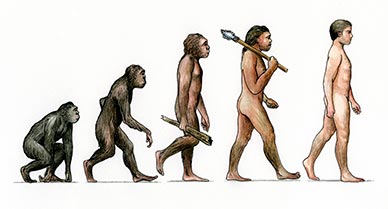
Consequences-of-evolution-388 1. Our cells are weird chimeras
Perhaps a billion years ago, a single-celled organism arose that would ultimately give rise to all of the plants and animals on Earth, including us. This ancestor was the result of a merging: one cell swallowed, imperfectly, another cell. The predator provided the outsides, the nucleus and most of the rest of the chimera. The prey became the mitochondrion, the cellular organ that produces energy. Most of the time, this ancient symbiosis proceeds amicably. But every so often, our mitochondria and their surrounding cells fight. The result is diseases, such as mitochondrial myopathies (a range of muscle diseases) or Leigh’s disease (which affects the central nervous system).

2. Hiccups
The first air-breathing fish and amphibians extracted oxygen using gills when in the water and primitive lungs when on land—and to do so, they had to be able to close the glottis, or entryway to the lungs, when underwater. Importantly, the entryway (or glottis) to the lungs could be closed. When underwater, the animals pushed water past their gills while simultaneously pushing the glottis down. We descendants of these animals were left with vestiges of their history, including the hiccup. In hiccupping, we use ancient muscles to quickly close the glottis while sucking in (albeit air, not water). Hiccups no longer serve a function, but they persist without causing us harm—aside from frustration and occasional embarrassment. One of the reasons it is so difficult to stop hiccupping is that the entire process is controlled by a part of our brain that evolved long before consciousness, and so try as you might, you cannot think hiccups away.

More here.

Posted by S. Abbas Raza at 12:49 PM | Permalink

Comments

Stephen Jay Gould used to argue that the best response to "intelligent design" was to point out the unintelligent ad-hoc design that exists.

Posted by: mcd | Nov 28, 2010 3:16:02 PM

Boy I get annoyed every time I see a chimp to caucasian progression.

Posted by: Carlos | Nov 29, 2010 11:13:01 AM

Post a comment


Subscribe to this blog's feed  

PayAnywhere with iphone credit card swiper

Android Tablet

Bluetooth Headset

2013 New Style Dresses

Compare Car Rental Prices

DHgate.com Wholesale

3QD on Facebook

3QD on Kindle

3QD by Daily Email

Receive all blogposts at the same time every day.

Enter your Email:


Preview 3QD Email

3QD on Twitter

Miscellany

Lijit Search

AddThis Social Bookmark Button

Add to Google

Recent Comments

oroboe on Lennon's "Imagine" and McCartney/Wings' "Band on the Run" overlaid: One way of reuniting (some of) the Beatles

Richard H. Randall on Obama must Make Fighting Climate Change National Project, or Die the death of a thousand Scandals

seth edenbaum on The First New Atheist? Kierkegaard

waqnis on Mortify Our Wolves

nogodrod on KFC smugglers bring buckets of chicken through Gaza tunnels

waqnis on Here’s how to change the world

Fernando on Mortify Our Wolves

seth edenbaum on The case against empathy

Dredd on Mortify Our Wolves

Max on Here’s how to change the world

Rohana on Mortify Our Wolves

Raza Husain on If Only We Had A Leader Like Chavez, Who Solved Real Problems -- Instead Of Debating Fake Ones Like The Deficit

mirel on If Only We Had A Leader Like Chavez, Who Solved Real Problems -- Instead Of Debating Fake Ones Like The Deficit

araldo on Here’s how to change the world

Elatia Harris on Here’s how to change the world

Sundar on Here’s how to change the world

araldo on Here’s how to change the world

prasad on Here’s how to change the world

araldo on Thursday Poem

Raza Husain on Here’s how to change the world

prasad on Here’s how to change the world

Raza Husain on Here’s how to change the world

prasad on Here’s how to change the world

Jim Sanders on the hudson review

Ian Kaplan on Stephen Wolfram: Dropping In on Gottfried Leibniz

Acclaim For 3QD


"I couldn't tear myself away from 3 Quarks Daily, to the point of neglecting my work. Congratulations on this superb site."—Steven Pinker, Johnstone Professor of Psychology, Harvard University.

"I have placed 3 Quarks Daily at the head of my list of web bookmarks."—Richard Dawkins, Charles Simonyi Professor of the Public Understanding of Science at Oxford University.

"Just wanted you to know I’m one of many who reads and enjoys 3 Quarks....almost daily."—David Byrne, musician, former lead-singer of the Talking Heads, artist, intellectual.

Read more here.

The 3QD Prizes

Subscribe to this blog's feed