
For over two decades, the only times we spoke to each other were at infrequent family gatherings. I didn't even call him when my stepsister—his sister—died in a horrible accident. But about six years ago, I was working on a memoir and contacted him to verify some details of the manuscript. He emailed a week later with an apology: “I'm sorry that I didn't get back to you sooner. Everything in my life seems to go slow.” But he had read the whole thing and gave me excellent, detailed feedback. Then he closed with this:
Well, I have so much more to say, but I'm already sore from sitting this long…. I don't know if you know this or not, but I have some seriously painful arthritis in my hips and lower back. So much so, that I had to quit school. I guess I don't know if you even knew that I was going. That's the reason I moved to Tacoma, to try to get a better life… Oh well… Right now I'm in constant pain and I can't walk as well as an average 80 year old!
He had been taking classes to become a dental technician. Years of working in warehouses and construction had taken a serious toll on his body, and he thought this new career would be something he would be able to do. But it was too late—even sitting at a workbench was too painful for him, and he had to drop out, in debt with thousands of dollars in student loans and no way to pay rent.
He wasn't on speaking terms with his father (my stepfather), and his mother had financial problems of her own. A few months later, when I was finally able to visit him (we live on opposite coasts of the country), I saw that he wasn't exaggerating about his condition. Although at the time he was just 39 years old, he stood stooped over, like a man twice his age. He leaned hard on his walking stick, and labored as he shuffled along, periodically wincing in pain.
Although Mark's situation was tragic, it's by no means unusual. Over 13 million Americans receive Federal benefits for a disability that makes them unable to work, and many others are rejected from the program even though they cannot work. The benefit Mark now receives, about $600 per month, is almost enough to cover his essential living expenses, but it can't cover unanticipated surprises like the $400 pair of insoles he had to buy a few months ago to relieve excruciating pain in his feet. Due to byzantine health regulations, if he had had diabetes, the insoles would have been covered, but since his foot pain was caused by arthritis, he had to pay for them himself.
Why isn't more being done about people like Mark, who worked for two decades and paid into a Social Security system that is now letting him down?
I would submit that at least part of the reason is this: Not enough people like me know people like Mark. My friends are professors, administrators, and other professionals who may struggle paying the bills from time to time, but certainly don't face the sort of day-in and day-out fight for the rudiments of survival that Mark does. If you've never sold a car to pay your rent, or had a bullet sail through the wall of your apartment, or had police shut down a meth lab in your building, you probably don't understand the kind of life Mark has had to lead.
When I reconnected with Mark in 2004, he wasn't receiving any Federal disability money. Instead, he had been relying on a state disability program that paid him about $350 per month. Given that his rent was over $600, this clearly wasn't a situation that was going to work for long. An old friend was helping him make up the difference and pay his rent, but then his friend got laid off, and Mark had nowhere to turn. I helped him with rent for many months, and eventually he moved into a small house in Centralia, Washington, which is notable primarily for having the cheapest real estate in the state.
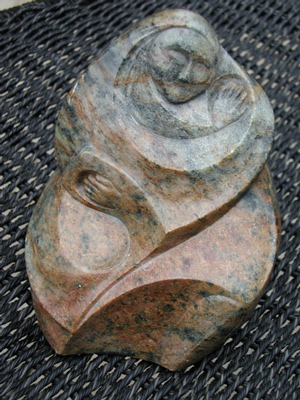
Now I call Mark once a week. We talk about his health, and problems with his house, and other day-to-day things, for sure, but we also talk about politics, and art, and science. These are the most rewarding conversations. Mark may not be traditionally educated, but he has immersed himself in art for decades. More than anything, Mark wants to be an artist. And he is an artist. The photo above is a small stone sculpture he made and gave to me in exchange for a camera.
Mark didn't tell me for years, but it turned out that the camera didn't work. When I found out, I bought him a new digital camera, and he immediately figured out how to make interesting effects by plugging it into his TV and taking pictures of the image the camera produced on the display.
Now he can't create sculptures like this because the laborious grinding and polishing is too hard on his body. He hasn't given up, though. He started taking jewelry-making classes a few years back, and he's gotten quite good. He sees each item he makes as a tiny sculpture, and work on this scale is something he can actually manage. He's never as animated as when he talks about the latest jewelry-making technique he just learned, or some idea he has for a new piece.
You see, despite our superficial differences in education and finances, Mark and I are a lot alike. Each of us lives for our respective arts: I try to write beautiful things, and Mark tries to make beautiful things. For me, it doesn't matter whether I'm writing a science article about the biological domain Archaea or a deeply personal memoir; in each case I strive to make the piece as perfect as it can be. Mark, who spent a lot of his life doing residential building construction, can derive equal satisfaction from creating a beautiful silver pendant or fixing the plumbing in his house. This is something it's taken me a long time to understand. I've offered to hire people for him, to fix up his run-down house so he can focus on his art. He says that even though he's slow and the work can leave him in tremendous physical pain, he'd still rather do it himself. He's tired of taking money from his family and friends, from the government. This is the one way he feels like he can create something of value.
Isn't that fundamentally what all of us want—to do or make worthwhile things?