
“The coming months will see a new world, where global history is redefined.”
– WikiLeaks’ Twitter Feed, November 22nd
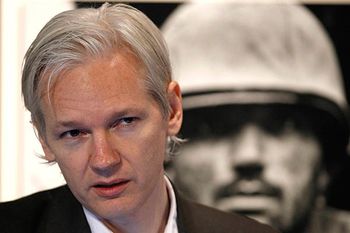
They say that journalists write the first draft of history. A Latin American term for a first draft is a “borrador” or “eraser.” But the line between journalism (or indeed history) and fiction is easily smudged. Statements like those above from WikiLeaks and Assange assume primary sources, like the ones WikiLeaks provide give us the whole truth, or at least possess a unique “truthiness.” But documents like those released in the war diaries and Cablegate do not represent “the truth,” but rather are simply another vantage point from which to try and glimpse it. How much of a first draft do you ever end up keeping?
If we believe “truth” in history is just a sheaf of diplomatic cables, or Pentagon memos – that if we just read them all, then we’ll know – we deny the shifting, impossible project that history is.
That instability is something we are taught to deny. Just as journalists – and fifth graders – are taught the 5 W’s: Who, What, When, Why, and hoW, so too do historians write – and students of history are taught to write, if they are to be considered “serious” – with a sense of inevitability as their guide. This is true at least at the mainstream and lower branches of the academy (I include my own BA here), where it is not so au fait to imagine that, for example, the assassination of Archduke Ferdinand or the accession of Gorbachev were anything more than matches falling into existing stacks of kindling. Teleology is seductive.
There is a way around this, and it is to be found in the counterfactual. Counterfactual histories, like Niall Ferguson’s popular Virtual History, occupy a liminal space at the bookshop. They’re lurking between serious scholarship and popular entertainment. By contrast and, especially, I daresay, in the United Kingdom, serious history for a general audience Must Offer Reasons Why.
It’s nothing new: American academic Richard Ned Lebow writes in his defense of the counterfactual, Forbidden Fruit, that historians since Thucydides have privileged underlying over immediate causes in determining events. But Lebow suggests that (in the West, at least), the First World War, in its unprecedented devastation – physical and psychic – shocked us into a kind of pathological century of avoidance issues.
If we can explain WWI as the (inevitable) result of the rise of the nation state, of the technology that sent Britain and Germany into an arms race, of a thousand and one Big Things Happening Over The Long Term, then we avoid the terrifying prospect that perhaps millions of people wouldn’t have died had Gravilo Princip not killed Archduke Ferdinand one day in Belgrade. Contingent causation is scary, because anything could happen at any time. Hence, Lebow’s odd title – knowledge of that contingency, once tasted, is terrifying, and there is no looking back.
What applies to telling the stories of the past applies to telling the stories of the present. Indeed, if we Americans can explain the disaster that is the last decade of war in the Middle East, blaming long term causes like sectarian violence, tribal patterns of life, or even medium term causes like 9/11 and the “war on terror,” a vast amount of responsibility is easily abnegated. How can any one individual, or any nation, be morally responsible for wrongs committed when the Angel of History is flying hard and fast? And so we – for the most part – keep our story simple: allowing a safe amount of critical reflection, to be sure, but never spending too long before the mirror.
In his most fanciful chapter, Lebow imagines world where Mozart lived a bit longer and thus World War II didn’t occur. In short: a mature oeuvre from Mozart meant Romanticism never happened; with no Romanticism, European reforms of the mid nineteenth century are not nationalist in character; without bellicose, nationalist Europeans – at the state and individual level – no Great War; and obviously, without a Great War, no WWII. At every inflection point, argues Lebow, lies another path not taken, another world potentially in existence. Quantum physicists, hopeless romantics, William James, small children, and, I suspect, many of us, know instinctively that this is true.
It is the political scientists and historians, the international relations theorists and practitioners, the elusive powers that be, who may need reminding. Counterfactuals, says Lebow, have relevance for those fields as well because immersing ourselves in the contingency of the past reminds us that “the future will once again defy prediction.”
Still, Lebow recognizes we’ve got to impose some sort of order, some sort of inevitably imperfect, problematic system or framework or (dreaded!) “lens” on the data around us, simply to get through the day. But the kind of stepping back Lebow proposes is too often neglected: by historians and, to return to the point, by journalists.
The historian as well as the journalist often fails to consider the “unknown unknowns”, the what-ifs, for lack of evidence or time or effort. There’s no reason that considering those other worlds might not lead closer us to the truth. Like the historian, even the best journalist has a hard time finding new routes through a story: even the best journalist is limited by her own contacts, her access, her time. And we – we the public, we the consumers of news – are limited even more: by our access, by our time, by our patience with reading lots of words or watching another 10 minutes of television.
We often don’t know how to take different routes through a story.
WikiLeaks, then, does not offer a rough draft of history. It will not “redefine” history any more than history should be redefined everyday, if it is practiced by thinking persons. What WikiLeaks offers, in a way historically unprecedented (and entirely contingent on technology), is the raw data of history. Causation and contingency are laid before us: a quarter-million instances of American foreign policy being enacted, or 391,832 points of data that future historians will use to write the history of this war in Iraq. And from that raw data: new approaches to the truth, yes, but not truth itself.
Wikileaks presents counterfactuals comprised of “facts”: new routes through – and deeper through – stories we thought we knew (if we were even paying attention.) The data they post remind us that the data we have are incomplete, and always will be incomplete, that every draft we write – from the first to the last, will be a borrador. History will not be, can never be redefined – because it should remain undefinitive and be constantly re-written.