
In today’s world, rarely do raping and pillaging so routinely coincide as in Eastern Congo's conflict. Increased scrutiny from the US Congress and concerned activist networks are highlighting the systematic rape and abuse of Congolese women and girls by marauding security forces, particularly Congo’s National Army. Equally appalling is Congo’s 'conflict minerals' problem—mineral ores extracted from mines controlled by various military factions, fueling the lucrative anarchy that is crippling the East and supporting the communications technology central to our way of life. Greater scrutiny should bring practical solutions, but our policy makers are missing the elephant in the room.
So is it greed, governance or grievance driving this crisis? Eastern Congo is a vast ungoverned space; some of its many armed groups are foreign, others domestic. Yet none treat the civilian population as brutally as President Kabila’s own National Army. A recent Human Rights Watch survey indicates that Congolese soldiers are the primary rapists in the East.
Since President Kabila took office in 2006, all three national security services—police, army, and intelligence—have operated as a winner-take-all bonanza where pedestrian pocket change, rare timber, protected fauna, and high-value minerals are equally expropriated by the services. As under Mobutu, a deliberate lack of oversight and no threat of sanction encourage economic opportunism among security officers, made easier with guns and uniforms with which to intimidate and extort. Would be public service providers but instead instruments of a nimble kleptocracy, state security services have become ‘Public Enemy Number One’, say Congolese here, raping and stealing instead of protecting and serving.
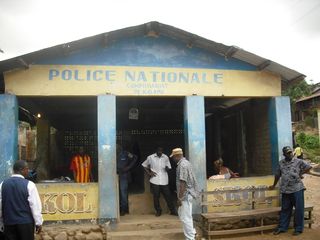
Outside observers, and many Congolese, believe that chronically unpaid soldiers and police must be destitute and thus obliged to extort, steal and beg in order to survive. The reality is that without a convincing deterrent to extraction and extortion—and their fantastic spoils—the security sector will continue to ransom the population into perpetuity. Lucrative extortion rackets and resource extraction are far more attractive than the promise of regular salaries, public accountability and civilian oversight. The current array of foreign-funded security sector reform programs, totaling hundreds of thousands of foreign tax dollars annually, contain only carrots, no sticks.
Against this backdrop it is surprising that Congo’s elite took note of the ‘blood minerals’ label and recent Dodd-Frank Reform Act, which will level US-listed companies with due diligence requirements for sourcing tantalum, tin, tungsten and gold from Congo. In early September, two months after the legislation, President Kabila issued a moratorium on mineral extraction in three eastern provinces, ostensibly to clean up the sector. With presidential elections scheduled for 2011, Kabila’s record and credibility are at stake.
Besides elections, two additional factors may have motivated the recent ban, the first sign of interest in public reform in years. First, the country’s investment climate is horrible. If nothing improves, Congo will sink to the lowest rung among the world’s business environments, where it is currently next-to-last. Second, Congolese voters are sick of their fraudulent political class, and pervasive immunity for a contemptible security sector. Official investigations into the June murder of a prominent human rights defender at the hands of the national police continue to languish in predictable opacity.
But with smuggling now flourishing and tin reaching its highest price in years, the moratorium is clearly window dressing, deliberately ignoring the elephant in the room: Kabila’s outlaw security sector. Why hasn’t Kabila gone after the commanding officers running the mines, and leave legal operators and pilots efforts at clean mining alone? Most likely, he fears upsetting the apple cart and directly tackling his criminalized security sector—these are hardened thugs who could very easily take his life, just as they took his father’s in 2001.
It is no coincidence that Kabila and international donors are both ignoring Congo’s primary driver of chaos, its security sector. But pressuring global tech companies, as recent US legislation seeks to do, or penalizing legitimate mining efforts in country as with Kabila’s mining ban, are both missing the point and, worse, risk a serious misstep. Recall the ill-fated ‘Blood Oil’ campaign of the late 1990s in which western oil companies, named and shamed by activists into quitting the country, sold their concessions to Malaysians and Chinese firms. The moral victory was short-lived as the new operators proved entirely deaf to any reform agenda.

Yet we know from the Kimberley Process and the campaign against West Africa’s ‘Blood Diamonds’ that naming and shaming combined with looming profit loss can motivate improved resource management in fragile states. Under international pressure to manage its natural wealth, Congo will either do the right thing or offer its concessions to less scrupulous operators, with no interest in transparency or rule of law. Unlike diamonds, the world needs Congo’s minerals, and as such there will always be a market.
The real problem is not the riches in Congo’s soil, or its lack of a justice system to try rapists after the fact. Prospects for better natural resource management and a definitive end to the rape epidemic hang entirely on a single public institution—domestic security forces. Equally passive as the international community, President Kabila is either protecting them, hoping their license to pillage and rape will translate into support for him, or simply fears their wrath should he try to change their ways.
Taming Congo’s security forces will require sustained, well-coordinated reform efforts, funded by the international community and enforced by Kabila’s senior cadres. Neither the international community nor the Congolese government has yet to demonstrate a credible commitment to either of these necessary conditions for ending Congo’s crisis.