
September 13, 2010
War and the American Republic
By Namit Arora
Shortly before the appalling ‘Shock and Awe’ attack on Iraq, and for years after, public support for the war was high in the U.S.[1] It was evident in the high approval ratings for Bush, who had hoped that the war would turn him into a great president and American hero. As if taking a cue from the Senate, the mainstream media mostly stood united. Few even from the universities came out to protest. A great many Americans silently relished their mounting excitement.
The opening night’s attack, coolly dubbed a ‘campaign’, was broadcast live into American homes and even looked like a massively coordinated fireworks show. It would lead to the deaths of hundreds of thousands of Iraqi civilians, create millions of refugees, and cost the U.S. taxpayer over two trillion dollars. Many American politicians and commentators who had supported Bush that night, later criticized him on the grounds that they didn’t support this kind of war, one so badly executed. Bush should have sent in more troops and supplies, and planned ‘to win the peace’. In other words, they had supported an operationally smarter war.
It is not enough to argue that Americans were lied to about Saddam’s nukes and links to al-Qaeda. With the same ‘evidence’, why did most Americans support the war—even reelecting Bush in 2004—when much of the world strongly opposed it?[2] Why is it that, as the historian Tony Judt put it, ‘the United States today is the only advanced democracy where public figures glorify and exalt the military’, where politicians ‘surround themselves with the symbols and trappings of armed prowess’? War is always spoken of as an option; to be averse to it is taken as a sign of weakness. Indeed, why are the Americans so much more jingoistic today than, say, the Europeans?
I offer three reasons that I believe, taken together, provide an answer: (a) The demographics of the American military (b) Historical inexperience of war and the world, and (c) The impetus from corporate capitalism. These are not original lines of investigation by any means. My modest goal in this short essay is to develop them into my own synthesis, and hopefully provide food for further thought.
The Demographics of the American Military
The idea of conscription, or mandatory service in the military, is rooted in a sense of civic virtue and community obligation. It is at least as old as the Athenian polis, which required military service from all citizens. But most nations today have a volunteer military. Serving in it is now a specialized profession like any other—only some men and women pursue it, the vast majority have nothing to do with it.
The volunteer model works well when citizens enjoy largely equal opportunities. People then follow their interests and temperaments to pursue the jobs they want. If you’re moved enough by patriotism and civic virtue, go enlist. Everyone is satisfied, including the utilitarians, the libertarians, and the liberals. But what if a society has huge disparities in opportunity and wealth? Doesn’t the volunteer military cease to be all that voluntary if many are led to join it out of poverty, lack of choices, and disadvantages of class? [3]
The composition of most militaries today, including the U.S., suggests that this is indeed the case. The economic and political elites tend not to serve in the military, but very much dictate its priorities. They increasingly have no skin in the game, and a diminishing sense of its human cost. 450 of 750 students in Princeton's graduating class of 1956 joined the military. Only 9 of 1108 graduates did so in 2006. This trend holds across other elite universities too, and has only accelerated since 1973 when Congress abolished the draft and made it an all-voluntary army. Only 2% of the members of congress have an offspring that has served in the military.[4]

According to Michael Massing’s 2008 report, The Volunteer Army: Who Fights and Why?, military recruitment in America increasingly revolves around a roster of basic material benefits: cash bonuses, health insurance, college tuition, etc.[5] Those least able to afford these—and their ranks have swollen in recent decades—are disproportionately drawn to the military. Doesn’t this begin to drift towards a mercenary model (think Blackwater), where the idea of community obligation is undermined? Doesn’t this lower the threshold for the elites to choose war? Thucydides clearly cautioned against such trends: ‘The nation that makes a great distinction between its scholars and its warriors will have its thinking done by cowards and its fighting done by fools.’
Historical Inexperience of War and the World
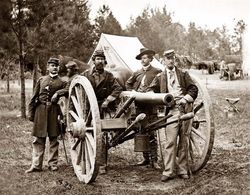
The last real war on the U.S. mainland was the Civil War, 150 years ago. Not since then has the U.S. experienced war at home. It is simply not in living memory. No carpet bombing of Boston, no bunker busters in Chicago, no nighttime air raid sirens in St. Louis, no cruise missiles raining on DC landmarks, no helicopter gunships over LA, no bombed out Nashville, no sniper fire in San Francisco, no land mines in the Virginia countryside, no hospitals choked with mutilated bodies, no hideously burnt out corpses in the streets, no mass burials, no wailing widows and orphans, no blown up highways, bridges, airports, or seaports, no knocked out food, medical, power, or water supplies. As Judt wrote,
‘Americans, perhaps alone in the world, experienced the twentieth century in a far more positive light. The US was not invaded. It did not lose vast numbers of citizens, or huge swathes of territory, as a result of occupation or dismemberment. Although humiliated in distant neocolonial wars (in Vietnam and now in Iraq), the US has never suffered the full consequences of defeat. Despite their ambivalence toward its recent undertakings, most Americans still feel that the wars their country has fought were mostly "good wars." The US was greatly enriched by its role in the two world wars and by their outcome ... And compared with other major twentieth-century combatants, the US lost relatively few soldiers in battle and suffered hardly any civilian casualties...
‘Indeed, the complacent neoconservative claim that war and conflict are things Americans understand—in contrast to naive Europeans with their pacifistic fantasies—seems to me exactly wrong: it is Europeans (along with Asians and Africans) who understand war all too well. Most Americans have been fortunate enough to live in blissful ignorance of its true significance.’[6]
Europeans are also shrewder than Americans about non-Western societies—a byproduct of Europe’s geography, colonial empires, and in some ways, their salad-bowl model of immigration (vs. the melting pot, more conducive to assimilation). Their scholars, administrators, and civilians once spent years abroad, returning with knowledge that filtered into public awareness. They continue traveling to and otherwise engaging with former colonies. One might say that the world has already paid the price for educating the Europeans. And whether or not they like others, Europeans have a keener sense of others’ cultural complexities, and of this Kantian insight: ‘Out of the crooked timber of humanity, no straight thing was ever made.’ Keener than the Americans that is, whose relative naivete, insularity, and evangelical instincts (religious, political, and economic) only make them more vulnerable to demagogues who cry wolf about threats from foreign cultures.
The Impetus from Corporate Capitalism
In a society of ‘AWOL’ upper classes, does the free market, the kind led by modern corporations, create its own impetus for war? How does America’s elite class—whose growing share of wealth depends on the relentless growth of corporations—safeguard its economic interests? Not usually through boardroom conspiracies, which surely happen, but by staying true to its dominant class character, like an animal who cannot help being any other way, whose one authentic instinct is to sustain and engorge itself. To that end, it uses every tool at its disposal.
One such tool is the news media, which has changed drastically in recent decades.[7] Most news sources are now owned by a handful of corporations. Unlike in most professions, free market economics has been disastrous for journalism. What it tends to produce is news that sells like any consumable, made palatable for the least demanding among us. The media, in all its freedom, builds and affirms myths about American greatness and benevolence. Dissenting analysis and uncomfortable truths tend not to be rewarded, sensational exposés and feel-good stories do. This eventually spirals into frivolity and conformism, the latter best evidenced in the U.S. right before the Iraq war.[8]
Many like Chomsky have reminded us for decades that the corporate media largely serves the agendas and interests of dominant groups. It tends to employ company men and women who uphold their bosses’ values and viewpoints—not from coercion but consent, in exchange for some of the spoils. It promotes a libertarian gospel of the free market, with minimal regulation and taxation—a system that increases disparity and reduces the economic well-being of most people. It wouldn’t survive if most people didn’t also buy into the libertarian ideal of the autonomous individual, heroically forging his own economic destiny. (No wonder rags-to-riches stories are so admired.) This oddly persistent dogma—reinforced by the corporate control of films, TV, and books—helps lubricate the free market’s ravishing of social democracy and redistributive justice. It has managed to even turn Scandinavian-style ‘socialism’ into a filthy word fit to taint adversaries with. A classic case of the Foucauldian nexus of knowledge and power.
U.S. corporations now make almost half of their money from the rest of the world. They also account for two-thirds of the international arms shipments, mostly to the developing world, many to regimes guilty of major ongoing human rights abuses.[9] As global conflicts over markets and resources intensify, the natural interest of the economic elites is a world safe for corporations. Towards this end, they hire lobbyists, grease political campaigns, or enlist the help of the military.[10] U.S. garrisons now occupy 700+ bases in 120 countries.[11] The trick that the elites—including political elites who also dream of empire or need diversions from domestic failings—instinctively practice is this: sensing a threat to their own economic interests abroad, they whip up fear and hysteria about threats to the ‘American way of life’ from evil others.
Of course, to build consent for openly hostile action (as opposed to covertly hostile action that is de rigueur), it is necessary to cultivate the illusion of common interest, grossly magnify the threat to national security, and dehumanize the enemy. Alongside, it is important to glorify patriotism and military service to counter dissent, continue recruitment, and ease collective guilt over the sacrifice of the few. The goal is to boost the ranks of fearful, flag-waving patriots to whom no cost of war is too high for a dubious promise of security.
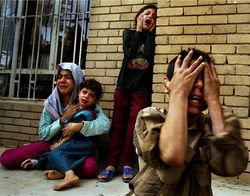
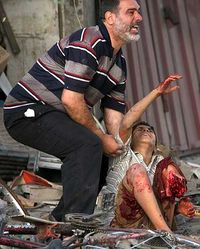
And this is exactly what the corporate media artfully enables. War often boosts the economy (especially via the military-industrial complex) and is usually good for the media. About the only thing that might expose the U.S. public to the realities of war—showing the mutilated bodies of soldiers and civilians, shattered families, disabled vets, or the experiences of people on the ground—is conveniently classified, censored, ignored, or made taboo on the pretext of respecting privacy or excessive violence.[12] Can we imagine corporate media anchors calling the invasion of Iraq a crime against humanity? Or asking why so many Americans became Bush’s willing executioners? Or demanding a formal apology and reparations to Iraq for a war based on lies? The business of news has no room for those who might be led to wonder on which side of the gate roam the barbarians.
__________________________
Notes:
- Pew Research Center, Public Attitudes Toward the War in Iraq: 2003-2008.
- Almost all of the largest protests took place outside the U.S. (source1, source2).
- For background, see Jacob Weisberg, Rough Draft, Slate, Mar 22, 2006, and Kathy Gill, The Military Draft, About.com.
- Michael J. Sandel, Justice: What's the Right Thing to Do? Farrar, Straus and Giroux, NY, 2009, pp. 83.
- Michael Massing, The Volunteer Army: Who Fights and Why?, NY Review of Books, Apr 3, 2008.
- Tony Judt, What Have We Learned, If Anything?, NY Review of Books, May 1, 2008.
- John S. Carroll, Last Call At The ASNE Saloon, American Society of Newspaper Editors Convention, April 25, 2006.
- Chris Lombardi interviews departing Newsweek editor Evan Thomas, Wolf in the Heart, Guernica, September 2010.
- Asian Tribune article on a New America Foundation report. Also see, Merchant of Weapons, my short blog piece.
- For a good look at corporate lobbying and campaign contributions, spend some time on OpenSecrets.org.
- From Sourcewatch.org.
- Dave Lindorff, Censorship American Style: Hide the U.S. War Dead from the American People, The Public Record, Sep 10, 2009.
Images:
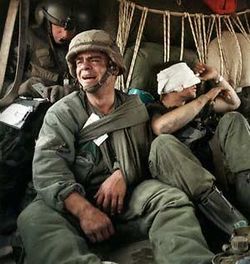
- Crying American soldier (copyright unknown [to the author, that is. :) See comment by Nancy below]).
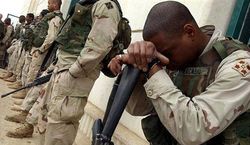
- American soldiers (source).
- An online ad.
- Civil War Artillery (source).
- Iraqi woman and children (source).
- A wounded Iraqi civilian (source).
More writing by Namit Arora?
__________________________
Posted by Namit Arora at 12:15 AM | Permalink


Comments
more iraq photos here, taken by a solder
http://xahlee.org/Periodic_dosage_dir/t2/iraq_pixra.html
Posted by: Xah Lee | Sep 13, 2010 8:10:30 AM
Nothing to add. Just wanted to say thanks for this clear overview of three of what will surely be seen as the failures of 20th and 21st century American democracy. I guess point two is more a historical circumstance than a fault, but the failure of America to learn from and empathize with the experience of others is the little sister of modern historical inexperience.
Posted by: Cyrus Hall | Sep 13, 2010 8:56:21 AM
No one I have read, or spoken to, or heard from, can propose a way to bring America back to sentient humanity.
But more of those pictures might be a start.
Posted by: Alice de Tocqueville | Sep 13, 2010 10:49:46 AM
I think government control by corporations is the problem driving this perpetual mess of blood, gore, guts and suffering. I don't know how citizens can resume control of government, taking it back from government of, for, by corporations. Not by voting for Murray Hill Inc. for Congress. How are wage slaves supposed to muster the courage to do anything about this?
Randolph Bourne
John Perkins
Excellent article, Namit, despite the fact that the subject is very difficult to read about without getting sick.
Posted by: Louise Gordon | Sep 13, 2010 5:44:40 PM
Well, Alice, the linked site has a further link to this:
http://xahlee.org/Periodic_dosage_dir/leaked_video_US_helicopter_killing.html
...which pretty much says it all. At the very least, we should have to watch things like this.
Posted by: Joe | Sep 13, 2010 7:18:25 PM
Let's see. First we see the bald assertion that Shock and Awe was "appalling." Didn't appall me. But I suppose it might have appalled Sadaam Hussein. We'll give that a pass, but with a suspicion that this writer has an agenda.
Reading along, we run into this statement: "It was evident in the high approval ratings for Bush, who had hoped that the war would turn him into a great president and American hero."
On what basis of fact does the author make this assertion? This is nothing more than speculation.
And then a little later, we see that canard that Bush lied about the nukes, when in point of fact the worst that can be said is that Saddam Hussein lied (or was himself misled by his own people who were afraid to tell him that he actually had no working nuke program) and the Western intelligence networks bought into it.
Given this kind of speculation and lack of attention to fact, why should anyone pay any attention to anything this author says? Maybe she's right, maybe she's wrong, but one thing she is not is reliable.
Posted by: punitius | Sep 13, 2010 7:34:41 PM
Joe, I completely agree, and I suggested that over at "My Nine Years As a Middle Eastern American."
I also suggested this to an activist group years ago, but the objection was raised that if the pictures were out in public they would frighten children ( I wanted to put glossy prints in my car windows). That stopped me. I should do it now. Every single picture I can find.
Although I don't relish the idea of giving my own grandchildren nightmares, or any other children, I do relish the thought of parents having to explain them. (Our tax dollars at work!)
(No, sweety, instead funding health care, or your education, Daddy and I decided to get you THIS!)
Any other ideas for getting them where people will see them? Let's see...
sending them to congresspersons who vote for war funding?
sending them to Obama?
Posted by: Alice de Tocqueville | Sep 13, 2010 7:45:14 PM
This article should be on billboards everyhere. Incidentally I have often thought that war documentary and soundtracks should be authentic, not edited. And if the entertainment media and news were able to convey the smells and temperatures of war to the viewer, we may all be less gung-ho about it.
Posted by: Judith | Sep 14, 2010 7:22:43 AM
Educated citizens performing their voluntary military service worked to moderate the career soldiers’ predisposition towards global adventurism. Professional militaries thrive on continuous, low-level conflict where resources and promotions are national defense priorities.
“[I]f you want to suppress domestic questioning of foreign military adventures, then eliminate the draft, create an all-volunteer force, reduce domestic taxes, and maintain a false prosperity based on foreign borrowing.” Geoffrey Stone, Perilous Times: Free Speech in Wartime from the Sedition Act of 1798 to the War on Terrorism
“The U.S. political system has been carefully crafted to ensure that no one who questions the natural goodness of the military-industrial-corporate power structure will be allowed through the portals of power.” Arundhati Roy, San Francisco, 2004
Posted by: BobbyV | Sep 14, 2010 7:38:15 AM
Was that 'puntius' Pilate? Ah yes, I knew him well.
Posted by: James F Traynor | Sep 14, 2010 6:37:50 PM
"Crying Soldier" is by ©2000 photographer David C. Turnley
US Sergeant Ken Kozakiewicz cries as he learns that the body bag, next to him in the medical evacuation helicopter, contains the body of his friend killed by "friendly fire."
Iraq/Kuwait, 1991
http://pdngallery.com/20years/photojournalism/21_david_turnley.html
Posted by: Nancy | Sep 15, 2010 10:45:00 PM
Another wonderful post by the always-brilliant Mr Arora. I have been thinking a lot about Alice's suggestion above that maybe part of the reason why Americans are unable to feel compassion and sympathy about our part in this is that it is all being swept under the rug-- I was a small child during Vietnam but I seem to recall there were more images on TV. Maybe I am not remembering correctly though... but one would never know we are fighting a war by the way trhings feel here or by watching TV even...
Posted by: Peony | Sep 16, 2010 1:37:53 PM
Peony, you're right. The press was 'forbidden' by Bush to show even flag-draped coffins of US soldiers returning from Iraq. I never did get by what authority he did that, but the press went along with it, just as they went along with 'embedding', that is, being managed by the military, since Bush, Sr.'s Iraq war.
We used to have actual journalists on TV during the Vietnam, and many say that the images on display night after night were a major factor in turning people against that war, hence both the Bushes' restrictions. That and the US body count.
Posted by: Alice de Tocqueville | Sep 17, 2010 1:11:22 AM
Alice, thank you. This has been on my mind. I have been overseas about 20 years and returning home, I have been surprised honestly by the total lack of conversation about the war and I have wondered about how nothing is on TV and I recall that with Vietnam it WAS different and people at least saw what was being done in their name and with their tax dollars. Put it this way, returning to this particular neighborhood in California--talking to friends, turning on the TV--one would not know the country is engaged in war....
Posted by: Peony | Sep 17, 2010 7:49:02 PM
Thank you for confirming two of my long term suspicions; firstly, that there is no such thing as a good war, secondly that the survival of the BBC is vital to British democracy.
I also wonder if some of these conclusions might not map on to the UK; we were empire builders, we are the largest arms producers in Europe (BAEsystems, Qinetiq etc.), and we have not felt the full horrors of war since 1066 (yes we were bombed, but never saw half the atrocities the French, Dutch and Belgians endured). Perhaps thus we are the most jingoistic nation in the EU?
Posted by: QuakerOats | Sep 30, 2010 11:27:54 AM
Post a comment