
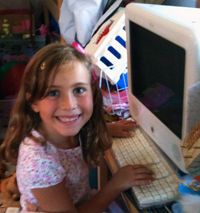
Over the last 10 months or so, I’ve ruminated in this blog on two major themes that seem, at first glance, only casually to have anything do with each other: educating children for 21st century success and children’s use of social media and technology. As it happens, I think that these two topics can and should be thoroughly integrated. We can debate the value of test taking and how else students’ progress might be evaluated, discuss the virtues of rote memorization and heavily invasive teaching methods, where most of the communication is a one-way transfer (or attempt to transfer) knowledge from the teacher to the students, but I would assume there can be little argument when I say that children, everyone really, learn best when the thing they are learning about interests them, or the teaching method is enjoyable. And there is no doubt that most children find technology enjoyable. Whether computers, cellphones or video games, these clearly engage children (and adults). So why don’t we utilize technology to better effect in education?
Most schools spends a lot of time trying to stuff facts into children’s heads and then repeatedly test to see how quickly and efficiently those facts can then be pulled out again. But we have ample evidence everyday that this is not the way children really learn; they’re curious, they explore, they experiment, they learn from each other. So why do we expend so much time, money and energy trying to educate them in these other, counterintuitive ways?
Prof. Sugata Mitra is the Professor of Educational Technology at the School of Education, Communication and Language Sciences at Newcastle University in the UK. He started the “Hole in the Wall” project in 1999. As part of this experiment, he put a computer in a kiosk in the wall in Indian slums where no English was spoken. Children in the slum were allowed to access the computer freely. Dr Mitra’s thesis is “The acquisition of basic computing skills by any set of children can be achieved through incidental learning provided the learners are given access to a suitable computing facility, with entertaining and motivating content and some minimal (human) guidance.” The surprising results were that the children picked up computer skills on their own, and then used those skills to acquire other knowledge through the computer and the internet. The Hole in the Wall experiment is fully explained in this wonderful TED talk given by Dr Mitra. I believe that what the Hole in the Wall experiment really shows is that children, allowed to follow their natural curiosity and enthusiasms and given provocative problems to solve, will learn. Adding technology into this equation provides problem solving equipment that children are comfortable with and find fun.
As it happens, there is some interesting experimental education taking place which seeks, in one form or another, to incorporate technology into education in fun and innovative ways. As this New York Times piece on the use of video games in the classroom in a New York City public school says, “What if teachers gave up the vestiges of their educational past, threw away the worksheets, burned the canon and reconfigured the foundation upon which a century of learning has been built? What if we blurred the lines between academic subjects and re-imagined the typical American classroom so that, at least in theory, it came to resemble a typical American living room or a child’s bedroom or even a child’s pocket, circa 2010 — if, in other words, the slipstream of broadband and always-on technology that fuels our world became the source and organizing principle of our children’s learning? What if, instead of seeing school the way we’ve known it, we saw it for what our children dreamed it might be: a big, delicious video game?”
Another article explains how a summer camp integrated cellphones into science education; the camp was part of a project by the New Youth City Learning Network, “which takes as a premise that most children already exist in a digital world…children used Nexus One smartphones, and with the help of probes that zipped bluetooth signals to the phones, the children tested the air for carbon dioxide, particulate matter and noise pollution.”
Why should education be about sitting in silence in straight lines behind desks while an adult spouts facts and figures? Does anyone learn best this way? I know I don’t. When I think about the learning experiences in my life that have been the most fruitful, the ones I still remember 20 years on (and some), they are never ones where a string of facts were drilled into me. I think we do all instinctively know this, at some level – we were all students once after all. But somehow, we’ve managed to forget this and instead kid ourselves that the way that most of the children in this country are taught is the best way, the most effective way, the way most likely to serve these children as they mature into 21st Century adults.
A constant refrain when the topic of this kind of progressive education comes up is, “but how do you assess progress?” There’s no doubt that the easiest way to teach and assess is the stuffing and regurgitating of facts and standardized tests work very well, if this is the only goal. But as Susan Engel, a senior lecturer in psychology and the director of the teaching program at Williams College says in a recent Op-Ed piece, “There is also scant evidence that these tests encourage teachers to become better at helping individual children; in fact, some studies show that the tests protect bad teachers by hiding their lack of skill behind narrow goals and rigid scripts. There are hardly any data to suggest that punishing schools with low test scores and rewarding schools with high ones improves anything.” According to the Washington Post, it seems that even paying teachers a bonus to improve test scores produces “no discernible difference in academic performance”.
Dr Engel suggests that a revised method of assessments “would have to measure students’ thinking skills, not whether they can select a right answer from preset options.” She discuss other possible methods of assessment whereby, “testing could be returned to its rightful place as one tool among many for improving schools, rather than serving as a weapon that degrades the experience for teachers and students alike.” She advocates coming up with assessments that “truly measure the qualities of well-educated children: the ability to understand what they read; an interest in using books to gain knowledge; the capacity to know when a problem calls for mathematics and quantification; the agility to move from concrete examples to abstract principles and back again; the ability to think about a situation in several different ways; and a dynamic working knowledge of the society in which they live.”
There clearly are other methods of educating and assessing our children. There is both academic research and real-world examples to support teaching based on the way children actually best absorb knowledge; exploiting their natural curiosity while making learning fun. It is possible to integrate the technology children already know and enjoy using into the classroom in innovative ways, while assessing them in ways that measures whether they are actually getting a good, 21st Century education. There are so many voices now, in the media, in academia, in industry shouting at the top of their voices that most children in this country are not being educated or assessed for 21st Century success. Why aren’t we listening?