
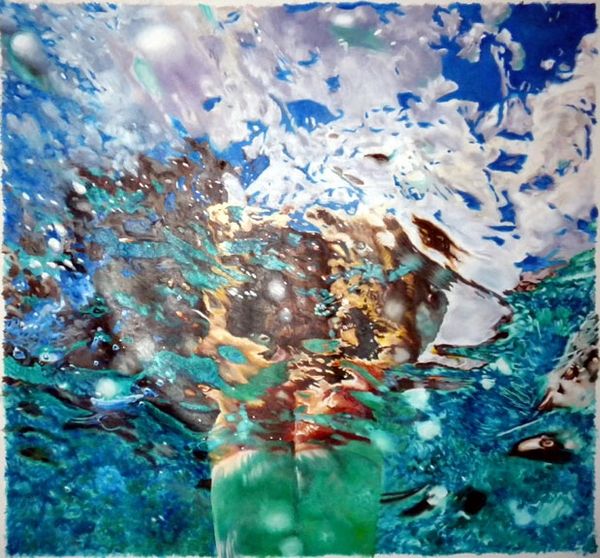
Top, And the vacuum cleaner swallows its bag. Oil on canvas, 72″ x 84″, 2010
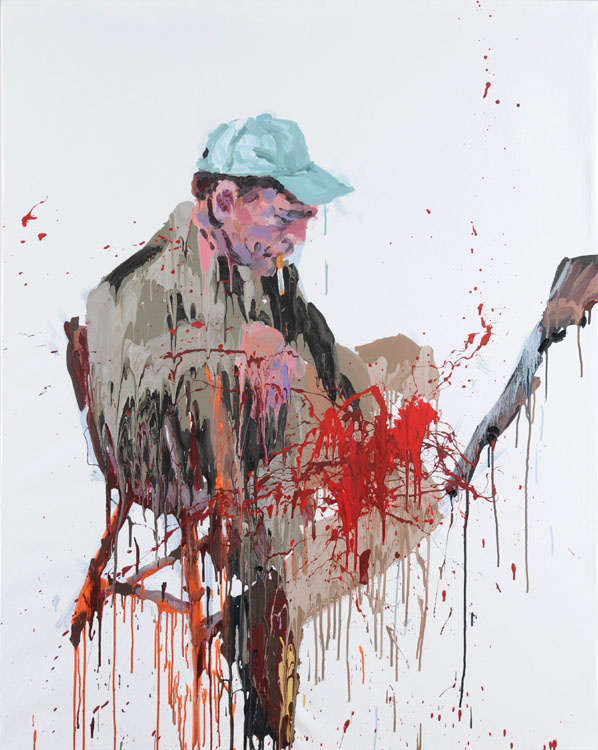
Bottom, Shotgun Accident. Oil on canvas, 62″ x 50″, 2009
All images courtesy of Kate Vrijmoet
Elatia Harris
Kate Vrijmoet, the Seattle-based painter and conceptual artist, is having a year that Carlos Castaneda might recognize as a slice of that famous non-ordinary reality he and various sorcerers, actual and imagined, mapped in the 1960s. Nothing to do with mushrooms – Vrijmoet is the mother of three – but if non-ordinary reality is that intensely present zone only a slight shift away from one's usual life, then Vrijmoet, in her career trajectory, has been over there since about last winter.
How did the transition happen? When an artist comes into her own, it may have an aura of inevitability, but getting internationally recognized for remarkable work is, as every artist understands, not inevitable. 3QD readers know that I Iike to interview people at pivotal points in their professional lives — a writer with an acclaimed new book out, an instrument maker mastering the secrets of the great violins, a chef launching a line of fantastically authoritative blended spices. But addressing this year of Kate Vrijmoet's life in art is like trying to anatomize a whirlwind. Better to start with the supercell thunderstorns that fed into it. And thereby hangs a tale.
50 Paintings in 50 Days
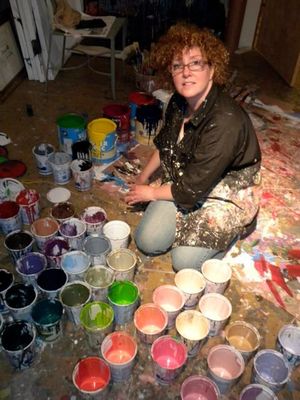
Since childhood, Vrijmoet has committed time each day to figure drawing, in the same spirit that Ellsworth Kelly and Mondrian drew nature studies: whatever your finished work looks like, the hand-eye coordination you have maintained, and the habit of inquiry, will serve you, even invisibly. For artists who draw from life for decades, there is also the long engagement with a model, a form of intimacy it's possible to write very confusingly about. Does observation of a human being as a mass in space revealed by light lead to penetration of that individual's deeper nature? Think of looking at a person — at everything about them as it relates to every other thing — for as long as it might take to draw them, and decide if what you know from doing that is data-gathering or closer to exposure to certain mysteries.
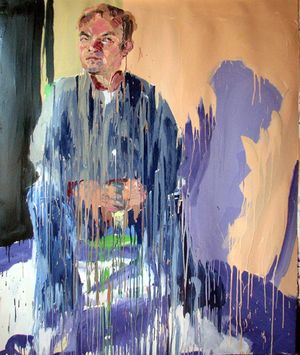
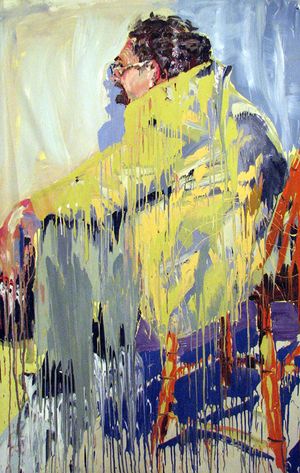
L., Alex, Benjamin Moore house paint on paper, 60″ x 51″, 2008
R., Tom Rose. Benjamin Moore house paint on paper, 64″ x 42″, 2008
Two Series in Seeming Opposition
After 50 Paintings in 50 Days, there was a lot of furious energy in Vrijmoet's studio — I could almost visualize it as still-dripping paint waiting to be captured. As she rarely works on one project at a time, I was not surprised to drop in on her blog to see two series in development — The Non-ordinary Reality Series, and the Accident Series. One painting from each is pictured under the title above, also below, and they will be pictured together throughout the post. Just as they arose together, they imply one another, as divergent as they seem. To quote from a catalog essay (“Painting Non-ordinary Reality: A Long Look at What You Can't See,” Kate Vrijmoet: Essential Gestures, Center on Contemporary Art, 2010) that I wrote,
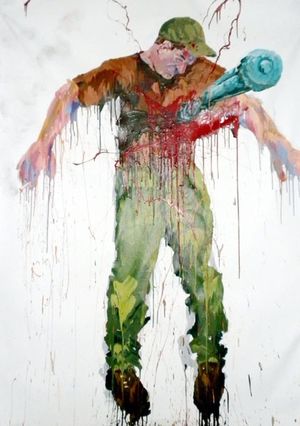
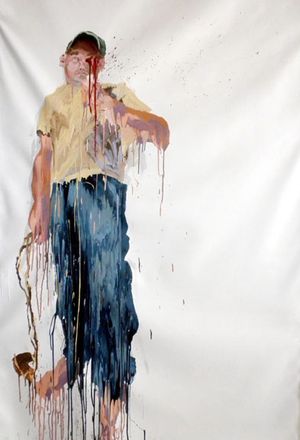
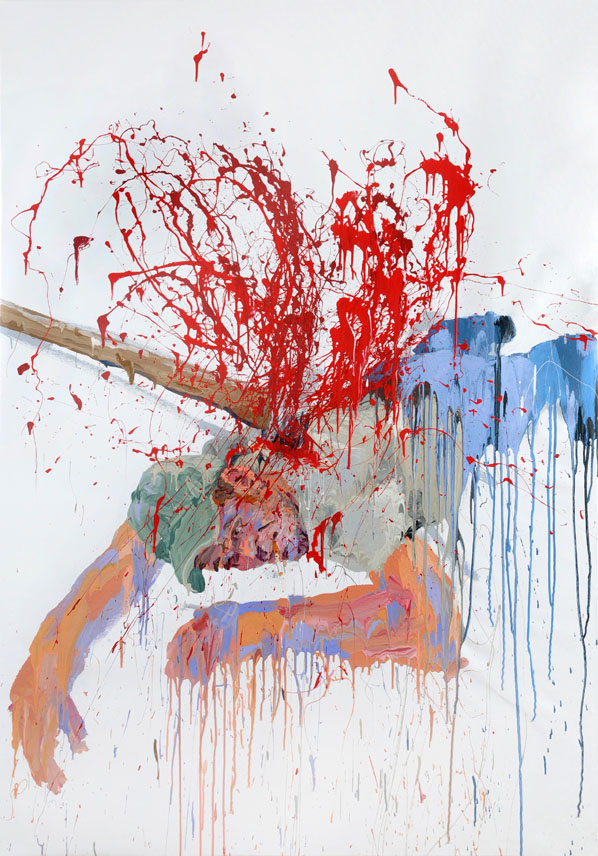
Any single image from the Accident Series — Chainsaw Accident, for instance — will freeze you where you stand. Motionlessly, you will check yourself for parts and think: Oh, that's the thing, the thing that happened to me, even if no one sees it. The water paintings (Non-ordinary Reality), on the other hand, will dislocate you — you are pulled, plunged and buoyed, seeing up and through and down.
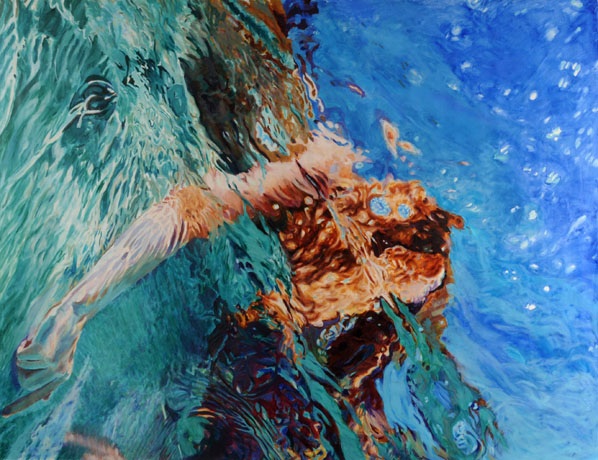
Top, I cannot of course come back. Not to this. Never. Oil on canvas, 72″ x 84″, 2009
Bottom L., Bazooka Accident. Oil on canvas, 74 ” x 50″, 2010
Bottom R. Slingshot Accident. Oil on canvas, 68″ x 50″, 2010
The move cross-country to Seattle barely disrupted these series, which are still not quite complete. Once established in an extremely small studio space in Seattle, Vrijmoet and her enormous paintings came to the attention of Joseph C. Roberts, an entrepreneur, poetry publisher (Copper Canyon Press), and igniter of the arts scene in the Pacific Northwest. Roberts' criteria for being interested in an artist's work include whether he feels “particularly disturbed” by that work. Vrijmoet's qualified. “Kate has a playfully twisted mind that is expressed on her canvases. Not just occasional aberrations but whole bodies of work,” Roberts wrote to me. “She's a bloody rising star.”
A show of both series was mounted last February at the Center on Contemporary Art (CoCA), a multi-site art center that takes Seattle artists and art lovers in new directions. As Ray C. Freeman III, an architect who is the president of the board of CoCA, tells it, “CoCA has long rejected the traditional model in which we would maintain a stable of artists in a gallery setting. We question definitions, roles, and by extension, the idea of what makes something art. Contemporary art is exploratory, experimental. CoCA is not here to enforce the status quo, but to expand the very field of inquiry, to find new not only new art and artists, but new art forms, and to find it in new places.” CoCA was the presenting organization which gave James Turrell one of his first major exhibitions, and they are instinctively repelled there by what they term the “predictable” cutting edge.
This month, Kate Vrijmoet: Essential Gestures, Part II inaugurates CoCA's newest location in Pioneer Square. In the interval between the two shows, Vrijmoet has won five important awards, including Third Prize in the Ecuador Biennale, and seen the publication of a 50-page catalog about her work.
A major solo show in the new and ambitious Luis A. Naranjo Noboa (LANN) Museum in Guayaquil, Ecuador, is in the works for next year. Pablo Martinez Rojas, LANN Museum director and creator of the Ecuador Biennale, differentiates his museum from others in South America by emphasizing that the LANN is “open to all kinds of tendencies and creativity,” including photography, poetry, music and installations. “Kate Vrijmoet's work,” he writes, “together with 64 works from 25 countries in Europe, Asia and the Americas, gave the Alvaro Noboa Biennial, and the LANN Museum, international recognition.”
Discerning writers are responding well to the painterly brew, too, the juxtaposition of swimming pools and great devastation. “They shiver with trauma,” Daniel Kany, an art historian and art journalist in Maine writes of Vrijmoet's paintings. According to Michael Upchurch, reviewing for The Seattle Times Vrijmoet's CoCA show last winter, “Artwork that's this accomplished, energetic, strange and alive is a rarity. Her images jolt you with the force of a Sylvia Plath poem or a Stravinskian percussion blast.”
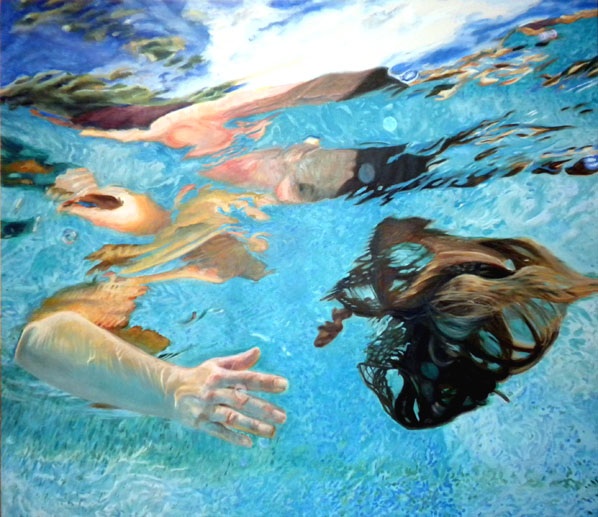
Top, Forgetting and Remembering in the Same Instant. Oil on canvas, 70″ x 80″, 2009
Bottom, Axe Accident. Benjamin Moore latex house paint on canvas, 66.5″ x 49.5″
In a series of conversations ranging from Gilles Deleuze to Andean painting to the poetry of Vicente Huidobro to the commoditization of the experiential aspect of art to the idea of a silent scream, Kate Vrijmoet and I discussed recent developments in her painting and her career.
ELATIA HARRIS: Kate, the titles of your Non-ordinary Reality paintings come from poetry. What have you been reading specifically?
KATE VRIJMOET: For these paintings, I was particularly referencing Ann Sexton, Adrienne Rich and Jorie Graham. After going to Ecuador, I started to want to read South American poetry — Vicente Huidobro especially, although he was Chilean, nor Ecuadorian. You can read Altazor in Spanish without knowing a word of the language, and recognize it as great poetry. I'm using one of his lines as a title of a painting I'm working on now.
EH: Werner Herzog recently remarked that if you didn't “Read, read, read,” you'd never be a great film maker. I wondered how many artists of any kind would take that to heart.
KV: Well, I do. Daniel Kany pointed me to a work of the mid-1700s by Edmund Burke, On the Sublime. “Astonishment,” Burke wrote, “is that state of the soul, in which all its motions are suspended, with some degree of horror.” That captures exactly what I mean in my Accident Series. I literally found what I was doing through reading that. Reading Jean-Luc Nancy has been tremendously fruitful for me. He gives the idea of freedom the largest possible meaning, something so much more vast than any notion of rights. Artists need to think about these things. Anyway, I need to, as an artist.
EH: People looking at them together — as readers of this post will do — often think the Accident paintings are are pretty horrifying while the water paintings — the Non-ordinary Reality series — are swimming pool idylls. I see them as two sides of the same coin, as intimately related as that. I've read that you began the Accident Series to amuse yourself…
KV: It's true, I did.
EH: And you've been kidded about that.
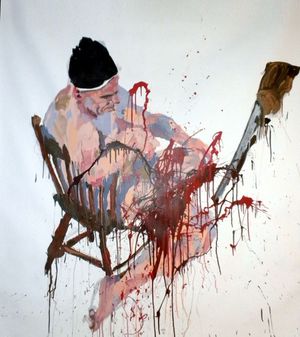
KV: Yes. I have two models for the Accident Series, and my response to that was to start painting my model Greg , naked. Ultimately I want the naked accidents to be shown with the accidents in clothes. The paintings are about moments of trauma that alter the perception of time, and make it dream-like. During trauma, we can appear detached, hyper-rational, and even indifferent. I wanted to explore the idea whether a trauma registered differently on a person dressed for snow-blowing, for instance, than on one who was naked. Which person is more vulnerable? Thomas York is the model in clothes.
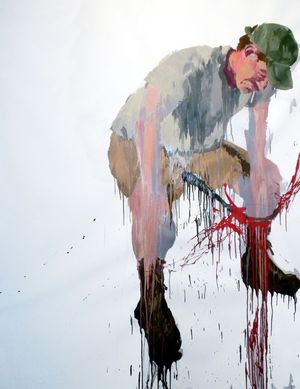
L., Machete Accident. Benjamin Moore latex house paint on canvas, 62″ x 50″, 2010
R., Shotgun Accident (Naked). Benjamin Moore latex house paint on canvas, 58″ x 50″, 2010
EH: You and Greg have just started. But you and Thomas have been through a lot.
KV: We have. We listen to Radio Lab, and we get overcome with glee, but also with deep discomfort. We are both in our ways exploring the concept of extreme vulnerability — the worst kind, in moments when you had no idea. It will collapse you. People have come up to me at shows, and they look at a painting from this series. “That's me,” they'll say. “You've painted me.”
EH: Yet they want to be inside the Non-ordinary Reality paintings — the Water paintings, I've heard people call them. That could maybe be a mistake? As optically seductive as they are, there's a sense of tight compression about them. It's portentous. Sometimes even ominous.
KV: They are companions to the Accident Series. They were generated together. I'm dealing with frozenness in a different way with them. Water slows light, and gesture, the way that trauma slows time. It results in another kind of seeming calm. In the Accident paintings, blood and paint are spilling and dripping. Arterial blood may surge, but generally there's a downward rushing feeling. In the Water paintings, there is upsurge and refraction.
EH: Each series has a different take on questions of identity, too.
KV: Yes. Thomas, the model in clothes, is always wearing the same cap, and smoking. I want to subject the viewer to simultaneous sensations of repulsion and attraction, horror and humor, disgust and delight. But the viewer needs to see Thomas as an individual to whom things are happening. In the Water paintings, the subject is never an individual. The water almost laps away at identity, replacing it with a sense of becoming.
EH: The Accident paintings are based on observation, too — you may not be observing the precise trauma, but you are closely observing Thomas. With the Water paintings, you are painting what cannot humanly be observed. How does that work for you — not to be drawing from life?
KV: Using images that a camera, not the naked eye, can see alters my stereotypical thinking, my ways of seeing, my visual interpretation of what I’m looking at. I want to communicate the movement of sound waves, and of looking underwater, glimpsing, having a secret, being given an extraordinarily generous amount of time to hear, observe and think beneath the surface, from an altered reference. Photography enables this. They are my photographs, and I am the one who alters them before I start to paint from them, too. This intense preparatory work is what Deleuze and Francis Bacon might have been talking about when they referred to “the painting before the painting.”
And it's something I’ve struggled with for a long time, and most often the answer to this question is the reason I work from life rather from photographs, so often the photographs limit greatly what one can see. They distort reality to what we habituate to, to what we think we’re supposed to see. However, from a practical standpoint it is not possible to work from life in these paintings. From the point of view of the (invisible) subject of these paintings, underwater, it is not possible to paint. More importantly and in contradiction to the implication of the question, these paintings are based on a physical reality that is sensed and felt and seen by any of us who possess powers of observation and have simply opened our eyes underwater. Furthermore, there is an inner reality that has a concrete physicality and that is felt intensely, sometimes violently, yet remains unseen, unheard, and unspoken, these images attempt to convey a physio-visual manifestation of that silenced power pulsating within us: the silent scream.
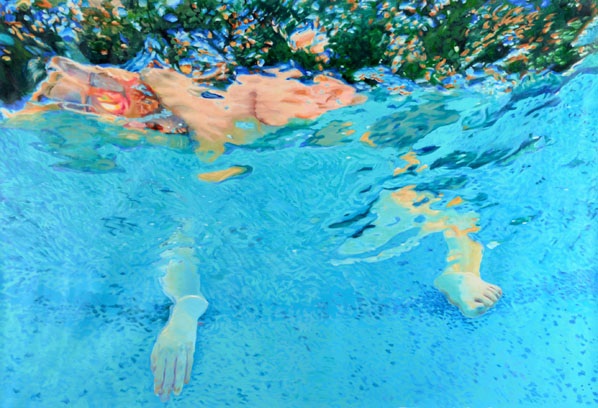
A need so great and deep it can never be swallowed. Oil on canvas, 66″ x 102″, 2009
EH: One of the disturbing things about the Non-ordinary Reality paintings is precisely that aural quality. You don't see the aparratus for screaming — I would call the images facelessly insistent — but you sense that kind of immanence. Another thing about them — they appeal to the haptic sense, the sense of touch and so much more. Partly because they are so very large?
KV: You really couldn’t do that on a smaller scale. The colors also appeal to a more haptic sense. When people see the ultramarine sky they feel the sunny day and respond. And the water too, for those who love being in and under water, these paintings evoke a sense of relaxation.
People walk around in an automatic processing mode, using their perception or recognition or highly over-learned stimuli that requires little or no processing. I want to challenge this. I want to awaken the senses. When the painting provides kinesthetic feedback the viewer can, in a sense, feel what they’re seeing, see what they’re hearing, hear what they’re feeling.
There is very new exciting brain research that contradicts the old conventions regarding the separate areas of the brain managing your senses. Now we know that the brain is polysensory. The brain also hears in the visual cortex and sees and smells in the auditory cortex. So, you really could hear the painting.
EH: I want to see all the Water paintings installed as an environment, like Monet's Nympheas. I hope you're working on getting them viewed together. It's so bad that Brice Marden's huge Greek-inspired canvases have never been fully assembled — too many people need to agree to risk transport of them for that show to happen, apparently. You'd need a big room, too. I read that Jenny Saville has a 20-room palazzo in Palermo for her paintings. Sounds about right.
KV: She deserves it. I can tell you that when viewed together, the Non-ordinary Reality paintings cause an extraordinary aural phenomenon to occur for the viewer. The room grows silent in the way it would if you were under water. Perhaps this is because of something called assimilation paradox — that a person will always use existing knowledge to make sense of new information, even when what is needed is to go beyond their existing concepts. Theoretically, that could work for painting as well as for photography.
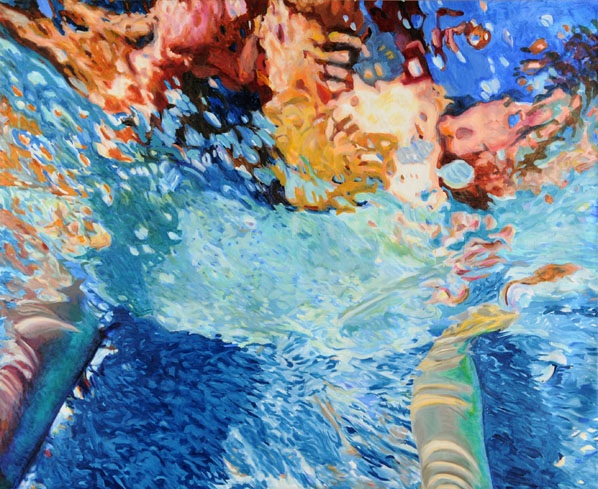
Ribs of disaster curving their assertion among the tentative haunters. Oil on canvas, 65″ x 89″, 2008
EH: There's a tilting of the felt axis, as well. They are like the Nympheas in that way too — you can't be sure what your point of view is when you're looking at them. And for all their ambiguity, they have a very inviting mood.
KV: My favorite place to be is in the water, completely submerged. It’s where I feel safest. The advantage to having painted these paintings as water images is that the natural relaxing qualities we associate with water such as the color, texture, buoyancy, sound, and context take over: automatic processing. This creates and environment conducive to reflection, to taking more time with the painting and becoming more receptive to what it has to offer. The paradox, of course, is drowning because you’re out of control. Although, I supposed, if it’s a surrendered choice it may not show a lack of control at all.
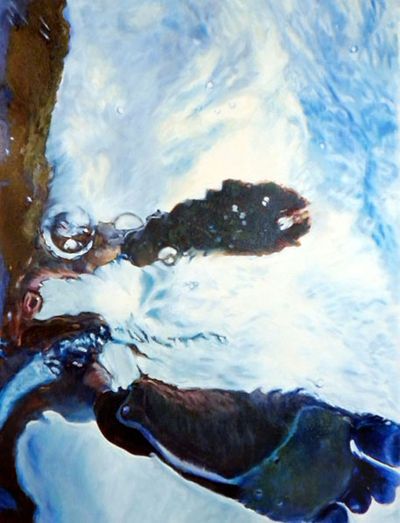
I was much further out than we thought. Oil on canvas, 48″ x 32″, 2010
EH: You're within reach of the completion of both the Accident Series and the Non-ordinary Reality series. Do you know what you want to show in Ecuador?
KV: Not to a certainty, no. The LANN Museum intends to be more “out there” than is particularly typical of a South American art museum, I understand, so I'm tending towards an installation that is conceptual, with elements of performance, as well as painting. I want very much to be in dialogue with the people of Ecuador, with whatever art I bring to them. It's a hard-working, committed, talented arts community, and it has my attention in a big way. Honing in on just exactly what is Andean painting is fascinating, and learning about Modernism in Ecuador is very important to me now.
EH: Did you get much of a chance to satisfy your curiosity at the Biennale in Guayaquil?
KV: I met some fantastic people, and saw wonderful things from all over the world. Going down there, I knew about Eduardo Kingman, the face of Ecuadorian art as far as I was concerned. But there's so much more. Oswaldo Guayasamín is the artist most people have heard of, with even Pablo Neruda referencing him. Ramiro Jacame is an artist I want to find out more about. Camilo Egas and Pablo Cardoso are artists I'd like to know better. Ecuador is a male-dominated art world, but the late Judith Gutierrez, born in Ecuador and active in both Mexico and Ecuador, was a pioneering woman in the arts. I am fascinated with X. Andrade, exploring the fringes between anthropology and contemporary art. Through learning about Andrade, I can see conceptual art is alive and well in Ecuador.
EH: I've found some super links — readers can get an eyeful if they choose. You have a project in development that is fully conceptual. Does this mean leaving painting behind?
KV: No, it means I have a vision that is not served by painting. When I have a vision that is served by painting, painting is what I will do. I'm working on an installation about not just the commoditization of art, but the commoditization of the experience of art. William Gibson touched on this in Pattern Recognition. Robert Hughes has written about it. You would like your subjective experience of art to be outside the reach of marketers, wouldn't you? You would like freedom from that? Robert Irwin feels so strongly about this subject that he won't allow photographs of his works — they are denaturing to it, and may make it “look good” only because the work is photogenic. What I'm developing is an installation, with performance, that uses transgression, authoritarianism and comedy to inquire into the freedoms we have to “own” what is intimately ours. Are those freedoms as intact as we think?
EH: I'll be watching. But painting — not.
KV: Not this time. But I am painting heroic scale zombie paintings. You shouldn't be thinking zombies are small and shriveled.
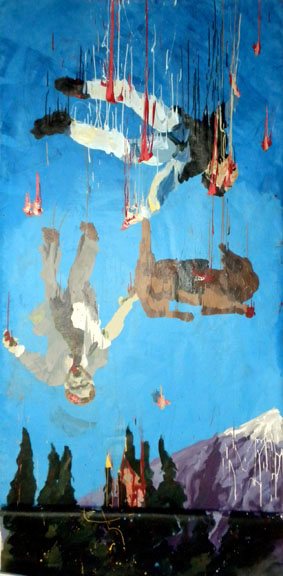
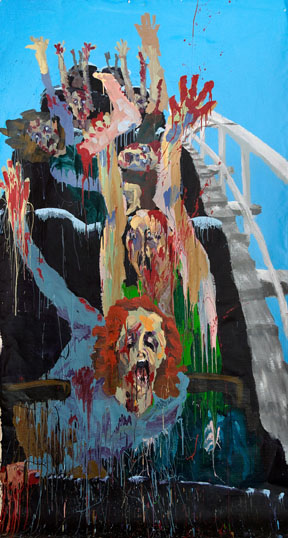
L., Skydiving Zombies. Oil on paper, 144″ x 50″, 2010
R., Roller coaster Zombies. Oil on paper, 120″ x 50″, 2010
EH: I didn't think they were small and shriveled. I just didn't think they fell out of the sky.
~~~~~~~~~~~~~~~~~~~~~~~~~~~~~~~~~~~~~~~~~~~~~~~~~~~~~~~~~~~~~~~~~~~~~~~~~~~~~~~~~~~~
Links to Museums, galleries, publications, artists and sites referenced in this post
Web site and blog of Kate Vrijmoet
http://www.figurespace.com/Kate_Vrijmoet/kVrijmoet_Home.html
Web site of the Center on Contemporary Art, Seattle
Kate Vrijmoet catalog, Essential Gestures, 2010
http://www.lulu.com/product/paperback/kate-vrijmoet-essential-gestures/12297533
Review of “Kate Vrijmoet: Essential Gestures” by Michael Upchurch, The Seattle Times, February, 2010
http://seattletimes.nwsource.com/html/thearts/2011117780_coca19.html
Post by Ming Holden, “What Do Seattle and Ecuador Have in Common?”, Hufington Post, June 18, 2010
Web site of the Luis A. Naranjo Noboa Museum, Guayaquil, Ecuador
DPM Gallery, Guyaquil, Ecuador
MAAC Museum, in Guayaquil, Ecuador
In Cuenca, The Antonio Pérez Foundation
http://www.dipucuenca.es/cultura/artesplasticas/FAP/framesetFAP.htm
X. Andrade, and Experimentos Culturales
http://www.latinart.com/faview.cfm?id=962
Pablo Cardoso
http://www.latinart.com/faview.cfm?id=96
Camilo Egas
http://www.latinart.com/faview.cfm?id=771
Oswaldo Guayasamín
http://www.latinart.com/faview.cfm?id=98
Ramiro Jácome
http://www.latinart.com/faview.cfm?id=99
Eduardo Kingman
http://www.latinart.com/faview.cfm?id=100