
July 19, 2010
Academic War About War
by Frans de Waal
[Film by The Department of Expansion.]
For many years, anthropologists and biologists have been comparing the aggression of animals with human warfare. It started with Konrad Lorenz in the 1960s, and remains a popular endeavor. We have an aggressive instinct that leads to warfare, hence war will always be with us. This message was a bit hard to accept from Lorenz, an Austrian who served in the German army during WWII, but the debate continues as seen in the video above featuring interviews with Steven Pinker, Richard Wrangham, and myself.
Part of the problem is that modern warfare seems to have little to do with the raw aggressive instinct. Modern warfare rests on a tight hierarchical structure of many parties, not all of which are driven by aggression. In fact, most are just following orders. The decision to go to war is typically made by older men in the capital. When I look at a marching army, I don’t see aggression in action. I see the herd instinct: thousands of men in lock-step, willing to obey superiors.
In recent history, we have seen so much war-related death that we imagine that it must always have been like this, that warfare is written into our DNA. In the words of Winston Churchill: “The story of the human race is War. Except for brief and precarious interludes, there has never been peace in the world; and before history began, murderous strife was universal and unending.” But is Churchill’s warmongering state-of-nature any more plausible than Rousseau’s noble savage? Although archeological signs of individual murder go back hundreds of thousands of years, we lack similar evidence for warfare (such as graveyards with weapons embedded in a large number of skeletons) from before the agricultural revolution. Even the walls of Jericho -- considered one of the first pieces of evidence of warfare and famous for having come tumbling down in the Old Testament -- may have served mainly as protection against mudflows.
Long before this, our ancestors lived on a thinly populated planet, with altogether only a couple of million people. Before this, about 70,000 years ago, our lineage was at the edge of extinction living in scattered small bands. A study of mitochondrial DNA by genographer Doron Behar suggests: “Tiny bands of early humans developed in isolation from each other for as much as half of our entire history as a species.” These are hardly the sort of conditions to promote continuous warfare. My guess is that for our ancestors war was always a possibility, but that they followed the pattern of present-day hunter-gatherers, who do exactly the opposite of what Churchill surmised: they alternate long stretches of peace and harmony with brief interludes of violent confrontation.
Comparisons with apes hardly resolve this issue. Since it has been found that chimpanzees sometimes raid their neighbors and take their enemies’ lives, these apes have edged closer to the warrior image that we have of ourselves. Like us, chimps wage violent battles over territory. Genetically speaking, however, our species is exactly equally close to another ape, the bonobo, which does nothing of the kind. Bonobos can be unfriendly to their neighbors, but soon after a confrontation has begun, females often rush to the other side to have sex with both males and other females. Since it is hard to have sex and wage war at the same time, the scene rapidly turns into a peaceful gathering. Lethal aggression among bonobos has been unheard of.
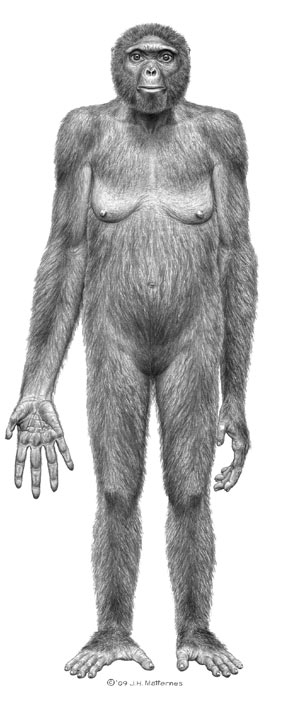
The recent discovery of "Ardi" has added to the debate. Considered close to the last common ancestor of apes and humans, Ardipithecus ramidus had a less protruding mouth equipped with considerably smaller, blunter canine teeth than the chimpanzee's impressive fangs, which serve as deadly knives, capable of slashing open an enemy's face and skin. The aggressiveness of chimpanzees obviously loses some of its significance if our ancestors were built quite differently. What if chimps are outliers in an otherwise relatively peaceful lineage?
I don't think these issues are resolved, but I do attach importance to the frequency of PTSD among soldiers. In the video interview, Wrangham argues that the only reason PTSD occurs is because soldiers feel bad about an act that they actually enjoyed committing, but isn't guilt an awfully cognitive emotion compared to the depth of despair, the intense fear, the inner darkness experienced by veterans? If it were just guilt, we could probably talk them out of it. If Wrangham were right, one would expect that after a strongly supported war (such as the so-called "good" war) there would be much less PTSD than after an unnecessary war, such as the one in Iraq. I have never heard of such differences, though.
Killing or hurting others is something we find so horrendous, that wars are often a collective conspiracy to miss, an artifice of incompetence, a game of posturing rather than an actual hostile confrontation. I suggest everyone to read On Killing by U. S. Lieutenant Colonel Dave Grossman. Killing at close range has no glory, no pleasure, and is something the typical soldier tries to avoid at all cost. Only a tiny percentage of men does the vast majority of killing during a war. Most soldiers report a deep revulsion: they vomit at the sight of dead enemies, and end up with haunting memories. Life-long combat trauma was already known to the ancient Greeks as reflected in Sophocles' plays about the "divine madness" that led to Ajax's depression after the Trojan War and his subsequent suicide.
Why would a Greek hero, trained to fight and be proud of it, have second thoughts? It makes no sense unless we assume that humans are in fact not designed to kill humans, and that those who do and feel good about it are the exception.
Posted by Frans de Waal at 12:40 AM | Permalink


Comments
Thank you for this excellent article. I posted the other day on Grossman's site, killology.com, in response to Gerald Dworkin's 3QD article on moral dilemmas. I thought it was so significant that the military had to condition and desensitize soldiers in order to get them to shoot to kill rather than firing in the air or not at all, as so many had done in WWI and WWII. Now, apparently, there are more cases of PTSD with Vietnam vets and more cases of suicide in the Iraq war than in the earlier wars.
Moral Dilemmas
I agree with you that soldiers going off to war are most likely "obeying orders" rather than seeking targets of aggression. Until citizens change the nature of the State and government, I fear that war is inevitable.
Randolph Bourne
Chris Hedges
Posted by: Louise Gordon | Jul 19, 2010 3:55:46 AM
Well, if we're not designed to kill humans, we do a f*cking good job of it. Perhaps it's more a case that we're not 'designed' to live in societies that repudiate violence and killing, and which require people to 'readjust' to 'normality'? Perhaps we're not designed at all, but rather evolved, and there's no particular reason that our psychological make-up has to make any sense, it just has to let us breed.
Posted by: dave | Jul 19, 2010 5:27:01 AM
Dave's comment about us being designed to breed is 100% accurate. Our genes have combined into DNA to achieve the goal of replication, which for us translates into breeding thus creating new vehicles for the subsequent generation of genes. Your genes don't care about your happiness. They give abilities selfishly. They seek out solely their own replication. Replication being the only thing they understand, why would they concern themselves with anything else?
Aggression has always been a necessary part of that program, hence our propensities for violence. That being said, sympathy and kindness also play key roles. That our deep interest in war and our revulsion towards personally inflicting death are in parallel, suggests a clash between these two parts of our program.
To say that we are not designed to fight is to look at the issue a bit melodramatically. We are not entirely violent nor completely peaceful. But happiness being the prize that it is, few people can allow their aggression program to go unchecked without sacrificing considerable peace of mind, hence PTSD.
Personally, I think countries invade and commit atrocities because those calling the shots, those actually commanding the army to invade, don't actually go to war. The Bushes and Cheneys of the world need soldiers to die so they (Cheney and Bush) can experience vicariously what they are too cowardly to risk in reality. Bush landed on an aircraft carrier in full battle-gear. He didn't go to battle though, did he? I don't mean to target the oil-junkies in particular. Many other leaders fit that profile. Mussolini wore a general's uniform but the most action he ever saw pre-WW2 was probably a fist-fight in a brothel. For the soldiers war is about loyalty and a commendable but unfortunate hybrid of nobility and naivety. For the leaders, it's about ego.
We believe in war because we are programmed to. We delve in its excesses because we are ordered to do so by leaders who are afraid to likewise do so. We are later repulsed by war again because we are programmed to.
I sincerely apologize for the arrogant tone, and given the respect I have for Steven Pinker and others like him, I'd be very nervous about challenging his point of view with my own, but I nonetheless would. I believe this subject is much less complex than it's been made out to be.
Something so universal can only have a few key elements.
Posted by: Louis | Jul 19, 2010 7:14:06 AM
War is an intense episode of the application of ultimate power, following a longer episode of the application of political power.
Those who hold that power corrupts seem to be supported by the data indicating that "less good" wars cause soldiers more psychological problems.
A lot of the problem stems from teaching them that the war they are fighting is good, is bringing peace and security to them and theirs, then letting them find out the truth about it.
The sudden and real departure from glorified fantasy into reality, when they find out what war really is, lasts the remainder of their life, which in more and more cases is a short time after they get back home and commit suicide.
When war is considered to be caused an overdose of toxins it can be treated as a disease instead of being praised as a glorified state of existence.
Posted by: Dredd | Jul 19, 2010 9:15:56 AM
War is simply a bad habit that occurs when sociopathic elites, to aggrandize their power and wealth, order young men to fight other young men, and the men, due to strong pressures to conform, line up to go. It will stop when parents teach their children that killing need not be a normal human activity. War must be denormalized, just as cigarette smoking has been. The elites won't like that. Fuck them.
Posted by: J. Hawkins | Jul 19, 2010 10:30:39 AM
I must say that I find your distaste for all that the ruling class has done to create a stable society rather boorish.
Posted by: Abernathy Chumplestein IV | Jul 19, 2010 11:18:51 AM
"Your genes don't care about your happiness. They give abilities selfishly. They seek out solely their own replication.Replication being the only thing they understand, why would they concern themselves with anything else?"
Although I agree that complex behavior can arise from (relatively) simple processes, don't fall into the trap of anthropomorphising non-thinking processes. There is no "why" to your genes, there is just "how." Genes don't "concern" themselves with anything nor do they "seek". Your genes are not aware that you are a sentient creature nor of any of your life experiences. Genes react and act. There's no intention to it. As such, they're not very useful for explaining complex behavior except to say that genes interacting with environmental conditions create the (very large) parameters in which the variation of behaviors can fit (or the phase space for multiple trajectories to put it another way).
That said, I feel a great deal of what is being proposed commits a fundamental attribution error, or more specifically, a context minimization error. Humans have a range of behaviors that include empathy and aggression, murder and altruism. The context plays a large role in determining which of those emotions/ thoughts/ behaviors will present themselves.
The concept of a "natural state" assumes some abstraction where we picture what an individual organism would do outside of all context. Because an organism (or culture for that matter) only exists inside context, it makes more sense to focus on what contextual factors seem to cause peace and which cause aggression. Indeed, experimental conditions show how easy it is to get humans to kill someone (Milgram experiment for instance) or help someone. Humans (thankfully) have enough adaptability that we must always look at the context to understand behavior. Hypothesizing decontextualized "natural" states assumes either a religious plan (fate) or it assumes less variability or adaptability than realistic.
I think part of the reason violent crime and human-on-human murder has been decreasing is that we are getting better at understanding the conditions to foster peace. The question now to ask is whether further peace could be brought about merely be spreading the conditions we know of (such as empathy training, giving people control over their own lives,increasing employment, etc to name some) or whether there are other factors to promote peace that we're missing (or haven't created yet).
Posted by: Mark | Jul 19, 2010 11:47:01 AM
I was about to write more or less what Mark has written, only he said it better.
Posted by: Mike Cope | Jul 19, 2010 3:01:38 PM
Hunter-gatherers usually don't have much to fight about. Agriculture increases population, makes it more susceptible to disease and in a much worse position if crops fail, As wekk as that, rulers of settled states can exercise much more control over much larger numbers of people than the leaders of hunter-gatherers. They had the opportunity tomake war and often had reason to do so.
Norman Dixon in The Psychology of Military Incompetence points out that military organisations spend much more time and effort not fighting than fighting.
Posted by: Roger | Jul 19, 2010 4:48:37 PM
People have to take control over their own lives if they want it. I don't think it's something that can be given as if it were a gift.
Nor do I think people like Cheney or Putin or Geithner or Wall Streeters or other power-hungry people would benefit from empathy training. I think the question is, how can people exercise their rights to governance?
This discussion reminds me of Ferdinand Lundberg's the Rich and the Super-Rich, Cracks in the Constitution and the Treason of the People. If people leave governance to the power hungry, this is what we get. War and more war, which fuels some people's economic interests and leaves other people dead or disabled.
On a more positive note, see David Korten's work on building sustainable economies. Dave Ranning's comments are a bit repetitive, with the Talking Snake, Flying Horse and swimming in the shallow end of the pool. But I think he may be right that the infinite growth model of economics has begun crashing down around our ears. It remains to be seen if people will change their ways in time to avert further catastrophes, including the environmental ones.
Posted by: Louise Gordon | Jul 19, 2010 8:41:39 PM
Frans De Waal's post is good, but Mark's comment is excellent. It needs to be repeated that context (environment) is everywhere in human behavior. The very idea of a natural state leads almost immediately into confused assumptions about a "true" or "essential" set of behaviors. Such assumptions (I wouldn't call them conclusions) are fabrications of emotional and/or practical interests in seeing people a certain way (as warriors who take what they want; as peaceful beings that achieve completion in giving, etc.)
The height of absurdity in this hereditarian way of thinking is to come up with a number that represents the "share" of some behavior that is due to genes, the rest being due to environment. There is no such univocal number. Genes always permeate behavior just as environment always permeates. This was the absurdity at the heart of the IQ debates. Conservatives would argue for some high share of intelligence due to genes, while liberals would argue that number was too high without generally calling into question the very idea of assigning a number and treating it as part of a causal relationship. Instead they would question the conservatives' definition of intelligence (which was fine, but didn't go far enough).
That said, De Waal's conjecture that early and proto humans tended to have long periods of peace interrupted by brief wars is plausible. But, if true, that is an historical fact about us. It doesn't establish our non-warlike essence.
Posted by: Jonathan Halvorson | Jul 19, 2010 10:26:09 PM
Jonathan,
I think Grossman's findings do reveal something fundamental about human nature. What does it mean when few soldiers in WWI and WWII even fired their weapons at enemy soldiers? There was apparently a strong inherent revulsion over the taking of human life. After this, the military had to come up with specific training-conditioning programs to get soldiers to fire their weapons in battle.
When more of the world begins to look like a wacko prison experiment, I think humans' basic nature gets distorted into ugliness:
Zimbardo
Alfie Kohn, whose field is education, not biology, has written convincingly on similar themes:
The Brighter Side of Human Nature
Posted by: Louise Gordon | Jul 20, 2010 2:17:23 AM
"Modern warfare rests on a tight hierarchical structure of many parties, not all of which are driven by aggression. In fact, most are just following orders."
This is statement is right on the dot. When I take a look around the post I live on, most people in the military are paper-pushers, not killers.
Posted by: chris | Jul 20, 2010 6:51:58 AM
Louise, I think you missed my point, since you repeated the view I'm denying without addressing the argument.
The soldiers who didn't fire in WWI and WWII came from particular kinds of upbringing. My point is that there is no complex social behavior at all without an upbringing, and very different kinds of upbringing produce very different kinds of complex social behavior...including in this case behavior that involves more remorseless killing.
You're choosing some set of formative conditions as "natural" in a normative sense, and then confusing it with an essential causal property. Spartans are people, too.
It's perfectly fine to say that given the range of formative conditions we typically find given historical conditions, certain behaviors are far more common than others. It's also fine to say that you prefer those conditions and behaviors over others that are less common and lead to results you don't like, or find immoral. It's just not fine to think that these conditions and behaviors are "fundamental" in some scientifically justifiable sense. No coefficient you find in the variables will be a constant, not even if you use a stochastic equation.
Posted by: Jonathan Halvorson | Jul 20, 2010 10:04:13 PM
Jonathan, Thank you for clarifying and elaborating. I wasn't ignoring your argument, just rambling on a bit with my own point of view.
Of course I can't prove it scientifically, but I do believe humans have an essential nature and that some forms of upbringing and social arrangements are more aligned with it than others. (You'd say that's merely my preference?)
Maybe Sparta was like a factory farm for militarists, but that doesn't mean that such an orientation was aligned with humans' essential nature. If you don't think humans have one, do you believe that humans are endlessly malleable?
I don't believe that. Obviously humans can be shaped in different ways, but distorted shaping, or conditioning, results in distortions and grotesque forms of humanity.
You write: "That said, De Waal's conjecture that early and proto humans tended to have long periods of peace interrupted by brief wars is plausible. But, if true, that is an historical fact about us. It doesn't establish our non-warlike essence."
Well, it doesn't establish it, but how do you know that it isn't more than historical fact and that as civilization has grown more complex, humans haven't moved away from some aspects of their essence?
Posted by: Louise Gordon | Jul 21, 2010 6:07:29 AM
I'm not sure I understand what you mean Louise. What is it to have an 'essence' as a human collective? When did we drop our 'fish essence'?
Posted by: MattInOz | Jul 22, 2010 9:04:06 AM
Violence is certainly a part of human nature. You only have to look at the hunter gatherer cultures in the Amazon and in New Guinea to see that. Young males have a very high mortality rate. On the other hand, large scale organized war is all about hierarchy, economics, politics and conformity, and has hardly anything to do with emotion.
Posted by: J. Hawkins | Jul 22, 2010 11:10:28 AM
MattInOz,
I said that I can't prove my speculation as scientific. What I'm saying is that I don't believe Spartans or Kitchen Midden people are examples of what it means to be human. Are feet subjected to Chinese foot binding natural feet? Are wild animals stuffed in a little zoo cage natural animals?
No, they become deformed and weird and grotesque. I think certain aspects of civilization have in some ways fostered unnatural human tendencies, while others have fostered greater humanity. But things like the cult of efficiency, mass production and mass consumption and conforming to their schedules, power-over versus partnership relationships, hierarchical power structures, etc., tend to suppress humans' growth toward better or more natural humanhood. They are like having the mind stuffed in or wrapped up in a foot binding.
Essence of fish is a scent we evolved out of.
Posted by: Louise Gordon | Jul 22, 2010 5:03:17 PM
"Maybe Sparta was like a factory farm for militarists, but that doesn't mean that such an orientation was aligned with humans' essential nature. If you don't think humans have one, do you believe that humans are endlessly malleable?" -Louise
We are not faced with only two options: an essence sprung from nature that determines certain complex social behaviors (or our reaction to them) VS endless and arbitrary malleability.
Think of it like this, if we must have an analogy with natural science: social behaviors are like phase states of a substance. It is not the nature of H20 to be liquid, or solid or gas. Under certain conditions it will be gas, under other conditions liquid and under still others solid. If you're going to say something is in our nature, you should say it is in our nature to be capable of all the things we do under the right conditions.
This is a bad analogy in some ways, because a human is more than a certain genetic combination and even to generate non-behavioral phenotypes the genotype must interact with the environment, so there is a kind of double-dependence on environment that H20 does not have.
And we haven't even discussed reflective self-consciousness and how that changes things. A topic for another day.
Posted by: Jonathan Halvorson | Jul 22, 2010 11:24:14 PM
PTSD is experienced by perpetrators and victims alike, even by total bystanders. i see it in lots of wars i work in, and have experienced it myself (as bystander and direct victim). this coheres with the hereditary argument above: i have nothing to do with the cultural or psychic dimensions of their conflict, but i walk away physiologically altered/compromised. what is conditioned is how different people handle or express their PTSD, which in itself takes a variety of forms. but across great cultural gulfs, like a Rwandan genocide survivor and a western aid worker, the psychic trauma can be the same, but how they handle it or suffer its impact can be vastly different. seeking revenge may be a consequence of PTSD for the rwandan, but not for the foreigner, for example. cultures for whom cyclical conflict is a psychological norm, such as somalia or rwanda, will either extinguish themselves or persevere in blood. but they will not change their ways, despite their hereditary capacity to experience PTSD, even on a massive, collective scale.
Posted by: ed rackley | Jul 28, 2010 7:06:24 AM
Post a comment