
| ABOUT US | ARCHIVES | LINKS | RSS FEED | MONDAYS | |

3quarksdaily

An Eclectic Digest of Science, Art and Literature

« Moral Questions in the Ancient Art of Human Enhancement (Now With Venn Diagrams) | Main | smartopus »

July 26, 2010

From An Old Book: An Old but Durable Commitment

by Michael Blim

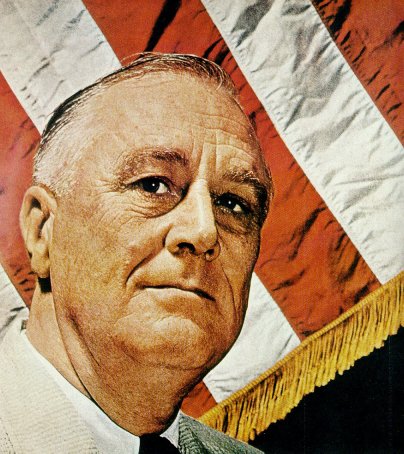
Fdr A bag of books for two bucks, said the sign. Deflation has hit the little Connecticut country library used book sales I haunt each summer. Imagine what you can stuff into a big supermarket paper bag, and then cross-rough it with a run of terrific books – a book of Giotto’s frescoes, Graham Greene’s The Comedians, three P.D. James mysteries, George F. Kennan’s Russia and the West under Lenin and Stalin, a compilation of comic art propaganda that includes a study and pictures of Hansi: the Girl Who Loved the Swastika (the protagonist escapes Nazism by becoming a bride for Christ). All of these and A Guide to Thomas Aquinas.

All of these books bid for my affections, hoping for a quick conquest of my summer reading plans. Having laid hands on Robert Sherwood’s Hopkins and Roosevelt (1948) my fate was sealed. And fortunately for me, having spent as 3QD readers know the past two summers on first Hitler and then Stalin thanks to my library sales book buys.

What a delight to read the history of heroes once more. Sherwood tells the story of how Roosevelt and Hopkins, FDR’s alter ego insofar as he ever had one, battled the Great Depression and World War II together, with Hopkins the iron fist in Roosevelt’s velvet glove. The story is told with admiration and a beguiling humility. Though a successful playwright and a speechwriting White House denizen from 1940 onward, Sherwood never lost his awe of the two men, sharing intimate space and time with two persons who never shared their intimate thoughts with anyone.

Sherwood’s sense of wonder at what he observed is perhaps only exceeded by the reactions of a sympathetic reader.  Hopkins, an Iowa-born New York social worker, put 4 million people to work in one month during the dark winter of 1933-34 and got 180,000 public works projects up and running in four. He put millions more to work with the Works Progress Administration, and after 1937 with half a stomach and successions of near-death crises due to chronic metabolic diseases left over after his bout with cancer, ran the Lend-Lease program that put ships, planes, tanks, and arms in the hands of a half a dozen of America’s allies in World War II and acted as FDR’s confidential agent with Churchill, Stalin, and their military and diplomatic staffs.

For all that Roosevelt did in his three and a half terms as President, he also left us the world blueprint of international organizations including the United Nations by which we still operate today. He was a man of indomitable spirit whose convictions were simple and unwavering, even as his means to accomplish them were shifting and often devious. In a world ruled by “policy” and polling where White Houses execute about-faces after bad overnight numbers, Roosevelt believed that society must help and support its citizens, and the state in no uncertain terms was charged by the people to carry out society’s will.

Sherwood cites a passage from a remarkable speech Roosevelt as Governor of New York gave to an extraordinary session of the state legislature on August 21, 1931. I quote it at length because of its germinal significance for the political beliefs of Roosevelt the man, before he became Roosevelt the president:

“What is the State? It is the duly constituted representative of an organized society of human beings, created by them for their mutual protection and well-being. ‘The State’ and ‘The government’ is but the machinery through which such mutual aid and protection are achieved. The cave man fought for existence unaided or even opposed by his fellow man, but today the humblest citizen of our State stands protected by all the power and strength of his Government. … The duty of the State toward the citizens is the duty of the servant to his master. … One of these duties of the State is that of caring for those of its citizens who find themselves the victims of such adverse circumstance as makes them unable to obtain even the necessities for mere existence without the aid of others. … To these unfortunate citizens aid must be extended by Government, not as a matter of charity, but as a matter of social duty.” (Sherwood, 1948, 31)

Roosevelt’s beliefs seem almost embarrassingly simple. The state serves the greater social purpose of protecting and supporting all of its citizens, but most especially those in need. Full stop.

For reasons that continue to be perplexing and profoundly enraging, neither the Administration nor the Democratic Party in Congress seems capable of upholding this one basic proposition under which they were rewarded with power in the first place. 

Now they are faced once again with the imperative to act. They need to assure that the rich pay marginally more taxes again, while those less fortunate do not. The so-called Bush tax cuts are due to expire. Study after study has shown that the rich garnered the lion’s share of the tax savings from the Bush tax cuts. An IRS study reported by Floyd Norris in The New York Times (July 24, 2010) shows that the over 300,000 taxpayers reporting incomes of one million dollars or more recouped 13% of the nation’s 2008 reported income, indeed a drop from 16% in 2007, but still higher than their share in 2004.

For the nation’s rich, this is no great cause for alarm. As a frequent reader of Robert Frank’s Wall Street Journal’s blog on the wealthy, I have not detected symptoms of great distress. No network news shows feature stories of the rich becoming the newly indigent. Luxury goods makers, after having taken a severe hit in the winter of 2008-2009, are making lots of money again thanks to increased demand.

Even if the rich were suffering, how many others less fortunate than they have suffered too? Even if a case were made to not take in new funds with higher taxes in order to support a fragile economic recovery, how could this money not be given to the truly needy? It is not a matter of charity, as FDR noted in 1931, but a social duty.

The campaign to sustain tax breaks for the rich is not question of economics good or bad, but another battle in the war of the rich and the right on the Rooseveltian state, the most fundamental guarantee upon which the Democratic Party – even after the betrayals since the late seventies – is still based. As Oregon Senator Ron Wyden put it in The New York Times (July 25, 2010): The political clash over the Bush tax cuts “is code for the role of government, the debate over the size of government and the priorities of the nation.” 

Democratic and White House desertion in the defense of this bedrock principle upon which their historic legacy is founded and upon which their future legitimacy depends will rend asunder their majorities and any prospect of effective governance. 

They had best take a stand – and win.

Posted by Michael Blim at 12:40 AM | Permalink

Comments

Clearly the class struggle in the US is heating up (I beg the pardon of all you folks who were taught that Marx is all crap, but you're wrong). Every economic indicator of the changes in the distributions of wealth and income over the last few decades shows that they are being skewed to a degree that we have seldom if ever seen in the country's history, and this has a direct effect on how the great majority of people live their lives, to the extent that the money they have to live on affects their lives, which is a considerable extent.

Unemployment, upside-down mortgages, defaults on credit card bills--all this and more is involved. The resulting anger, and even a growing level of despair, is largely what is fueling the rage we see in politics these days. A lot of people are fearful that they are close to ruin, and mistakenly think it is because "those people" (somebody other that their own group) is "getting too much," probably as a result of a government "give-away" engineered by that Kenyan in the White House (shades of that "damned cripple in the White House" of the 1930s) and that "witch Pelosi."

The problem is that Americans have long been sold the fiction that anyone in this great country can make it if they work hard and are given a fair shake. People know they are working hard, so, they figure, they are not making it because they are being cheated, probably by "big government."

What will it take to correct this educational failure and get people to understand that it is the economic system itself, not the false villains the right wing is pushing out on the stage of their puppet theater, that is at fault? The very few people who understand the real situation haven't found the key to succeeding in this educational task, but if it isn't found soon, we are in for real trouble, because it will be quite easy for the Right to manipulate the people in the next few years into putting some folks into power who will win the class struggle in a very ugly way.

Posted by: JonJ | Jul 26, 2010 11:20:36 AM

A recent article here at 3Quarks described research that showed that, presented with evidence that their perceptions are incorrect, tea party types "double down" and insist they are right all the more. (Maybe someone more organized than I will remember the title?) So that's one problem.

However, I'm afraid that if they knew more of the truth they'd be even more angry than they are.
Jonj's dismissive comment that

"A lot of people are fearful that they are close to ruin, and mistakenly think it is because "those people" (somebody other that their own group) is [sic] "getting too much," "

is too hasty. Maybe he's not aware that there is a lot of outright fraud and law-breaking involved in the impoverishment of millions of Americans, and the fact that there's nothing but money to be made by those who are supposed to be policing these matters, if only they look away, take a bribe, or actively collude with the already-haves. And after all, they're often already-haves themselves, and that makes it so natural. Be true to your school, you know?

But he's right that the teaparty types are the ones who buy into the idea that they'll benefit from this as soon as they get rich, too. The poor dears.

I think academics need to speak and act more publicly, to help get out the information that, for just one example, at least half of the sub-prime mortgages were forced on people who actually qualified for prime rates, and a high percentage of those went to people of color. More profit in those.

Posted by: Alice de Tocqueville | Jul 26, 2010 12:25:55 PM

Thanks for correcting the grammatical mistake, Alice; don't know how I missed proofreading that one.

Fraud and corruption is always with us, for sure, but even if the economic and political system were wiped clean of all that, I think it would still generate increasing inequality unless a real working class movement acted against this tendency. It's like the law which says that a stone will roll downhill unless someone or something acts to push it back up.

It's certainly true that the "tea-partyers," like many working Americans, have a vague hope that someday they might strike it rich. Look at how many lottery-players there are. But when times are really tough, the idea of collective action to benefit all does manage to get into their heads, at least sometimes. There were once such things as strong labor unions and even real left political parties, and we can always hope they will appear again.

One could even try to make a case that the inchoate "tea party" groupings could turn in that direction under some conditions, and some progressives are arguing that the Left should try to encourage that evolution. I'm pretty doubtful, because it looks like the Republican Party already has them pretty firmly in its grasp, but who knows?

Posted by: JonJ | Jul 27, 2010 10:50:50 AM

Heck - wrote "is" instead of "are" again! Must be a deep defect in my brain.

Posted by: JonJ | Jul 27, 2010 12:02:18 PM

Thanks for caring about 'is/are', JonJ. I can't help it, grammar and punctuation and spelling are for the purpose of clarity, not trivial things, so I'm glad to hear you also try to proofread before you post.

As to the teaparty types being moved to the left, I've been at that most of my life, having grown up in teaparty heaven, i.e., Arizona. I managed to convert 1 that I know of.

These are not people who listen to different points of view and then form an opinion; that would be 'liberal', by definition, and....they can't, and that's why they're illiberal. But there surely are some who just sort of inherit these views, and they can perhaps be reached if correct information can get to them. That's why I still go out to meet them and talk to them, as much as the police allow. (They've taken to physically separating the right and left factions before there's "any trouble, ma'am"). It's sad for those who are simply misinformed, because they vote for the very things/people who impoverish them, and spit on the ones who can make it better.

Posted by: Alice de Tocqueville | Jul 27, 2010 2:38:47 PM

Post a comment


Subscribe to this blog's feed  

PayAnywhere with iphone credit card swiper

Android Tablet

Bluetooth Headset

2013 New Style Dresses

Compare Car Rental Prices

DHgate.com Wholesale

3QD on Facebook

3QD on Kindle

3QD by Daily Email

Receive all blogposts at the same time every day.

Enter your Email:


Preview 3QD Email

3QD on Twitter

Miscellany

Lijit Search

AddThis Social Bookmark Button

Add to Google

Recent Comments

j_93 on Syria: Inventing a Religious War

j_93 on Syria: Inventing a Religious War

j_93 on Syria: Inventing a Religious War

Lusine on Syria: Inventing a Religious War

over here on The Nominees for the 2010 3QD Prize in Science Are:

Raza Husain on Syria: Inventing a Religious War

j_93 on Why Steven Pinker Is Wrong

martina_j on Syria: Inventing a Religious War

Raza Husain on Why Steven Pinker Is Wrong

Bill on Why Steven Pinker Is Wrong

roger gathmann on Why Steven Pinker Is Wrong

Doogle on Why Steven Pinker Is Wrong

Kyle on Syria: Inventing a Religious War

Peter John on Gezi Park

dthoko on The History of Typography - Animated Short

Richard on John Gray’s Godless Mysticism

Abbas Raza on Why Steven Pinker Is Wrong

nogodrod on Syria: Inventing a Religious War

Lusine on Quest for 'Genius Babies'?

Bill on Syria: Inventing a Religious War

j_93 on Gezi Park

j_93 on Syria: Inventing a Religious War

Norman Costa on The Insanity Virus

Dave Ranning on Political Ideology and the Avoidance of Dissonance-Arousing Situations

Sundar on Quest for 'Genius Babies'?

Acclaim For 3QD


"I couldn't tear myself away from 3 Quarks Daily, to the point of neglecting my work. Congratulations on this superb site."—Steven Pinker, Johnstone Professor of Psychology, Harvard University.

"I have placed 3 Quarks Daily at the head of my list of web bookmarks."—Richard Dawkins, Charles Simonyi Professor of the Public Understanding of Science at Oxford University.

"Just wanted you to know I’m one of many who reads and enjoys 3 Quarks....almost daily."—David Byrne, musician, former lead-singer of the Talking Heads, artist, intellectual.

Read more here.

The 3QD Prizes

Subscribe to this blog's feed