
by Michael Blim
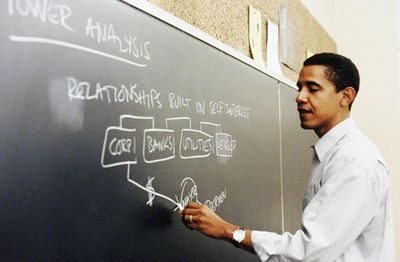
Good government in Chicago was and still is an honorable tradition. It produced Paul Douglas, Adlai Stevenson, Abner Mikva, and Barack Obama. It joined with Chicago’s black community to elect Harold Washington. With Jane Addams and John Dewey acting as its exemplary turn of the 20th century intellectuals and activists, Chicago’s good government movement is one of the taproots of American liberalism.
I confess that it has taken me a while to accept that Barack Obama, for better or worse, is a “goo-goo.” He is the latest in a distinguished line of pragmatist, intellectually inclined politicians who believe that the public interest can be served by intelligent decision-making based upon the analysis of facts and the implementation of technically sound rules and administration.
What is interesting about the new “goo-goo-ism” of Obama is that it is shorn of its more radical roots. The radical reformism and pacifism of Jane Addams and John Dewey, despite Obama’s community work that derives from their inspiration, is notably absent. Missing too is the New Deal version of good government: there is no left wing in the White House west wing as there was under Roosevelt. There is no one the likes of Frances Perkins, Harry Hopkins, or Raymond Moley, just to name a few that put a radical liberal edge on the New Deal, to push the Obama Administration from within toward more fundamental government guarantees for a people being battered by economic crisis and an inept political system.
Here perhaps one example suffices to illustrate how the Obama administration “skipped” the New Deal tradition in its policy-making. Franklin Roosevelt broke with the Progressive tradition of Theodore Roosevelt and Woodrow Wilson that was largely content with reform through regulation by creating jobs directly through public works of all sorts – from dams to drama one might say – as an answer to the private sector’s inability to solve the massive unemployment problem. Obama instead has taken passive measures such as extending unemployment benefits and supporting business recovery via a variety of means. Yet the unemployment problem is grave and growing, as the proportion of the long-term unemployed rises relentlessly. Whole social strata ranging from poorly educated factory workers to young people seeking a foothold in the job market from all sorts of backgrounds are being savaged. Yet, one hears not a peep from Obama’s administration of how absent direct government employment, 15% of America’s workers are to find their feet again economically.
The goo-goo instincts of the Obama administration thus reflect more accurately the turn of the 20th century progressive politics of Wilson and the elder Roosevelt than those of the New Deal. As Robert Wiebe in his much-celebrated Search for Order (1967) argued, the new middle class from which progressivism flowed was distinctly managerial in orientation, seeking a new rationality through the technologies of bureaucratic organization and regulation. It represents and operates in and on the world as if there were a class-less general interest that can be safeguarded through the wise administration of enlightened experts drawn from a meritocratic elite. Its justification thus is of competence rather than of the fulfillment of more radical goals such as using government as a primary agency of resolving social injustice through direct economic redistribution.
Obama proposes good government, in other words, which is something we dearly need. Since Reagan, we have lived in a society where government was not merely a necessary evil, but evil per se. Successive administrations either savagely or passively looted the federal government of expertise and practical power of personnel that guarantee the country’s basic laws. The ballooning list of government regulatory failure grows by the day. Whether in regard to health and safety, food and drugs, or natural catastrophes and civil defence, it as if, as concerns government resources, to cite Gertrude Stein, there is no there there. The now infamous neglect of basic environment safety propagated by British Petroleum and sanctioned by the Minerals Management Service of the Interior Department has led to our latest disaster, and Katrina debacle displayed how thoroughly disemboweled the federal government had become under successive regimes of government-haters and weak executives of Republicans and Democrats alike.
Obama’s two “great reforms” are cut from the same cloth: in essence they consist of regulation through the wise management of experts. In health care and finance, the task is to manage the status quo more efficiently, not transform it. Not my choice, of course. But it is theirs, and now they must really manage these two great chunks of the American economy wisely with some notion, however watered-down, of the public interest.
As regards health care, they have created via private insurance a network of care in where the incentives still point the wrong way: the profit motive still governs the system. If the federal government does not govern the health market directly with a firm hand, citizens, now mostly insured under one title or another will find themselves continually victimized by insurers and providers seeking to shift costs and increase profits by either sticking the other with increased costs and diminished profits, or sucking the difference out of the insured via low reimbursements, exclusions and billing tricks. If you find yourself in frequent conflict with your health provider and/or your insurer, your aggravations and financial liabilities are guaranteed to grow under the new scheme – unless the Obama administration staffs up the new regulatory entities, appoints tough good government reformers, and supports them politically.
The same is true for financial reform, essentially a “reset” of the same big capital game under some new rules. Most of the elements that led the economy over the cliff are still in place. Most importantly, banks escaped the more radical impulse to redefine them as public utilities, thus leaving a pure profit motive at the heart of their operations. It will take extraordinary capacity-building on the part of the federal government to enforce its new laws, and more still to apprehend new forms of mischief in the works. Once more, the appointment of stalwart good government experts and supporting their efforts become critical.
The political challenge is enormous, particularly as good government is a sort of political odorless, tasteless, colorless, classless gas that surely fuels the good government experts to do their best, but fails to ignite the citizens on whose behalf they govern. I have been on the road for the last month and so did not actually see the reportage on Obama’s spill site visits, nor did I see his White House address on the BP disaster. I have gotten back in time to hear all the carping about his seemingly technocratic and dispassionate approach to the problem.
The disappointment of the chattering classes is wrongly put, I think. With his seemingly Zen-like concentration, Obama is staying “inside” himself, matching his beliefs and methods with his actions, and showing careful attention to detail and the need for dispassionate judgment. There is some “truth” in his rhetoric in as much as it appears to reflect his character and beliefs, and I would argue that this internal correspondence between character, belief, and action is a value per se in an American political environment full of insinuation, fraud, and character assassination.
It is not the Obama I wanted. I wished for more than a “goo-goo.” But a goo-goo is what we got. Though his mission may be modest by my lights, our lives will be a little bit better if he succeeds in providing good government after a generation of government destruction and neglect.
However, it must be said that his disavowal of radical reform even of the ultimately balanced sort offered in the New Deal is bound to cause him problems politically. In trying to solve everyone’s problems in the “general interest,” he solves no one’s in particular. No one is his majority. Should he be re-elected, it will be because voters one by one in a plebiscite on his rule, will decide that some good government of a modest, technocratic sort is preferable to a right-wing reconstruction.