
Adichie then goes on to comment on the remarkable changes that have taken place in the Nigerian psyche in recent years. “There is a growing collective confidence in our future, a new restorative sense of self…” she writes, in reference to the fast-rising Nigerian pop music industry.
Interestingly, another arena that has seen significant change, and provides evidence of an impressive cultural renaissance in Nigeria, is the one in which Adichie herself occupies a vantage spot: the literary arts. On a recent Saturday afternoon, the Silverbird Lifestyle Store in Victoria Island, was cramped with guests attending the 4th edition of the monthly BookJam reading series; featuring Adichie, Kenyan’s Binyavanga Wainaina, and UK-based Nigerians Chuma Nwokolo and Sade Adeniran.
Lagos is suddenly a hot new destination for writers from all over the world – courtesy of the exploits and efforts of writers like Adichie. Her four-year-old annual Creative Writing workshop, sponsored by Nigeria’s oldest and biggest beer company (which before now appeared to be more at home with sponsoring music festivals and talent hunts) has brought Jason Cowley, Nathan Englander, Binyavanga Wainaina, Jackie Kay, Doreen Baingana and Dave Eggers to Lagos, to facilitate writing sessions. This year Ama Ata Aidoo, Niq Mhlongo and Chika Unigwe are the guest writers.
In July it will be the turn of Helon Habila to lead creative writing workshops in Lagos and Abuja. The Habila workshops will be sponsored by Fidelity Bank, which sponsored the first two editions of Chimamanda’s workshop, before Nigerian Breweries Plc took over.
Contrast the scenario above with the mid to late 90s, when Nigeria lay in the grip of a military dictatorship that took special interest in writers. Take this scene from Helon Habila’s debut novel, Waiting for an Angel, winner of the 2003 Commonwealth Writers Prize for Best First Book, Lomba, the young journalist protagonist, is told by his editor James:
“You won’t find a publisher in this country because it’d be economically unwise for any publisher to waste his scarce paper to publish a novel which nobody would buy, because the people are too poor, too illiterate, and too busy trying to stay out of the way of the police and the army to read. And of course you know why paper is scarce and expensive – because of the economic sanctions placed on our country. But forget all that. Say you found an indulgent publisher to publish your book, someone who believes in this great book as much as you do; and because you are sure your book is good, you’d want to enter it for a competition – what is the most obvious competition for someone from a Commonwealth country? Of course, the Commonwealth Literary Prize. But you can’t do that.”
“And why not?” Lomba asks. He stands and moves to the window, away from James, so that they stare at each other, the table between them, like antagonists.
“Because Nigeria was thrown out of the Commonwealth of Nations early this morning. It was on the BBC.”
*
The above may be from a novel, but its origins lie in reality. Nigeria was indeed suspended from the Commonwealth in November 1995, in the global outrage that followed the extra-judicial murder of writer and activist Ken Saro Wiwa and eight others, by the military dictatorship of Sani Abacha. The suspension remained in place until the emergence of a democratic government in 1999.
Waiting for an Angel is full of journalists being arrested and imprisoned and their printing presses sealed off – or set ablaze. It also includes a slowly but steadily mounting body count.
Towards the end of the novel, Mahalia, a painter, tells Lomba: “You really must try and get arrested – that’s the quickest way to make it as a poet. You’ll have no problem with visas after that, you might even get an international award.”
That was the Nigeria of the 1990s: writers hounded into exile by oppression and poverty. Recall the words of Adichie's The Globe and Mail essay about the only thing worth aspiring to being a “foreign visa”.
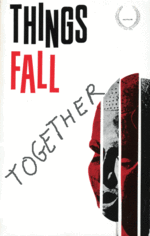
But things arguably started to fall together at the turn of the century. In 2001 Helon Habila opened the floodgates by winning the Caine Prize for African Writing, the second person to do so (after Sudanese Leila Aboulela in 2000), and the first Nigerian.
The next year Adichie was shortlisted for the Caine Prize. Following that was her win in the 2002/2003 PEN/David TK Wong short story award (now defunct). The next edition of that prize (2004/2005) was won by fellow Nigerian Sefi Atta. In 2004 Chika Unigwe was shortlisted for the Caine Prize, and the following year Segun Afolabi took the Prize.
It was between 2002 and 2004 that Adichie’s Purple Hibiscus, Habila’s Waiting for an Angel and Abani’s Graceland were published. All three books, debut novels, established their authors as outstanding writers of fiction, and earned acclaimed prizes.
The controversial Nigeria Prize for Literature, sponsored by Nigeria Liquefied Natural Gas (LNG) Limited was launched in 2004, offering $20,000 annually “to honour the author of the best book published in Nigeria within the last four years.” The prize is rotated each year between the genres of fiction, poetry, drama and children’s literature. Today the prize value has risen to $50,000, making it one of the biggest on the continent.
The second half of the first decade of the 21st century would turn out to be even more exciting. All the writers above released their second books, and Adichie’s Half of a Yellow Sun won the prestigious 2007 Orange Prize.
The biennial $20,000 Wole Soyinka Prize for Literature in Africa was established by The Lumina Foundation in 2005, and first awarded in 2006. The Association of Nigerian Authors (ANA) has in recent years also upped its game, increasing the monetary value of its literary prizes, the oldest surviving in the country (ANA was established in 1981 with Chinua Achebe as pioneer President).
In 2006, Sefi Atta made the Caine Prize shortlist; in 2007 there were 3 Nigerians on the shortlist: Uwem Akpan, EC Osondu and Ada Udechukwu. In 2008 it was the turn of Uzor Maxim Uzoatu to take a place on the shortlist, and in 2009 EC Osondu returned, this time to claim the 10,000 pounds sterling Prize.
Adichie launched her annual writing workshop in 2007; it is now in its fourth edition. In 2009 Sefi Atta won the Noma Award for Publishing in Africa. The last three Commonwealth Writers Prizes for Best First Book (Africa Region) have been won by Nigerian writers: Sade Adeniran for Imagine This (2008), Uwem Akpan for Say You’re One of Them (2009) and Adaobi Tricia Nwaubani for I Do Not Come To You By Chance (2010). In 2008 Karen King-Aribisala won the Best Book (Africa region) for The Hangman’s Game, while Chimamanda Adichie won the overall Best First Book prize in 2005, for Purple Hibiscus.
This year will see the commencement of Nigeria’s first writing residency in many years – the Ebedi International Writer’s Residency, located in Iseyin, Oyo State.
And then there are all those exciting online literary magazines edited by Nigerians: African-writing, Saraba, Maple Tree Literary Supplement, Sentinel Poetry, The New Gong Magazine and Farafina (on hiatus).
Also worthy of note are the annual Lagos Book and Arts Festival (usually held in November), which is now in its 12th year; and the annual Nigeria International Book Fair (usually held in May). The Lagos Book and Arts Festival is organised by the tireless Committee for Relevant Art (CORA), winner of a 2006 Prince Claus Fund grant.
The number of Nigerian writers – based at home and abroad – with impressive book deals in Europe and America, is rising – the latest entrants to that club being Teju Cole (pub. date 2011); EC Osondu (2010); Lola Shoneyin (2010); Chika Unigwe (2009); Adaobi Tricia Nwaubani (2009); Kachi Ozumba (2009) and Sarah Ladipo Manyika (2008).
Most exciting however is this fact: that these writers, even while getting inspiring publication deals abroad, can find devoted homes for their books in Nigeria and West Africa through the efforts of publishing ventures committed to telling Africa’s stories to the world: Kachifo Publishing and Cassava Republic being outstanding examples. This wasn’t always the case.
As we move into the second decade of this century, one fact is incontrovertible: these are indeed exciting times to be a pen-wielding Nigerian. Or even merely a Nigerian lover of the written word!
***
Note: This year, Africa is the continent of focus at the 2010 Gothenburg Book Fair, the biggest and most important book event in the Nordic region (around a hundred thousand visitors annually). I attended the 2008 edition, as a Guest Writer at the Nordic Africa Institute (NAI), Uppsala, Sweden. I will be attending again this year, courtesy of NAI. Read my blog posts on the 2008 Fair here, here, here and here.