
May 10, 2010
Dying Most Securely
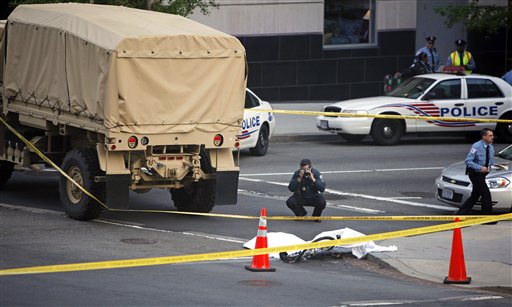
In the middle of last month, a colleague of mine, a writer, was run over by a five-ton military truck on a public street in Washington, D.C. Patrons at a restaurant nearby—it was dinner time, about 6 p.m., a nice day to dine outside—said the sound of her getting crushed beneath the wheels was stomach-sickening. She was sixty-eight years old and riding a bicycle, less a block from work. She wrote about lots of hard-core science and had been at the magazine since 1970, and so was well known; Francis Collins commented on her death. She also edited a breezier news section called Short Cuts, and I think she would have enjoyed and appreciated 3QD—she painted seriously on the side, and played music.
I admit I knew her (I’ll call her T.) less well as other people where we used to work together. And yet the news still stunned me. Stunned me in that way when everything gets very quiet and your focus narrows severely and you can suddenly concentrate very, very hard. Or rather, everything else seems to fall away, because what you’re concentrating on just doesn’t make sense, doesn’t jive with what was, until just then, real. D.C. has a pretty abysmal record of bikers and pedestrians getting run over by careless buses and trucks—the number of ghost bikes around town (memorials, painted white, one for each victim at the site of an accident) gets eerie. But T. died because people took far too much care, in the empty name of security.
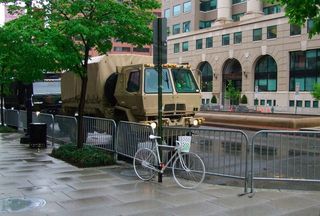
You see, her workplace had the misfortune of being a half mile from the Washington Convention Center, where dozens of world leaders held a profoundly unproductive nuclear security summit in April. The big outcome, as you undoubtedly heard, was that all parties present denounced terrorism as “one of the most challenging threats to international security” and decided that it would be idea to make sure terrorists cannot get nuclear materials, starting in four years. Of course, they agreed to this in a non-binding resolution, so even that milquetoast agreement means little. Maybe, just maybe, a lot of the real work of international disarmament did get done those two days behind the scenes, and perhaps the summit sowed the seeds of future accords. But from all appearances, it achieved even less than the Copenhagen Climate Change Conference last year.
Regardless, with dozens of heads of state present, you might have heard that security was wound extremely tight around the Convention Center. And much of that security—pat-downs, metal detectors, armed guards, strict ID access at each entrance—was unquestionably prudent. But Washington also decided to put a tourniquet on the neighborhood surrounding the Convention Center, shutting down dozens of streets and intersections. And mind you, the Convention Center sits in a residential neighborhood, with row homes and apartment buildings and coffee shops and pet stores. But the Secret Service and other protective branches of the government erected 10-foot riot barricades to block access for blocks all around. And like something out of an old Eastern Bloc country, people had to show IDs to one of the hundreds of uniformed, gun-toting guards on the street corners to get into their homes at night, and anything they bought and tried to bring back into their homes was subject to search and presumably seizure. According to the Washington Post, the uniformed authorities even took it upon themselves to “screen anyone on the ‘outskirts’ of the security zone who ‘appears suspicious.’ ” People trying to get to work had to provide Social Security numbers and let their backgrounds be picked apart, or they couldn’t work. At one point I heard rumors (I live on the outskirts of the security zone) that the Secret Service was knocking on people’s doors and fitting them with arm bands, or people wouldn’t be allowed to return home for two days. I don’t think that happened, but the fact that people thought it credible shows you lockdown mentality.
Nor did the harassment stop at the edge of the security zone. It bled all over town, with the police and National Guard shutting down long stretches of streets and sidewalks for sporadic motorcades. Now again, I’m objecting here to the restrictions placed on people walking. Because, to be fair, it makes sense to clamp down on some things—as the near-bombing in Time Square last week showed, vehicles can conceal dangerous things. So shut down car traffic, by all means. But a pedestrian ten or more fucking blocks from the Convention Center, someone trying to walk home hours after the summit supposedly shut down for the night, obviously wasn’t going to do a lot of damage.
And yet there the police were, erecting more (albeit smaller) metal barriers, and bullying people out of the crosswalks and back to the curbs even a mile away from the summit. This was perhaps the worst part of the spectacle, how the feds co-opted local police officers—many of them young, a fair number of them minorities—to do the really crummy jobs of yelling at pregnant women and people in wheelchairs and the elderly and infirm that they had better not step off that curb again and better had keep quiet. For twenty minutes stretches, nothing would happen—no motorcades would come down the empty street—but we still couldn’t pass, and had to stand and watch the empty streets as these policemen checked their radios, a few wanting to let us go, but none daring to disobey orders.
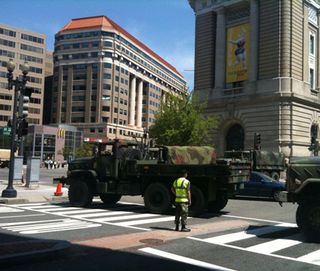
And I haven’t even mentioned the Tiananmen-like display of heavy trucks grinding their gears through the streets and blocking off some intersections. Trucks like the ones that crushed T.
It’s not surprising this happened in Washington, given the ridiculously elaborate security detail our Presidents have. I’m not talking about the heavies with sunglasses and earpieces. They have a function. I’m talking about the dozens of black SUVs and police cars that shut down major thoroughfares every time the President wants to escape for a sandwich, and the way the Secret Service practically condemns a three-block radius if the President has to enter a building. Not long after Obama’s inauguration in January 2009, an acquaintance told me that for the first time she was happy to see the motorcade tearing through town; she no longer felt an uncontrollable urge to flip it off.
I laughed, but was less sanguine, no matter who the motorcade escorted. At the time, I thought the motorcades merely tiresome, and silly. Because face it: If someone wanted to commit a crime again the President’s body, he (or she) could probably do so. He wouldn’t get away with it, and he would die for it, and, in American minds, he’d end up in the same circle of Hell that Dante reserved for Judas, Brutus, and Cassius—but it could happen. And the whole dreadfully expensive security detail for the President is predicated on ignoring that reality. But the Nuclear Summit security situation showed that mentality isn’t just silly—it actually causes danger, it actually introduces hazards. Again, heads of state obviously need some protection, like bodyguards; but it was just as obvious to anyone who tried to get within a mile of the Convention Center last month that security had spilled over into paranoia. To the point that military personnel were so worried about getting their trucks into the proper place that they crushed a 68-year-old woman on a bicycle five blocks from the nearest point you could have spit on the Convention Center.

Now, I should make it clear here that I don’t know the details of how T. died. I wasn’t present. It could have been something simple, and sad—perhaps a frightened young kid in the National Guards (it was a Guards truck) saw T. and panicked and hit the gas instead of the brake. Perhaps T. was brazenly running a red light or swerved into the truck’s ways. Perhaps when the truth comes out, we’ll see a series of unlucky events, an unfortunate but excusable death. Then again, the military hasn’t tried to explain anything yet. And given the recklessness and disregard for the security and privacy of regular people that characterized the rest of the scene, I’m dubious.
Of course, you could argue that the fact that no terrorists attacked the Convention Center those two days in April proves that all the security worked. But you could use that same logic to give the security detail credit for preventing a rash of tiger or pirate attacks. And all jokes aside, it ignores the fact that, for T. (right, a self-portrait), the security itself was a deadly, blundering force.
Posted by Sam Kean at 12:40 AM | Permalink


Comments
It's rare when I can agree with practically everything written in an article, and yet disagree vehemently with the drawn conclusion. T.'s death is a tragedy, one of many such seen on the streets every day. But I fail to see, from the writer's long tirade against strict security procedures, how her death was any different than a biker run over by a car, or a delivery truck. I wholeheartedly agree about security turning into paranoia. I agree that roadblocks and security checks turn policemen and soldiers into oppressors, whether they want to or not. As an Israeli, I see this process on a far greater magnitude, I see how fear and security concerns can turn an entire country paranoid and turn teenagers into violent authoritarians. But still, I fail to see how this perfectly justified rant is linked to T.'s death, other than to take her tragedy and use it to augment its potency. Her death can just as easily by attributed to consumerism, which fills our roads with delivery trucks, carrying products for all those pet-shops and cafés. It can be attributed to road-rage and the state of anxiety in the country, due to the economy or anything else. But T. was not killed by a security checkpost or by an overzealous bodyguard. She died because a truck driver made a stupid, tragic mistake.
Posted by: Avner | May 10, 2010 8:02:13 AM
To Avner: was there some part of the phrase "five-ton military truck" you failed to understand?
Posted by: David Ker Thomson | May 10, 2010 12:49:53 PM
First, why the anonymity? A quick google search gives her name. Second, this is a strange argument: They should use less security because having more large trucks on the streets increases the probability that a cyclist will get hit by one. What is that probability? "The commanding general of the DC National Guard says nothing like this has ever happened before."
What conclusions would you draw if a cyclist got hit and killed by a large dump truck in D.C.?
Posted by: billy | May 10, 2010 3:36:52 PM
Controversy set aside
This is the kind of excellent stuff one gets from a daily visit to this superb site. To me 3QD is my ‘daily intellectual bread’.
Posted by: Felix E F Larocca MD | May 10, 2010 4:04:45 PM
Is this essay about why a particular cyclist died, or about whether we are spending a lot of money, and sacrificing lives and liberty, on things which do not make the average citizen safer? If you think it is the former, I suggest you should read again more carefully.
Posted by: Vicki Baker | May 10, 2010 4:28:09 PM
Of course the added security wasn't about the "safety of the average citizen"--it was about protecting the leaders from terrorist attacks. Yes, some liberty is sacrificed, but even Sam thinks that's needed--he's just think it's too much. Do you think we shouldn't sacrifice any liberty?
But sacrificing lives? I only read about one life lost in this article, and it was simply a tragic accident. There's no lessons to be learned from it.
Posted by: billy | May 10, 2010 5:18:26 PM
One possible lesson: perhaps the military should not be deployed in US cities. Though this is a lessons Americans continue to resist, despite the attack on the Bonus Army, Kent State, etc. Apparently the truck was there to stop traffic. Talk about overkill.
Posted by: giotto | May 11, 2010 1:13:47 AM
The tragic death of this cyclist may have been a result of the militarisation of Washington. Nontheless I think that road safety for cyclist is such a universal issue in major cities that this essay was a poor way to highling this (if that were the intent) as being tightly linked to unsafe military vehicles. The causes are sometime totally benign, The previous mayor of London had a policy of replacing traditional double decker buses with more disability friendly, 60+ foot long "bendy buses", from which the drivers found it hard to see cyclists and were thus frankly lethal. Turning Washington into a fortress sounds like an estremely bad thing in and of itself but the safety of cyclists in major cities is a problem that cannot be necessarily be blamed on the army alone. Whether this was the writer's intention, based on this essay alone, it is hard to say.
Posted by: Martin | May 11, 2010 6:05:17 AM
I read the bare facts of the accident on a bike blog, but nothing about the cyclist herself, so I appreciate the remembrance. Though I don't see much connection to the lockdown either, I was not aware things in DC had gone that far, so I appreciate that information, too.
Posted by: Donal | May 11, 2010 10:23:34 AM
I see Avner's point, David.
Yes, it was a military truck. But that does not mean "security" caused the accident, any more than we could say that "environmentalism" caused the accident if the victim is struck by an alternative fuel public bus. There are accidents with all kinds of vehicles- and Sam does not pass judgement, noting that it may have been the bicyclist's fault.
If there's any lesson to be learned here, it's that we should all try to ride and/or drive safely. But I hope we already know that.
Posted by: Swami | May 11, 2010 12:25:12 PM
A really beautiful essay, Sean, thank you. As a bicyclist who has braved D.C.'s streets and seen them change into a theater of near-martial law, I appreciate your way of drawing attention to all this.
Posted by: Nathan Schneider | May 11, 2010 4:54:42 PM
The power of the essay for me isn't in any conclusion about militarization or cycling safety. It's the image itself that stirs me: the juxtaposition of five ton military truck with 68-year-old writer on bicycle. Those two entities, each a character of immense and different might, in the same space at the same time. In this case, tragedy stops the movement, frames these creatures in a still-life: the graceless taupe hulk stalled behind the lifeless cyclist, so powerfully fragile in her human vigor. But what if each had gone on its way?
It is fitting that the writer reminds us of the trajectories involved.
Posted by: Quince Mountain | May 11, 2010 7:40:10 PM
Post a comment