| ABOUT US | ARCHIVES | LINKS | RSS FEED | MONDAYS | |

3quarksdaily

An Eclectic Digest of Science, Art and Literature

« Perceptions | Main | Fighting fungibility, changing the definition of marketing and putting Dylan against the Monkees: Colin Marshall talks to writer, speaker and "Agent of Change" Seth Godin »

April 05, 2010

Henry Moore: Tate Britain, London

ID_091 Sue Hubbard

ID_080 When Henry Moore's sculptures were first displayed, they were considered so shocking, says the art historian Hilary Spurling that opponents not only daubed them with paint but decapitated them.  Yet during the 20th century Moore’s work became so ubiquitous within the public domain that familiarity bred a benign contempt.  From Harlow New Town to Hampstead Heath, from the UNESCO building to the Lincoln Centre every new ‘modern’ public building had to have its signature Moore.  Nowadays there is a tendency to see him as an avuncular Yorkshire man, with an ee-by-gum accent, who made sculptures with holes in the middle that became the easy and acceptable face of modern art, much lampooned in the cartoons of the late lamented satirical magazine Punch. How did this shift from earthy radical to the country’s artistic maiden aunt come about? A revaluation of Moore’s work at Tate Britain attempts to redress this balance.

It is hard for those born in the last 30 years, who have lived through the technological change and economic prosperity of the Thatcher and Blair years, to imagine a post war Britain; grey and ground down by bombing and rationing, a mono-cultural society where white skins predominated, the class system prevailed and poverty was, for many, a daily reality. Divorce was rare, sex outside marriage kept secret and homosexuality a criminal offence. After all, according to Philip Larkin, who was then a young poet:

''Sexual intercourse began
In nineteen sixty-three
(Which was rather late for me) —
Between the end of the Chatterley ban
And the Beatles' first LP.'' (1)

This was a country where the food was bad, central heating unknown and, as the wonderful painter the late Prunella Clough once told me, no one was much interested in ‘modern art’, so that a black and white photograph of a Korean pot on the front of The Studio magazine was considered rather bold. Moore’s gently rounded female forms; his family groups, mothers and children abstracted from natural shapes - rocks, pebbles and bones – can all too easily seem to us, now, as they sit in their city centres and sculpture parks, as easy, undemanding and quintessentially English. Pastiche examples of his work abound in every little St. Ives craft shop and gallery. And yet this exhibition reveals a Moore who is darker, edgier and altogether more radical than these seemingly familiar images would suggest.
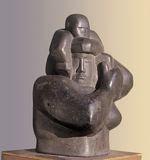
ID_001It has become the norm in this depoliticised, postmodern world to assume an urbane insouciance towards both politics and culture, a wearily sophisticated ennui where, at best, things are seen as ironically amusing, a little shocking (if, indeed, shock is still possible) or simply not relevant to our immediate pragmatic or consumerist concerns. Yet in the 1920s and 1930s, when Moore began to make his mark, the world was very different.  After the nadir of the Great War civilization appeared to be in crisis and a sense of trauma and shock prevailed. “Paralysed force, gesture without motion” as T. Eliot wrote in The Hollow Men. Not only had worst war in human history just ended, but another lurked on the horizon. The mood was anxious, philosophical and inward looking; psychoanalysis was in vogue, as was ‘primitive’ art. The writings of Joseph Conrad and D. H. Lawrence had created associations between the female, the primitive, sexuality and death. A study of the ‘primitive’ was to enter, as Picasso found when trawling through the exhibits in the Musée d’Éthnographie at the Trocadéro in Paris, into dark, liberating realms. ‘Primitives’, as Marianna Torgovinick writes (2)  were equated with “our untamed selves, our id forces – libidinous, irrational, violent, dangerous.” Whilst for those of us born since the war and touched by the awareness of post colonial studies, such views might seem a little essentialist, at the time they were radical; a reaching towards freer connections with the body and sexuality outside the dictates of constrained social mores. The primitive equated not only with subterranean Freudian drives, but also with Jungian ideas of the timeless archetype.

Moore claimed not to be particularly interested in psychoanalysis, only getting half-way through the first chapter of The Archetypal World of Henry Moore, Eric Neumann’s 1959 Jungian study of his work. But he did understand his own obsessions and that “there is no doubt a deep psychological exploration of the fascination of the hole”, not just because of it obvious erotic connotations but because of it its return to the atavistic and the chthonic. As the critic John Berger observed of Moore’s work in the 1950s, “one can’t go back further than he has”. Whilst Moore said of his figures “I suppose [they] could be explained as a ‘Mother complex’. In fact, what he seems to have been doing is discovering new ways to illustrate what it meant to experience a body from the ‘inside’ – its urges, its desires, its vulnerabilities and pre-linguistic memories - rather than as something simply observed from the outside by another. In Moore’s hands the body becomes less an object and more of a site for psychological investigation. In his Suckling Child 1930, the mother’s body has been reduced – abstracted - to a pair of Kleinian ‘good’ and ‘bad’ breasts. The featureless maternal shape is simply a mammary site to fulfil the child’s libidinous demands. Moore’s mothers and children return us not only to a Rousseau-like sense of origins, but become catalysts for self-exploration. Mother and Child images represent something like a quarter of Moore’s work. He saw it as “a universal theme from the beginning of time”, addressed in Western art by the Madonna and Child, as well as in carvings from other cultures such as Africa and North America.
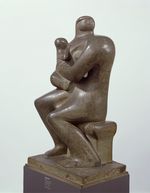
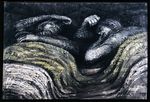
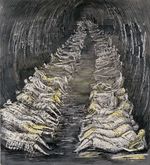
ID_032 Before he became known as an artist revered for his grand (and some might argue of the later work, grandiose) archetypal human forms that graced such places as Lucio Costa’s 1960s modernist utopia, Brasilia, Moore produced some of his most outstanding work in the form of prints and drawings. The pivotal moments that shaped this work were the Spanish Civil War (1936-9) and the Luftwaffe’s bombing raid on London in 1940-1 when he was moved by “an extreme experience of peril”. On the way home to Belsize Park, Moore and his wife witnessed, from the interior of a Northern Line underground train, the crowds seeking shelter on the platforms from the mayhem above ground. Huddled beneath blankets, these reduced forms inspired a series of drawings and sketches that would embody a sense of British resilience against Nazi aggression, as well as, intuitively, prefiguring the abject figures to be found during the Liberation at death camps such as Auschwitz.  Like a vision of Dante’s Inferno, Moore portrays the odoriferous slum dwellers, the small shop keepers and the bewildered children of the London poor like ghosts; ectoplasmic images of death and putrefaction that seem to have been reduced to little more than x-rays. In a 1983 interview in The Washington Post he recalled the spectacle on the tube platforms: “they bathed and undressed their children as though they were in private. And, oh! The stench –very unsanitary conditions. It struck with me – the sight of it.”

ID_115

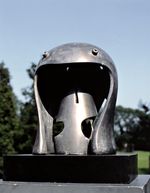
Born on the 30th July in Castleford, Yorkshire, the son of a miner and the youngest of seven, when his mother “was no longer so very young,” Moore was always political and his views can be seen as the key to much of his art. Against the backdrop of the First World War he read Thomas Hardy, Dostoevsky and D.H. Lawrenece. Between 1917-18, he enlisted and served on the Western front, where he was gassed during the battle of Cambrai. In 1921 he became a student at the Royal College of Art. He travelled to Paris and Italy and met T.S. Eliot and E. M.Forster. But he remained true to his roots, solidly on the left; some even claim a communist sympathiser. More likely he was a humanitarian, galvanised in his political beliefs by the plight of the urban poor and the rise of totalitarian Fascism in Spain and Germany. In the 1950s the existential anxiety generated by the nuclear threat of the Cold War lead to him to create works such as Helmet Head No 1. 1950. A founding member of the Campaign for Nuclear Disarmament in 1958, his Falling Warrior was proposed by the writer and critic John Berger as the organisation’s emblem. Like Giacometti, Moore wanted to create figures that embodied fragmentation and anxiety, that were not part of the classical tradition but symbols of eroticism, irrationality and disharmony. As with Giacometti his ideas were linked to those of Georges Bataille and to the surrealist movement, and he was to add his name to various political tracts issued by the British Surrealist Group.

ID_143

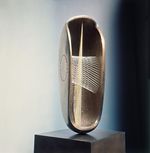
ID_113 For us, a generation so used to post 60s freedoms, where sexual imagery seeps from every hoarding, computer and TV screen, it is hard to appreciate that Moore’s figures were a reversal of Enlightenment ideas of progress, a reframing of the Cartesian split between the mind and body, where new attitudes towards bodily urges and sexuality were placed back centre stage. In his works the body, as well as the psyche, are reconnected to the mystical, the irrational and the largely repressed. Many of his sculptures – especially those that use string or wire to create tension between revealed and enclosed spaces – exhibit the sense of anxiety and entrapment associated with the troubled 1930s and the Cold War, as well as a personal existential angst. In such works as Head and Ball 1934 or the Fourpiece Composition Reclining Figure 1934 in Cumberland alabaster, the fragmented forms speak implicitly of dismembered war torn bodies, metaphors that embody the anxiety of yet another global conflict.

ID_052

In many ways Moore has suffered from his own success. His later works became de rigour for so many new public spaces, and lost, in their capacity as official ‘modern art’, much of their early edginess and physicality, which owed a good deal to the investigations of Freud and Jung, as well as anthropologists such Margaret Mead and Malinowski. This Tate exhibition ends around the middle of the 1960s, when it might be argued that Moore’s work began to lose touch with its roots, and become increasingly self-referential. For many it became the ‘acceptable face’ of  20th century art that would soon be supplanted by the anarchy of Pop, performance and conceptual art. Yet if we bother to look at Moore's early work with an historic eye, rather than through a postmodern lens, where glittering surfaces have replaced troubling depths, and understand something of the atmosphere of those grim and tragic times in which he worked, his oeuvre begins to look like a challenge to reason; a celebration of the uncanny, the unconscious and the absurd. His figures of the human body became sites to explore the loosening of rigid social ties and generations of strict repression. From now on it would mean that from Doctor Spock’s liberal ideas on potty training, to the Beat generation’s embrace of easy sexuality, art and society would never be the same again.


1. Philip Larkin (1922-1986), British poet. (Written June 16, 1967). Annus Mirabilis, st. 1, High Windows (1974)

2. Marianna Torgovnick. Gone Primitive: Savage Intellects, Modern Lives (The Uinversity of Chicago Press) 1990


LIst of images from top:

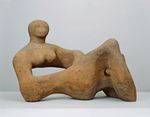
1. Recumbent Figure 1938. Tate

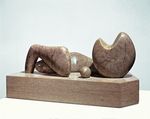
2. Stringed Figure: Bowl 1938 (cast 1967). The Henry Moore Foundation

3. Mother and Child 1924-25. Manchester City Galleries

4. Mother and Child 1932. Robert and Lisa Sainsbury Collection, University of East Anglia. Photo: James Austin.

5. Two Sleepers in Undergoround 1941. Thomas and Anthea Gibson

6. Helmet Head No 1 1950. The Henry Moore Foundation. Photo: Michael Muller

7. Tube Shelter Perspective: The Liverpool Street Extension 1941. Tate

8. Four-piece Composition. Reclining Figure 1934. Tate

All images reproduced by permission of The Henry Moore Foundation.

Tate Britain, London 24th February - 8th August and touring to Art GAllery of Ontario, Toronto and Leeds Art Gallery, Leeds.

Posted by Sue Hubbard at 12:21 AM | Permalink

Comments

I grew up with Henry Moore in the sculpture garden -- no, not mine -- in distant Texas. He and Philip Johnson were the face of progressive art and architecture then, and some of us Texans embraced that in a big way. Each of them epitomizes parental taste, and more than that about a thing, I usually don't want to know. It's preserved in amber -- who's even worried about it anymore? So it's really WILD to be provoked into re-examining Henry Moore -- many thanks!

Posted by: Elatia Harris | Apr 5, 2010 12:58:28 AM

I enjoyed this provocative essay, but frankly there's something so backward looking about Moore that really bothers me-- after all, all these supposedly radical moves already had been proposed and promulgated two generations earlier. That's why he became and remains an establishment icon.....

Posted by: sunil rashel | Apr 5, 2010 5:48:40 AM

Henry Moore`s work doesn`t interest me that much. His achievement is largely that he managed to distort the figure without a hint of violence.....but then again Arp did that in a far superior and economic way.
Writing from Japan,
Moore`s work seems particularly irrelevant. As a painter, I see it very much as the stuff you trip over in the gallery as you stand back to see the paintings...to paraphrase a typically acid remark made by Ad Reinhardt.
I once saw a small Moore retrospective in the Maeght Foundation in Saint Paul-de-Vence some time in the 80`s and left, quickly, choking with boredom and frustration at the `Englishness` of it all, which was painfully exposed by being displayed in rooms adjacent to galleries hung with work by significant European Modernists. I took refuge over a brandy in a nearby bar and dispersed the boredom by recalling a comment written,I think, by John Berger that Moore`s entire oeuvre could be summed up in two pages from one of Picasso`s 1930`s sketchbooks.
That aside however, this is an excellent essay by Sue Hubbard. She attempts and is partially successful at re-assessing Moore`s work, at least in his early career, in the context of anti-Enlightenment modernism which is driven by a sense of the primitive and all the rawness that implies. I particularly warm to the argument that the early work, made in the shadow of mechanised world conflict, contains a disbelief in the idea of human progress. Clearly Moore sold out fairly quickly to the Establishment. Ms. Hubbard acknowledges this. My only issue here would be when he sold out. Given this, the author might be intrigued by the fact that in 1919 Moore was invited to tea in Downing Street by then Prime Minister, David Lloyd-George.The sculptor was 21.

Posted by: Fred Crayk | Apr 7, 2010 5:47:42 PM

In many ways I do not disagree with Fred Crayk. The point and purpose of this essay was to look at Moore afresh, rather than to 're-establish' him. For far too often we look at artists through the distorted lens of history, unable to see what was originally fresh about their work. I would agree that Moore's later work became unimaginative and corporate, but I would still argue that early on he was motivated by ideas of the primitive, of psychoanalysis etc. It is always dangerous for artists to flirt with the establishment. Whatever may once have been original is in danger of being lost in a welter of official approval. Many of the YBAs have suffered this fate.

Posted by: Sue Hubbard | Apr 8, 2010 5:41:25 AM

Post a comment


Subscribe to this blog's feed  

PayAnywhere with iphone credit card swiper

Android Tablet

Bluetooth Headset

2013 New Style Dresses

Compare Car Rental Prices

DHgate.com Wholesale

3QD on Facebook

3QD on Kindle

3QD by Daily Email

Receive all blogposts at the same time every day.

Enter your Email:


Preview 3QD Email

3QD on Twitter

Miscellany

Lijit Search

AddThis Social Bookmark Button

Add to Google

Recent Comments

carlos on The Gut-Wrenching Science Behind the World’s Hottest Peppers

Dredd on A young Houston couple is planning to give away $4 billion—but only to projects that prove they are worth it. Can they redefine the world of philanthropy?

Dredd on Why Rational People Buy Into Conspiracy Theories

JonJ on Daniel Dennett's seven tools for thinking

JonJ on Race Is Not Biology

omar on Race Is Not Biology

omar on Race Is Not Biology

Dredd on Race Is Not Biology

Dredd on Race Is Not Biology

allsmiles on A Mother, a Son and a Wife

sverson on Race Is Not Biology

carlos on Daniel Dennett's seven tools for thinking

araldo on Race Is Not Biology

jo smith on Daniel Dennett's seven tools for thinking

Louise Gordon on Why race as a biological construct matters

Louise Gordon on Race Is Not Biology

Dave on Race Is Not Biology

Bill on Daniel Dennett's seven tools for thinking

Boursin on Why Rational People Buy Into Conspiracy Theories

Usha Alexander on Race Is Not Biology

Abbas Raza on Daniel Dennett's seven tools for thinking

X on Race Is Not Biology

Usha Alexander on Race Is Not Biology

jo smith on Mohsin Hamid: 'Islam is not a monolith'

araldo on Mohsin Hamid: 'Islam is not a monolith'

Acclaim For 3QD


"I couldn't tear myself away from 3 Quarks Daily, to the point of neglecting my work. Congratulations on this superb site."—Steven Pinker, Johnstone Professor of Psychology, Harvard University.

"I have placed 3 Quarks Daily at the head of my list of web bookmarks."—Richard Dawkins, Charles Simonyi Professor of the Public Understanding of Science at Oxford University.

"Just wanted you to know I’m one of many who reads and enjoys 3 Quarks....almost daily."—David Byrne, musician, former lead-singer of the Talking Heads, artist, intellectual.

Read more here.

The 3QD Prizes

Subscribe to this blog's feed