
| ABOUT US | ARCHIVES | LINKS | RSS FEED | MONDAYS | |

3quarksdaily

An Eclectic Digest of Science, Art and Literature

« Scientists Explain How Males Evolved From A Self-Fertilizing "Third Sex" | Main | In Disobedient Rooms: China Mieville on J.G. Ballard »

March 31, 2010

The Fate of Angkor as Told by Tree Rings

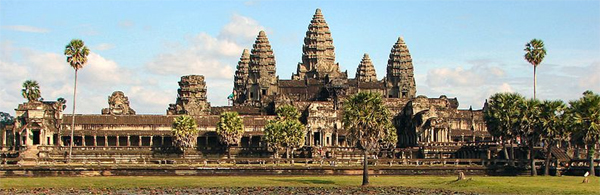
Angkor

Ed Yong over at his blog Not Exactly Rocket Science:

Today, the city of Angkor in Cambodia lies in ruins. But a thousand years ago, life there was very different. Then, Angkor was the heart of the Khmer empire and the largest preindustrial city of its day. It had a population of a million and an area that rivalled modern Los Angeles. And the key to this vast urban sprawl was water.

Radar images of the city by the Greater Angkor Project (GAP) revealed that Angkor was carefully designed to collect, store and distribute water. The “Hydraulic City” included miles of canals and dikes, irrigation channels for supplying crops, overflow channels to cope with a monsoon, massive storage areas (the largest of which was 16km2 in area), and even a river diverted into a reservoir. Water was the city’s most precious resource, allowing it to thrive in the most unlikely of locations – the middle of a tropical forest.

But water, or rather a lack of it, may have been part of Angkor’s downfall. Brendan Buckley from Columbia University has reconstructed the climate of Angkor over the last 750 years, encompassing the final centuries of the Khmer Empire. The records show that Angkor was hit by two ferocious droughts in the mid-14th and early-15th century, each lasting for a few decades. Without a reliable source of water, the Hydraulic City’s aquatic network dried up. It may have been the coup de grace for a civilisation that was already in severe decline.

Many theories have been put forward for the downfall of Angkor, from war with the Siamese to erosion of the state religion. All of these ideas have proved difficult to back up, despite a century of research. Partly, that’s because the area hasn’t yielded much in the way of historical texts after the 13th century. But texts aren’t the only way of studying Angkor’s history. Buckley’s reconstruction relies on a very different but more telling source of information – Fujian cypress trees.

Posted by Robin Varghese at 11:22 AM | Permalink

Comments

Post a comment


Subscribe to this blog's feed  

PayAnywhere with iphone credit card swiper

Android Tablet

Bluetooth Headset

2013 New Style Dresses

Compare Car Rental Prices

DHgate.com Wholesale

3QD on Facebook

3QD on Kindle

3QD by Daily Email

Receive all blogposts at the same time every day.

Enter your Email:


Preview 3QD Email

3QD on Twitter

Miscellany

Lijit Search

AddThis Social Bookmark Button

Add to Google

Recent Comments

carlos on Daniel Dennett's seven tools for thinking

araldo on Race Is Not Biology

jo smith on Daniel Dennett's seven tools for thinking

Louise Gordon on Why race as a biological construct matters

Louise Gordon on Race Is Not Biology

Dave on Race Is Not Biology

Bill on Daniel Dennett's seven tools for thinking

Boursin on Why Rational People Buy Into Conspiracy Theories

Usha Alexander on Race Is Not Biology

Abbas Raza on Daniel Dennett's seven tools for thinking

X on Race Is Not Biology

Usha Alexander on Race Is Not Biology

jo smith on Mohsin Hamid: 'Islam is not a monolith'

araldo on Mohsin Hamid: 'Islam is not a monolith'

Dr. X, Ph.D. on Race Is Not Biology

jo smith on Physicists Create Quantum Link Between Photons That Don't Exist at the Same Time

jo smith on Mohsin Hamid: 'Islam is not a monolith'

omar on Why race as a biological construct matters

Dr. Smith on Race Is Not Biology

Sundar on Daniel Dennett's seven tools for thinking

Sundar on Daniel Dennett's seven tools for thinking

Sundar on Why race as a biological construct matters

Sundar on Race Is Not Biology

Joel Grant on Why Rational People Buy Into Conspiracy Theories

khaled on Evolution shapes new rules for ant behavior

Acclaim For 3QD


"I couldn't tear myself away from 3 Quarks Daily, to the point of neglecting my work. Congratulations on this superb site."—Steven Pinker, Johnstone Professor of Psychology, Harvard University.

"I have placed 3 Quarks Daily at the head of my list of web bookmarks."—Richard Dawkins, Charles Simonyi Professor of the Public Understanding of Science at Oxford University.

"Just wanted you to know I’m one of many who reads and enjoys 3 Quarks....almost daily."—David Byrne, musician, former lead-singer of the Talking Heads, artist, intellectual.

Read more here.

The 3QD Prizes

Subscribe to this blog's feed