
| ABOUT US | ARCHIVES | LINKS | RSS FEED | MONDAYS | |

3quarksdaily

An Eclectic Digest of Science, Art and Literature

« What the Internet Will Mean for Journalism and Journalists: Insights from the Edge | Main | The pope's entire career has the stench of evil about it »

March 15, 2010

Rousseau Meets Japanese Primatology

by Frans de Waal

Yesterday in a restaurant in Tokyo, someone at the table next to us lit up a cigarette. I asked my Japanese host if no one ever asked smokers to go outside. His answer took me by surprise: one is not allowed to smoke on the street. Inside is fine, outside is wrong. It's the opposite of what we are used to in the West.

The point is not so much the reason for the Japanese rule (which is that a walking smoker often holds his or her cigarette at children's eye level, hence may accidently blind a child - apparently, this has happened!), but the fact that cultural differences often baffle us. This is because we assume our own perspective to be the only one that matters or makes sense. The same applies very much to my field of primatology, which owes much to Japanese pioneers.
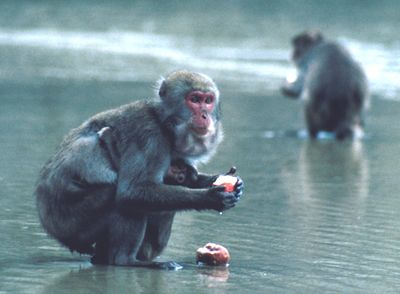
Potato Today I met in Kyoto with my old friend Toshisada Nishida, who is a student of the late Jun’ichiro Itani, who in turn was the most prominent student of Kinji Imanishi, the founder of Japanese primatology. Imanishi was interested in the connection between primate behavior and human evolution well before Louis Leakey and others in the West, and had fewer inhibitions to speculate about it. In 1952, when European ethologists still worked on instinct theories and American behaviorists still trained rats to press levers, Imanishi wrote a little book that criticized the view of animals as mindless automatons. He inserted an imaginary debate between a wasp, a monkey, an evolutionist and a layman, in which the possibility was raised that animals other than ourselves might have culture. The proposed definition of culture was simple: if individuals learn from one another, their behavior may, over time, become different from that in other groups, thus creating a characteristic culture. Soon thereafter, his students demonstrated that the potato washing started by a juvenile female monkey on Koshima Island spread to other members of her troop. The troop had developed a potato washing culture.  [Photo, taken by the author, shows Japanese macaques on Koshima Island are still washing potatoes half a century later.]

Imanishi was also the first to insist that observers give their animals names and follow them for years so that they understand their kinship relations. His concepts are now all around us: every self-respecting field worker conducts long-term studies based on individual identification, and the idea of cultural transmission in animals is one of the hottest topics of today. But that is now: at the time, all Imanishi got was ridicule.

In 1958, he and his students toured American universities to report their findings. They encountered a great deal of skepticism about the ability of mere humans to distinguish between all those monkeys, which all look alike. Weren’t the Japanese grossly overestimating the social lives of their monkeys, and who said that monkeys could tell each other apart even if human observers said they could?* Also, what about the humanizing inherent in giving names to animals: hadn't they heard that scientists need to keep their distance?

Only the greatest American primatologist of the day, Ray Carpenter, saw the point and became a staunch supporter of Japanese primatology. He visited Japan three times, and within a decade the practice of identifying primates individually had been adopted at Western primatological field sites from Gombe Stream to Cayo Santiago.

In another little-known example, Western and Eastern scientists held contrasting expectations about our closest animal relatives, the great apes. Until well into the 1960s, the Western view was positively Rousseauian: apes were autonomous “noble savages,” free of social ties and obligations. They didn't need each other and traveled in haphazard combinations from one fruit tree to the next. The ever-changing parties of chimpanzees that researchers encountered in the forests of Africa seemed to confirm that they lacked any social coherence.

While Western scientists described female chimpanzees and their dependent offspring as the only bonded units, Nishida's team worked under quite different assumptions. How could a species that supposedly fills the gap between ourselves and other animals have no complex social life, they wondered. Should't they have a community life, like us? Eventually, through persistent field observations, they cracked the puzzle and showed that chimpanzees live in large communities with a stable membership. The male-bonded society of the chimpanzee is now taken for granted, but the initial discovery came out of a firm conviction that chimpanzees could not be nearly as “individualistic” as Western science had made them out to be.

To understand how this “alien invasion” of ideas could have taken place under our noses, we need to look at Eastern culture, and also appreciate how linguistic monopoly affects science.
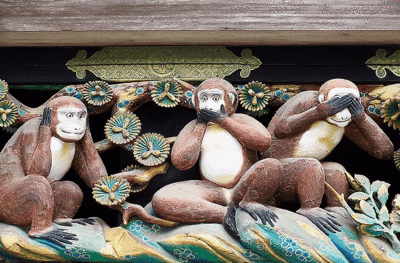
ScreenHunter_03 Mar. 14 18.35Plato’s “great chain of being”, which places humans above all other animals, is absent from Eastern philosophy. In most Eastern belief systems, the human soul can reincarnate in many shapes and forms, so all living things are spiritually connected. A man can become a fish and a fish can become God. The fact that primates, our closest animal relatives, are native to many Eastern countries, has only helped to strengthen this belief in the interconnectedness of life. Unlike European fables, which are populated with ravens, rabbits, foxes and the like, Eastern folk tales and poetry are laced with references to gibbons and monkeys. The three wise men, or magi, of the Bible are matched in the East by the three wise macaques of Tendai Buddhism (of “See no Evil, Hear no Evil, Speak no Evil” fame).  [Photo shows the three wise monkeys in a carving at the Toshogu Shrine.]

Feeling humility towards animals affects the way we study them. If we believe the soul can move from monkey to human and back, there are no grounds for resisting the idea that we are historically connected. So, it’s hardly surprising that evolution was never controversial in the East: it was a logical and welcome thought. As Itani put it, “Japanese culture does not emphasize the difference between people and animals and so is relatively free from the spell of anti-anthropomorphism”.

The lack of credit for the Japanese approach (most treatments of animal culture either forget to mention Imanishi or, worse, claim that the studies of potato-washing were naive and ill-conceived) can be partly attributed to the language barrier. It is just hard for non-English speakers to make themselves heard in an English-speaking world.

Since English is not my native tongue, I am familiar with the effort involved in writing and speaking another language -- even though my native Dutch is probably the closest another language can come to English. Scientists from other places have to make ten times the effort. English itself is of course not the problem: It is not better or worse than any other language. The problem is the attitude of native English speakers.

Naturally, you speak your own language faster and better than any other. This can make it impossible for those who are not native English speakers to keep up at international meetings. It is worse on those occasions when an English speaker doesn’t pull any punches while debating with a scientist whose English is poor.

I have seen it happen often. The English speaker rises from the audience, articulates a penetrating question, sometimes with a joke mixed in, and barely takes the time to listen to the clumsily phrased reply of his opponent. Since English speakers dominate every discussion, they form a class of great minds strutting around in the secure knowledge that no one will challenge them.

Good ideas formulated in bad English either die or get repackaged. It is a bit like a Hollywood remake of a French play such as La cage aux folles: its origins are immediately erased once it's called The birdcage. One reason Eastern thinking could creep into the study of animal behavior unnoticed is that it filtered into the literature through awkward formulations and translations that native English speakers found it easy to improve.

In a way, it is delightful to see how views that were clearly at odds with the traditional Western dualism could slip into our thinking. It helped us chuck out some of our cultural baggage. At the same time, however, the way it happened hints at the difficulties other cultural and linguistic groups experience when they seek a voice in science and gain proper acknowledgement.

Each culture is too wrapped up in its own relation with nature to step back and see it as it is. To gain a full picture requires all kinds of scientists, who together take on a task equivalent to comparing the images in a range of fun-house mirrors. Somewhere in that heavily distorted information resides the truth.

*There is now abundant experimental evidence that monkeys and apes tell each other apart and have excellent face recognition skills, which engage similar areas of their brains as our own face recognition.

Frans de Waal is a professor of psychology and director of the Living Links Center at Emory University, in Atlanta. He is a new guest columnist at 3QD [see our About Us page for more] and is currently traveling in Japan to promote his latest book The Age of Empathy.

Posted by S. Abbas Raza at 01:50 AM | Permalink

Comments

Dear Dr. de Waal,
I have been a longtime admirer of your superb work in socio-biology, particularly your sophisticated research and writings on the Bonobos. I am delighted to see your article on 3quarksdaily. I had no idea about the pioneering contributions of the Imanishi group until I read this article. Thank you for acknowledging their critical role in defining the social lives of our closest cousins and also for exposing the harm that a linguistic monopoly of science can cause. Even as English is not your mother-tongue, your writing is brilliant and enchanting. I look forward to reading more from you on this blog.
Azra.

Posted by: Azra Raza | Mar 15, 2010 5:43:46 AM

An unexpected Moday treat from 3QD!

Posted by: Felix E F Larocca MD | Mar 15, 2010 8:23:16 AM

Thank you for this interesting read. I have actually learned something in the time it took me to finish my morning cup of coffee.

Posted by: Margit | Mar 15, 2010 8:24:04 AM

beste frans de waal,

3quarksdaily is mijn lievelingsblog op het wereldwijde web en u bent een lievelingsbioloog van me. als ik u bioloog mag noemen...

dat u hier nu verschijnt, doet me dus deugd.

fred dijs

ps
translation in bad english:

dear frans de waal,

3quarksdaily is my favourite blog and you are one of my favourite biologists. if i may call you a biologist...

so i am very happy with your appearance here and now.

fred dijs

Posted by: fred dijs | Mar 15, 2010 9:06:48 AM

Excellent article! Animal culture is a bit of a no-brainer if one does not have a Cartesian attitude to animals.

Posted by: Mike Cope | Mar 15, 2010 9:11:51 AM

Dear Dr De Waal:

Welkom hier by 3QD. Ek is Afrikaans en skryf ook hier in Engels. Maar ek het nooit gedink dat ek myself ooit in dieselfde plek as u sou bevind.

Your writing on those hedonistic Bonobos made you my favorite scientist. I actually wish us humans were more like Bonobos than chimpanzees.

I cannot believe that the 3QD folks have landed you here. Congratulations all around.

Evert

Posted by: Evert Cilliers | Mar 15, 2010 9:28:14 AM

Frans,

Thanks for recounting this instructive bit of ethological history. Your musings about the linguistic domination of one culture over others has set various trains of thought in motion in my head. Here's one: in the expected economic competition among India and China in the coming decades, India may have an advantage through its British colonial history: familiarity with English. And this is not limited to just scientific/technical stuff, but perhaps as importantly, India may be the only country for which it is possible to challenge the cultural hegemony of the United States. (Think pop music, movies, video games, etc.) Already Bollywood productions are becoming near-Hollywood quality, for example.

Anyway, thanks.

Posted by: Abbas Raza | Mar 15, 2010 9:42:37 AM

A fascinating essay to think about all day and for many days. Wonderful for us to have Dr. de Waal here. What a coup, Abbas! You can pick 'em!

Posted by: Elatia Harris | Mar 15, 2010 10:43:29 AM

Wonderful essay. Will look forward to a lot more from Professor De Waal.

It's worth noting that animals are referred to as "it" in English. To this day, I can not bring myself to say that. Animals are always "he" or "she" for me even when I cannot for sure determine his/her gender.

Posted by: Ruchira | Mar 15, 2010 11:12:30 AM

Thanks!
I've had enough of Karen Armstrong.

Posted by: Dave Ranning | Mar 15, 2010 11:33:40 AM

so where does this leave us on primate experimentation?

Posted by: eli | Mar 15, 2010 12:04:59 PM

Thank you for your wonderful insight.

Posted by: Zarahn Southon | Mar 15, 2010 1:49:20 PM

Dear Dr. de Waal:
I've been an admirer of your work on primatology for several years. It's great to see you posting in one of my favorite web sites. Your contribution is taking 3qd to new heights.

Abbas: Congrats!!

Posted by: Pepito | Mar 15, 2010 4:46:34 PM

Is the 'great chain of being' really associated with Plato? According to my (admittedly poor) recollection it is a Christian idea. Belief in re-incarnation was not alien to the Greeks: it was a tenet of Orphic religion and Pythagoreanism. If I remember correctly (see above caveat), Plato himself believed in spiritual reincarnation (isn't there something about this at the end of the Republic?), though I don't know about interspecies transmission - certainly that was accepted by the Pythagoreans, and was supposed to form the foundation of their commitment to vegetarianism.

Posted by: Vesuvium | Mar 15, 2010 4:53:56 PM

I was just listening to Melvyn Bragg's show on the infant brain (http://www.bbc.co.uk/programmes/b00r2cn4), and one of his guests was explaining how recent studies have shown that six months old babies had no problem at all distinguishing the faces of individual monkeys. Fun that the issue should pop up here.

Posted by: Bryon | Mar 15, 2010 5:59:12 PM

Each culture is too wrapped up in its own relation with nature to step back and see it as it is. To gain a full picture requires all kinds of scientists, who together take on a task equivalent to comparing the images in a range of fun-house mirrors. Somewhere in that heavily distorted information resides the truth.

Touché! It made me recall my recent">http://blog.shunya.net/shunyas_blog/2009/06/the-orangutans-of-sumatra.html">recent visit to the Gunung Leuser NP on Sumatra, and the fact that “orangutan” literally means “person of the forest”, indicative of an entirely different relationship to animals and nature in many eastern cultures than western/monotheistic ones. No wonder, indeed, that the theory of evolution causes almost no anxiety in the east.

This essay also illustrates how cultural presuppositions are inseparable from our investigations of nature, that ontology (in this case our a priori view of 'animal nature') underlies the questions we ask, the answers we get, and what we make of them. Even categories like “reason” and “logic” are inseparable from culture (or metaphysics, more generally), a point so often missed, including by so many self-avowed rationalists.

Posted by: Namit | Mar 15, 2010 6:00:28 PM

Dear Frans,

Wonderful to see your first essay here! I hope everyone will read the Age of Empathy, which is a very encouraging book.

Posted by: Louise Gordon | Mar 15, 2010 7:05:06 PM

Dear Namit,

What you've written may be true, with the exception of Native American cultures, destroyed by the Wild West:


Nature and Native American Cultures

The Native American view of the relationship between the "Me" and "Not Me" is famously illustrated in the speech of Chief Luther Standing Bear of the Ogala Sioux:

We did not think of the great open plains, the beautiful rolling hills, and winding streams with tangled growth, as "wild." Only to the white man was nature a "wilderness" and only to him was the land "infested" with "wild" animals and "savage" people. To us it was tame. Earth was bountiful and we were surrounded with the blessings of the Great Mystery. Not until the hairy man from the east came and with brutal frenzy heaped injustices upon us and the families we loved was it "wild" for us. When the very animals of the forest began fleeing from his approach, then it was that for us the "Wild West" began.

Posted by: Louise Gordon | Mar 15, 2010 7:17:27 PM

Very nice article Frans! Sorry I missed your visit to Japan this time, but as usual your sensitivity to other cultures and to primatology in Japan hits upon an important topic dead center!

Posted by: Mike Huffman | Mar 30, 2010 10:08:32 PM

Post a comment


Subscribe to this blog's feed  

PayAnywhere with iphone credit card swiper

Android Tablet

Bluetooth Headset

2013 New Style Dresses

Compare Car Rental Prices

DHgate.com Wholesale

3QD on Facebook

3QD on Kindle

3QD by Daily Email

Receive all blogposts at the same time every day.

Enter your Email:


Preview 3QD Email

3QD on Twitter

Miscellany

Lijit Search

AddThis Social Bookmark Button

Add to Google

Recent Comments

Norman Costa on The Bystander Effect in Medical Care. Why Do I Have So Many Doctors Not Taking Care of Me?

Hannah Carlton on POETRY IN TRANSLATION: CORDOBA

Joe on Digging Up Bones or, The Labyrinths beneath Our Feet

JonJ on The Beautiful German Language

cpfaff on Passionate About The Actor's Art: an interview with Michael Howard

Sumiran on Sunday Poem

Ethan on Getting Smarter

Pacificklaus on NORTH KOREA’S NERVE WAR

Félix E. F. Larocca, MD on POETRY IN TRANSLATION: CORDOBA

Shane on That's not music – that's just noise!

seth edenbaum on Habermas, Adorno, Politics

Raza Husain on If Only We Had A Leader Like Chavez, Who Solved Real Problems -- Instead Of Debating Fake Ones Like The Deficit

Raza Husain on Think About Nature

Raza Husain on Getting Smarter

johnnyred on Getting Smarter

Lou on Throwing away ancient wisdom, painting with sound and staying awake: a conversation with radio dramatist and ZBS Foundation president Thomas Lopez

Sundar on If Only We Had A Leader Like Chavez, Who Solved Real Problems -- Instead Of Debating Fake Ones Like The Deficit

flowers rainbows on Lift up your voices: The century-long battle for women's freedom

mr.ed on wagner in new york?

mirel on Here’s how to change the world

mirel on If Only We Had A Leader Like Chavez, Who Solved Real Problems -- Instead Of Debating Fake Ones Like The Deficit

X on Getting Smarter

Ross Williams on Getting Smarter

oroboe on Lennon's "Imagine" and McCartney/Wings' "Band on the Run" overlaid: One way of reuniting (some of) the Beatles

Richard H. Randall on Obama must Make Fighting Climate Change National Project, or Die the death of a thousand Scandals

Acclaim For 3QD


"I couldn't tear myself away from 3 Quarks Daily, to the point of neglecting my work. Congratulations on this superb site."—Steven Pinker, Johnstone Professor of Psychology, Harvard University.

"I have placed 3 Quarks Daily at the head of my list of web bookmarks."—Richard Dawkins, Charles Simonyi Professor of the Public Understanding of Science at Oxford University.

"Just wanted you to know I’m one of many who reads and enjoys 3 Quarks....almost daily."—David Byrne, musician, former lead-singer of the Talking Heads, artist, intellectual.

Read more here.

The 3QD Prizes

Subscribe to this blog's feed