
March 01, 2010
Psychological Science: Sigmund Freud – A Personal and Scientific Coward? Part 2
by Norman Costa
Part 1 of “Psychological Science: Sigmund Freud – A Personal and Scientific Coward?” can be found HERE.
Note: Sources for this article, Part 1 and Part 2, can be found at the end of this article.
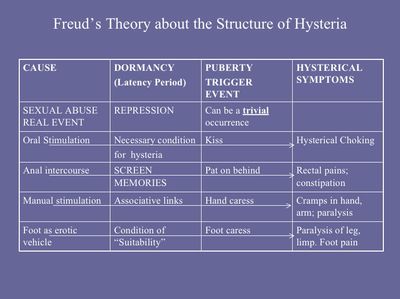
Questions, Questions, Questions!
In Part 1 of this article, I posed three questions:
1. How did Freud, with his collaborator and mentor, Joseph Breuer, and independent rival, Pierre Janet, discover the traumatic basis of hysteria, as well as its treatment?
2. Why did Freud repudiate his findings on the traumatic basis for hysteria?
3. In the face of his prior scientific investigations, how did Freud come to develop psychoanalysis? And to develop a psycho-sexual theory of development based upon the inferiority, mendacity, and erotic fantasies and desires of women?
I provided answers to the first two questions in Part 1. Here, in Part 2, I deal with the third. Freud repudiated his theory of the traumatic aetiology of hysteria, but as a scientist he still had to account for his data. The problem one confronts in finding an answer to the third question is this: How does one go from Freud's observations and recorded data to the theory of the Oedipal Complex – the cornerstone of his psycho-sexual stages of personality development, and psychoanalysis?
Sigmund Freud was a life long student and reader of the great works of his time, and of history. He knew the ancient mythologies of Greece and Rome, the Greek playwrights like Sophocles and Aeschylus, and the works of the Greek philosophers like Plato. He studied the Torah and Talmud, and read and quoted the plays of William Shakespeare from the age of eight. He was also an exceptionally gifted writer. Critics and scientists, with both great admiration and a justified “cutting-him-down-to-size,” have commented on his tremendous gifts as a writer. Central to Harold Bloom's views of Freud is the following: “For many years I have taught that Freud is essentially prosified Shakespeare: Freud”s vision of human psychology is derived, not altogether unconsciously, from his reading of the plays.” Bloom notes, also, that
Throughout his lifetime, Freud considered himself a scientist doing proper science. Supporters and critics alike cede to each other that Freud understood the philosophy of science, the experimental method, the concept of falsifiability, and science's foundation in empiricism. Yet, he believed psychoanalytic psychotherapy was properly the purview of lay psychoanalysts. Freud never forgave the American medical community for embracing psychoanalysis, as he felt the practitioner should be outside the sciences of medicine and biology.

Getting from Point A to Point B
This brings us back, however, to how Freud got from his research data on hysterics (point A) to the Oedipal Complex (point B.) Since it takes a gifted literary mind and writer to span this chasm – one that science could never traverse - then where did the literary metaphors originate? Freud's tripartite, and reified, division of personality, Id, Ego, and Superego, analogizes directly to Plato’s dialog, “Phaedrus.” The dialog features a charioteer and his team of horses, one white and the other black. The white horse was well behaved, well bred, and needed little coaxing by the driver. The black horse was ill tempered, badly behaved, and poorly bred, requiring great control and exertion by the charioteer. This was Socrates' model of the human soul, or psyche. In the vernacular of Freud's structure of personality, the black horse was the Id, the white horse the Ego, and the Charioteer the Superego.
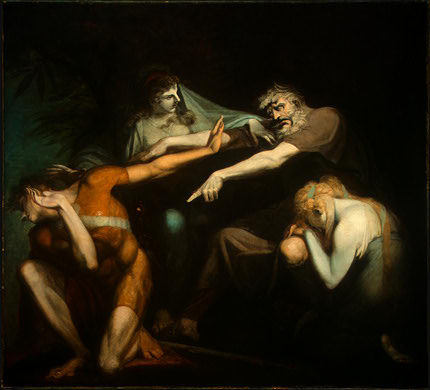
The most important, and by far the most powerful, metaphor for Freud was the Oedipal Complex. Without the Oedipal Complex there is no psycho-sexual theory of development, no tripartite division of personality, no psychoanalysis, and no Freud. Where did the Oedipus Complex originate? It originated with Shakespeare's ambivalent character, Hamlet. More accurately, it originated with Hamlet, as interpreted by Freud. Sophocles' play, “Oedipus the King,” was not the inspiration for Freud. Rather, “Oedipus the King” was the closest fitting literary metaphor he could attach to his understanding of the Dane, with whom Freud identified, strongly.
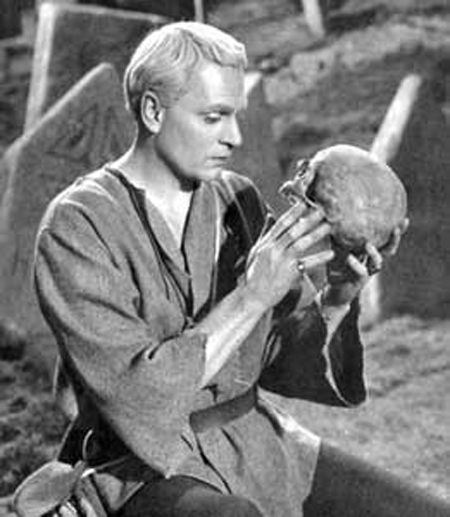
First came Hamlet, followed by the Oedipus metaphor – the fit is strained, if not illogical. It's a match that demands assumption, followed by assumption, followed by interpretation, followed by assumption, etc. This is a near perfect example of an argument that doesn't even come close to Occam's description of an acceptable simple explanation. At the very least, Oedipus has no knowledge that the man he killed is his father, nor that the king's wife is his own mother. For Hamlet, his own father is dead, killed not by Hamlet, but by Hamlet's uncle, Claudius. The only event that was near incestuous – but not really – is Claudius marrying his brother's wife, Gertrude. The Dane had two charges from the ghost of his bellicose father: Avenge his father's murder, and bring no harm to his mother. The only one he manages to murder, at the end, is his uncle; but only after his mother is dispatched, accidentally, with a poisoned drink. Bloom wonders why Freud adopted the name “Oedipal Complex” when, more rightly, he should have labeled it the “Hamlet Complex.”
Some people have, and will continue to have, great difficulty in reevaluating the Oedipus Complex in light of its origin in Hamlet, and the very imperfect correspondence of the two. This is because the genius of Freud, the writer, has forever insinuated the Oedipal Complex into the DNA of western, if not all of, modern civilization. Everyone knows Freud, and understands the Oedipal Complex – even the great masses who have never read Shakespeare or Freud or Sophocles. It is my personal view that the non-readers, especially, credit themselves with great insight and understanding on all subjects Freudian. It is the predicted outcome of the Dunning-Kruger Effect. As illogical as it sounds, it's a daunting task to reassess the purported Oedipal nature of Hamlet's conflicts and internal struggles, and reassess the manifest clarity of the metaphor of Sophocles' character. How can one discard an explanation that is so obvious on its face. Can it be any more clear that a rereading and reinterpretation are hardly worth the effort? The idea is imparted in milk for the infant, and particulate matter in the air we breathe.
I repeat myself, with cause: How does one go from Freud's observations and recorded data to the Oedipal Complex, the cornerstone of his psycho-sexual stages of personality development, and psychoanalysis? The answer is very simple. You don't, and you can't, unless you are as creative, imaginative, broadly educated, and skilled in writing with the genius of Sigmund Freud. His genius and intelligence did produce worthy ideas that survive to present day practice. For the most part, Freud's theories have not survived the rigors of research studies over the past six or seven decades. However, some of the vocabulary associated with his theories survives in the contemporary lexicon, but with different interpretations.
Oh Why, Oh Why, Oh Why?
Oh, and let's not forget that along with means and opportunity, Freud had the motivation to fly his metaphors over the gap, and a very significant motivation at that. Why Hamlet? Why Oedipus? Why abandon the trauma theory of hysteria? Why did Freud discredit his own patients? Why interpret every objection of his patients as proof of the validity of his own interpretations?
1. In Part 1, I discussed the possibility that Freud and his siblings were abused by his father (see Kupfersmid, below) and that he could not deal with matters that were obviously repressed.
2. There is the possibility that the objective realization of the frequency of horrible sexual abuse in the population was beyond comprehension.
3. Freud was met with hostility and shunning within his professional community, and from his colleagues.
4. Freud's professional career and livelihood were tangibly and seriously in jeopardy.
Freud's own motivations are the stuff of a century of literary and psychological analysis and debate. It is not possible to arrive at a final word on the matter. The best one can do is put forward as reasonable an explanation as possible, accept that others will proffer their own interpretations, and possibly ridicule one's own.
One might allow that Freud's own abuse, and not unreasonable incredulity give him a free pass from our harshest criticism. Freud's doubts, and ambivalences toward his own traumatic theory of hysteria was emerging late in the game, at the same time as he was formalizing and publishing his great contribution to the scientific literature. In my view, it was as if his self doubt and denial were a direct result of being so close to the truth of the traumatic aetiology of hysteria. Possibly, he was getting too close to the repressed memories of his own abuse. The closer he got, the more difficult it was to sustain adherence to his trauma theory and to the awful truth. Joel Kupfersmid (1992) argues that
All Freud needed to sustain his work on the trauma theory, in my opinion, was a gesture of validation from his professional colleagues. Breuer and Freud's colleagues not only let him down, they dismissed him, and were hostile toward him. Breuer, his collaborator and mentor, was especially cruel on this with his remark to Freud, “All the same, I don't believe it.”
Explaining Freud's buckling under the recriminations from his colleagues is a different matter. Freud's career, livelihood, and professional standing were in serious jeopardy. Understanding Freud's reaction to the threat, however, requires the acceptance of a simple, but important, fact. Freud was a snob and elitist (see Bloom, below.)
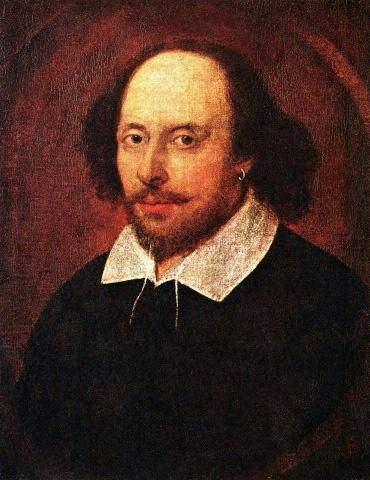
Why Hamlet? If you are a snob and elitist, why not Hamlet? Hamlet is the most intelligent of all of Shakespeare's characters. In Hamlet, Shakespeare creates the self-reflective man who can become interior and evaluate his own motives and actions, as no one did before. It is unreasonable not to expect Freud to identify with the Prince of ambivalence. In “Shakespeare: The Invention of the Human,” Bloom says, “No single character in the plays, not even Falstaff or Cleopatra, matches Hamlet's infinite reverberations.” P. 384. Again he says,
Hamlet resonates with everyone. It is universal, and so it was with Freud. As with the rest of us, Freud played out his own motivations in the never equaled, one-size-fits-all Hamlet. Analyzing Freud, vis a vis his identification with Hamlet, is to engage in the same projections and internally consistent tautologies that Freud was wont to do. We may or may not be any better at it than Freud, but we do it anyway, as I am about to do. In my view, it is not an accident that Freud identifies with literature's most intelligent character, one who is of royal blood, written by the greatest writer in western civilization, and who is face to face with fecundity and evil in the greatest conflict of his life – a matter of life, death, honor, and duty for a non-confrontational, non-warrior-like, but clever, reflective bookworm. Is this Hamlet or is it Freud?
Harold Bloom adds to the characterization of Freud as snob and elitist by pointing to Freud taking many ideas from Shakespeare, yet not wanting to share the credit with Shakespeare. This led Freud, in Bloom's view, to an exaggerated sense of his own importance as a solo inventor, and dismissing Shakespeare's contribution to the development of the psychoanalytic view of man. Bloom said in “The Western Canon”:
Strangely, Freud signed on to the theory that the Earl of Oxford, and not the son of a glove maker, was the actual author of Shakespeare's plays. If Freud was going to get his ideas from Shakespeare, then it's preferable to have the 'real' Shakespeare be of noble birth. Bloom's thesis is clever, and I like it, but it's not without its critics. Suffice it to say that there was plenty of evidence that Freud was very ambitious, and he saw himself as not exactly like the rest of us.
The most telling evidence of Freud's snobbery and elitism, as well as an indicator of the intellectual posturing and hocus-pocus surrounding early psychoanalysis, was that Freud and his theories became a cult of discipleship. Membership and good standing were contingent upon acceptance of dogma. Disagree and out you go. It's interesting that those early adopters of Freudian psychoanalytic theory, who later developed different ideas, or proposed elaborations upon psychoanalysis, or simply disagreed, were considered to have “broken off” or “broken away”' from Freud.
Personal and Scientific Coward?
I am very much tempted to label Freud a personal coward for his retreat from the traumatic origins of hysteria. What argues against Freud is the fact that Janet, unlike Freud, did not put his ambition ahead of his integrity and the well being of his patients. If it were clearly and solely the ambition, prestige, money, and power that associate to success in a respected profession, there would be no discussion. But, if the hypothesis is true that Freud, himself, was a victim of sexual abuse (along with his siblings), then his profound denial is not a character flaw as much as it is an expected outcome that is necessary to his psychic survival. As a result, I can't make the case for his being a personal coward.
In my opinion, Freud cannot escape being seen as a scientific coward. He had no excuse, since he positioned himself, his entire career, as a scientist doing science. There is no question he understood what science was and how it was conducted. As a scientist he had an obligation to explain his data, if he wanted to continue research in the same line of inquiry. He slandered his clients with charges that had no supporting evidence, whatsoever. His only claim to authority was his own sexism and that of his larger male culture. He proposed theory and explanations based purely on literary metaphors and the analogizing of observed behavior (more like personal interpretations) to the metaphors. This is perhaps literature, or speculative theory, but it is not science.
What especially works against Freud is that there were numerous situations in which he did behave like a scientist. He modified his thinking, or discarded a view on the basis of new data or the lack of expected findings. But, he was selective about what was deserving of objective analysis and what was not. Judith Herman was kind to Freud in saying that he, as a lone scientist, cannot shoulder the entire blame in the absence of political or cultural support for changing old ways of thinking. I am not as kind because Freud did influence the entire world, over the course of a few generations, in so many areas of work, art, literature, medicine, social behavior, mental health, education, religious thought, and personal morals
The result of abandoning the traumatic origins of hysteria meant that women (and men) were to suffer, needlessly, for another 100 years, after the cause (traumatic sexual experience) and treatment (a safe place, recovering repressed memories, talking out the detail of both events and affect), had already been discovered. Science, politics, and medicine did not bring an end to 2,500 years of blaming women for the pain that is delivered upon them everyday in every country in the world. It was women, themselves, in the feminist movement that called him out.
Note: Below are the principal sources for this article.
Judith Herman MD. “Trauma and Recovery”
Sigmund Freud. “Studies on Hysteria”
Sigmund Freud. “The Aetiology of Hysteria”
Harold Bloom. “The Western Canon”
Harold Bloom. “Shakespeare: The Invention of the Human”
Paul Robinson. “Freud and His Critics”
Irme Salusinzky. “An Interview with Harold Bloom”
Thank you very much for reading. Please offer your comments, below, and join us for a discussion. I'll see you again on Monday, March 29, 2010.
Posted by Norman Costa at 12:20 AM | Permalink


Comments
I'd have to say this is weaker than the first half of the article. The first half started from the label "coward" but worked back into some of the particular decisions Freud had to make, allowing us to think of his patients and others whom he affected directly. This one includes some factual material, but retreats into labels.
Posted by: Acilius | Mar 1, 2010 8:40:48 AM
Acilius,
Thanks for taking the time to read and comment. Yours is a good observation.
I think it's clear what my views are, but what about yours. How do you see Freud? What's your interpretation of the man? In light of this article, has anything changed in your assessment of him?
I'm not looking to argue or convince, only to know your views. Thanks again.
Posted by: Norman Costa | Mar 1, 2010 12:54:34 PM
Sigmund has been dead for almost 75 years, so neither sticks and stones nor name-calling will hurt him much at this point. But those interested in the history of ideas should take the story presented here with a grain of salt. Freud did not theorize that hysteria was the result of trauma (that was Charcot, and even he came to have his doubts), and therefore could never have turned away from such a theory, in cowardice or otherwise. Rather he wrote, in describing the theory he would quickly come to repudiate, that hysteria was caused by "sexual experiences in childhood consisting in stimulation of the genitals, coitus-like acts," and that "infantile sexual experiences are the fundamental precondition for hysteria." (my emphasis)
Sexual experiences in childhood are, of course, deeply traumatic, and they do lead to a wide range of emotional problems. But there is a diffrence between saying that sexual abuse causes hysteria, and all hysteria derives from sexual abuse. Seduction theory was a development of the latter idea, not the former. And it was never causally tied to trauma generally (as it was in Charcot's theory.)
Nor did Freud publish any compelling scientific data to support Seduction Theory. Certainly it is likely that many of his patients had been abused in childhood--sexual abuse is all too common. But seduction theory was predicated on the notion that all hysteria was caused by a sexual transgression. This is unambiguous in the Aetiology. And while Judith Herman would like to redefine hysteria as PTSD, it's clear from Freud's own writings that he meant Seduction Theory to apply to all neurotic pathology generally.
The reason Freud abandoned this theory was that he realized it was too restrictive, that it was possible to suffer from hysteria (even in the limited PTSD sense) without childhood sexual experiences. As Kurt Eisler wrote (note the appeals to scientific standards)
Freud needed another explanation for why his patients tended to discuss their parents in sexual terms, and hypothesized that this represented a feature of unconscious fantasy. The function of the "Oedipal Complex" was to concretize children's taboo sexual desire for their mothers, and competitive hostility for their fathers. Of course this has the demerit of only being coherent for (presumably heterosexual) males, as later theorists pointed out. But it was a first step in constructing a meaningful model of the psyche, something nobody had undertaken before.
The price of this was, perhaps, high. Women who actually were abused in childhood ran the risk of being disbelieved. Though Herman does not have any specific evidence of this happening, it is still a statistical probability. But it is a bit of an overstatement for her to write that psychoanalysis "was founded in the denial of women's reality." The primary insight of psychoanalysis was that fantasy is not a matter of "internal vicissitudes ... dissociated from the reality of experience," but rather that it is a kind of map to that experience. There is no evidence that this insight has been harmful to women, on the balance. Certainly Freud's early, reductionist modeling of it was crude, but so were the first iterations of medical procedures that we laud today. Few of us would submit to be stuck with the first hypodermic needle or fitted with the first prosthetic teeth. But we don't wish to return to the medicine of Galen and Hippocrates just because their successors were at first imperfect.
Posted by: Chris Schoen | Mar 1, 2010 6:37:11 PM
@Norman Costa: Thank you for your very courteous reply.
I'm certainly intrigued by your point about Shakespeare's influence on Freud. I'm a Classicist by occupation, and have always suspected that Freud's references to Greek legends were a bit stretched. I think you've made a good point in this wise. Perhaps he really was thinking of Shakespeare and was appealing to the ancients as a way to avoid invoking an Englishman. Considering the political climate in Vienna in those days, it may well have been the better part of valor not to advertise one's admiration of any English writer.
As for the question of why Freud revised his theory of the origin of hysteria, I suspect you are right that his motives were not such as could be defended before a medical ethics board. The theory he abandoned seems to fit the evidence far better than the one he adopted, while the theory he adopted fitted his professional ambitions.
But I do wonder just what point there was in the sort of undaunted scientific honesty the canons may have demanded of Freud. As I mentioned in my comment on your previous post, a Freud who persisted with flinty determination to press the case that "hysteria" was a sign that the patient had been subjected to sexual abuse would be shunned not only by his colleagues and fashionable society, but would most certainly have been avoided by any patients unwilling to face the fact that they had experienced such abuse. If walking into Dr. Freud's office meant admitting that one had been sexually abused as a child, that office might never have welcomed a patient whom a heroically truthful Freud could have helped.
Posted by: Acilius | Mar 1, 2010 8:17:57 PM
I'm writing a new essay. It's called: "Euclid: A Geometric Coward"
It goes like this: we all know Euclid postulated that two parallel lines will never meet. Yet we also now know, because we have invented trains, that if you stand on some train tracks the two parallel edges of the track will converge in the distance.
I maintain that Euclid only held to his postulate because, in his childhood, he had been sexually molested by a crazed newt (see Smyth 2005, "Euclid Molested By Newt?").
I conclude that Euclid should be banished from the geometry textbooks for this cowardice.
Posted by: Nick Smyth | Mar 1, 2010 8:57:25 PM
In my opinion, Dr. Costa assumed a hefty and (I might add) courageous, intellectual burden, when he placed Freud on the witness stand on his two excellent articles about the man and his ‘discoveries’.
I agree, the first one we read was the one of the Great Expectations, while the second one turned out to be anticlimactic by comparison.
But to me, that does not lessen my positive reaction to both papers.
However, there are other considerations to take into account while I speak on the subject.
Since Jeffrey Mousaieff Masson wrote his famous book The Assault on Truth, things have not been the same neither for the truth nor for avowed loyalties, when what it’s to be served is the ego and to judge Freud’s contributions to Hysteria.
On these matters I take a different stance bolstered by the teachings of luminaries like Paul McHugh who, along with others, doubts the existence of hysteria in the Freudian sense as stated in his book Try to Remember…
Hysteria, that romantic Victorian metaphor, has become a thing of the past thanks to the so-called ‘architects’ of DSM-ETC.
So, that no one in this day and age, would attempt to restore it to the main stream of psychiatric knowledge.
But if the desired task is the vilification of Freud, then the book to read is Sigmund the Unserene by Percival Bailey.
However, if it is to revise one’s opinion on Freud’s intestinal fortitude, Costa offers a challenge.
For having accomplished his goals, at least with me, I am satisfied.
Kudos to you Dr. Costa, from a reformed renegade (oxymoron and all).
Posted by: Felix E F Larocca MD | Mar 2, 2010 11:22:17 AM
Dr. Larocca,
Thank you, again, for your kind words, your views, and taking the time to offer your comments.
I deliberately stayed away from referencing Masson. While he has some worthy criticism for us to consider, he has gone 'over the top' in some of his "Assault on [Freud] Truth." So, I didn't want to associate myself with his more extreme views.
I use the sub-chapter "The Heroic Age of Hysteria" from Judith Herman's book, "Trauma and Recovery," for my psychological research methods classes. Of course, I present my assessment of Freud, which is almost the same as that of Herman. The main point I wish to make with my research students, however, is that TRUTH MATTERS in scientific research. I try to instill in them the serious obligation they have to the field and to society as social science researchers. When they are making research decisions or interpreting data, they must consider the consequences to society and to our profession. We cannot do 'pure' science in a vacuum apart from the rest of humanity.
While I have stated my view on Freud, I don't think the matter of his motivations regarding the repudiation of the trauma theory of hysteria will ever be resolved in final form. Yet, I believe it is a fit subject for discussion and deep thinking for each successive generation of scientists and practitioners.
Posted by: Norman Costa | Mar 2, 2010 5:25:01 PM
Nick,
Euclid repudiated his original theory of a third dimension. Ignoring evidence to the contrary, he stated that our true home is Flatland, and that the third dimension was a fantasy, a desire for an extra dimension as a compensation for feelings of inadequacy from being limited to Flatland.
Euclid accused most Flatlanders of 3D envy. The great woman scientist and mathematician, Hypatia, said only a plane geometer could invent something as ridiculous as 3D envy. Euclid did concede that sometimes a solid cylinder is just a solid cylinder.
Posted by: Norman Costa | Mar 3, 2010 12:50:01 AM
Or that sometimes a penis is just a cigar?
Or whatever...
Posted by: Felix E F Larocca MD | Mar 3, 2010 3:52:51 AM
Everyone,
For those interested in this subject, I found a biographical memorial to Percival Bailey (1892-1973), author of "Sigmund the Unserene", from the National Academy of Sciences. The URL is:
books.nap.edu/html/biomems/pbailey.pdf
I was not familiar with Bailey, a psychiatrist. His professional life is a story of a man who wanted to establish care and treatment of the mentally ill upon a foundation of research in the most advanced areas of medical science, and the training of better providers of mental health delivery. Though he was not as successful in his lifetime, he did contribute to the work of those who followed.
"...[H]e had been unhappy ... with the failure of his efforts to bring neuroanatomy, neurophysiology, neurochemistry, neuropathology, medical neurology, and neurological surgery together into one discipline in our universities. Bailey was ahead of his time.
"Bailey was a scientist—a seeker after truth by the establishment of facts and intolerant of dishonesty."
Thanks Dr. Larocca for citing his name in these comments.
Posted by: Norman Costa | Mar 3, 2010 4:13:19 PM
From mythology to . . . science! ;)
LA Times Editorial
DSM "Science"
Posted by: Louise Gordon | Mar 3, 2010 6:05:45 PM
I think Freud got numerous things wrong, but opened a door down a pathway where we needed to travel.
Along with Euclid and parallel lines, gravity is also multifaceted: Gravity
Posted by: Dave Ranning | Mar 3, 2010 6:52:09 PM
Once again, Dr Costa opened a new vista on Freud, both as a human being and as a historical figure.
An intellectual feat that not many can achieve as gracefully as he did.
In my opinion his two papers on Freud are not going to be soon forgotten.
Kudos again
Posted by: Felix E F Larocca MD | Mar 3, 2010 8:20:58 PM
Louise,
Thanks for the paper from Allen Frances. I was unaware that as the principal developer of DSM-IV (and a couple of prior releases) he had a few serious regrets about his prior work.
"Our panel tried hard to be conservative and careful but inadvertently contributed to three false "epidemics" -- attention deficit disorder, autism and childhood bipolar disorder. Clearly, our net was cast too wide and captured many "patients" who might have been far better off never entering the mental health system."
I am not in a position to evaluate this first draft of the DSM-V. However, having done plenty of applied research over the years, I agree that secrecy, as described by Frances, almost always works against a better outcome.
Another cardinal rule of mine is to involve ALL constituencies in the research development process from the very beginning. It's my understanding from Frances that the development committee is composed entirely of academic psychiatrists.
In my experience, a process that is open (not secret), and inclusive (not members only) is less efficient in terms of time, money, and iterations. The yield, however, is better quality and far more post-release support by ALL the constituencies.
What I've described is Research Project Management 101, as I've practiced it in industry and consulting.
Posted by: Norman Costa | Mar 3, 2010 9:30:15 PM
Norman,
What does that say about the validity or reliability of the DSM when even one of its chief developers is this critical?
In reading your last article on Freud, I was reminded of the fate of Ignaz Semmelweis in Vienna and wondered if it might have crossed Freud's mind. Difficult not to speculate.
I thought you might also be interested in this:
David Shenk
Posted by: Louise Gordon | Mar 3, 2010 10:41:40 PM
Norman, I wish there were going to be a Part 3 -- you seem to have assembled many of my favorite commenters.
Speaking as a neo-Freudian and a feminist, I have enjoyed this series. I admire Judith Herman tremendously and well remember the atmosphere into which she introduced _Trauma and Recovery_. The era was the perfect platform for her. I rather wish you had not skipped over Jeffrey Masson. Sure, he's a nut-bar -- but a nut-bar with many good points to make. Personal opinion only, but Freud has rarely had such an eloquent and imaginative detractor as Masson, whose background in psychoanalytic thought and practice is very deep.
One of the interesting aspects of this series is how it has made me long to go back to the books -- in so far as there's time for that in my life. When I comment, if I don't know it off the top of my head, then it doesn't get said. So this may be an error of memory, but I could swear the way Hamlet fixates on his mother's sex life and is intent on elbowing the man who's sleeping with her -- okay, not his father -- is an important aspect of the drama. I want to dig out a very old-fashioned book, _Hamlet and Oedipus_, by Ernest Jones, but I won't. What I recall with certainty is that anyone who wants a reading of Hamlet that suggests he has a rageful desire for Gertrude will find lines to support that reading. And, anyone wanting to contend that Hamlet more simply bears his mother no gentle love, would be horrified at the very idea of desiring her sexually, will find lines to support that point of view. Hamlet can't be figured, only interpreted. It's an infinite role. Any interpretation is allowed.
Close readers of _Oedipus Rex_ will remember that Jocasta twigs to the identity of Oedipus significantly earlier than the other way around. A brilliant characterization inheres in how she tries to cover this recognition over, and just...move on. It may be that Oedipus did not want to sleep with his mother as his mother, but he did inadvertently sleep with Jocasta, his mother. His tragic flaw was NOT sleeping with his mother, however -- breaking that taboo was just one thing that brought him down.
So, you are correct in your contention that there are not tidy parallels between _Oedipus Rex_ and _Hamlet_, and that Freud was being imaginative and literary. I believe, based on nothing more than reading, that the point of analytic thought on this subject is to explore the reverse side of taboo -- desire, that is -- and the tremendously powerful intertwining of the two, in literature and in life. It would have no power in literature if it did not compel in life. Literature is a kind of collective dream. And it is very real. Not just stories -- if you ask me. Freud was imaginatively plumbing these taboos at precisely the time society was least hospitable to his line of inquiry yet most ripe for being revolutionized by it. This is precisely what Judith Herman would later do.
The question whether Freud though medical doctors should be analysts is a fraught one. In 1916, he gave a series of lectures at Clark University in Worcester, MA -- it was an exposure to the United States that left him shaken. He did believe that psychoanalysis would founder on these shores, and observed that America was "a giant mistake." Many European women at the time were training as lay analysts -- I will always wonder what would have happened had their ascent not been co-opted by the American medical establishment.
Posted by: Elatia Harris | Mar 3, 2010 11:49:30 PM
Everyone,
Here is an interview (2000) with Psychiatrist Judith Lewis Herman. It was hosted by Harry Kreisler of the Institute of International Studies, Berkeley.
http://globetrotter.berkeley.edu/people/Herman/herman-con0.html
Dr. Herman's interview is a bit slow at first (she talks about her parents and their influence on her.) It picks up, though, when she talks about how she and her psychiatrists in training became deeply involved in Trauma. There are a couple of touching stories that she relates.
You can select the video on Youtube or a transcript. I recommend watching her on video.
Posted by: Norman Costa | Mar 4, 2010 3:10:22 PM
Louise,
You state: "What does that say about the validity or reliability of the DSM when even one of its chief developers is this critical?"
It says that the practice of diagnosis can be very tricky; and the problems of dealing with false positives, and false negatives, can be significant - very significant. Does this call into question the entire DSM-IV which has been used since 1994? Of course not. I'm sure you are not suggesting that the bath water have a baby in it when it gets tossed out.
Why should this be any different than a diagnostic manual for tropical diseases, or cancer? Is anyone questioning the validity of the diagnostic categories of ADHD, Autism, and Childhood Bipolar Disorder? ADHD is a legitimare disorder (now viewed as two disorders: ADD - Inattentive Type, and ADD - Hyperactive Type). The same goes for the other disorders.
Allen Frances talks about the problem of dealing with false negatives, and concern about missing patients that could benefit for therapies. He is very concerned about the erring on the side of false positives, as a general rule, in the draft of DSM-V. In the article you referenced, he believes that we will have far more unnecessary 'epidemics' with the policies of the present DSM-V committee. If true, this is very serious.
I am not being dismissive or discourteous when I repeat an early statement of mine. "Welcome to science." It doesn't get any better than this. What science has, unlike other fields of inquiry into understanding nature, is a self-correcting process that works over the long haul. If there is suspicion of problems with diagnosis using DSM-V, it will be research, observation, and measurement that will enlighten the process of doing something about it.
One could argue for a better process to monitor the DSM's use, especially in the early years following release. I think this would be a good idea. One thing I mentioned earlier, as well, is that the primary purpose of the DSM is research. We can't study anorexia nervosa, or schizophrenia, or dysthymia unless researchers in the field agree upon a definition that includes symptoms that can be observed, biochemical properties that can be measured, etc.
Posted by: Norman Costa | Mar 4, 2010 3:55:12 PM
Elatia,
My Goddess! Part 3? I am flattered, and thank you. This is all I can contribute to a discussion of Freud, at this time. Perhaps there will be a reason to revisit the subject - maybe going beyond Freud.
As for reading Freud, in your case it would be re-reading, I propose that Harold Bloom would suggest these:
1. The Interpretation of Dreams
2. Three Essays on the Theory of Sexuality
3. Inhibitions, Symptoms and Anxieties
4. Beyond the pleasure principle
Posted by: Norman Costa | Mar 4, 2010 4:18:49 PM
Norman,
I should re-read those. It was a lifetime ago that I thought I knew them. Alas, they are in deep storage -- along with much of what I've read. Deep storage in both personal RAM and hard copy.
One reason why reading Freud is a good idea is that any objections readers have can be articulated with the very source of offense in mind and in hand. Here as elsewhere, revisionism has been...not so good.
Posted by: Elatia Harris | Mar 4, 2010 8:20:33 PM
Norman,
I suppose I should be grateful for the fact that you've merely addressed me in a patronizing tone rather than suggesting that I resemble Sarah Palin, as you did last time we discussed this.
Be that as it may, I am of the opinion that the DSM, whichever version you choose, is largely a political document, not a scientific one. I know you disagree. No point really going round on this one again.
You write: "Why should this be any different than a diagnostic manual for tropical diseases, or cancer? Is anyone questioning the validity of the diagnostic categories of ADHD, Autism, and Childhood Bipolar Disorder? ADHD is a legitimare disorder (now viewed as two disorders: ADD - Inattentive Type, and ADD - Hyperactive Type). The same goes for the other disorders."
The difference is that the clusters of behavioral patterns or "symptoms" that you refer to as disorders are not diseases like tropical diseases or cancer. They are deviant or unwanted behavior that is considered abnormal. With the exception of autism, where do you have any evidence that the disorders you've listed correlate with any known physiological abnormalities or diseases? Or, let's put it this way. Was something wrong physiologically (as in tropical disease or cancer) with homosexuals while homosexuality was still listed as a disorder in the DSM, and then suddenly, the physiological disorder disappeared when homosexuality was no longer listed in the DSM? This is preposterous, yet you continue to tell me, Welcome to science.
You write: "We can't study anorexia nervosa, or schizophrenia, or dysthymia unless researchers in the field agree upon a definition that includes symptoms that can be observed, biochemical properties that can be measured, etc."
Where is anyone measuring biochemical properties in relation to schizophrenia and dysthymia? Urine tests, blood tests, spinal taps? What are you talking about? And while symptoms can be observed, collections of symptoms are not the equivalent of tropical diseases or cancer.
Posted by: Louise Gordon | Mar 4, 2010 8:49:48 PM
Louise,
I can't answer for Norman, but I have an observation to make. In trying to determine if a disease or a disorder is present, it's hard to know what the final word is when it comes to the brain. The organ affected is the organ that makes the decisions -- that goes for physicians and taxonomy freaks too.
I want to cite just two examples of recent research findings that point to physical causes for serious maladies. First, there is a certain very small area of the brain that is particularly associated with suicidality. Second, there is research to show that the brains of young people with schizophrenia didn't finish growing in a certain area. Where doctors once knew only behavioral symptoms, they now can map areas of the brain that produce symptoms -- that is, behavior. Anyone who has ever ghad a psychotic episode or tried repeatedly to kill himself might care about this research -- it suggests an accurate diagnosis and a cure are closer than we thought. Or, closer than they were a decade ago.
Physicians do distinguish between medical and psychiatric illnesses, but quite a few psychiatric illnesses are now deemed biologically based -- that is, present regardless of emotions. This owes not to medicalizing the behavior of unruly kids (and adults!!!), but to brain imaging.
I am not so sure this is less "real" than the applications of virology to cancer. But I agree with you that analogizing emotional ills that -- so far -- exist in the absence of pathogens to TB and cancer is not compelling.
Posted by: Elatia Harris | Mar 4, 2010 9:27:20 PM
It owes to brain imaging and neurology, no? Not to the DSM!
I never said that I thought neurology or brain imaging might not lead to discovery of brain quirks as an explanation for psychiatric ills, just as Alzheimer's or syphilis are known to cause abnormal brain functioning. Or the absence of mirror neurons in the brain might lead to autism.
autism
Much of the behavior categorized as disorder in the DSM is in fact due to the medicalizing of behavior, as Allen Frances himself acknowledges, which in turn leads to blindly treating such behaviors and often creating chronic disability in the process.
Robert Whitaker's research shows that the entire basis of abnormal brain chemistry on which drug treatment of symptoms rests, is based on faulty premises without scientific evidence.
Posted by: Louise Gordon | Mar 4, 2010 10:01:04 PM
Louise,
I was not being patronizing, but I suspect we will have to agree to disagree.
Science is always a work in progress. To characterize the DSM in terms of its worst abuses gets us nowhere, except to make it a perpetual straw man. In 1974 homosexuality was dropped from the list of disorders in need of a cure. The Church hasn't changed it's view on homosexuality, but science, in the form of the DSM, changed. The Church has no built in process to self-correct, but science does.
The fact that one diagnostic manual is for pathogen based diseases and another is for a behavioral based personality disorders does not change the concept I was getting across about creating diagnostic criteria and recommendations for treatment. Diagnosis has always been a combination of art (experience) and science.
While they are not in the DSM at this time, there are fMRI criteria for diagnosing psychopathy - Yes, some con artists can be detected with procedures using fMRI. PTSD can now be diagnosed with a computer analysis of patterns of electrical currents in the brain. I can't name them, but there is biochemical analysis for a number mental disorders. How widely they are used outside of research, I don't know.
Some time ago I gave an example of how disorders are determined and classified. It's a combination of statistical frequency, cultural standards of acceptable behavior, the degree to which the individual is distressed or is suffering, and the extent to which the individual is able to function in the world one lives in. Psychosis tends to be universal, while neurosis and varied disorders have a significant cultural component.
ADD is more common in U.S. Marines and paratroopers. That's good for the military and forest service smoke jumpers. It is also more common among trauma (ER) physicians and surgeons. One major problem, though, is getting the trauma physician to write up complete case notes when required. ADD wants to jump to the next emergency rescue. Untreated ADD might get the physician fired or subject the hospital and physician to law suits because of incomplete or non-timely case notes. For the ADD president of Jet Blue Airlines, he lives on the excitement, stimulation, risk taking, and challenge of running his business and is not medicated.
Regarding the characterization of the DSM as political, what is your point? Name anything of consequence in our society (medicine, education, architecture, law enforcement, publishing, etc.) that isn't political. Does that dispose us to disregard the benefits of anything and everything that might have a measure of 'politics?'
My article focused on the political nature of Freud's decisions and the judgments of the professional elite. In this case it took quite a while to begin to undo the consequences of the intrusion of 'politics' into mental health. Even now there are plenty of people who don't buy PTSD and the frequency of child sexual abuse. However, there were people like Janet and others who carried on the good fight until women had the 'political' power to change things.
Posted by: Norman Costa | Mar 4, 2010 10:09:24 PM
It's true, Louise -- the DSM reflects the current state of research. Classification is not research, diagnostic criteria are not research -- but they are the results of research. Maybe it's a little like being angry at the Koran when you meant to be angry at the Taliban? Or do I mean that the other way around? Must go back to the Analogy and Simile Manual -- ASM V -- to see if it can redirect me....
Posted by: Elatia Harris | Mar 4, 2010 10:11:41 PM
Louise,
You stated: "It owes to brain imaging and neurology, no? Not to the DSM!"
Au contraire! First comes the descriptive work of science. The basic function of science is to describe the properties of things. We observe behaviors, and then sort, categorize, list, etc. in ways that suggest commonality of behavior - aka, clustering of behaviors into recognizable patterns of non-adaptive behavior. This is the DSM. How can you do brain scans to determine neuro-anatomical correlates of schizophrenia without first defining schizophrenia by diagnostic criteria? How would you look for inadequately developed brain structures without the disorder being defined, first?
Posted by: Norman Costa | Mar 4, 2010 10:34:16 PM
Norman,
You said one or two article threads downstream now that you believed the greater number of "disorders" always finding their way into new editions of the DSM was based on the scientific ability to MEASURE more precisely or accurately.
I have yet to read any reports or studies that demonstrate the growing diagnostic categories included in the DSM are based on science.
By political, I mean the considerations given attention in the book I cited earlier, Selling the DSM, and a later volume by the same authors, Making Us Crazy.
If you read those books, you'll see exactly what I mean by political, by the medical establishment's competition with counselors and social workers and others in so-called health care or helping professions for its share of client or patient populations. With sufficient medicalization of life problems and treatment with drugs, the psychiatric establishment could create a built-in clientele. That is, they have been able to pathologize things in human life that are not pathological, e.g., "normal" grief as depression in need of treatment, etc.
If mass numbers of people are suddenly classified as in need of treatment, including normal children, the helping professions have created a steady stream of clientele and will never go out of business, especially with more and more voluminous editions of the DSM. Is that politics or science?
Also, while science, unlike the Catholic Church, may contain within itself the capacity for self-correction, I think you are being disingenuous to cite deletion of homosexuality from the DSM as an example of this capacity in action. The APA acquiesced to pressure brought to bear by gay activists. Science? Or politics?
Posted by: Louise Gordon | Mar 4, 2010 10:39:20 PM
Norman,
You write: "Au contraire! First comes the descriptive work of science. The basic function of science is to describe the properties of things. We observe behaviors, and then sort, categorize, list, etc. in ways that suggest commonality of behavior - aka, clustering of behaviors into recognizable patterns of non-adaptive behavior. This is the DSM. How can you do brain scans to determine neuro-anatomical correlates of schizophrenia without first defining schizophrenia by diagnostic criteria? How would you look for inadequately developed brain structures without the disorder being defined, first?"
Neurologists are also able to recognize "non-adaptive" behavior and "neuroanatomical" correlates without the DSM.
I'm beginning to feel like Holden Caulfield trying to clean up graffiti on bathroom walls, so that's all for tonight.
Posted by: Louise Gordon | Mar 4, 2010 11:03:31 PM
If there is suspicion of problems with diagnosis using DSM-V, it will be research, observation, and measurement that will enlighten the process of doing something about it. [...] The Church has no built in process to self-correct, but science does.
It would be difficult to show this built-in process in depathologizing homosexuality. All of the data militating against homosexuality being a pathology had been long known by 1973. Hooker and Kinsey's work was done in the 40s and 50s, and would have been familiar to the committee who classified it as a sociopathy (!) in 1952 and a "deviancy" in 1968. What got homosexuality out of the DSM was political pressure, assiduously applied by gay activists, and a changing of the guard on the inside.
The data didn't change people's minds; rather, the inavoidability (thanks to persistent activism) of seeing homosexuality as normative did. 90 percent of APA members thought homosexuality was an illness in 1970. Today roughly 10 percent do. Science had very little to do with it. The etiology of homosexuality is still widely debated, but this debate does not directly bear on whether homosexuals have an equal right to pursue their romantic desires. This is a moral, not scientific question.
Of course our old friend Freud, following Havelock Ellis, thought that homosexuality was perfectly healthy.
Posted by: Chris Schoen | Mar 5, 2010 1:39:15 PM
DSM: Diagnosing for Money and Power
Summary of the Critique of the DSM
Posted by: Louise Gordon | Mar 5, 2010 8:58:44 PM
Everyone,
A recently published book on Freud was brought to my attention by the author. We have different views on some of the points discussed here. However, I am going to make sure I read it before returning to this subject some time in the future. Here is a description of the book, and an excerpt, taken from the book's website:
http://www.adreamofundyingfame.com/
A Dream of Undying Fame
by Louis Breger
In 1877, a young Sigmund Freud met an established physician named Josef Breuer and they began a collaboration that would lead to the publication of the classic work, Studies on Hysteria. But, by the time this book was released, Freud was moving to establish himself as a major psychological theorist — a great scientist — and would let no one stand in his way. He consequently minimized Breuer's contributions, betraying his former mentor and benefactor.
In A Dream of Undying Fame, renowned psychologist Louis Breger narrates the story behind the creation of Studies, as well as Anna O. and all the other case histories on which Freud's ideas were built. Breger reveals that Freud's own self-mythologizing and history not only affected everything he did in life, but also shaped his emerging beliefs about psychoanalytic theory and treatment. Illustrating the importance of personality and social context behind an intellectual breakthrough, Breger provides an in-depth look at a field that reshaped our understanding of what it means to be human.
Excerpt
from Chapter 1: Exploring the Irrational
Sigmund Freud’s ideas had a revolutionary impact on twentieth-century thought and culture. He demonstrated the many manifestations of the unconscious; created a method of psychoanalytic treatment, and developed a wide-ranging theory that revealed the meaning found in symptoms, sexual life, dreams, fantasies, childhood, art and literature. Like Johannes Kepler in astronomy and Charles Darwin in biology, he radically altered our understanding of our place in the world, overturning the view of humans as rational, conscious beings.
Yet few people today are aware that many of the essential features of psychoanalysis were first invented by Freud’s older colleague, Josef Breuer, and can be found in the groundbreaking book they coauthored in 1895, Studies in Hysteria...
…yet in subsequent publications, when his drive for fame had become more powerful, Freud gave a sinister twist to Breuer’s work with this patient and increasingly took credit as the sole inventor of psychoanalysis. He rejected Breuer’s ideas and approach to treatment, setting the field on an unfortunate course that was only corrected many years later.
Freud’s concepts continue to have a hold on the popular imagination. Psychological treatment is frequently referred to as being “on the couch,” and numerous cartoons about psychotherapy show a patient—who may be human, dog or cat—lying down, with a bearded man behind the couch, taking notes. This image persists even though classical psychoanalysis, with its couch and Freud look-alike, has been dwindling to the point of oblivion over the last few decades. Psychotherapy is increasingly conducted face to face and is not Freudian in the traditional sense. The silent, severe psychoanalyst, who presumably knows the deepest secrets of one’s unconscious, is no longer a revered icon. Those aspects of the theory that are most captivating intellectually—Eros and Thanatos or the life and death instincts, libidinal energy, phallic and vaginal symbols, the primal scene, penis envy, latent homosexuality—are more alive in departments of literature than in the consulting rooms of therapists.
At the same time, many of Freud’s other concepts—unconscious motives; the id, ego and superego, oral and anal stages of development: the Oedipus complex; defense and repression; the Freudian slip; the couch and the fifty-minute hour—have passed into popular culture and are often used without an awareness of their origins or implications…The technical rules of analysis have also permeated the popular domain: the therapist’s relative silence and detachment; a strict schedule of fees; the fixed hour (now down to forty-five minutes); explanations focused entirely on early childhood, to the neglect of current life experiences such as discrimination, poverty, or the traumas of war; and interpretations of a wide range of diseases as “emotional,” “psychological,” or “all in your head.”Psychoanalysis has always been a mixed bag: valuable insights coexisting with overblown theories …
Our ideas about personality and psychotherapy are intertwined with our own cultural values and life experiences; we can move beyond inclinations, preconceptions, and emotional reactions—gain some degree of distance objectivity—but our personal histories exert their influence, all the more so when they are unconscious. We need to keep our minds open to alternative theories and be aware of other factors that influence our approaches…
Freud is no exception in this regard. His personal history, as well as his social background, influenced both the theories he developed and the kind of treatment he practiced…He constructed psychoanalysis from a combination of observation of patients and his understanding—and misunderstanding—of himself.His famous self-analysis, carried out just after the publication of Studies, is a clear example of this. Freud discovered many important things about himself during the self-analysis, while simultaneously pulling back from others—such as the losses he suffered as a child—that were too frightening. What he could see and not see, what he could know and not know, were the basis for the duality and contradictions that run through his work.
Copyright © 2009 by Basic Books
Posted by: Norman Costa | Mar 5, 2010 9:31:23 PM
Norman and others,
"Very interesting," as the Viennese used to say, to hear from Dr. Breger, who is a pretty big deal. While I have heard of him, I have not read him, so this excerpt is all I know of his work really.
Dr. Breger appears to be among those psychologists who maintain that Freud, in his famed self-analysis, misunderstood himself -- it's a safe position to take. Although not a scientific one. The premise that Freud had unconscious conflicts that skewed his self-analysis, and forbade him to recognize signal aspects of his own psyche is, of course, an orthodox Freudian premise. We all have those blind spots, make those same compass errors with exponentially hideous results. Freud doesn't get a free pass here, not if he discovered anything worthwhile -- as I believe he did, in a big way. That Freud may have missed that he, himself, was fallible and vulnerable, when it came to achieving total consciousness, is kind of the icing on the cake. But there were things Nietzsche didn't get about Zarathustra, too -- though others got them.
It is fascinating to see later comers try to put Freud on the couch. If I were more Viennese than I am (even), I would say that this amounts to reckoning with the dead father -- when one's true task lies elsewhere. In the course of my adulthood, Freud has gone from being the father of psychology to the dead father of psychology, and his children do love to dance on his grave. No one is having half so much fun at the grave of Jung, I'm sure.
It could be Freud would understand all this, but we can never know if he would. Take his own attitude towards Shakespeare, the deepest psychologist of all, who managed the supreme trick of splendor without theory. Freud had not only intense admiration but hostility for Shakespeare, after all. Citing the filth in which most Elizabethans lived, Freud saw fit to note reading about an exceedingly tall dung heap that stood at the door to Shakespeare's father's house. And that business about denying Shakespeare his identity -- well.
In a memoir written in his dotage, James Watson said that the causa causans of the discovery of DNA was "girls." Girls who needed to be impressed by a young genius of marrying age. I think we can take it as read that personal ambition is a huge factor in feats of intellect, and a blinding one. I think it's interesting to imaginatively inhabit Freud's mind, as long as we are clear that's what we're doing. That we are not in fact psyching him out. It's interesting to ponder whether he saw himself at a crossroads, able to turn either to the hero/martyr route or to the one that led to the glittering prizes and the posthumous badge that says, "mountebank." But, does any among us know when he is standing precisely there? I seriously doubt it. As Oppenheimer remarked, very late, "I wanted to have a significant life. I did not think I would have a tragic one."
Posted by: Elatia Harris | Mar 5, 2010 11:09:43 PM
Elatia,
Thank you. If only I had a fraction of your insights and ability to communicate it.
Posted by: Norman Costa | Mar 5, 2010 11:46:20 PM
Louise,
You reference on the DSM is a good one. We all need an astringent, once in a while, or we wouldn't learn anything new. I'm still cautious about the baby and bath water thing, but there are many good points here.
Posted by: Norman Costa | Mar 6, 2010 12:02:48 AM
Dear Dr. Costa: thank you for calling your readers attention to my new book on Freud; A DREAM OF UNDYING FAME (Basic Books, 2009). It reviews, in condensed form, many of the issues you cover in your two articles on Freud with some overlap and some points of disagreement. The book is short (a little over 100 pages) and according to a number of reviewers, very readable. I would love to engage in a dialogue with you or any of your readers about the ideas you raised and how I treat the issues in my book,
Lou Breger
Posted by: Louis Breger | Mar 6, 2010 9:15:54 AM
Another comment to Everyone:
Here is a review of Lou Breger's book Freud: A Dream of Undying Fame written by the superb novelist John Banville (Booker Prize, 2005) which appeared in The Irish Times.
The Irish Times - Saturday, November 14, 2009
Uncovering the great Freudian slip
by John Banville
BIOGRAPHY: A devastating critique of the father of psychoanalysis reveals that the discoverer of the unconscious was often unaware of his own motives.
A Dream of Undying Fame: How Freud Betrayed His Mentor and Invented Psychoanalysis By Louis Breger, Basic Books, 146pp
In STUDIES ON HYSTERIA, the revolutionary book by Josef Breuer and his younger colleague Sigmund Freud, which they published together in 1895, Freud remarked in some bemusement: “It still strikes me myself as strange that the case histories I write should read like short stories and that, as one might say, they lack the serious stamp of science.” It was one of those classic subconscious insights so many examples of which Freud would adduce in The Psychopathology of Everyday Life, published six years later, after “the father of psychoanalysis” had turned his back on his old friend Breuer and set out in hot and single-minded pursuit of what he identified as “eternal fame”.
Freud wished to be considered a scientist, and failed to see that he was, more than anything, a literary artist, made from the same mold as his fellow Viennese fiction writers Arthur Schnitzler and Stefan Zweig. Indeed, an argument might be put that his work, especially in the case studies, far from being the rigorous technical engagement he presented it as, resembled nothing so much as the fantasies of investigation and unmasking spun by Arthur Conan Doyle. Freud was the self-appointed Sherlock Holmes of psychotherapy, and many of his solutions of the mind’s mysteries were as fanciful as Holmes’s triumphs of detection.
Louis Breger’s Freud: Darkness in the Midst of Vision (2000) was a perceptive and penetrating biography of one of the key figures of the 20th century, and in the notes to A Dream of Undying Fame the author points out that the new book is a distillation of themes to be found in its far more extensive predecessor. Yet A Dream is entirely autonomous. It is a radically revisionist study of Freud and Freudianism, similar to Erich Fromm’s seminal – it is the only word – Greatness and Limitation of Freud’s Thought. While Fromm wrote more in sorrow than in anger, Breger adopts a more detached standpoint, which makes his critique all the more devastating.
In Breger’s version, Freud is “the discoverer of the unconscious who was, at the same time, unaware of many of his own motives; the greatest psychological theorist of the 20th century, whose doctrines were often wrong; the man who developed a strikingly new method of treatment while at the same time encumbering it with rules that made it less than therapeutic”.
Born into a deeply anti-Semitic society, Freud was the son of a financially incompetent Jewish father – Jacob Freud went bankrupt when his son was three years old – at whom a Gentile had once shouted “Jew! Get off the pavement!”, a command he meekly obeyed. For his doting mother Freud was “my golden Sigi”, though in later life she was described by one of her nieces as a selfish tyrant. Little Sigi “came to know the helplessness of poverty”, as he wrote, yet cast himself in the role of heroic figures of the past: Alexander the Great, Cromwell, Napoleon. No doubt it was at this time that he developed “the expectation of eternal fame” as the great escape from the terrors of childhood, which continued to plague him as an adult.
Throughout the 1890s Freud suffered extended periods of anxiety, phobia and depression, which he sought to treat by undertaking a thoroughgoing self-analysis, resulting in his formulation of the Oedipus complex, the “nuclear complex of the neuroses”, as he called it, which “every new arrival on this planet is faced by the task of mastering”. The Oedipus complex was the supposedly universal law the discovery of which, after a number of what he considered false starts, would win him recognition as a great scientist, the Isaac Newton of psychology, and ensure him everlasting renown as the “conquistador” that he later saw himself as being.
Which it did – but at what cost? “It is one of the tragedies of psychoanalysis,” Breger writes, “that Freud insisted on the centrality of the Oedipus complex despite the lack of supporting evidence, thus marring work filled with many insights and provocative new ideas.” In fact, Breger suggests, the idea of the Oedipus complex, which “first came to him at the point in his self-analysis when he was confronted with his childhood traumas”, originated as a subconscious defensive strategy against the enduring power of those very traumas. In this, as in so much else, Breger is eminently sensible, and does not mince his words: far from being the “nuclear complex” of all neuroses, he writes, the Oedipus complex “isn’t much of a factor in anyone’s neurosis”, and when there are Oedipal problems in childhood “it is because real things have been done to the child”.
It was natural, according to Breger, that the classically educated Freud should fix upon a hero from Greek drama as his universal, emblematic figure:
Sophocles’s play was perfect . . . because it contained many themes that resonated with Freud’s life. Oedipus’s father is a king who, unlike the failed Jacob, when ordered to get off the road (“Jew! Get off the pavement!”) strikes back with violence. He is also (as Freud the psychoanalyst would become) a great solver of riddles. Like Sophocles’s protagonist, Freud “will start afresh; and bring everything to light”.
In his professional life Freud sought out father figures, and found them in his early teachers Ernst Brücke and Jean-Martin Charcot and, later, in Josef Breuer, the Viennese physician and scientist who was 14 years his senior, and who became his friend and mentor, to the extent of paying him a monthly stipend without expectation of repayment. Breuer “encouraged Freud’s independence”, Breger writes, “pushing him to realize his potential in his own way. He also enriched Freud’s understanding of philosophy, literature and art”. This was the “man of great personal and scientific integrity”, in Breger’s description, whom Freud would first collaborate with and then reject – or betray as Breger has it – in pursuit of “eternal fame”.
Breuer, Breger tells us, coined the terms “hypnoid state”, “splitting of the mind”, “double conscience” and “dissociation” to identify “a condition in which severely traumatic events do not register consciously because they are too frightening or emotionally overwhelming” but which “persist as physical and emotional states in a split-off part of the mind”. To combat the psychological illnesses resulting from these unconscious suppressions, Breuer and Freud developed the “cathartic method” – once again showing the influence of their classical education – in which patients would be encouraged to go back and experience again the original traumas and thus rid themselves of them.
Breuer’s most famous patient was Bertha Pappenheim, known as Anna O, and his treatment of her was, as Breger writes, “the true beginning of psychoanalysis”. She suffered from “hysteria”, as Breuer called it – Breger: “the answer to the question ‘What was hysteria?’ is that it never existed” – which resulted in a variety of symptoms Breuer considered ripe for “cathartic” treatment. She was a highly intelligent, cultivated young woman, from a wealthy Jewish family, and in later life would become, among other things, a social worker concentrating on rescuing young women from cruel treatment by men. It was she who invented the term “talking cure”, also referring to her sessions with Breuer as “chimney sweeping”. Although she laid no claim to scientific expertise, she can surely be considered one of the founders of the psychoanalytic method.
Freud learned much from Breuer and his treatment of Bertha Pappenheim, yet his later version of the case of Anna O is, according to Breger, “the ugly aftermath to Breuer’s work and is the key to understanding the way [Freud] dealt with many of his later psychoanalytic colleagues when they did not completely agree with him”. In 1909 he was still giving Breuer credit as the inventor of psychoanalysis, but by 1914, in his paper On the History of the Psycho-analytic Movement, he states that “I have come to the conclusion that I must be the true originator of all that is particularly characteristic” in psychoanalysis. That sentence is the blade Freud wielded to strike the father dead. Breuer’s daughter-in-law recalled an incident years later in Vienna when Breuer, by now an old man, spotted Freud approaching in the street and threw out his arms in greeting. “Freud passed by as if he did not see him.”
A Dream of Undying Fame is a scrupulously even-handed, elegantly written and, in the end, sad and frightening account of the overweening ambition that was the fatal flaw in the character of a great man. Unreconstructed Freudians, if there are still any about, may deplore Breger’s book, but the rest of us owe him a debt.
John Banville’s latest novel, The Infinities, was published earlier this year by Picador.
Posted by: Norman Costa | Mar 6, 2010 6:56:46 PM
Gary Greenberg on the Dodo Bird Effect and other wonders of modern therapy in September 2010 Harper's.
The war on unhappiness:
Goodbye Freud, hello positive thinking
By Gary Greenberg
Gary Greenberg’s most recent book is Manufacturing Depression. His last article for Harper’s Magazine, “A Mind of Its Own,” appeared in June 2008.
Posted by: Louise Gordon | Sep 1, 2010 2:58:24 PM
Post a comment