
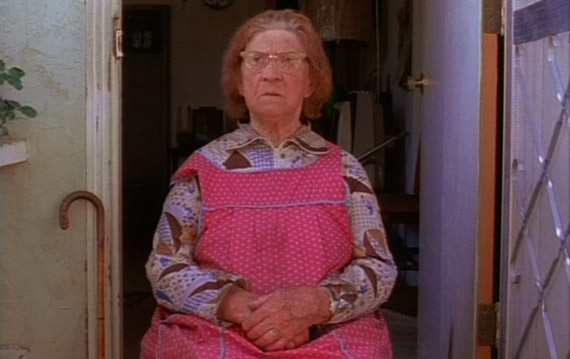
Errol Morris is not a humanist. Or at least he's repeatedly claimed not to be one. In fact, he's gone so far as to label himself a misanthrope, a pessimist, a perpetual bemoaner of the human condition and the hopeless, delusional humans eternally walled in by it. But his filmography would seem to give the lie to his assertions. In all of Morris' movies, but especially in this, his first, his attentiveness to and curiosity about humanity, confused or trapped though it may be, is made obvious by every conversation, every shot, every observational choice.
Known as an examiner of the fanciful personal worlds — intellectual cocoons, really — that people build around themselves, he doesn't exempt himself from the diagnosis. Perhaps, then, he's as unable to achieve full self-awareness as his subjects are. Maybe that's why he can insist his own distaste for the human race when the truth is more complex. Gates of Heaven is not the work of a man with an abjectly dim view of humanity; it feels like nothing so much as the product of a questioning mind, a probing demeanor and a highly unorthodox kind of love.
Not every viewer will agree with this. There's a good chance that no other viewer will agree with this, as everyone seems to come away from the film with entirely different ideas about what it thinks, what it argues, what it explains, what it's “about.” By design or by chance, Morris has crafted an artwork that brightly reflects back whatever themes an audience happens to bring into it. The result is a film you can watch over and over again, undergoing a different set of revelations in each screening. Roger Ebert, one of the picture's earliest champions, may have been the first to realize this. “I have seen this film perhaps 30 times, and am still not anywhere near the bottom of it,” he wrote in 1997. “All I know is, it's about a lot more than pet cemeteries.”
But on a concrete level, it's about pet cemeteries. You can frame it as a tale of two of them, one good-intentioned but failed; another successful but, in some ineffable way, bothersome. Through a series of narration-free interviews, Morris spends the film's first half telling the story of Floyd McClure, would-be Los Altos pet cemetery entrepreneur and living definition of the term simpleton. He'd hoped to build a veritable “garden of Eden” to honor the departed domestic critters who have so loved and been loved, but the sales projections didn't pan out. He and his weary investors relate the tale of their clients' dispossessed pet caskets, which had to be exhumed and relocated to the slicker, more solvent Bubbling Well Pet Memorial Park.
The wheelchair-bound, childlike McClure front-loads the picture with bathos, but it's the Harberts, owners and operators of Bubbling Well, who deliver the subtler pathos. Appearing to have put themselves in the background of day-to-day operations, they've left much of the work to their pair of sons. Junior in age but senior in animal interment experience, Danny serenely tends to the grounds, grows pot on the windowsill of the guest house in which he lives and lays down rock guitar tracks on his hi-fi. A former Salt Lake City insurance salesman, Phil has taken up the bottom rung of family business after some kind of burnout, alluded to with chilling vagueness.
Where McClure is given to naïve cris de coeur — “the only thing I'm guilty of is compassion,” he announces, and then announces again — the Harberts indulge what must be a stong Y-chromosome-linked predilection toward all-encompassing pronouncement. Cal, the patriarch, expounds at length on the causes of the coming “pet explosion,” evidently foreseen by none but him. Phil trots out, as if by rote, a bewildering array of aphoristic, programmatic and/or mnemonic self-motivational schemes, as if to psychologically propel himself up from his position mowing the grass of a graveyard for dogs. Even dreamy Danny has much earnest wisdom to share on the subjects of self-expression, brokenheartedness and acceptance.
Surely a former aspiring rock guitarist who drank his way through Chico State and on to combing out the matted fur animal corpses knows full well the importance for acceptance. The convictions espoused by Morris' cast of real-life characters ring not as conclusions arrived at after serious cogitation but as coping mechanisms, nothing more but nothing less. This is especially true in the case of deceased pet owners — that is to say, living owners of buried pets — interviews with whom appear between the segments with those in the business. These couples come off as all but in thrall to their own magical thinking, attesting to the humanlike exceptionality of their former dogs and the current whereabouts of their souls.
Having established that each of us takes from Gates of Heaven something unique in correspondence with our own personality, let me reveal that I take open-mouthed astonishment at this degree of anthropomorphization. Here are people who, in all seriousness, attribute emotions like “relief” to their pets. Who commission grave plaques with inscriptions like “Our Beautiful Son”. Son. Who describe how their half-terriers or what have you — equipped with brains the size of golf balls — “knew” not just the emotional tenor but the substance of human conversations. Their pets are described in terms normally reserved for the more industrious saints.
Ever since the film's nearly unheralded initial release, questions have arisen about whether or not Morris is making fun of these people. And indeed, anyone throwing around beliefs like the above expose themselves to ridicule and worse. Now picture them clad in the absolute nadir of late-1970s American fashion. We are, in several senses, dealing with grotesques. Given their unselfconscious goofiness — or, in some cases, their self consciousness-induced goofiness — and numerous linguistic fumbles, they might as well have stepped out of one of Christopher Guest's improvised celebrations of awkwardness. (The operator of the local rendering plant, on a higher level altogether, comes off not as a candidate for a future Bill Murray performance but as a Bill Murray performance.)
And yet, what tack does the film itself take toward them? None that we can pin down. It watches, it listens, and it certainly picks the choicest, most entertaining moments to show us, but at no point does it make an argument. This is vastly to the good, as it is for most any movie that refuses to push a line. But what line could it push? Does anyone who isn't actually featured in the movie hold strong opinions, of which they seek validation, about pet cemeteries?
Morris' filmmaking style may or may not be relevant here, but I'll bet it is. Though Gates of Heaven predates the invention of the Interrotron, his double-ended advanced interviewing apparatus that allows interview subjects to make eye contact with both him and the camera simultaneously, it does not predate his desire to replace existing rules of the documentary genre with his own. The principles of cinéma vérité — as we might draw them from the work of, say, Frederick Wiseman — might dictate that the documentarian should hand-hold a light camera, stand back from the action and never set anything up beforehand. Morris uses the heaviest possible camera, brings it in close to his subjects and meticulously arranges whatever's in front of the lens. (Phil Harberts' sales trophy-crowded office is no accidental discovery.)
This highly intrusive, selective and aestheticized method brings out not truth, exactly, though it does put a series of personal, unverifiable “truths” on display. It creates something that, in a cinematic sense, is richer than that; it creates the all too rare truly irreproducible film experience, and one that's not likely to provoke the same reaction twice. You might laugh at an hour and a half of human intellectual frailty, or you might bow before — really — a solemn meditation on nothing less than life and death. You might see the work of a misanthropic pessimist or an infinitely open enthusiast of humanity. It probably doesn't matter which.
All feedback accepted at colinjmarshall at gmail.