
by Aditya Dev Sood
I know the grip, more or less, but nothing else about how to swing a club. I hold the club away from me, shuffle into a likely stance, and settle its head down, behind the ball, already resting on the tee. Hold your right foot steady as you swing back, Abhinav says, and your eye on the ball. My brother is a natural coach, but I am an awkward athlete. Yet there is a determination in me to show physical and kinesthetic ability now, in full adulthood, that I never felt in my youth. I see the ball staring back at me, daring me to hit it.
My cousin Rohit has been on my mind a lot, lately, and perhaps that's why I'm here at the driving range. He was the one who first showed me how to hold a golf stick and sink balls into the little holes marked with numbered, red, rusting markers. The putting green was right next to the club house, from where a roar of social chatter rose up, among many uncles boasting and guffawing over multiple beers, each of which progressively drowned out more sound. That nineteenth hole was where my cousin really shined, winning people over with his smile, his one chipped tooth that could kick-start any number of increasingly incredible bar tales.
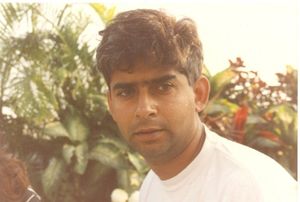
Rohit had a natural orientation to fun that continuously engaged new drinking and golfing and squash-playing buddies wherever he went. I think he used his boarding-school persona to open people out and to let them feel comfortable being friendly. But he also had space in his life in which to receive them, which was not already filled up with the projects of young adulthood — getting into college, grad school, finding a job, charting a career, building a business.
Along with his dad and brother, Rohit also looked after — or looked into — the shop, Burlington's of Calcutta, the city's best known shop for men's tailoring. I have but one memory of Rohit actually working in the shop: It was a rainy Calcutta afternoon and customers tromped in with black sewer sludge on their shoes and sandals, creating pools of water at the entrance, which was then repeatedly mopped and thrown back out by the jamadar. Rohit teased his manager, called out to assistants, played a game of catch with the cashier, all the while also chatting up bedraggled customers and flirting with the mother and daughter visiting from Dhaka, whom he promised to visit whenever he made it out to Bangladesh. After a long stretch of entertaining the both of us with his energies, his humor and his presence, there was a quiet and distracted moment for us, in which the monotony and mundanity of selling clothes suddenly opened out. Neither of us could wait for closing time, for a swim and a beer, or maybe a game of billiards at one of his clubs.
My teenage years were peppered with Rohit's visits to New Delhi. He would quiz me on my circle of friends, my best friend, the politics of school friendships, and my girlfriend, in the absence of which we'd talk about the girls I was soft on. His interest in my life was flattering, as were the glimpses he offered me into the pleasures of adulthood that awaited me once I'd managed to overcome this self-consciousness. Rohit was my source for everything to do with girls, from making the first move, to close-dancing, to timing orgasms. And though I saw him only intermittently, his accounts of his exploits, from New York to Bangkok, were always filled with fun, gamesmanship, and the throes of romance.
One winter, Rohit was visiting again for what had started out as a week but was now stretching to more than a month. I sat down to study in my parent's living room, and was soon lost in memorizing something for the class twelve board exams. I'd forgotten Rohit was sitting on the sofa nearby, doodling or doing something on his own. When I got up to take a break, he slyly showed the pencil drawing he'd made of me. I was stooped over my textbook and my profile showed the natural grain of the scraggy beard I was growing for luck in the exams. That he could draw so well was a revelation to me. Rohit could have been in architecture or advertizing or media, but all these directions were blocked to him by his family's business interests, and perhaps also by the old-boy, sportsman, gymkhana club persona that he had allowed to manifest.
As men and women around him moved out of the flush of youth, into adulthoods of varying shades of gray, Rohit's new friends were becoming younger every year. His romances were becoming crushes, and he had still not found a path, a plan, a safe way of coursing gradually through life, in stages. I don't know whom he could have talked to, to try to explain that nothing was as satisfying as winning a bet on a golf game, as meeting up with a stranger in Thailand or Goa and falling quickly and deliriously in love, as filling up a party with your oversized presence and teaching your new friends party tricks.
By the time I was in college, the seven years that separated us no longer seemed so far apart, yet we were living life in different ways. It may have hurt him that I would no longer stay up nights talking about the flailing distractions of his heart, which were now beginning to form a repetitive, problematic pattern. I doubt I had the human insight, then, to completely hear what he was trying to say about his life. Apart from his love-life, he did say he'd been looking for purpose and direction in life, and that he'd finally found it. He was going to focus on golf, which he had gotten really good at, and aim to break into the Indian national team. I think I was skeptical. Maybe I said something like good luck and good night.
My memory of Rohit's death is muffled, like something locked away in the mind, incompletely experienced, because it is so unimaginable and far away. I was in grad school at Chicago, when I got a single line mail from another cousin, saying simply, I don't know if you've heard, but Rohit is in hospital and very serious. A few days later, another mail: I don't know how to tell you this but Rohit has passed away. Lost in the inanity and insularity of institutional life, I could barely register the meaning of those words, I was too many miles away to actually experience his loss.
On the phone with my parents, I heard the story of his being untraceable for hours or days, it wasn't clear which, having been discovered in a delirious fever, and of being rushed to the ICU by his parents and brother. He could not be diagnosed and rare tropical diseases were now being suspected. The doctors gave it one last chance, pumping him full of drugs. He awoke from his stupor, seemed to acknowledge his family, and passed away, aged thirty-three.
Months later, I heard that he'd been out of touch with his family and was spending his days on the golf course. The mysterious illness he had was now thought to have been a heat stroke, which could not be diagnosed because no one knew that he'd been on the golf course everyday for days, in the mad-dog heat of Calcutta.
Some years ago, I celebrated my own thirty-third birthday. Like Rohit, I had behind me a failed marriage, an unrequitable love and other impossible desires, an uncertain career, and the disquiet of a family that wished it could understand me better. Of late I have wondered why I made it through those life crises, when Rohit did not. All I can think of is that he went through it all first.
Ease out, you don't have to kill the ball, Abhinav says. Step back, and just try swinging the club forward and backward. I paid a lot of money for those clubs you're using, so let them do the job.
My grip is loose, my shoulders are tired, and I've been topping the balls, running them like grounders far down the range. After a break, I tee up again.
I'm entering a zone that I don't recognize, a rhythm of placing ball on tee, and cutting the air with a whoosh whose consequence is certain. The ball veers right from time to time, but it looks beautiful, streaming through the air all but invisible until it finally plonks down, nearly hitting the armored ball collection cart that is now foraging around the range. I could do this again and again. I could do this forever, so long as the arms hold out. Nothing in my life seems as satisfying to mind and body, as beautiful or constant, as the power to make ball take flight. I am beginning to understand how Rohit felt.
I imagine him at the Golf Course that day, plagued by questions that he'd made no progress on for a dozen years. How to move through this life? What was one to do that would actually satisfy one's ranging, shifting desires? How to be at peace with one's family and with one self? What to do now that nothing seemed novel any more, and each new experience came redolent with the memories of former lives, so many loves loved and burned through faster than the speed of life?
Rohit is thirsty, hot, sweaty, and in fact this makes him feel better, except for the dull headache that is getting sharper now, trilling around the edges of his temples, forcing him to squint under his shades.
I see the ball staring back at him, willing him to kiss it and make it sail again, careless and free from the complex needs of other men and women, but also of himself. I can feel his shoulders aching from the game now, acknowledging that the reason he was playing on no longer has anything to do with breaking into the national team or getting a sports job. He is on his own now, hacking the turf and smacking the ball with his last energies, which he now wills to dissipate, into the single clear goal, which would define his life.