

| ABOUT US | ARCHIVES | LINKS | RSS FEED | MONDAYS | |

3quarksdaily

An Eclectic Digest of Science, Art and Literature

« There Are Seven Big Bad Countries In The World -- Is America The Worst Of Them? | Main | Perceptions »

February 15, 2010

Here's a radical thought: let's differentiate childhood education from dog training!

TreeThe photo to the right is of our family dog, Treetree (we stupidly allowed a 2 year old to name her and Treetree is what we ended up with.) She’s a yellow Labrador Retriever, a breed notoriously easy to train. Dog motivation, and particularly Lab motivation is pretty simple: they want to please their owners and extra food is always welcome, and so a carrot and stick approach works very well. They do a good job, they get a treat, they do a bad job and they are scolded. Despite the fact that Treetree is definitely not the smartest dog in the world, and that we were not the most consistent and industrious dog trainers ever, she’s a well trained dog; the carrot and stick approach of “if-then” turns out to be a good way to train a dog, but is it how we should be educating our children?

To recap briefly my argument put forward so far over the last few months: as traditional “left-brained” jobs get automated and outsourced to China and elsewhere,  and as these countries themselves start to move into the innovation space, the US and other western countries need to be educating children in a whole new way. We are not educating our children to be creative, innovative, inventive leaders for the 21st century, we are not even improving our ability to compete in traditional left-brained-based activities with other countries. So, now let’s fantasize for a moment that the Department of Education wakes up and realizes how truly lacking the education system in this country is. They do away with standardized, multiple-choice exams; they do away with the traditional grading system until high school; they devise a curriculum that encourages children to be intellectually vibrant, academic risk-takers for life. Even if this were all to happen, I think that there would still be a part of the puzzle that would be missing: how to motivate children in this brave new world.

Daniel Pink’s new book, Drive: The Surprising Truth About What Motivates Us, proposes a simple, but very powerful theory: as we move from a left-brain, task-based economy to a more creative, right-brain one, we need to upgrade our motivation structures. Corporations and schools have been attempting to motivate people in much the same way that our family tried to train our dog: the carrot and stick approach. And this approach will no longer deliver the desired outcome: to give people an incentive to do a better a job; in fact, it can actually inhibit these outcomes.

Pink claims that tasks can be bifurcated into those that are algorithmic, “following a set of established instructions down a pathway to a single conclusion”, and the diametrically opposed heuristic tasks which need experimentation in order to “create a novel solution.” Traditional white-collar jobs, concentrating on left-brain activities fall primarily into the algorithmic group. I would argue, so does most of the “teach to the test” of the US education system. The traditional view is that when “work consists mainly of simple, not particularly interesting tasks..The only way to get people to do them is to incentivize them properly and monitor them carefully”. Much of what is taught in most schools is boring, consisting primarily of rote memorization and training for multiple-choice tests. How to motivate students to improve grades and test scores in this environment is clearly an issue. In corporations these incentives are usually some form of monetary compensation but even in education, there has been a move towards offering cash prizes to students for good grades and attendance. And even without these overt bribes, there has always been a carrot and stick attitude prevalent in schools; detentions for poor performance and behavior, ice cream socials to reward the desired behaviors.

There is much to be questioned about the long-term effectiveness of such incentives even in the realm of algorithmic tasks. As Pink points out, “when the tasks called for ‘even rudimentary’ cognitive skill, a larger reward [leads to] poorer performance.”  One very good reason for not paying for educational performance is that, as Pink also points out, "The short-term prize crowds out the long term learning" as “schoolchildren who are paid to solve problems typically choose easier problems and therefore learn less”. Another, compelling argument is that once the road to paying for performance is taken, it becomes an expectation and there is a need to constantly up the ante. Once a student has been given an iPod for good grades, how can they ever be motivated to study for anything other than an expensive piece of electronic equipment?

But beyond the wisdom of paying children to study for standardized tests and more left-brain school work, following Daniel Pink’s logic, these kinds of external motivators will definitely not produce the desired behaviors once applied to more creative, heuristic-task based learning. In the case of this kind of education, “intrinsic motivation is conducive to creativity; controlling extrinsic motivation is detrimental to creativity.” These types of incentives work to narrow the focus as they concentrate the mind on achieving precisely the desired outcome. This might be the desired behavior for a rote task, but for a task that requires a more thoughtful, creative, innovative solution, narrowing the focus is precisely the wrong driver for the behavior. If all a science teacher wants to teach is the history of other people’s science, then narrowing the focus might be a perfectly valid goal. However, if the teacher wants to teach the scientific method, want to turn her students into scientists, to open their mind to the possibilities of scientific discovery, then the students’ minds need to be open, their sense of wonder expansive.

What might this extrinsic motivation consist of? Well, as a recent McKinsey study shows, the top three non-financial motivators “play critical roles in making employees feel that their companies value them, take their well-being seriously, and strive to create opportunities for career growth. These themes recur constantly in most studies on ways to motivate and engage employees.” These incentives, from a corporate perspective are praise from immediate managers, leadership attention and a chance to lead projects. The study showed that once base pay is at a satisfactory level, then these three motivators work better than “cash bonuses, increased base pay, and stock or stock options”.

Peter Bregman tells an interesting story in the Harvard Business Review about one possible way to tap in people’s deeper, intrinsic motivations. His thought is, “We can stoke another person's internal motivation not with more money, but by understanding, and supporting, his story.” It is possible to tap into someone’s internal, intrinsic motivation by reinforcing their internal story of the kind of person they are, asking them, “Why are you doing this work? What moves you about it? What gives you the satisfaction of a job well done? What makes you feel good about yourself?”
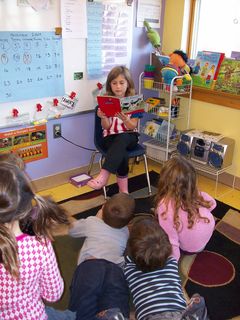
Sasha Putting the McKinsey results and Bregman’s thoughts together leads me to posit that a better way to motivate students follows much the same conceptual pathways. Rather than paying for educational performance, perhaps more emphasis should be put on praise, leadership attention and the chance to be a leader. My children’s school has mixed age grades, and my youngest daughter is now in 1st grade. As an early reader, she loves nothing more than to be given the chance to sit and read to and with the kindergartners, to be a leader. Their school has a very strong mentoring program between older and younger students and this philosophy more informally pervades all aspects of the school day. My older daughter has regularly helped one of her struggling classmates and this is encouraged and praised by her teachers. Her story about herself is that she’s a good student and a good friend. Reinforcing her internal story about herself and pointing out its benefits and the possible results of not living up to that internal story are a powerful motivating force for her.

Schools do have the Honor Roll and other ways of recognizing outstanding students, but what about the struggling students, the ones unlikely to ever make the Honor Roll? How can their intrinsic motivation be nurtured? And perhaps, if we can speak to this intrinsic motivation and teach them the benefits of relying on it rather than external incentives, we would have taught them an even more important life lesson. Because, after all, isn’t the very worst part of paying our children to study is that we are reinforcing the notion that the only things worth doing are the things that you get some extra pay to do? Instead, Pink claims, we should be encouraging the “drive to do something because it is interesting, challenging and absorbing”  And if a task just can’t viewed in this way, then we need to add another dimension to the activity, one that highlights “autonomy, mastery and purpose”. Becoming better at something, mastery of it, can be a driving force even in less creative tasks, if it is tapped into appropriately. Let's not only rethink how and what we teach our children, but also reconsider the rewards and punishments used to motivate them to learn.

Posted by Sarah Firisen at 02:40 AM | Permalink

Comments

There is something very elitist about this whole article. We can't even motivate a large percentage of children to finish high school, and now we are suppose to prepare the (obviously elite) students to work toward better life goals. Those tire marks on your back are from Asia.

Posted by: Steve Schwartz | Feb 15, 2010 3:24:17 PM

I don't think the article is necessarily elitist, since the same ideas could be applied in any school -- if schools changed. The mixed-age grouping seems like a good idea, and this is fundamental at Sudbury Valley, which Peter Gray writes about.


Peter Gray

As public schools have become more like prisons, less and less learning is taking place there. It sometimes amazes me that anyone graduates today, at least if they are subjected to a steady diet of Run, Spot, Run, standardized tests and the occasional SWAT team raid.


The War on Kids Documentary

Sarah's children are certainly learning in a much freer environment than most public school kids.

Readers of this article might also be interested in Alfie Kohn's books, including Punished by Rewards.

Posted by: Louise Gordon | Feb 15, 2010 8:20:12 PM


Sarah Firisen,

My personal impression is that your remedies for deficits in our schools are contingent on being correct about your characterizations of present day education.

I wonder how accurate is your picture of 19th century stereotypes for education, paired with late 20th century models of pay-for-performance.

I get the feeling that you are asserting truths that apply in all times, in all places, for all people: Schools do not teach children to be creative; Education emphasizes rote exercises over meaningful verbal content; The problem is finding our how to motivate our children to learn. Looking back over many decades from which these observations were cloned for each successive wave of educated parents, one concludes that nothing at all has changed in the class room.

The school learning theories of D. P. Ausubel from mid-twentieth century on have not been superseded on these basic points: 1. Find out what the student already knows, and start new learning at that point. 2. Don't focus on 'motivating' a student to learn. Focus on the learning, itself, which will become its own reward. 3. Teaching heuristic, problem-solving, creative skills, separate from substantive school content, is a waste of time.

Posted by: Norman Costa | Feb 16, 2010 2:32:46 PM

The point is not that we have to motivate children to learn, rather it's to keep from drubbing the motivation out of them. Children are born free, and they are born learning, at an amazing pace, but all the schools want is to take their freedom and 'give' them obedience, and that is immoral.
Children are hardwired not to 'work.' They are hardwired to play and learn, to create and to love.

The idea of putting a healthy six year old's tuchis in a desk for more than, say, a half-hour, is sick.

Another thought; should we want children to be 'industrious'? Isn't industry literally killing us?

Posted by: Alice de Tocqueville | Feb 17, 2010 9:42:58 AM

Children need to play, but they also need discipline. Try seating a child at the piano and saying "Do whatever you want. Express yourself. Enjoy!" This will not lead to anything resembling music.

Posted by: J.Hawkins | Feb 17, 2010 9:54:10 AM

It's not the child that needs the discipline, it's those who don't care for the sound of banging artlessly on a piano. That is, others need the child to have discipline. The child doesn't need the discipline until she wants to play the piano.

And yes, of course it takes discipline to learn to play the piano. My point is that if and when a person wants to play it, they will apply themselves, and will accept and appreciate guidance.

But we were talking about schools, and schools today don't teach useful things like how to play the piano. Can't afford it. Too many highly disciplined mortgage bankers need that bigger house. Too many highly discplined generals need all the money there is.

Posted by: Alice de Tocqueville | Feb 17, 2010 10:45:34 AM

Few of today's schools actually "consist primarily of rote memorization"--though this is a very common claim made against them.

When it comes to mathematics, lack of rote memorization is actually a problem: students are no longer gaining the fluency in arithmetic that is necessary to advance effortlessly into algebra and beyond.

Singapore Math does a wonderful job combining necessary drill with problems that require true mathematical creativity (as opposed to the poor substitute for creativity that Reform Math offers).

On my blog (which is all about the virtues of all those left-brain strengths that our most lauded model schools now marginalize) I give weekly comparisons of Reform Math and Singapore Math problems:

http://oilf.blogspot.com

Posted by: Katharine Beals | Feb 18, 2010 12:12:51 PM


What Katharine Beals said.

Posted by: Norman Costa | Feb 18, 2010 12:46:02 PM

Wow, thank you, Katharine Beals! Afraid I'd heard of your book, but not gotten to read it. Just from a brief look at your website, I can see it will be a great resource!

In my previous post, I seem to be saying that children don't need discipline. I don't mean that, but I do think they need to be shown the reason for a discipline; they have got reason and it should be appealed to, so that they can develop their autonomy. For instance, a little artless banging should lead to the child hearing music played, and it should be stipulated that if they apply themselves to learning how to play it, they'll be allowed to do so. Then if they desire to do that, they'll have their own motivation to practice a technique.

They also have compassion, which can and should be appealed to. "When you do that it hurts my head (ears, heart, whatever)".

In this way, the adult can affirm their own responsibility to impose a degree of order, which the child also needs, but an order that is based on rationality and sympathy.

Maybe this is really what you meant.

Posted by: Alice de Tocqueville | Feb 18, 2010 2:24:53 PM

Alice,

"if they apply themselves to learning how to play it, they'll be allowed to do so"

My nine year old son has been taking piano lessons for 5 years. He practices every day, but it is never just a question of "allowing" him to practice. He does "like" it, but it is very hard work and often requires a lot of interaction from my wife or myself and even coercion. At times he cries and protests at the effort, but when we say "do you want to give it up?" he never wants to. When you write "if they desire to do that, they'll have their own motivation to practice a technique" I have to say that it is not that simple. The truth is that, without a parent over their shoulder, I doubt if any child would practice piano when they could be playing video games.

Posted by: J.Hawkins | Feb 18, 2010 3:05:14 PM

@ J.Hawkins: Believe me I know exactly what you're describing, every parent does. So, this isn't meant to be critical, but an objective analysis might clarify the situation. Does your son really want to do the lessons to please himself, or you? (He might not know himself.) Does he dislike the lessons, but also hate the idea of quitting? (Do you, like most of us, only ask that question when you're exasperated with standing over him, which makes him feel guilty and unappreciative?)

Lots of parenting problems are alleviated by allowing children more autonomy. Allowing them to experience the natural consequences of their decisions, insofar as they won't be harmed unduly by them, removes a lot of guilt and recrimination for both parent and child. In other words, if the child later thinks, 'I wish I hadn't wasted so many hours on the piano', he's analysing and critiquing his own decision, rather than blaming dad or mom. And if he's stuck with it and is glad, he can pat himself on the back, and take the credit, rather than knowing (which he will) that it's mom and dad who deserve the credit.

Have you ever heard of Summerhill? It is a school in England where children are almost entirely autonomous. Results were mixed, but something that stuck with me, reading about it, was that the children who'd gone wild with such freedom were those from very strict households, who'd finally rebelled enough to get sent there, and kids who'd been allowed to make more decisions for themselves at home functioned better at the school.

In other words, making good choices takes practice, too.
I know that all us loving parents try to avoid any discomfort for our children, but we forget we can also rob them of self-confidence.

Posted by: Alice de Tocqueville | Feb 18, 2010 5:45:29 PM

Hmm, Summerhill is a bit more structured than Sudbury, isn't it? I think they have a lesson plan at Summerhill. But I believe both are democratic.

Posted by: Sagredo | Feb 18, 2010 10:21:16 PM

Chiming in to say I enjoyed the article, and also the tone and content of the comments, although I have to agree with Norman Costa and Katherine Beals.
I think Dan Pink (like Malcolm Gladwell, and other "big thinkers") can have a very interesting take on applying findings of cognitive science to the world of education, or advertising, or whatever, but the reason the cognitive scientists themselves aren't making similar claims is that the evidence for separating the world as neatly as Pink proposes is not as convincing as he portrays.
The world's tasks
(and people) do not split so easily into "right-brained" and "left-brained." To creatively compose music, you need a significant amount of background knowledge. The same is true of computer programming, or science, or writing novels.
The science example is a great one, but for the opposing side. We don't get great scientists by turning our budding young creative scientists loose in the world, or teaching them the scientific method and then giving them a garden and telling them to explore. Good science requires an immense amount of hard work and background knowledge and a surprisingly little amount of insightful "creative" thinking.
With that said, I would love for my kids to work in a garden at school, but just not to expect to learn science without a corresponding rigorous science curriculum (yes, with facts, some which they might ave to memorize).

I would absolutely agree that we need to treat students' motivation and engagement with school as an educational goal in itself. I also agree with the rejection of simple-minded bribery schemes.

But I think the article could allow for the fact that the tasks that confront the modern student and worker, and the drives that motivate them, are more complex than this. The "creative" tasks are in most cases actually related to (and built from) the rote tasks. Intrinsic motivation is a laudable goal, but that doesn't mean that more autonomy will necessarily produce more learning.

Posted by: Cedar | Feb 18, 2010 10:21:49 PM

Post a comment


Subscribe to this blog's feed  

PayAnywhere with iphone credit card swiper

Android Tablet

Bluetooth Headset

2013 New Style Dresses

Compare Car Rental Prices

DHgate.com Wholesale

3QD on Facebook

3QD on Kindle

3QD by Daily Email

Receive all blogposts at the same time every day.

Enter your Email:


Preview 3QD Email

3QD on Twitter

Miscellany

Lijit Search

AddThis Social Bookmark Button

Add to Google

Recent Comments

Ross Williams on Getting Smarter

oroboe on Lennon's "Imagine" and McCartney/Wings' "Band on the Run" overlaid: One way of reuniting (some of) the Beatles

Richard H. Randall on Obama must Make Fighting Climate Change National Project, or Die the death of a thousand Scandals

seth edenbaum on The First New Atheist? Kierkegaard

waqnis on Mortify Our Wolves

nogodrod on KFC smugglers bring buckets of chicken through Gaza tunnels

waqnis on Here’s how to change the world

Fernando on Mortify Our Wolves

seth edenbaum on The case against empathy

Dredd on Mortify Our Wolves

Max on Here’s how to change the world

Rohana on Mortify Our Wolves

Raza Husain on If Only We Had A Leader Like Chavez, Who Solved Real Problems -- Instead Of Debating Fake Ones Like The Deficit

mirel on If Only We Had A Leader Like Chavez, Who Solved Real Problems -- Instead Of Debating Fake Ones Like The Deficit

araldo on Here’s how to change the world

Elatia Harris on Here’s how to change the world

Sundar on Here’s how to change the world

araldo on Here’s how to change the world

prasad on Here’s how to change the world

araldo on Thursday Poem

Raza Husain on Here’s how to change the world

prasad on Here’s how to change the world

Raza Husain on Here’s how to change the world

prasad on Here’s how to change the world

Jim Sanders on the hudson review

Acclaim For 3QD


"I couldn't tear myself away from 3 Quarks Daily, to the point of neglecting my work. Congratulations on this superb site."—Steven Pinker, Johnstone Professor of Psychology, Harvard University.

"I have placed 3 Quarks Daily at the head of my list of web bookmarks."—Richard Dawkins, Charles Simonyi Professor of the Public Understanding of Science at Oxford University.

"Just wanted you to know I’m one of many who reads and enjoys 3 Quarks....almost daily."—David Byrne, musician, former lead-singer of the Talking Heads, artist, intellectual.

Read more here.

The 3QD Prizes

Subscribe to this blog's feed