
A Glimpse Into The Work of Pina Bausch
By Randolyn Zinn
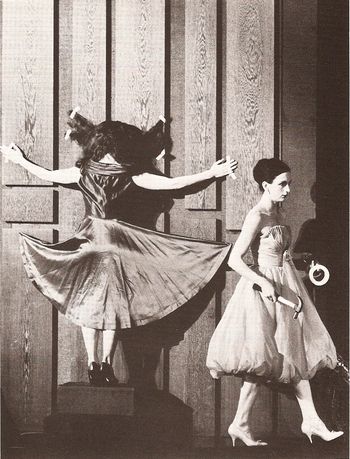
Beatrice Libonati, Meryl Tankard in Walzer Photo by Gert Weigelt
On June 30, 2009, dance devotees from around the world mourned the untimely death of choreographer Pina Bausch. At 69 years of age and just four days after a diagnosis of cancer, she left behind a son, an acclaimed dance company, devoted fans, and a trove of masterpieces that changed the course of dance and theater history. Her work always left us wanting more. We were sure she had a century inside her.
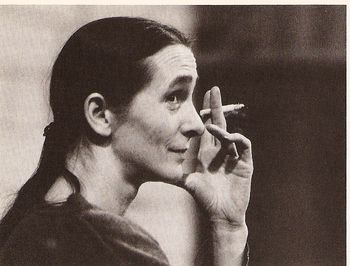
Pina Bausch in rehearsal. Photo by Gert Weigelt
In Paris, whenever tickets went on sale for her company Tanztheater Wuppertal, a long line of Pina fans would snake out from the box office into the street. Television crews scrambled to put together elaborate promos, giving them pride of place on the evening news. Imagine if American news shows featured dance and theater segments alongside sports and weather. Take a look at one of these promos and be amazed not only by the snippets of the work, but by the cultural divide.
Bausch found original and highly theatrical non-linear strategies in her compositions for merging real actions and feelings with dancing. You cannot be a choreographer today without reckoning with Pina Bausch, just as previous generations had to come to terms with Martha Graham’s influence. Bausch studied dance briefly in New York before returning to Germany where she challenged its own Expressionistic dance traditions as mentored by Kurt Joos at the Folkwang School. She broke open new ways of using costumes, music, and set design; even her company bows are different (more on this later).
As an example of her innovations, take the astonishing first moment of Palermo, Palermo as witnessed by some of us at the Brooklyn Academy of Music in September of 1991. Spanning the width of the Harvey Theater’s stage, an imposing 30-foot high gray wall of concrete blocks faced us, silent and still, as we waited in the darkened house for the piece to begin. We expected an entrance, an overture, something…and we thought our eyes were playing tricks on us when it seemed that the solid wall appeared to be tipping forward from the top. All of a sudden, in arguably one of the most astonishing opening cues in the history of theatre, the enormous wall smashed to the floor, whereupon the performers entered to dance through the rubble.
When something real happens in the theater, expectations shatter about the limits of performance. Bausch’s work was all about the real, but refracted through the kaleidoscopic artifice of the proscenium arch. Her dancers were comely, their costumes gorgeous, and the sets extraordinary, all of which furnished visual pleasure for the audience. Bausch's aesthetic territory of heightened emotion broken into collage and her methods of trekking through it were always marked by a confusing ambiguity that required an open mind to refrain from reducing her stage business to simple homilies. Palermo in ruins might serve as a metaphor for the rubble we make of our lives, but Bausch probably wouldn’t have ascribed one single meaning to that or any other of her works.
Here’s a clip from one of her earliest pieces when she was still choreographing to someone else's libretto set to a musical score (in this case, Stravinsky’s Rite of Spring). She would abandon this tack later as her work matured into sophisticated collages, but it is good to begin here because you will see already how uncompromising she was in her choices. Watch how the dancers move slightly off the music, how their spatial arrangements create menace for the sacrificial victim doomed to dance until she dies. Note the power of repetition and the effect of the stage covered with peat that stains the dancers’ costumes and heightens the sense of innocence lost to the brute power of the clan.
Hard to deny the emotional power of this choreography. We are meant to see the dancers’ sweat and heavy breathing. During the 1984 filming of this piece for German television, Malou Airaudo, the leading female dancer, fell into the last pose face down as choreographed, but two counts early, having fainted from exhaustion. That earthen stage floor evokes an archaic past of sacrificial ritual, and yet when watching it, we can relate to it today as a fact of life we have experienced.
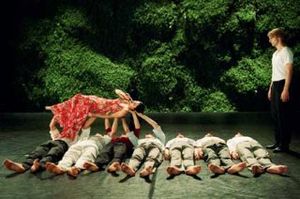
Masurca Fogo
Q: TANZTHEATER – Is it dance or theater?
Q: CAKE — Is it flour or eggs?
When Bausch stopped setting dances to pre-written narratives (Tannhauser, Ipigenie on Tauris, The Rite of Spring, Seven Deadly Sins, Bluebeard) to move into her own original compositions, she experimented with how best to render the essence of loneliness, tenderness, the battle of the sexes and the search for love (what it is and how we experience it), and found that by using gestural or dramatic vignettes collaged with overlapping danced sequences set with, against or without music, suited her mission best. Apparently she never began with a blueprint, but entered the studio with questions posed to her dancers.
“I pick my dancers as people,” she once said. “I don’t pick them for nice bodies, for having the same height, or things like that. I look for the person, the personality….I like people who are difficult to open. Otherwise there’s nothing special.” She held auditions all over the world during residencies and formed an international company of extraordinary performers.
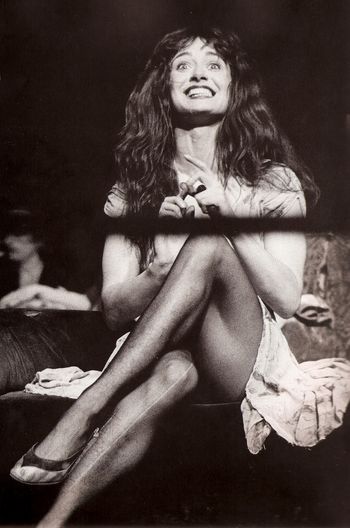
Mechtild Grossmann in He Takes Her by the Hand and Leads Her into the Castle, the Others Follow Photo by Ulli Weiss
For On The Mountain a Cry Was Heard, Bausch went into rehearsal with these situations as jumping off points for the dancers.
Something which is steadily growing and can no longer be
stopped/Breaking something in the belief one can stop something
by dong so/Indicators of death and fear/Making a weakness something positive/The lull before the storm/Everything will turn out all right/
Wanting to feel something at any price/The desire to move mountains/
A sign that things are improving/Something broken and something whole.
She expected her performers to respond honestly to her questions with their own improvised dance phrases and/or little scenes that she would watch silently while scribbling notes and sometimes laughing, but always exhorting them to go further into uncomfortable emotional territories. How she would later sequence scenes, arrange this woman with that man, expand one movement phrase for the group and so on, she kept mostly secret. One day she might come in and cut everything and start over in an uneasy process that would change slightly with each try. As artists from every discipline know, every new sculpture, poem, painting or song requires new and particular rules. In talking about her process with Jochen Schmidt, Bausch revealed a bit about how she made her work.
Basically one wants to say something which cannot be said,
so what one has done is to make a poem where one can feel
what is meant…I have asked hundreds of questions. The dancers
have answered them, tried something out…Part of the problem
is that is that many of the questions don’t produce anything.
They don’t get you anywhere. Gradually we build up short
dance sequences which we memorize…I don’t know. I’m
always trying. I keep desperately trying to dance. I’m always
hoping I’m going to find new ways of relating to movement
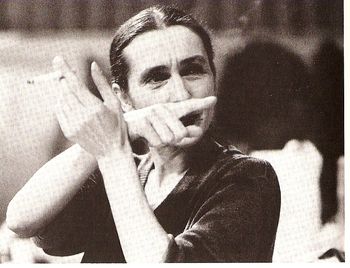
Pina Bausch Photo by Gert Weigelt
At a press conference in Rome, she said that her pieces didn’t grow from start to finish but rather from the inside out. I like how plain spoken she was about her process, which is in sharp relief to the dense academic articles written about her. She grappled with real issues, not theories. When questioned about her process, more often than not she would reply, “I don’t know. I don’t know…” She didn’t shy away from mixing high and low culture, but would avoid typical beginnings, expected developmental arcs, easy conclusions and sappy-happy endings.
Episodes of lazzi or stage business (Jan Minarik cooking an egg on a hot iron comes to mind from Palermo, Palermo) were intercut with movement phrase repetitions performed by soloists or groups that might perform in unison to music as disparate as popular ditties, international jazz and electronica mixed with scant text and/or anecdotes and questions posed to the audience.
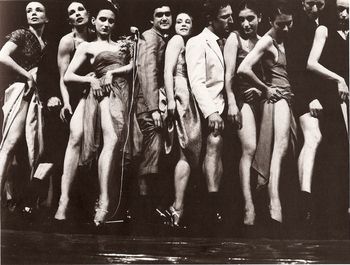
Monika Sagon, Heide Tegeder, Meryl Tankard, Arthur Rosenfeld, Mari DiLena, Hans Dieter Knebel, Isabel Ribas Serra, Anne Marie Benati Lutz Forster, Anne Martin in 1980 A Piece by Pina Bausch Photo by Gert Weigelt
In Two Cigarettes in the Dark, husky-voiced Mechtild Grossman addresses the audience with the deadpan glamour of a Hollywood hostess with this provocation salutation, “Why don’t you come in? My husband is at war.”
In another moment from Palermo, Palermo, a group of men in black suits enter carrying a woman (in itself a provocative image), having tucked a bottle of mineral water between the woman’s knees so that the water continually spills out–a potent symbol of the woman’s humiliation. Later, the same woman enters, demanding that two men hug and then pelt her with tomatoes. Sicily might be a culture of corruption and decay, but for Bausch, the inner culture always furnished her real points of interest.
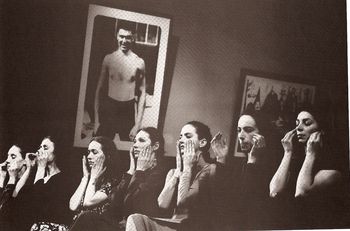
Nazareth Panadero, Malou Airaudo, Vivienne Newport, Heide Tegeder, Meryl Tankard, Anne Martin, Anne Marie Benati from Bandoneon. Photo by Gert Weigelt
Set design was an integral part of Bausch’s process: the stage as battleground. Her epic pieces featured elemental, elegant yet untraditional stage architecture that provided a meeting ground between body and mind. In Bluebeard the enchanted castle of the tale is presented as an empty 19th century room bordered by high windows whose floor is strewn with dead leaves.
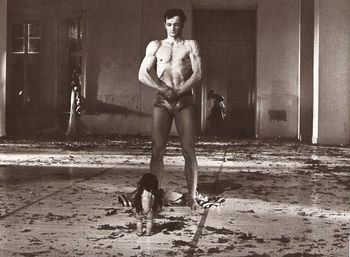
Jan Minarek in Bluebeard Photo by Gert Weigelt
Arias takes place in an inch of water so that by the end of the evening the dancers in their silken evening clothes are soaked to the skin. Nelken features a stage of standing carnations.
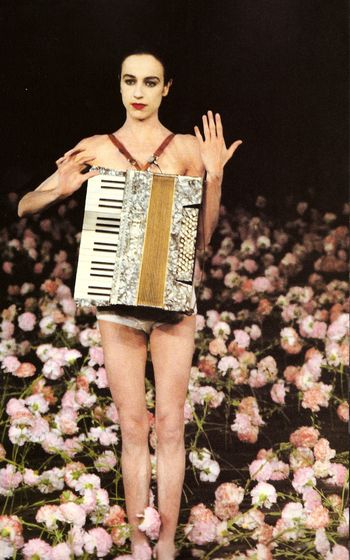
Ann Martin in Nelkin Photo by Ulli Weiss
Rolf Borzik was Bausch’s set designer (and companion) until his death in 1980. Since then Urich Bergfeld, Peter Pabst, and Gralf-Edzard Habben have contributed designs.
“I’m Interested Not How People Move But What Moves Them”
Bausch’s famous quote. To some critics, mostly American, her theatrical collages elicited suspicion and distaste for their affront to the cool symmetries and gender neutrality of post-Modern American dance. Her many pas de deux of gender inequality (suggestive situations that were also often comic), refused to take a moralistic tone or show “positive” alternatives, which feminist critics criticized as glamorizing victimhood for the sake of entertainment. Bausch didn’t follow the Dickensian morals of television dramas we’re so accustomed to watching where perpetrators of violence are hunted down and punished.
Instead she set up repeating of scenes that did not develop in narrative terms where performers come to terms with the consequences of their actions, but as power equations to be studied and recognized for what they are. Yes, men were often aggressors, plying violence, but if watched closely, you would see that they were also tormented by each other – and by women.
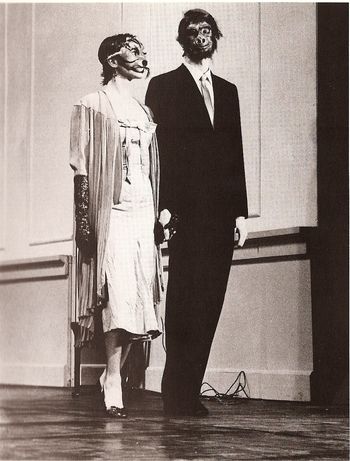
Anne Martin, Lutz Forster in Kontakthof Photo by Gert Weigelt
Bausch was questioning the male/female dynamic, but she also said that it was theoretically not impossible to find satisfaction in it. “…we keep trying…” One can speculate about whether her man/woman equations serve as metaphors for cultures and countries, inequalities that have determined world history and the fates of millions. But the truth is, she always started from a single human life, finding in it the seeds of discontent where the perennial battleground of complicated unhappiness took root and grew.. She didn’t psychoanalyze discord in order to offer up easy answers or theatrical tonics for her audiences. She was looking for the truth, and like Keats, if she found it, it was beauty enough.
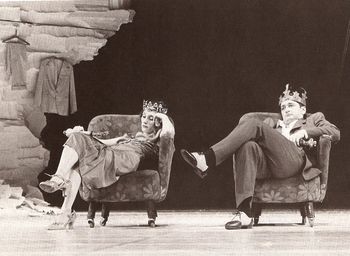
Nazareth Panadero, Jan Minarik in Renate Emigrates Photo by Gert Weigelt
KOMM TANZ MIT MIR/COME DANCE WITH ME Try making a tanztheater moment for yourself. Choose a complicated internal circumstance (the best kind for theater) and find an action that epitomizes it, a tanztheater snapshot of sorts with a gesture that could only belong to you. Use an incident from your past (or present) and try to remember what your hands were doing when you felt angry, anxious or happy about it: were you tight in the chest, lightheaded, was your gut swirling?
For instance, let’s say you chose feeling trapped by your choices. How to show that? You might wrap your arms around your middle body, which would be a fine choice except we’ve seen that gesture a thousand times before. Try another. Although it’s a fairly abstract idea – being trapped by your choices – the feeling is palpable enough, but because it has been made from hundreds of tiny personal compromises, it is nearly impossible to pin down and communicate quickly to an audience with any depth of feeling. How to find an apt yet original theatrical metaphor?
As the title of this essay suggests, here’s what Bausch Wuppertal Tanztheater came up with in Walzer:
A woman, entering from stage right in a long silk gown, walks with a male companion. As they reach stage left (audience right), the man begins to nail the woman’s skirt to the proscenium arch. Bang! Bang! Bang! Then while holding the man’s hand, she tries to accomplish a slow and formal plié.
The BAM audience laughed at this moment, and yet like so much of Bausch’s work, we all felt shocked and stung by what the woman had allowed to happen. Complicated, to be sure. And yet so simple. So inevitable.
Now let’s reverse the process. Here are some tanztheater situations; you identify the feelings:
1. A woman in red high heels enters, wearing six balloons glued strategically to her naked body. Three men follow her, lazily smoking cigarettes. What happens next is inevitable. Pop! Pop! Pop!
2. A woman sits down at a café table and accepts a red tulip offered by a gentleman. She lays the flower on her plate, cuts it into bite-sized pieces with her knife and fork, and proceeds to eat it.
3. A man drapes a woman around his neck like a scarf.
Check out this clip from Masurca Fugo, watching for the collage of elements: how music, lyrics, clothing, real actions (lifting, falling, the weight of bodies holding still versus bodies in motion) and vocal reactions (via the mic) combine to evoke emotion.
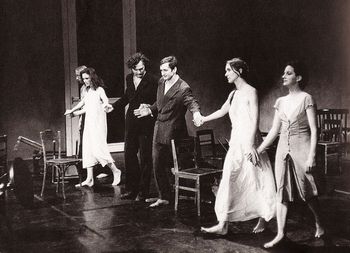
Dominique Mercy, Malou Airaudo, Rolf Borzik, Jan Minarik, Pina Bausch, Meryl Tankard in Café Muller Photo by Ulli Weiss
Finally, those company bows I mentioned earlier. They did not rush on. They took their time. There was no humiliating pecking order from least important chorine to star. Exhausted after the rigors of a 3-hour opus, the company walked out together, holding hands at a modest pace to stand in line staring back at the audience. No flashy Hollywood smiles. They seemed to be saying that there was plenty of time to show our appreciation — an approach that always drove the audience wild. We wanted them to linger so we could study each and every dancer, and so we stood to show them our love and appreciation.
Eventually Pina herself would amble onstage in her signature black silken trousers and long jacket. She was always humble and a little sad, bowing with downcast eyes. For us, it was like getting a glimpse of the Queen of the world.
Bausch made us appreciate the human cost of performance, and as such, we were an integral part of her work. After all, the theater is as much about the audience as it is about the actors. We were always honored to be in the same room with Pina Bausch and so lucky to be alive during her career. She made us part of dance/theater history and we shall always be grateful for that. Meanwhile we shall keep searching for ways to deal with our own battlegrounds. Danke, Pina, we will remember you.
Here she is dancing in Café Müller with Jan Minarik, Dominique Mercy, Malou Airaudo, Rolf Borzik and Meryl Tankard
For further reading and exploration:
* Pina Bausch Wuppertal Dance Theater or The Art of Training a Goldfish by Norbert Servos.
* Pina Bausch by Royd Climenhaga.
* & several YouTube performance videos posted online, much obliged for those
* Pina Bausch Wuppertal Tanztheater is scheduled to return to the U.S. this fall.
Tour schedule online here: http://www.pina-bausch.de/spielplan.html