
| ABOUT US | ARCHIVES | LINKS | RSS FEED | MONDAYS | |

3quarksdaily

An Eclectic Digest of Science, Art and Literature

« Perceptions | Main | Mammogram Math »

December 14, 2009

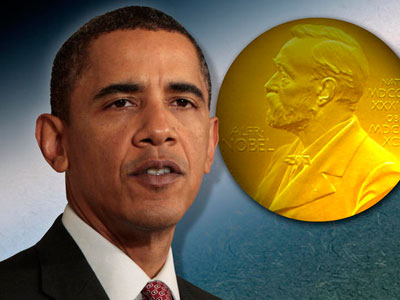
The Obama Nobel Speech: What It Reveals and What It Conceals

by Michael Blim

Obama Nobel And so the speech, the “just war” speech is given. Or rather “the cold war” speech is given.

President Obama’s Oslo Nobel acceptance speech, that is. It could have been given by John F. Kennedy. It could have been written by Kennedy’s Sorenson, Goodwin, or Schlesinger, filled as it was with allusions to freedom, liberty, tyranny, and the need to defend the vital center.  It was all there: America the underwriter of world security and the keeper of world peace since World War II, the historic champion of democracy even when compared with Johnny-come-lately Europe, the everlasting voice for universal human aspirations.

Tough-minded idealism, cold war realism. The United States, the President says, goes to war to defend its interests only when its cause is just. Afghanistan is a war of self-defense, and thus is just. Other wars undertaken while we have protected the peace these last sixty year have been just too, and they include the first Iraq War and the Balkan wars against Serbia. Missing from the ledger of the just are the Korean, Vietnam, and Second Iraq Wars, though American action in the Korean War is still so unquestioned that its costs and consequences lie unexamined.

We live, the President tells us, in an imperfect world. In a breathtaking claim upon human nature and humanity’s history, he argues that we as a species knew war before we knew peace, and accepted war as another fact of life “like drought and disease.” Though our natures remain warlike, and evil and injustice a constant of the human condition, he believes that we have made halting steps toward the rule of reason as well as a greater human interest in governing our conduct, especially during the American half-century.

Obama’s is a profoundly Christian vision, though a less Manichean outlook than was characteristic of the hot Cold War. The persistence of evil, however, is still its center. Humanity must hope for redemption but persevere in the face of life’s inevitable iniquities. Like Browning, he argues, “that a man’s reach should exceed his grasp, or what’s a heaven for?”

Applying the pilgrim’s progress to war can be both deadly and deceiving.  Deadly because devotion makes a casualty of proportion, and memory becomes millennial. The march of human progress makes even terrible human tragedy and mendacity small.

Clearly, Mr. Obama has lost a sense of proportion. Don’t the deaths of the Afghan War exceed the golden mean when considered against the loss of life on September 11? What kind of scale can balance the loss of life in Iraq with justice?

According to Mr. Obama, when did the United States become virtuous, exactly? With Wilson’s 14 Points? After genocide against the American Indians was finished, the Chinese sent back, and Black Jack Pershing returned from a “punitive expedition” in Mexico in 1917 to lead U.S. forces in a war to make the world safe for democracy?  After killing half a million in the Philippines in a fit of imperial madness? After which invasions in Central America and the Caribbean? After the assassinations of Lumumba, the Diems, and Allende, coups too many to count in Latin America and a more than a few in Asia and the Middle East? After the Vietnam War said to have cost finally a million lives? The destabilization of Cambodia before the murderous regime of Pol Pot? The murder of at least half a million leftists by Sukarno aided and abetted by the CIA?

Obama’s claims for American virtue are a little like those of the lady who has lost hers. He doth protest too much.

But just as Stalin and the Soviet Union had its one great “patriotic war,” so the United States, Obama notes twice in the Oslo text, can point to the war against Hitler as an unassailable just war. Does one exception prove the rule here? How about a few more?

In the Oslo text, the President refers obliquely to Japan and Italy as the Axis powers, a curious considering that Japan declared war on us, and it was Hitler’s mistake rather than an American declaration that put us at war with Germany. Franklin Roosevelt didn’t think he had the votes for war in Congress until after Pearl Harbor, and public opinion polls were at best divided over the wisdom of entering the Second World War fully two years after Hitler had invaded Poland, and one year after he had conquered France. As American casualties in Europe skyrocketed after the continental invasions, so did public resentment that Americans were dying in great numbers bailing the Europeans out of their mess. Americans fought the war with tremendous energy and enthusiasm, but they appear only after Pearl Harbor to agree to its justness, despite the great Roosevelt. And of course, Hitler’s great evil notwithstanding.

This raises a sticky issue. What is the relationship, Mr. Obama, between democratic consent and embarking on what you argue is a just war? If the people prefer peace to war, is the war still just? Is a war just regardless of what people think, once they elected you? Apparently like all war presidents, you find need to invoke your powers as “Commander in Chief” something you did twice at Oslo, and twice at West Point, which makes one wonder.

One just war amidst so many unjust wars is a slender support for a just war doctrine. In fact it suggests that most wars are unjust, and that we pilgrims have not made much notable progress. As historian Eric Hobsbawm has noted, the 20th Century was perhaps the deadliest in human history, if measured by the number of the victims of states and the wars they made upon each other. And we, the United States, were the custodians of half of the century, by Obama’s account?

The President insists that his idealism is tempered by a “clear-eyed” realism. Even as he makes a special plea for America’s “special burden in global affairs,” his words at West Point, he says that our actions reflect our enlightened self-interest in seeking “a better future for our children and grandchildren, and we believe that their lives will be better if others’ children and grandchildren can live in freedom and prosperity,” his words at Oslo.  War, however unfortunate, plays a role in preserving a peace that can bring freedom and prosperity to all.

How has war made the United States or the world for that matter more free and prosperous, exactly? It has enriched a precious few at the expense of many, whether at home or abroad. War save the campaign against Hitler (and the Chinese might throw in the Japanese) has protected economic privilege, dispossessed the poor, and rendered American democracy day-by-day less an instrument of the popular will.

The Oslo speech, sadly, shows that our President is a retooled Cold War liberal, unable to acknowledge America’s longstanding imperial history, nor accept America’s imperial decline. If his prose no longer soars, if his ideas are now becoming more obviously shopworn, if the Kennedy comparisons seem so strained, it is because the world has moved on while the United States and its current President have not, prior indications on his part to the contrary.

The world needs no lectures about just wars. It tires of the “shining city upon a hill” messianism, albeit now more a metric in Obama’s hands than an incantation from its American big brother. It longs for an United States that can come to terms with its history, and “bend” itself (not history as Obama opines) “in the direction of justice.”

In the words of the prophet Micah: “And what does the Lord require of you but to do justice, to love kindness, and to walk humbly with your God?”

Posted by Michael Blim at 04:30 AM | Permalink

Comments

While I don't think there are many thinking people, at least on the left, who don't flinch at least a little bit when someone talks about the unalloyed good that was American foreign policy in the 20th century, there's not much of worth in here beyond that. What's especially glaring is the author's more or less explicit assertion that the world is becoming a more violent place--Obama's argument to the contrary being a "breathtaking claim about human history," and the 20th century being "the deadliest in human history." (With the U.S. being its bloody steward, of course.) Yes, more people died in the 20th century from wars than in any other century. But that's because *there were more people, period, in the 20th century*. Only a smidgen of intellectual honesty would be required to admit that, in fact, well-established numbers exist on the number of deaths caused by war *per capita* through the last several centuries, and that those numbers have been falling precipitously.

Also, the world tires of authors who use "the world" when they mean "I."

Posted by: Daniel | Dec 14, 2009 5:03:43 AM

The father of the U.S. Constitution, author of the bill of rights, and 4th president is at odds with Obama.

However, Obama is on the side of U.S. imperialism when put in historical perspective.

Posted by: Dredd | Dec 14, 2009 9:22:58 AM

Mr. Blim: Daniel has a point about absolute versus per capita death rates owing to war. What do you think about this issue?

Posted by: Don | Dec 14, 2009 10:06:48 AM

Michael, you've articulated some painful disappointments of mine. While I am hardly surprised that the presidency is changing Obama more than Obama is changing the presidency -- that's life -- the particulars are threatening and saddening. As usual when you write about him, I hope somebody prints it out and leaves it beside his arugala.

Posted by: Elatia Harris | Dec 14, 2009 11:05:07 AM

Thank you Mr. Blim.

Posted by: maniza | Dec 14, 2009 1:12:40 PM

I don't know whether to laugh or cry at correspondent Daniel's trivialization of the loss of life caused during the 20th Century by war, genocide, ethnic cleansing, and state violence. HIs exercise in cost accounting by minimizing the number of dead when compared with population growth is a text book case of how to lie with statistics.

10 minutes work on the internet reveals that most estimate that between 175 and 200 million people died from war, genocide, ethnic cleansing, and state violence. Scholars ranging across the political spectrum including Zbignew Brezinski, Niall Ferguson, and Eric Hobsbawm seem content with these estimates. They broadly concur that the 20th Century was, as Charles Maier puts it, "a moral atrocity." Once more, Hobsbawm: "More human beings had been killed or allowed to die that ever before in human history."

Matthew White, a contributor to the Historical Atlas of the Twentieth Century, uses a 188 million person estimate. But then he goes on to compare this number with other death causes in the 20th Century.

Death by smoking: 71 million
Influenza pandemic 1918-19: 13 million
AIDS: 12 million
Natural disasters: 3.5 million
Homicides: 8.5 million

Given population growth, these may strike today's correspondent as trivial too. All of them though do not add up to the number of people killed through war, genocide, ethnic cleansing, and state violence which accounts for 4.5% of all the century's dead.

For a detailed survey of estimates and claims, see Mark Mazower, "Violence and the State in the 20th Century, American Historical Review (2002), 107:4.

More disturbing than the accounting trick is the moral blindness displayed by the correspondent. It is as if he had missed the great innovations in violence of the 20th Century including "total war," genocide, massive state violence, and ethnic cleansing. It is not simply that many people died, but that they died as a result of an intention of mass murder. The growth of state power per se and the technologies of violence at states' disposal have left histories earlier atrocities behind. Alexander may have slaughtered whole cities out of pique, Charlemagne one morning may have annihilated a Germanic army out of psychotic rage, but the United States killed more people probably than either of them with two atomic bombs in Japan. Never mind the millions done by HItler and Stalin and Mao.

Then there is the question of moral proportion. Surely correspondent Daniel does not want to find himself saying that losing these millions is on average, "not so bad," when compared with the past. Making human suffering and wrongful death more palatable in this way creates a dangerous moral indifference and encourages the false reading of history as a whiggish every upward climb. Surely the President opposed this view, as do I.

Finally, the smug self-assurance of correspondent Daniel leads him into misrepresentation of a crucial point of my piece. "Breathtaking" clearly applies to the President's assertion of an essential human nature, clearly Christian in its origin, and a mythic retelling of human history as a violent past that may make sense of Homer, but as of yet has no firm empirical basis either in archaeology or written history. Abhorrence of war is as old as the Greek myths themselves, and the Code of Hammurabi even older.

Michael Blim

P.S. I'll take his condescending acceptance that American foreign policy is imperialist. A flinch is better than no reaction at all.

Posted by: michael blim | Dec 14, 2009 1:28:27 PM

I am left a bit puzzled by the statement that the Korean war (p[lice action and still ongoing) is missing from the ledger of just wars. Is that war simply to be linked with the 2nd Iraq war as questionable?

Posted by: fred lapides | Dec 14, 2009 1:59:34 PM

Daniel's statistic was per capita deaths for war. Blim replies with a total estimate for war, genocide, ethnic cleansing, and state violence. Surely this is not quite the same thing, especially since Blim laid the cost at the feet of the United States:

…the 20th Century was perhaps the deadliest in human history, if measured by the number of the victims of states and the wars they made upon each other. And we, the United States, were the custodians of half of the century…

In fact, as is quite well known, the megadeaths that so 'distinguished' the 20th Century were more likely to be far from where the USA had custody: Russia, Nazi Germany, China, and Cambodia, and were not easily categorized as war deaths.

Perhaps I am mis-comprehending Blim's inference? I hope so, but if not this is an unsupportable position that I would hope he would be willing to take a second look at.

Posted by: Carlos | Dec 14, 2009 2:11:24 PM

Breathtaking" clearly applies to the President's assertion of an essential human nature, clearly Christian in its origin, and a mythic retelling of human history as a violent past that may make sense of Homer, but as of yet has no firm empirical basis either in archaeology or written history

Well let's not exchange one breathtaking assertion for another. The idea of Man as having innate warlike tendencies is a notion that as surely precedes Christianity as war and empires do. Are you referencing something sourceable that could defend such a statement?

Posted by: Carlos | Dec 14, 2009 2:29:10 PM

The Afghan war is not a war of "self-defense"... the very idea is ludicrous. Afghanistan never attacked us. If you really want to point fingers, you should point at the Saudis, as they made up the majority of the 9/11 attackers - but still, Saudi Arabia never attacked us, either. This was an act of criminals, well below the level of a nation state, and we were NEVER justified in attacking any nation over it. All we did is make ourselves into exactly the same kind of criminals.

Posted by: fyngyrz | Dec 14, 2009 4:59:17 PM

My problem with Obama's speech in Oslo was that it was wordy and contained some vacuous, platitudes. For example, he spoke of "human aspirations" as if everyone's aspirations are necessarily good or compatible with the aspirations of others. Of course we know what he meant: the aspirations of ordinary people to have a decent standard of living and to be free from political and economic oppression. But what about the people who aspire to dominate others, who are willing to cheat, steal, and kill to realize their goals? A good speech doesn't leave room for such quibbles.

As for Mr. Blim's essay, I will only say that what is unusual about the United States is not that it has been free from the age-old sins of conquest and exploitation, of which every other civilization on earth has been guilty; rather it the role it has played, for all its faults, in building a world in which such things are no longer acceptable.

That such a state could arise in the first place is the real miracle, made possible by an unlikely combination of circumstances. And for that I am, not proud, but thankful, and I think most of the rest of the world is too.

Of course the world is only half way there yet. I am glad there are other states now who can call us out when we stray from out own ideals. Maybe Obama can help us atone for these sins. Knock on wood.

Posted by: Luke Lea | Dec 14, 2009 5:58:27 PM

I don't understand the point of essays like this -they seem to willingly leave out one important aspect of the President's role: to maintain and expend America's interests and influence.

Yes, its easy and convenient to blab on about imperialism and other cliche things without offering any type of viable alternate solution. Instead of finishing a war in Afghanistan, this author suggests that Obama should "...accept America’s imperial decline." What good could possibly come from a President enacting policies that belittle and lessen our international standing?

Perhaps the author thinks he has a better strategy for winning wars? -one that has the caveat that when combat casualties exceed those that we incurred in the initial attack by the bad guys, we should declare the war has lost moral force and give up -thus recognizing our declining influence, blah blah...

How come these commentators don't ever start from the notion of "The President has a responsibility to maintain and promote our interests and influence." Anybody can rant and wave their hands protesting how bad imperialist America is, and imperialism, and more imperialism, and we fought bad wars and imperialism!!! Yeah, we got it. But that doesn't address the issue of Obama's speech -How to win in Afghanistan.

Posted by: chris | Dec 14, 2009 7:24:55 PM

There is little to be proud of in the record of America's wars. And I think we know it, or we'd be more honest about that record.

From 1964 to 1973, we dropped more bombs on Laos (580,000 bombing missions during the anti-communist domino game) than fell on all of Europe during World War II, without bothering to declare war. This is equivalent to a planeload of bombs every 8 minutes, 24-hours a day, for 9 years.

We may still be playing dominos in Afghanistan. Instead of communists, we now fear talibanists. Consequently, we're spending multiples of Afghanistan's GNP to neutralize a handful of talibanists, most of whom we actually think are in Pakistan.

Osama bin Laden knocked down two buildings. Since then we have responded like an elephant in a mall being chased by a mouse. Lots of damage, but not to the mouse.

Posted by: ehj2 | Dec 14, 2009 7:39:41 PM

chris-

The reason no one spends time defending Imperialism is that most people here have concluded that self-interest is not a valid reason to kill or control others. There are the typical, limited exceptions of course, self-defense being the main one, but outside of that murder is normally seen as wrong. This is why power elite are always in a tizzy trying to justify war with self-defense or just-war rhetoric.

Influence is certainly different than Imperialism, and I doubt many disagree that Presidents are supposed to gather and maintain influence for their country on the world stage. This is very different than war, the subject of this column.

As far as Afghanistan goes, where would you like to set the goalposts you call "win"? Until that's clear, it's rather hard to respond. Certainly the President has yet to clearly demarcate what he considers victory. My own feeling is that victory would be to get the hell out and not have the country descend into chaos. The best way to do that seems to be a power sharing agreement between elements of the Taliban and the currently empowered warlords. It probably wouldn't last very long, but it's either that or we're stuck there for decades. Does that sound like a way to protect American influence to you?

Posted by: Cyrus Hall | Dec 14, 2009 10:38:04 PM

I don't suppose we could simply allow the Taliban to have free reign over a sector and guarantee safe passage for anyone wishing to enter or leave, could we? Yeah, that would just be stupid.

Posted by: Carlos | Dec 14, 2009 11:25:05 PM

Obama's speech(es) and his demeanour irritate at an emotional level.

The exact reasons might be many but I suppose the fact that the USA has been able to kill and take advantage in the name of justice consistently makes people angry at themselves at being the trusting fools that they have been.

Posted by: Adil Saleem Khan | Dec 15, 2009 4:48:21 AM

I hardly think the phrase "murder" plays any role in modern conflicts that involve the brunt of our military.


Influence...imperialism, one is just less obvious version of the other.

I thought Obama made it rather clear that he did have have a timeline that included some key aspects of what it meant to win -and under what conditions we can begin leaving. Presumably, it involves some benchmarks that gauge the strength of the government we set up, ie., the afghan army, etc...Something like 18months?

And it wouldn't surprise me if we stayed in Afghanistan for a while -even in terms of a non-combat role. After all, we're trying to literally piece together a rather dumpy nation, into one that likes us and doesn't like people we don't like. That sounds like a way to protect our influence.

Posted by: chris | Dec 15, 2009 7:01:24 AM

Mike,

Sorry, but I am one of those who find it a plausible thesis that a greater proportion of people (in the billions now) live more secure, free-from-the-perpetual-threat-of-violence lives than in the past. And if that is indeed true, I also find it plausible that this is due to the development of social institutions which control and settle individual, tribal, and other group impulses toward violence.

I feel that you have skirted Daniel's point, perhaps because of the rude tone of his comment, but at least for me, it remains one worth thinking about.

Now please don't eviscerate me! :-)

All best,

Abbas

Posted by: Abbas Raza | Dec 15, 2009 9:56:43 AM

chris-

I didn't use the word murder, although I think in many cases it's arguably valid (drone strikes for example). I said kill. As in, we are snuffing out the only life of many people. As an atheist I find any killing repulsive and only very rarely justifiable.

There as been no real indication from the administration in terms just what benchmarks they will be using to judge victory in Afghanistan. Without making strict guidelines public they are opening themselves up to the military moving the target as we get close to a deadline.

I also think you are quite delusional if you think we can make the population of any country like us via invasion and occupation. Imagine if some country tried that with the U.S. I'm sure you'd cuddle right up with them, right? Anyway, since when was it okay to kill people in order to make their relatives like you?

I'm a pretty simplistic thinker on these issues. War is for self defense, not for "spreading influence" or "making people like us."

Posted by: Cyrus Hall | Dec 15, 2009 10:10:21 AM

The Afghan situation is now a "six of one and half a dozen of the other" kind of scenario. I doubt that anything is going to improve there vis-a-vis fundamentalism, women's status, corruption, tribalism or spread of democracy due to US presence. The time for that is long past due to Bush-Cheney-Rumsfeld's decision to cut and run from the mountains of Tora Bora in order to go and wage their war of choice in Iraq.

I feel that our withdrawal from Afghanistan may in fact bring stability back in that part of the world sooner even if we do not eventually get a government that suits our taste. A US departure will act as an impetus for Pakistan and Iran to take matters into their hands more firmly. Neither country wishes to see a Talibanistan to take shape there, especially after what is transpiring within Pakistan now. As long as the US is in control of the war, both Iran and Pakistan may be pulling their punches in eradicating the terrorists and the war lords, if only because of a passive-aggressive wish to see the US military slowly bleed in a rough and unmanagable terrain against a wily opponent who may have the support of a majority of the local residents.

As for Abbas' assertion that the human race is now less violent on the whole than our illustrious ancestors, despite the rise in death toll, Steven Pinker seems to agree. For an apple to apple comparison, imagine what may have happened if the crusaders had air power and Napalm or Chenghis Khan possessed nuclear capabilities.

Posted by: Ruchira | Dec 15, 2009 12:54:16 PM

Cyrus,

I think its a practical matter that Obama will allow the military to shift the timeline if need be -18 months is so short that the mission simply might not be accomplished in that span, but its also long enough for some unforeseen major set back to occur. *Reasonable* flexibility is key -so i think administration is focused on big picture issues of government and not political minutiae.

I simply don't care about the population of Afghanistan as long as the government is Westernized in its sentiments (read: treatment of its citizens)and its policies. If we have to kill thousands of Taliban in the process...I think that will be ok with the general population.

Posted by: chris | Dec 15, 2009 2:38:07 PM

Yay, Ruchira! The voice of reason...

Posted by: Elatia Harris | Dec 15, 2009 2:52:17 PM

Mr. Blim--

Abbas is right that my first comment had a rude tone; I'm sorry about that. I do, however, respectfully believe that both your original post and your response to my comment contain some amount of bad faith in themselves.

I think, for example, that implying that I think the deaths of hundreds of millions of people is no big deal is not really called for. I decided not to reiterate the fact that I think innocent people dying (even guilty people dying) is a bad thing, because I took that for granted, and instead addressed a particular point that undergirded both the mood and substance of your essay: namely, that the world under America's leadership has become a more violent place, and Obama is continuing/defending that legacy. My argument was that, in fact, this is objectively false.

At this link (http://www.slate.com/id/2224275/) you can read some of the exact numbers. The most important, I think, is that deaths per year as a result of war or state-sponsored genocide killed as many as 3.8 million people per year during the first half of the 20th century, and 800,000 during the second half. Given that the second half of the century was by far the most influential period for American foreign policy, I think that's a pretty important number to deal with. (Keep in mind that those numbers actually understate the per capita difference.)

Also of note--since you write in your response that Obama's "Christian" view of human history as one with a "mythic" violent past that "has no firm empirical basis either in archaeology or written history"--is that the article quotes two academics who estimate that in early hunter-gatherer societies, between 14 and 25 percent of all human deaths were at the hands of other humans. That number is 3 percent for the 20th century. Maybe you believe that there's no "firm evidence" for these claims because you have done your own research and have specific reasons to cast doubt on the methodology of those academics? This is a serious question, and if you do, I'd be interested to hear them.

But if not, I think your essay suffers a lot by not trying to incorporate these facts into your thesis.

- Daniel

Posted by: Daniel | Dec 15, 2009 3:01:57 PM

Daniel: I suppose I disagree and do not believe "[Michael's] argument was that, in fact, [the world is a more violent place] is objectively false."

You seem to be saying -- by your per capita argument -- that today I am less likely to encounter violence than if I were alive say 500 years ago, ie. in the past. Is that fair? So, if there were a total of 4 people, including me, alive in the world and 2 died violently I would likely know at least one, but if there were 40 people total and 10 died violently I would be less likely to know one, correct?

Why is that the correct and "objective" measure? Why is proportion more "objective" than absolute in this case? I know you want to try to limit this to 'just the numbers', but presumably violence is bad and so if there is less violence in the world the world is becoming a "better place". If so, how can I not construe that to mean that when there are fewer people they are 'worth' more? Also, if you extend your argument to really absurd numbers, we might be having trillions of people killed horribly and violently, but with trillions upon trillions upon trillions in existence we might hardly care.

I know you are not making that argument, but I find it difficult to read you any other way; I apologize for being irrational if I am being so. Also, if I am making a poor argument please help me to understand!

(Side note: I did not find your original post rude.)

Posted by: czrpb | Dec 15, 2009 5:16:29 PM

chris, you wrote

I simply don't care about the population of Afghanistan as long as the government is Westernized in its sentiments...

Yes, who cares what the Afghan's might want? Screw them - as long as the government plays lip service to Western values and does whatever we want, we're happy! (Note: the current government doesn't feel the need to do either of those things, but don't let the facts burden your optimism down. Also, your conceptualization seems fundamentally flawed, as last I checked caring what the people think is a Western value. See the Swiss minaret debate threads for the nuances.)

On killing Taliban: many of them are nothing more then young men who feel they are defending their land and values. Most of them are not inherently global jihadists (although we continue to argue, through our actions, that they should reconsider that view). They certainly don't hold Western values, but I guess I missed where that made their lives inherently less worthy. Indeed, we treat it as something to celebrate anytime we kill some. This is a twisted world view for anyone who hasn't been on the battle field.

As for flexible timetables, I still want to know what the goals are. A vague notion of a "stable Western government" doesn't cut it. Do we desire a cessation of Taliban activity? A 50% reduction? A security situation that assures Kabul doesn't fall? None of that happens in 18 months without a power-sharing agreement. Such an arrangement will not give you your lovely, if far fetched, modern Western democracy with women's rights protected and ethnic minorities treated fairly. At best a fractured country will emerge, where the situation is differentiated based on the local power broker. In other words, pretty much how Afghanistan has been for hundreds of years.

Posted by: Cyrus Hall | Dec 15, 2009 5:52:49 PM

czrpb, you wrote:

"presumably violence is bad and so if there is less violence in the world the world is becoming a "better place". If so, how can I not construe that to mean that when there are fewer people they are 'worth' more? Also, if you extend your argument to really absurd numbers, we might be having trillions of people killed horribly and violently, but with trillions upon trillions upon trillions in existence we might hardly care."

I think the issue is that you're using a kind of utilitarian argument about total goodness and badness in the world. In other words, each murder (unjust death, whatever the wording) is worth 1 unit of badness, and so a thousand murders is more badness than ten murders, no matter what the general population.

I think there's a lot of problems with this, but the basic issue is that that's not the definition of goodness that I use, or that I think most people use. Rather, it has to do with the ability of individuals to lead their lives in a way they find meaningful--to form relationships, to set goals and achieve them, to consider and reconsider their lives with free access to information. Unwanted death, obviously, is about the most extreme possible impediment to that kind of quality of life. The point, then, is that for the average person living on Earth the ability to lead this kind of life has dramatically improved over the last several decades, centuries and millennia.

As for why you should prefer that definition of good to a utilitarian one, there's a summary of arguments here (http://en.wikipedia.org/wiki/Utilitarianism#Criticism_and_defense). But with respect to the original author's argument, I think this debate is moot, since a utilitarian understanding of evil would leave his thesis absolutely meaningless: if the world is getting worse because more people are dying, and more people are dying simply because there are more people alive, then it has nothing to do with U.S. foreign policy or just war theory or the violent tendencies of early man and it's not clear why he wrote this essay at all.

Furthermore, the link I posted in my last comment shows that *absolute* violent deaths fell in the second half of the 20th century. So even according to the utilitarian scheme things are getting better.

- Daniel


Posted by: Daniel | Dec 15, 2009 7:12:33 PM

Cyrus,

I'm in the military. The life of a Taliban combatant is worth less than the round I place in his chest. Some might be innocent little farmer boys or something under false impressions, and thats sad, but over time, as we pretty much decimate the Taliban, such sad stories will decrease in number.


"Their values..." Yeah, nobody cares. It sounds harsh, but really, how many people here think to themselves "I wonder what an Afghan would do?"

Details of Obama's goals would be nice, but perhaps a good way to think about is that they want in 18 months for Afghanistan to look like what Iraq does today. Iraq is still garbage, but its at least workable without the entire us army living there.


Posted by: chris | Dec 15, 2009 8:41:27 PM

Hi Daniel!

If you do not mind, I will reply to two specific statements.

1. "In other words, each murder (unjust death, whatever the wording) is worth 1 unit of badness, and so a thousand murders is more badness than ten murders, no matter what the general population." I will totally 'own' this: I think 1000 murders is "more bad[]" than 10 and I am not sure if it matters if the average is improving.

Which leads me to the second: "The point, then, is that for the average person living on Earth the ability to lead this kind of life has dramatically improved over the last several decades, centuries and millennia." This seems to be exactly the basic happiness utilitarian calculation that you dislike; but I assume I am wrong? I would not want to try trading "average" happiness for murders.

I actually do not disagree that things are getting "better", but I think they are at an unacceptable trade-off of misery applied to the world by the US that Michael wrote about.

I am trying to figure out how to say what seems to be in my mind, so sorry if I am repeating or confusing: I think things are getting better, but if we were more humanitarian things could be much further along. One simple example would be to spend say $20billion/yr[1] to better all the world's children, taken straight from the US' defense budget of >$500billion/yr[2].

[1] http://www.encyclopedia.com/doc/1P2-1164825.html "cost $20 billion a year to reduce sharply ignorance, starvation and mortality of children by the end of the century." I do not really like this link, but seems reasonably authoritative. I assume we both agree that it would take a fraction of the budget to vastly improve millions of children's lives?

[2] http://en.wikipedia.org/wiki/Military_budget_of_the_United_States

Posted by: czrpb | Dec 15, 2009 9:19:28 PM

czrpb,

I think that putting absolute numbers in a different context might get you to think differently about what counts as good. Imagine, for example, Rust Belt City X. In 1950, before white flight and deindustrialization, it has a population of 1,000,000 and 100 murders, for a murder rate of 10 per 100,000 people. In 2000, it has a population of 400,000 and 80 murders, for a murder rate of 20 per 100,000. Is this a 20% improvement in the violent crime situation in RBCX, since the total number of murders has fallen, even though the chance of being murdered has doubled? I don't think the residents of the city would say that it is.

For the second point, the idea isn't "average" happiness, or happiness at all, but a just world in which people are given a fair shot at making of their lives what they want. All else being equal, then, RBCX was a more just place to live in 1950; and the world now is a more just place to live (for the sake of argument, holding everything but violent crime and war constant) than it was 50, 100 or 5,000 years ago.

I entirely agree that "more just" doesn't equal "just enough." I do think, though, that it raises questions about the original thesis, which is the thorough moral corruption and violent influence of U.S. power on the world. While it's undeniable that the U.S. has played a direct role in killing an ungodly number of people worldwide in morally repulsive ways, it would be worth noting if it tended to do this less--and influenced other state and non-state actors to kill less--than during previous eras. Not that it would erase any of the guilt, of course, but it would put these sorts of denunciations in perspective: given that we have always lived in a violent world, given that actors with enormous relative power--whether that's globally, regionally, or in a high school hallway--tend to grossly abuse it, a period of significant decline of such behavior would suggest that something is happening that is taking us on the right path, even if we are very, very far from the goal--and that we might want to figure out what that thing is, so we can do it better or more intensely. When people address the role of the U.S. in world-historical perspective and don't get that, I think they're really missing a lot.

Daniel

Posted by: Daniel | Dec 16, 2009 8:19:08 AM

chris-

I can understand your feelings if you're on the ground, and I'll refrain from argueing further after this message. Not because I think you're right, but because you are in the thick of it. I'd viscerally hate any group of people that tried to kill me on a daily basis as well.

For your leave time, some questions to research\think about:
* what percentage of the taliban are foriegn fighters?
* why would killing someone stop someone else from signing up to the cause? in what contexts does this happen, and in what contexts does it not?
* when does disagreement with someone lower their worth? I clearly disagree with your values, but I don't believe I can dismiss you.

Indeed, your statement "It sounds harsh, but really, how many people here think to themselves 'I wonder what an Afghan would do?'" sums up so much of what has been wrong with the American strategy in the Afghan war. If we had been asking that question for the last eight years we would be in a better position.

Stay safe man,
Cyrus

Posted by: Cyrus Hall | Dec 16, 2009 11:54:26 AM

"I'd viscerally hate any group of people that tried to kill me on a daily basis as well"

I suppose if you fly half way around the world into a colonial war in other people's land to assert U.S. power, some locals may try to kill you. People are funny that way.

Posted by: J.H. | Dec 16, 2009 12:09:47 PM

Hi Daniel!

Again, if you do not mind, I have two replies. I say this in case you feel I am ignoring something you feel important -- I do not mean to.

1. "given that we have always lived in a violent world, given that actors with enormous relative power--whether that's globally, regionally, or in a high school hallway--tend to grossly abuse it, a period of significant decline of such behavior would suggest that something is happening that is taking us on the right path, even if we are very, very far from the goal--and that we might want to figure out what that thing is, so we can do it better or more intensely." Ah! Again, I think we agree; but perhaps we disagree on the "thing" causing the reduction: I am partial to the line of argument that it is (absolutely) NOT the 'state' or 'government' but the people who push against it. I am sure you know the argument: Why do we have worker rights? Becuase workers fought for it. Why are women now allowed to vote? Because people fought for it. Civil rights? Slavery? Blah blah blah. So, I think we are coming to what might be a fundamental difference: Our understanding of history and the forces that have moved things is a positive way. And this is how I read/interpret Michael's post: The "government", and specifically Obama, still suck and by his speech sounds as if he will continue the suckage.

2. "In 1950, before white flight and deindustrialization, it has a population of 1,000,000 and 100 murders, for a murder rate of 10 per 100,000 people. In 2000, it has a population of 400,000 and 80 murders, for a murder rate of 20 per 100,000. Is this a 20% improvement in the violent crime situation in RBCX, since the total number of murders has fallen, even though the chance of being murdered has doubled? I don't think the residents of the city would say that it is." But, the "chance of being murdered" has NOT doubled right? The way you set this up -- when you use the date of 1950 and the term "white flight" -- perhaps we should wonder if the original "violent crime" rate for those that remain (the poor and minority) was 75 of those original 100. So the increase to 80 is little, but the way the statistic is presented lacks the specificity it ought to: In short, if you were part of the demographic that remained before, your "chance of being murdered" was hardly changed. For some reason I feel we agree on this; am I wrong?

Posted by: czrpb | Dec 16, 2009 6:36:11 PM

Post a comment


Subscribe to this blog's feed  

3QD ADVERTISING

Find the best prices on Las Vegas Show Tickets at Best of Vegas and Orlando Theme Parks at Best of Orlando!

3QD on Facebook

3QD on Kindle

3QD by Daily Email

Receive all blogposts at the same time every day.

Enter your Email:


Preview 3QD Email

3QD on Twitter

Miscellany

Lijit Search

AddThis Social Bookmark Button

Add to Google

Recent Comments

Klausi on the defeated

Anjuli on Perceptions

gautam on The Human Peacock’s Ghastly Tail

VirtualMachine on What goes into making beautiful celestial images?

WJAbbe on Illuminating the history of medicine

Namit on The search for a two-thousand-year-old city

Anjali Kelling on Adagio in Blues

Phil S. on KILL THE CAPS LOCK, And four other modest proposals for improving the contemporary computer keyboard

Adam on Canadian Insights on America’s Lunatic Fringe

WJAbbe on Illuminating the history of medicine

WJAbbe on Illuminating the history of medicine

WJAbbe on Illuminating the history of medicine

WJAbbe on Illuminating the history of medicine

whatev on Canadian Insights on America’s Lunatic Fringe

WJAbbe on Illuminating the history of medicine

WJAbbe on Illuminating the history of medicine

Sara on Superbowl Spleen

Liam on The Human Peacock’s Ghastly Tail

Anand Manikutty on Adagio in Blues

Sagredo on How To Implode A Myth

Michael Harbour on The Emptiness of Pluralism

Kai Matthews on Superbowl Spleen

Albertan Atheist on Canadian Insights on America’s Lunatic Fringe

Kai Matthews on Adagio in Blues

Nick Smyth on The Emptiness of Pluralism

Acclaim For 3QD


"I couldn't tear myself away from 3 Quarks Daily, to the point of neglecting my work. Congratulations on this superb site."—Steven Pinker, Johnstone Professor of Psychology, Harvard University.

"I have placed 3 Quarks Daily at the head of my list of web bookmarks."—Richard Dawkins, Charles Simonyi Professor of the Public Understanding of Science at Oxford University.

"Just wanted you to know I’m one of many who reads and enjoys 3 Quarks....almost daily."—David Byrne, musician, former lead-singer of the Talking Heads, artist, intellectual.

Read more here.

The 3QD Prizes

Subscribe to this blog's feed