
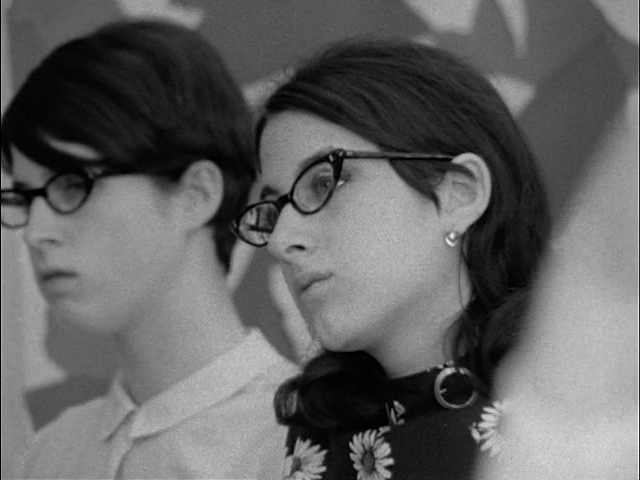
Are we meant to look at Northeast High School in 1968 and marvel at the similarities to our own memories, or at the differences? Surely Frederick Wiseman's documentary, unencumbered by framing or commentary, would have looked like life when first screened. Did Wiseman himself compare the experiences of these late-60s kids in front of his camera to his own, from the late 40s? Could he have avoided it? Did he feel the condition of the American high schooler had improved or worsened since then? Should we feel things have taken a turn for the better, or the worse?
Kids These Days presumably see the picture, with its improvisatory handheld camera, harsh black-and-white 16-millimeter visuals and occasionally cloudy sound, as a garbled transmission from the ancients. But the astringent aesthetics resolve into the trappings of an all too recognizable sub-society: drab utilitarian surroundings, ceaseless bureaucratic ceremony, trumped-up administrivia, arbitrary judgments from pathetic figures, the glazed eyes of one's fellows. Past the superficial, what's the big deal? It's just another couple semesters in high school.
Contemporary reactions to the film would surely surprise them. “High School shows no stretching of minds,” writes Peter Janssen in Newsweek. “It does show the overwhelming dreariness of administrators and teachers who confuse teaching with discipline. The school somehow takes warm, breathing teen-agers and tries to turn them into 40-year-old mental eunuchs.” What eighteen-year-old could guess that this gritty time capsule was once banned in the state of Philadelphia for its sheer gall in daring to reveal that — brace yourself, America — teenagers subject to public education are, on the whole, bored and unreceptive? That's not the stuff of a brazen j'accuse — it's self-evident to the point of otiosity.
But regardless, what a gift Wiseman has given us. Each viewing of High School is tantamount to a trip, if a short one, in a time machine. Now often cited as an early example of cinéma vérité, the documentary drops us straight into Northeast High and ejects us 75 minutes later, having offered not a word of guidance, explanation or editorialization. We pass, ghostlike, through classroom, hallway, auditorium, office and gymnasium, rarely noticed by faculty, staff or student. (This is definitely a time before reality television.) On a hunt for the interesting, Wiseman's camera swings from one subject to the next, occasionally pausing to closely observe the fine detail of a grimace, fidget or hesitation.
Despite deeper similarities with the modern day, what we see through this lens sometimes comes off impossibly distant and socially archaic. Much has the flavor of midcentury caricature come to life: blustering, bull-necked middle-aged disciplinarians with severe brush cuts and short-sleeved dress shirts; frank assessments of the minute physical shortcomings of girls in the student fashion show; vague sex-ed lectures punctuated with tidal waves of nervous laughter and scattershots of breathtakingly ignorant questions; a younger teacher's futile attempt to reach her class via Simon and Garfunkel's “The Dangling Conversation”; slightly older ones in unsettlingly advanced states of physical decay; the absolute, iron-clad requirement of tuxedos at the senior prom; horrifically unflattering one-piece gym uniforms; awkward, static-blanketed announcements spoken too closely into metallic public address systems.
Yet for all the strides since made in the average physical, sartorial and attitudinal health of those who spend seven or more daily hours enclosed by high school walls, those walls are built of the same beige-coated cinder blocks now as then. No matter how recent our graduation, those of us who have forgotten (or blocked out) the crushing tedium of wedging ourselves into folding desks and praying for the day's quick passage will find the feelings flooding back with the first glance at our 1968 counterparts doing the same.
And though a 1968 release, High School is largely drained of the mythological Nineteen Sixty-Eight. For the first few scenes, younger generations regaled with tales of flying freak flags and mass youth rebellion could hardly be faulted for assuming Wiseman shot his footage a decade earlier. Only just past the halfway mark do identifiable “60s kids” make themselves seen, and they're a pretty shabby bunch, vainly cultivating the cut-rate Lennon look as they complain incoherently about the grip of authority. It's the out-of-touch buffoons versus the lazy poseurs — hardly the noble struggle of popular lore.
Not that Wiseman or his film explicitly hold these views. But then, it's not as if they need to be made explicit. This is the part where an academic would argue that, in fact, there is no such thing as cinéma vérité, direct cinema, objective truth in documentary, what have you, since the filmmaker must inevitably make choices about what footage to exclude, what footage to include and how to present it, imposing his own perspective with each. There is a sound point here — this is far from a Warholian exercise in extended static-frame surveillance — but one of which perhaps too much gets made. Then again, tenure is tenure, and that's only the beginning of the dreary film-studies field day to be had at the movie's expense: countless papers have droned on about what Wiseman's footage says about the “gender relations” and “power structures” of institutionalized education.
We needn't dig quite that deeply — or build quite that unsupportably — to find the substance of High School. More important than any overtly political point is a purely mechanical one, to wit, that our educational machine isn't working as desired, or at least as advertised. The mismatch between large-scale education's declared aims and its actual function should come as no surprise to anyone who's spent any time in the system, but here Wiseman has assembled an effective reminder indeed. This isn't an environment of intellectual enrichment; it's a waiting room.
Despite occasional moments of apparent success — some of the kids really seem to enjoy that space-simulation program — this view into Northeast High never refutes the refrain that schools fail their students. The dominant feeling here isn't so much that the institution is doing something wrong as that, by its very nature, it's simply incapable of doing much right. Wiseman gives the grown-ups in charge plenty of time to air their assertions about schooling as the crafting of citizens — the kind that can follow orders, as one teacher flat-out states to a kid headed for detention. But as the cinematic evidence mounts, it becomes clear that even such a modest outcome is a bit much to expect from what is, essentially, a containment unit.
All feedback happily accepted at colinjmarshall at gmail.