
| ABOUT US | ARCHIVES | LINKS | RSS FEED | MONDAYS | |

3quarksdaily

An Eclectic Digest of Science, Art and Literature

« Early Islam, Part 4: The Mystic Tide | Main | A marketplace of media ideas »

December 07, 2009

Psychological Science: Measurement, Uncertainty, and Determinism – Part 1

by Norman Costa

Scientific Psychology, an Oxymoron?

In the minds of many, including scientists from the more successful sciences, the field of psychology is not a science and may never be a science. The Nobel Laureate, Richard Feynman, was kind in his criticism of psychology as a science when he said that we have the form [of science] down, but we are not producing any laws of nature. In my view, psychology as a science has made some important contributions to describing mental life and behavior in animals and humans, but, on the whole, I tend to agree with Feynman.

I care about psychology as a science, very deeply. But, why should I care? Why should anyone care? Scientific psychology must care if we are to have confidence in our discipline as a science, in ourselves as scientists, and be respected by the larger scientific community as colleagues on an equal footing. For anyone who doubts that psychological science had a serious problem of credibility, consider the following:

  1. The American Psychological Association (APA) did not issue a position in support of science in the classroom in the recent Dover, OH school case. The case involved the integrity of the school district's science curriculum for teaching of the science of evolutionary biology, and against the introduction of faith-based pretenses to science.
  2. The ascendancy of the Association for Psychological Science (APS) is due, not in a small way, to the failure of mainstream psychology to embrace the mantel of science.
  3. The de facto secession of Division 14 from APA and the creation an independent professional association, the Society for Industrial and Organizational Psychology (SIOP).


Students today are not as [insert your own text] as when I was a student.

I began teaching psychological research methods at the undergraduate and graduate levels after two careers in research psychology – one at IBM Corporation, and another as a social science research consultant. The new mission I gave myself was the training of the next generation of research psychologists. Very quickly, I fell in love with teaching, and I fell in love with my students (not inappropriately, I might add.) For the father in me, it felt like having my children back home again. 

So it is with some embarrassment and guilt that I confess to entertaining the thought that my students didn't know anything. I couldn't believe they were as ignorant as they appeared. Is it really true that students today are not as good as students when I was an undergraduate?

I mentioned this to a colleague and friend, more seasoned than I, who, quite a while before I did, entered college teaching after a long and successful corporate career. In the first semester of his new role as educator of the neonate professional, he came to the same conclusion as I. He complained to his wife that his students were ignorant of practically everything that mattered. They didn't know a damn thing. The light of perspective descended upon him when she suggested he put himself back in time to when he was an undergraduate. How much did he know about anything that mattered? He came to the conclusion that he had been equally ignorant. He didn't know a damn thing either at that age. I considered myself lucky that he passed on his wisdom to me at the time that I could best profit from it.

I became comfortable with the fact that my students were as smart as I was at their age, if not a lot smarter. If they were ignorant about important matters in life and scientific psychology, then it was my job to impart the requisite knowledge and skills. They might not know a damn thing coming into my classes, but they were sure as hell going to know a lot when they went out. At the end of each semester, I would praise my students for the fine work they did. I told them, however, that I had one complaint about them. They did not argue enough with their teachers, including me. I didn't want them to be disputatious for its own sake, rather I wanted them to question their own willing accession to 'truth delivered by the professor', and challenge ideas that didn't make sense to them.


Academic Psychology, Today

Unfortunately, the new found appreciation for my students, and confidence in them were not matched in my rediscovery of academic psychology. In my earlier “Psychological Science” articles, I described significant shortcomings in psychological test theory. The problems were as fundamental as they get:

  1. A philosophy of science that is founded on Plato's Ideal Forms;
  2. Regarding mathematical constructs, like the normal curve, as if they were derived from nature and actually represented nature;
  3. Failing to see psychological test theory as a tautology and not a real scientific theory;
  4. And equating the high utility of statistical models to scientific evidence of truth about nature.

The three-fold sources of my disillusionment, the grating on my intellectual nerves, and my uppity reactions are the many errors in some psychological research methods texts, my role as a reviewer of technical papers for one of my professional associations, and the indifference of some of my colleagues in various institutions. For some colleagues, the indifference was so forced as to thinly veil a seething hostility. On my part, as an example, I suppose it didn't help that I was quick to describe a long used and treasured text as a 'piece of crap.'

Measurement

I remember, very well, my frustration with the undergraduate text I was using. I didn't like the examples. The beginning of each chapter seemed to read well, but the later half seemed to dilute the earlier clarity and became confusing. Some of the graphics had style elements that, I thought, were supposed to contribute something to conveying meaning. They didn't. They were gratuitous and distracting. There were substantive errors throughout the text, and statements by the author that were just wrong.

The moment of truth came for me in the chapter on measurement scales. I told my students that my frustration level had reached the limit, and it was no more Mr. Nice Guy when it came to the shortcomings of the text. In the five prior chapters we dealt with fundamental concepts of science and experimental design. In chapter six we were getting down to the meat and potatoes of all scientific research.

Q. What makes science different from other approaches to understanding nature and ourselves?

A. Observation and the recording of data.

Q. And what is it about the recording of data from observation that allows science to be science?

A. The concept of measurement.

And here is where the fun starts for scientific research.

But there was no fun in that chapter on measurement. “The mighty Casey had struck out.” I was mad as hell and I wasn't going to take it anymore. The text book author expounded upon different types of measurement scales, and the use of frequency distributions, percentiles, measures of central tendency, and standard scores. Never once did he bother to define the concept of Measurement. There was no entry for Measurement in the book's glossary. So what was a frustrated and impatient research methods teacher supposed to do?

Madeline_picture_small


The Madeline Theory of Measurement

It was at this point that I first developed my Madeline lecture on Measurement. I opened my lecture on chapter six with the opening stanza of the classic illustrated children's story, “Madeline,” by Ludwig Bemelmanns:

"In an old house in Paris

that was covered with vines

lived twelve little girls in two straight lines.

They broke their bread

and brushed their teeth and went to bed.

They left the house at half past nine

in two straight lines in rain or shine

—the smallest one was Madeline."


This wonderful children's story captured the attention of any student, no matter the circumstances of their upbringing. Almost everyone could associate to wonderful memories of being read the book as a child. But, my use of the story's opening had more of a function than eliciting childhood memories. I focused on the opening lines, “In an old house in Paris that was covered with vines...”. I began the substantive part of the lecture by saying that in an old government building in Paris, a half dozen levels below street level, were a number of objects that were guarded day and night, and stored under strictly controlled conditions of temperature and humidity. Among those objects was a platinum rod and a metal alloy sphere. The rod was the universal standard of length for the meter. The metal alloy sphere was the universal standard of weight for the kilogram. They were deemed universal standards as a result of international treaties going back centuries, professional associations, industry groups, and standards committees that work through the United Nations.

Measurement is a comparison to a standard. Without this understanding, there is no measurement. This begs the questions, as to how standards are determined, and who or what makes the determination? Not a few of my students were miffed, initially, at the answer to the first question: We make them up! Part of my lecture discusses the first person to articulate the notion of relativity. It was Galileo, and not Einstein. Galileo was the first to articulate the idea that there was no absolute reference to position and momentum. Pick a point of reference that makes sense, and you have a standard. This leads to some interesting examples about settling on a standard for length based upon the distance from the King's nose to the tip of his longest finger on an outstretched arm. I tell my students that if they and some of your friends agree to use some arbitrary determination of length, as an example, then you have a standard. If lots of people agree to use your standard, then you have a unit of measurement.

Finally, I make the point in my lecture that standards do not last. The old house in Paris, that is the depository for many of the world's standards for measurement, will become, someday, a reliquary. Electronic and atomic level standards are being developed and adopted, and will render the old standards obsolete.


Enter The Graduate Students and Their Instructors

At the level of graduate study in the social sciences, and research psychologists with doctoral degrees, the problem of defining Measurement can become downright ludicrous, if not professionally embarrassing. I see this in the technical papers I review for professional conferences. The definition most often cited is from a 1946 paper by S. S. Stevens, “On the theory of scales of measurement.” Science, 103, 677-680. It reads:

“…[M]easurement, in the broadest sense, is defined as the assignment of numerals to objects or events according to rules.” (p. 677)

Stevens' definition of Measurement is totally useless. I could go even further. It is one of the worst definitions I've ever seen. In common parlance, “It really sucks!” Upon closer scrutiny, it is not a definition of anything that has value or utility for the social sciences. I can assign numerals to phenomena according to 'rules' that have nothing to do with comparisons to standards. The result would be a collection of assigned scores that are totally meaningless for any measurement purpose in psychological research.

For example, I approach a person on the street and ask if I may assign that person a number. Given a positive response, I put my hand into a bag full of coins of different monetary values (U. S. legal tender coinage) and pull out a single coin. I determine the face value of the coin and assign that numeral to the individual. I pull out a nickel (a U.S. five-cent piece) and say, “You are a five.” As I leave to approach another person on the street, my graduate student assistant asks the individual to “...pick a number, any number, between 1 and 10.” The picked number is recorded along with the coin number. A final score (a measurement) is determined by multiplying the coin number by the picked number. The picked number was four. So the final measurement value is 20 (5 x 4 = 20.) Yes, this definition really sucks!

The only way the Stevens definition could work, is if the 'rules' involved a comparison to a standard. I have seen a few authors who appended the idea of 'a comparison to a standard' to the Stevens definition. When that happens, the centerpiece of Stevens' definition, 'rules', becomes superfluous. The definition reduces to, “...the assignment of numerals to objects or events according to...[a comparison to a standard.]”

Most authors of technical papers and books, who cite the Stevens definition of Measurement, do not realize that this is not Stevens definition, at all. In fact, there is some doubt that he accepts this as a definition of Measurement, or, at the very least, does not accept it as a good definition. To understand this you would have to go back to the work of the Ferguson Committee, established by the British Association for the Advancement of Science in 1932. The purpose of the committee was to determine whether or not real scientific measurement was a possibility for the psychological sciences. In other words: Is psychology a real science or not? The Ferguson Committee, dominated by N. R. Campbell, an important figure in the philosophy of science for the physical sciences, answered the question with a resounding, “No!” Of course, the report put its response in a highly technical treatment, focusing on Campbell's theory of scientific measurement based on physical additivity, the structural additivity of the mathematician Otto Holder, and, in my personal view, the fact that Campbell would rather die from eating bad shell fish than recognize psychology as a science.

Stevens' definition of Measurement was, as he states, a paraphrasing of Campbell's definition, although he does not give us Campbell's definition from the final Committee report. In Campbell's view, measurement involved the assignment of numerical values to phenomenon according to scientific laws. This meant that psychologists had to conduct experiments to demonstrate the properties of physical and structural additivity in psycho-physical, psycho-social, and psychological measurement. Physical additivity was akin to taking many one-foot rulers and laying them end-to-end along side a much longer object to be measured. Add up the number of rulers, and you have a measure of the length of the object. Structural additivity was a set of mathematical axioms developed by Otto Holding, and published in 1901. Today we see these axioms in our first courses in algebra. For example,

  1. a is equal to b (a=b) or not equal (a < b; a > b).
  2. For any lengths a and b, a + b > a.
  3. Order of operation doesn't matter, a + b = b + a.
  4. Additive relation is indifferent for compound operations, a + (b + c) = ( a + b ) + c.


Stevens ignored the report of the Ferguson Committee. In short, he dismissed the matter entirely and felt that they simply got it wrong. He did not bother to address the call for experiments that would address the issues of additivity. It fell on later psychological researchers and statisticians, in the 1960s, to develop the mathematical proofs that scientific measurement was clearly in the domain of psycho-physical, psycho-social, and psychological science.
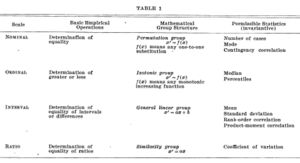
Stevens_Measurement_page_678_Table_1


Stevens' Theory of Measurement Numerical Scales

Stevens went on to develop his theory of measurement scales, that is well known to all students of psychological research methods. On this page is the graphic of Table 1 from his 1946 article. He asserted, correctly, that different types of measurement scales are derived from different measurement operations that we use to produce them. This is of utmost importance to psychological science because, depending upon the type of measurement scale a researcher is using, different decisions must be made about how to analyze the data. For example, you can't compute averages for nominal measurement scales like religious affiliation. Suppose the numeral '1' represents a Southern Baptist, '2' represents a Zen Buddhist, and '3' represents a Sufi Muslim. It is meaningless to compute an average religious affiliation score for a sample of people for which you have data.

Stevens thought he was developing a theory of measurement that would yield a definition of Measurement based upon the operations required to produce measurements. He was greatly influenced by the concept of operationalism in the work of fellow Harvard faculty, Percy Bridgman, a Nobel Laureate in Physics. In the end, he did no such thing. A close examination of his table shows that his theory of measurement is really a self-contained, mathematical description of the properties of different numerical scales. What he developed was a theory of numerical scales, not a theory and definition of Measurement. He constrained himself to the confines of the internal mathematics involved, and never ventured to examine the relationship of a fundamental or derived measure to a standard. He was stuck on the fact that the differing operations [different 'rules'] that were applied, would impute different properties to the assigned numerals. He was correct, as far as it went. But, we still don't have a definition of Measurement.

Throughout Stevens' discussions of Nominal, Ordinal, Interval, and Ratio scales, Measurement as a comparison to a standard is implied to the point that it almost jumps out and bites you on the nose. He was so focused on the operational aspects and internal mathematical properties of the resulting scales, that he simply missed the essence of what he was talking about. He couldn't see the forest [the concept of Measurement] for the trees [the scale properties that are contingent on the operations of measuring]. If he thought it was too obvious to mention, which I highly doubt, then he should have said it out loud. The fact is that he already committed himself to a useless definition of Measurement. Stevens redeemed himself, thankfully, by giving psychological and behavioral sciences an understanding of different types of numerical scales that serves us to this day.


Measurement is a comparison to a standard

E. L. Thorndike, who bridged the 19th and 20th centuries, and his contemporaries were keen on developing the scientific foundations of psychological and the behavioral research. He was the first psychologist to attempt a codification of the properties of scientific measurement in the social sciences. Though his effort fell short – he never captured the idea of comparison to a standard, for example – it was an impetus for others who followed, and who sought to elevate psychology to a science. We are not there, yet. But, we can get there if we get our fundamentals in order.

How have we come this far without a consensus for a good definition of Measurement?

Is it really true that so many of us haven't a clue, that as a science, and scientists, we are missing something very important?


In Part 2 of this article, I will discuss the issues of Uncertainty, and Determinism in the science of psychology. I think a good subtitle for Part 2 might be: “How Psychologists Quote Heisenberg and Drive Physicists Up the Friggin' Wall!”

Thank you for reading. Please COMMENT, PRAISE, CRITICIZE, SUPPORT, DENOUNCE, ARGUE, and DEFEND as you are inclined to do. All of your observations help me, enormously, in developing my ideas. I'll see you here at 3Quarksdaily.com on January 3, 2010. Happy Holidays and Happy New Year!

Posted by Norman Costa at 12:03 AM | Permalink

Comments

A worthy follow-up to your first three articles on Psychological Test Theory, Norman. From time to time I find myself in conversations where people attack or defend the idea that psychology is science -- now I'll have something to say and someplace to refer others to. I have always felt it was comparable to economics: econometrics is a science, but economics isn't. Is that partly what you want to get away from? Thanks for a good read...looking forward to the next.

Posted by: Elatia Harris | Dec 7, 2009 1:45:05 AM

Makes sense.

I had trouble trying to put numbers to an analytical structure for determining degree of corruption in political offices.

It worked better when I used a standard ("tables") with which to measure politicians.

I am still working on it, because as you say, one wonders if this is science sometimes.

Posted by: Dredd | Dec 7, 2009 3:46:26 PM

I would like to ask a general question, one which, in our usual desperate and pathetic attempts to make sure our inquiry is classified as "science", we never end up asking.

What is the point of psychology, of a "science of the mind"? Does psychology have as its sole aim the correct description of mental phenomena under some coherent theory? Or does it also have normative aspirations, in particular the goal of helping individual human subjects to understand and improve their mental lives?

The two goals are not the same. It is perfectly possible that a certain psychological practice which lacked the kind of foundational philosophical principles you're looking for might still be extremely helpful to people. Many models used (for example) in successful psychotherapy do not particularly concern themselves with the "scientific" status of their foundations, so long as the theories and practices they employ promote mental health and personal well-being. "It works" is enough.

You heap scorn upon the field without telling us why a deep theory of measurement is so important for the aims of psychology. If the sole importance of such a theory lies in its ability to be classified as a "science", then almost nothing is at stake here whatsoever.

Posted by: Nick Smyth | Dec 7, 2009 8:21:25 PM

Norman,

You have some fun at Freud's expense in this series, perhaps justified. But part of Freud's genius was in recognizing that the mind is a structure of highly subjectified symbolic content. In fact it is when he tried to over generalize, as in his theorizing of the instincts of eros and thanatos, that he got into trouble. The mind is also historical, each one being a unique collusion between inborn personality and early formative experience. These are some of the factors--subjectivity and variability--that militate against the kind of measurement efforts you argue for (without ever making a case for why they are needed beyond "respectability").

I think you present a kind of neo-postivist vision here which needelessly conflates empiricism with quantification. The more important and relevant human qualities become, the more they resist scientific measurement: beauty, sorrow, contentment, loneliness, fairness, anger, to name some obvious ones, are not counted out in SI units. Psychometrics is a clumsy device for measuring them (as every semi-intelligent child who has ever taken a Stanford-Binet test knows) and has an unfortunate tendency to dehumanize the very experiences they are trying to understand. If you care deeply about psychology, as you say, this cannot be your primary intent.

Perhaps science (at least in the Baconian-Popperian sense that this term usually indicates today) is the wrong rubric for study of the mind in the first place. Maybe something much more like art is required. This is not to say that no discipline and no theory should underlie it (any more than we would say none underlie Parsifal or Starry Night). It is simply to say that perhaps we should meet the mind on its own terms, as organic rather than mechanical, steeped in symbolic content and requiring interpretation, not statisitical analysis. As Nick observes, psychoanalysts have been having success with this approach for decades.

At any rate, count me among those who would like to know "what is at stake" in the science of mind as you see it, and what Thorndikian learning theory has contributed, except for Behaviorist folly.

Posted by: Chris Schoen | Dec 8, 2009 6:21:21 AM

I know I'm being picky, but I "ask" to differ about "begging" questions. Popular saying, yes. Correct, no. On the other hand, it seems that the goal of any measurement is to end up with an accurate estimate, which is an oxymoron itself. But which of us is not, at least partially? You know which part! (You're right! I ain't being serious about this at all. Merry Christmas, Norm.)

Posted by: Don | Dec 9, 2009 5:13:30 PM


Nick,

Thanks for taking the time to read my article and for your comments. You are asking questions which are as central to psychology as one can get. So let me set the stage of definitions and terms so we can be on the same page in a discussion.

Science is an approach to understanding nature and ourselves, and is based upon observation and the recording of data. [Notice that the word 'an' is used, and not the word 'the' or 'the only'.]

The basic function of science is to describe the properties of things. [At its foundation, all science is descriptive. Good science can be done, and has been done, at the level of description. Explaining (theories), predicting, and controlling are other functions of science. None is more basic than description, and all these functions are built upon description.]

Psychology is the science of mental life and behavior in animals and humans. [Psychology as a science is more than just a 'science of the mind.']

With all respects to Julius Caesar, “Omnes psychologiae sunt divisa in tres partes – scientiae, agricolae, scientiae-agricolae atque.” The field of psychologists is made up of scientists, practitioners, and scientist-practitioners.

You ask, “What is the point of psychology, of a "science of the mind"? Does psychology have as its sole aim the correct description of mental phenomena under some coherent theory?”

Here is where I have to nitpik in order to give good answers. Regarding your first question, I defined the field of psychology, above, and that its basic function is to describe the properties of phenomena in mental life and behavior for animals and humans.
For your second question, I have to flip it around. The descriptive function of science is, more or less, separate from any coherent theory. Rather, a theory is a coherent narrative that is based upon data. The aim (I like the word 'function') is to do a bang-up job of describing phenomena. Describing the properties of phenomena is the only aim (function) that is sufficient by itself to do good science. Beyond that, some scientists try to build good theory that explains current data, can incorporate new, unanticipated data that are yet to be discovered, and can predict data that are yet to be observed.

“Or does it also have normative aspirations, in particular the goal of helping individual human subjects to understand and improve their mental lives?”

Yes, there are normative aspirations at the descriptive levels of the science, and in the work of practitioners in mental health services, organizational psychology, educational psychology, etc. Practitioners need normative references to understand their clients, as well as for purposes of helping or improving them (people, institutions, etc.)

“It is perfectly possible that a certain psychological practice which lacked the kind of foundational philosophical principles you're looking for might still be extremely helpful to people.”

Yes.

“Many models used (for example) in successful psychotherapy do not particularly concern themselves with the "scientific" status of their foundations, so long as the theories and practices they employ promote mental health and personal well-being. "It works" is enough.”

Yes, but....
There is an expression that originated in the frontier-pioneer history of the North-American continent in the latter part of the 19th century, and is founded on the battles for resources for farming and grazing. It is, “Whiskey is for drinking. Water is for fighting.” Well, we are in an analogous situation in the field of psychology. “Mental health is for promoting. Determining what works is for fighting.” There is only one approach that can determine, objectively and empirically, the success of promoting mental health and personal well-being – science.

If for no other reason, the objective and empirical assessments of success in mental health delivery (leaving other areas of psychology aside for the moment) are important to the moral, philosophical, and political demands to demonstrate therapeutic efficacy, for which public resources will be committed. In short, why should tax monies be spent on programs and personnel if there is no evidence of effectiveness?

Science is the only tool we have to make the determination. Therefore, if scientific psychology is going to be pressed into service for the greater good, then we ought to stop farting around in our self-congratulatory arrogance, and get the basics of blocking, tackling, running, and punting down pat – basics like definitions, the philosophy of science, and the proper use of mathematical models, to name a few.

“You heap scorn upon the field without telling us why a deep theory of measurement is so important for the aims of psychology. If the sole importance of such a theory lies in its ability to be classified as a "science", then almost nothing is at stake here whatsoever.”

Nick, everything is at stake for psychology. If we don't get the science part right, then we might as well pack up and go home. There is nothing left for us to offer to our discipline and our society.

Posted by: Norman Costa | Dec 9, 2009 6:39:26 PM

"There is only one approach that can determine, objectively and empirically, the success of promoting mental health and personal well-being – science."

Who defines mental health? Seems to me that traditionally psychologists and psychiatrists have defined it as happy adjustment to social norms. Who determines which social norms are "healthy"?

It was only in 1972, I believe, that the realm of shrinkdom took homosexuality off its list of mental illnesses or aberrations. Now, however, the diagnostic manual has an illness for everyone.

">http://harpers.org/archive/2009/06/hbc-90005262">
Harper's

I suppose if you wanted to be really scientific about it, you could go the route of brain chemistry and start fiddling with the brain chemicals of babies and children, the way Dr. Biederman at Harvard has. All of a sudden, so many crazy babies.


Mental Health for Babies

How is any of this more scientific -- or objective -- than clergymen declaring what is sinful and what isn't? Is "mental health" some sort of scientific equivalent of what religionists might call holiness?

Posted by: Louise Gordon | Dec 9, 2009 9:56:19 PM

I'm sorry the link disappeared. This should take you to the Harper's article:

http://harpers.org/archive/2009/06/hbc-90005262

Posted by: Louise Gordon | Dec 9, 2009 11:26:19 PM

Norman, Nick and others,

I am interested by Nick's distinction between psychology and psychotherapy. I feel that anyone who has ever been in therapy -- successful or un- -- probably senses that nothing terribly scientific is going on, and judges the effectiveness of the therapy outside measurement systems that belong only to science. But that's leaving therapy, and I wonder, would the person seeking it have ANY confidence going in that they would ever feel better if they darkly suspected nothing based in science would happen there? To make a very obvious remark, there can be no placebo effect without a properly applied placebo. I am not -- entirely -- suggesting that good psychotherapy depends on the placebo effect, but that it depends on the giftedness of the therapist and the sincerity of the patient. If it were only about being ill and getting help, then the medical model would obtain. But it seems to me the medical model fades to spectral when it's about being ill enough to want rather than merely need help, and being fortunate -- or just determined -- enough to get it from someone who is gifted at giving it.

Posted by: Elatia Harris | Dec 10, 2009 12:01:01 AM

Go Louise!

Posted by: Chris Schoen | Dec 10, 2009 1:00:11 AM


Oh God! Now I have to deal with both Chris and Louise at the same time.

Well, my brains have curdled into cottage cheese, so I'll have to pick this up in the morning. Please, no comments about my brains turning to cottage cheese before I wrote my article.

Don, the least you could have done, as my friend, is say something about how you thought I was so insightful and incisive in my reasoning.

I look forward to continuing this very good discussion after a breakfast of scrambled eggs.

Posted by: Norman Costa | Dec 10, 2009 1:33:47 AM

Chris and Louise,

Thanks very much for taking the time to read and offer thoughtful comments.

At another time I will be having even more fun with Freud when I pen my article, “Sigmund Freud, A Scientific and Personal Coward.” It will be, largely, a retelling of the section on “The Golden Age of Hysteria,” in the early part of Judith Herman's book “Trauma and Recovery.” If you are going to buy the book, I recommend you get the latest edition.

If Freud was a genius, it certainly wasn't as a scientist. In terms of the science of his tripartite theory of personality and stages of psycho-sexual development, he has been proved wrong on just about everything. As for his articulation of defense mechanisms, you may want to consider Harold Bloom's view that Shakespeare anticipated 90 percent (or did he say, 95 percent) of Freud.

My discussion of psychology as a science, and whether or not my field is functioning as a science, provokes comments that center on two things.

1. A very limited subset of psychology as a field of study and a body of knowledge – the mind, mental health, and psychotherapy.
2. That the content of such matters (and other matters) are not, and could not, be properly examined by science.

Addressing the first point, psychology is a very large field of scientific study with many specialties and sub-specialties – psycho-physics, neuro-cognitive psychology, organizational behavior, educational measurement, sports psychology, social psychology, counseling, vocational assessment, engineering psychology, and behavior modification, to name a few.

The second point is much more fundamental to the discussion. We might characterize it differently by asking the following:

1. Who decides what is the content of psychological science?
2. How do we know that psychological science is successful in studying such content?

Psychology, itself, and it's researchers decide on the subject matter for scientific inquiry. It's no different than how content is determined for any science. If non-psychologists (perhaps scientists in other fields) decide that the mind, for example, is not amenable to scientific investigation, their assessments are a complete irrelevancy. The phenomena of nature that are the proper subjects of scientific study for evolutionary biologists is determined by evolutionary biologists, pure and simple.

A familiar problem arises, for any science, when someone else determines a particular phenomenon to be outside the scope of scientific investigation, simply because they define it as outside the scope of science. In my undergraduate days, I came across a psychology text titled, “Catholic Psychology.” The author said that human memory was a function or property of the soul (the disembodied, supernatural immortal kind created by God) and, therefore, is not subject to scientific inquiry. The properties of human memory, according this view, were not accessible to science, so don't even bother studying it since it would be a waste of time.

Subjectivity and variability and idiosyncrasy do not advise against the attempts by psychologists to describe the properties of phenomena, through observation and recording of data, in the realm of mental life and behavior. Subjectivity, variability, and idiosyncrasy are problems in all sciences, more for some and less for others. These are not deterrents to science, only problems to be overcome.

Psychology needs to get it's scientific house in order (definitions, form, experiment procedures, mathematical argument, etc.) as a minimum entrance fee for admission to the club of scientists. It's the first undergarment of respectability, without which no outer uniform will properly fit. If we are not good scientists, then nothing else matters.

The second issue is far more important. Who says that we did a good job? How do we know when our science is good science? How is it determined that the scientific investigation of the mind, for example, is successful and yielding good results?

The answer for psychological science is the same as for all sciences. All scientific knowledge is provisional, and no level of scientific achievement is, or ever will be, permanent or absolute. Given the indefiniteness and impermanence of all scientific knowledge, the only criteria we have for judging our success are:
1.The general acceptance and consensus among our colleagues;
2.The overall utility of our results (predicting behavior or having positive outcomes in therapy, for example);
3.Surviving definitive and critical experimentation; and
4.Contributing to scientific explanations (scientific theories) that seem most parsimonious, plausible and reasonable.

The work of Isaac Newton that is presented in his “Principia” was judged one of the greatest scientific successes for three centuries, by these criteria. Albert Einstein's special and general theories of relativity rendered Newton's view of the universe almost completely wrong. Such is the nature of all of science.

Posted by: Norman Costa | Dec 11, 2009 2:35:00 PM

Elatia,

Thanks for taking to time to read and comment, and being encouraging in your remarks.

You ask regarding psychotherapy, “...I wonder, would the person seeking it have ANY confidence going in that they would ever feel better if they darkly suspected nothing based in science would happen there?”

Eventually, all persons seeking the benefits of psychotherapy, and all practitioners in the delivery of mental health therapies, will have an answer to your question. State and federal laws, and insurance reimbursement policies are requiring, with greater frequency and specificity, that reimbursement funding will only be provided for evidenced based therapies. Evidence = scientific evaluation.

There will not be any escape from empirical research on the efficacy of varied treatments for psychological disorders and mental health problems. This is why it is so important that scientific psychology get its scientific act together.

Practitioners, themselves are among the most resistant to developing empirical evidence on the efficacy of what services they provide their clients.

The placebo effect, the giftedness of the therapist, the sincerity of the patient, the specific therapeutic model (medical or otherwise), and so much more are all variables that need to be studied in developing empirically-based therapies. Doing science in psychology is very difficult. That's why we need good science and good scientists.

Posted by: Norman Costa | Dec 11, 2009 7:04:01 PM

Norman, You wrote: "There is only one approach that can determine, objectively and empirically, the success of promoting mental health and personal well-being – science."

Your latest response is interesting, but I am still left wondering how you can measure success in promoting "mental health" unless someone defines what that is and what criteria are used to define it. By what standard is mental health assessed? Would psychologists use the DSM IV as a standard of "illnesses" and attempt to measure freedom from its list of mental and emotional maladies as success?

I fail to see the science in any of this, and it seems to me that psychology and psychiatry are primarily another form of religion dressed in pseudoscientific garb, where cultural conformity -- not well-being -- is the normative goal.

Leaving aside for now psychoses and brain chemistry problems that even neurologists don't understand, is there some standard for defining what you call psychological disorders and mental health problems?

Also, how do psychologists attempt, through the empirical evaluation you claim is so important, to measure success of an individual's attainment of mental health if that person is enmeshed in an environment that's "sick"? For example, we live in a culture that promotes consumption and successful consumption as a measure of success. Psychology has lent its science to the service of marketing, of trying to fathom consumer psychology and exploit it -- even in the case of very young children -- for the sake of corporate profits. We are awash in ads everywhere, television and other media and even in school textbooks.

Would psychologists treat excessive consumption disorder (I made that up, but it might be in DSM IV) without addressing the social context in which such excess is fostered?

Or take war, for instance. People get driven into it through psychological propaganda. Interesting studies can be found at www.Killology.com showing how the military used psychology to get more soldiers to fire their weapons in battle. Now, there are more or more severe cases of PTSD. Are psychologists trying to measure success in treating individual cases of PTSD or are they be addressing the military's program that attempts to block the human aversion to killing another human being?

I could continue with the list, but I think you get the point. What used to be called neuroses don't grow in a vacuum. By attempting to "treat" individuals and measure success of treatment objectively and empirically without addressing the societal issues that helped spawn "dysfunctional" ways of being to begin with, I think psychology misses the point. It also misses the point in its concentration on so-called illness if no one has any idea what "mental health" is. The words make me think of Wally and the Beav in Leave It to Beaver or 1950s Good Housekeeping promotion of "wholesome." Around the same time, of course, the Rand Corporation was determining foreign policy based on game theory and other "scientific" mathematical formulas, some of which originated with John Nash.

Well, I guess you have your work cut out for you in getting that scientific act together.

Posted by: Louise Gordon | Dec 12, 2009 12:33:08 AM


Louise,

You know, if you didn't ask such fundamental questions about psychology and science, I could dismiss this series of comments and finish my Christmas shopping. On the other hand, this is far more challenging and interesting.

Let's go back to the definition of science. Science is an approach to understanding nature and ourselves, and it is based on observation and the recording of data. The basic function of science is to describe the properties of things (phenomena of interest.) There is nothing in this definition that says science, by definition, produces results that are exact or immutable. More successful sciences have very small error terms in their observations. Physics deals with very small errors of measurement. Econometrics deals with much larger errors of measurement. Psychology is between the two. The qualifier, 'exact,' does not define science.

Psychology is a science to the extent that it conforms to the definition of science. If you believe psychology is not a science, or is a pseudo-science or religion, then you ought to state clearly how psychology fails as a science. Is is not conforming to the definition of science? Do you have a different understanding of what science is that would exclude psychology from being a science? This discussion would be even more interesting if we knew we were on the same page of definitions.

You ask: “...[H]ow you can measure success in promoting "mental health" unless someone defines what that is and what criteria are used to define it[?] By what standard is mental health assessed? Would psychologists use the DSM IV as a standard of "illnesses" and attempt to measure freedom from its list of mental and emotional maladies as success? … [I]s there some standard for defining what you call psychological disorders and mental health problems?”

I mentioned in my article, above, that some of my students were miffed at the notion that standards [of measurement] were arbitrary inventions of people like you and me. They are arbitrary in the sense that we pick a reference that seems to make sense and see if it is useful for some purpose. When I say that standards are arbitrary, it is not to say they are capricious.

So how do we determine standards of mental health? Generally, we use four standards in combination – each with its own continuum. The standards assess properties of behavior or mental functioning.
1.Statistical infrequency – How rare is the behavior? [Believing others are plotting against you.]
2.Disability or dysfunction – Is there a loss of normal functioning? [Being unable to go to work due to alcohol abuse.]
3.Personal distress – Is the person unhappy? [Having thoughts of suicide.]
4.Violation of norms – Is the behavior culturally abnormal? [ Shouting at strangers.]

In general, these are what drive the modern DSM, the descriptive handbook of mental disorders. From these standards we derive the criteria for assessing mental health and efficacy of treatments. If you had thoughts of suicide before treatment, but none after, then we have a measure of improvement in mental health.

So why does the DSM keep changing, you might ask. My answer is, Welcome to science. Aristotle thought the natural state of any object is to be at rest. Newton showed this view to be completely erroneous with his laws of motion and his description of gravity as an attractive force. Then Einstein upset Newton's conceptions by demonstrating that gravity, as we perceived it, was an illusion. String (M) theory has a new description of gravity, but no empirical support as yet.

With the exception of the psychoses, which seem to be universal in our species, what we classify as mental disorders are to some extent culturally bound. Psychiatry used to have a term (which I forget) that described behavior that was normal within a particular subculture (like the mafia) but not normal in the larger society. That term was dropped a long time ago. The novel and film, “Zorba the Greek,” had a very good example of this in the murder of the widow who rejected the love of a young man in the village. The father of the young suitor avenged his son's suicide by slitting the throat of the widow following Sunday church service, with the cooperation and collusion of the islanders.

Where does all this leave psychology? The history of psychology is replete with conscientious efforts to put it on a level with other modern sciences. It is replete, also, with movements and cults that can best be described as unscientific, pseudo-scientific, and even bizarre. The questions still remain as to how we can answer questions about treatment efficacy, for example, and discover psychological laws of nature. There is only one approach available to us, and that is science. That is why we have to make sure we get the form of science correct.

Posted by: Norman Costa | Dec 12, 2009 11:49:05 AM

Norman,

Repeating the remark "There is only one approach available to us, and that is science" over and over is not going to make it any less false. History is not a science in the narrow sense you use the word here. Nor is jurisprudence, ethics, economics, or literary criticism, but all of these pursuits are just as interested in truth and social rectitude as psychology is.

Bloom's remark about Shakespeare anticipating Freud is an important one. I wonder if you know the context of that statement? Bloom is an ardent humanist, a staunch defender of the western canon, and he would even less friendly to your efforts to scientize the study of mind as he has been to Freud's (who he admires). Unlike the physical sciences, discoveries in the social sciences almost always first appear in the arts (as Neil Postman observed). They are only developed, and methodologized, by the scientist. And yet while we have many effective psychological therapies today, we are no closer to "laws of psychology" than we were 100 years ago. Either we are really bad at this, or the notion that psychology observes scientific laws has misled us. (You excoriate Freud, but seem to have no quarrel with the positivists that inspired him to search for psychiatric universals, like Compte, or those that first analogized human behavior to orderly machinery, like La Mettrie).

I don't see that you have really answered either Nick's or Louise's questions here, and I'm not entirely sure you have understood them. This isn't a total surprise coming from someone who thinks that Plato and Freud (whatever their flaws) have no serious contributions to make to our understanding of ourselves, but it makes me reluctant to press the matter much further. Surely some readers will be taken in by your passionate appeal to measurement and precision, and will not have a sufficiently strong foundation in the humanities to wonder to what end this precision will be directed, and who decides it. (The blithe incuriosity in the DSM standards you quote is perhaps the best testament to the inadequacy of your position. Taken at face value, without a nuanced conversation about what "happiness," "normalcy," "distress," and "disability" are, they give us a picture of mental health right out of Brave New World, or, perhaps, "Mad Men.")

Is "science" really going to reveal to us the proper way to understand mental health, and how to manage it, the same way it revealed the laws of bodies in motion (and how to manage them?) The idea is plausible only to those who have been denied a decent education, of a kind advocated by our friend Harold Bloom (denied, ironically, by the very technocrats and metricians you defend here, who have mortally wounded our education system)--a sad fact you have in your favor when presenting this case. However, I still entreat you to take your critics just marginally more seriously, if you have the ego-strength to endure it.

Posted by: Chris Schoen | Dec 12, 2009 1:58:49 PM


Chris,

I thought my ideas were up for debate, not an aspect of my character, ego-strength. I need some time to collect my thoughts and compose them to make mine a worthwhile contribution to this discussion.

Posted by: Norman Costa | Dec 12, 2009 3:17:50 PM

Chris, I share some of your concerns about the definition of "normalcy" and dysfunction - after, all dissidents in the former Soviet Union were confined to psychiatric wards because discontent with the workers' paradise was considered proof of dysfunctional mental processes.

But I'm struck by the unfairness of this:

The idea is plausible only to those who have been denied a decent education, of a kind advocated by our friend Harold Bloom (denied, ironically, by the very technocrats and metricians you defend here, who have mortally wounded our education system)--a sad fact you have in your favor when presenting this case.

[Reference to deity functioning solely as linguistic convention]* knows, our education system has a huge problem with experts in empty suits. Because they clothe themselves in the mantle of scientific authority, the only way to unclothe them is to be more scientifically rigorous. A movement that would result in more "I don't knows" than falsely quantified certainties could only be positive I would think.

What I'm sensing in your comments and Louise's is a discomfort with technocracy, which you extend to science, full stop. They don't have to be the same thing.


*Must not offend sensibilities of our neo-atheist friends.

Posted by: Vicki Baker | Dec 12, 2009 4:12:22 PM

Wow, it's nice to just ask a little question and have more articulate pals expand on it so effectively.

A position I am currently attracted to is this: we generally associate "science" with any inquiry which tries to distance itself as much as possible from local, perspectival influences (Bernard Williams is speaking here, not me). Physics is taken to be paradigmatic here because the methods and hypotheses used in physics are as "third-personal" as possible: their validity (ideally) hinges not on particular, local values/prejudices but on the world.

Yet, this conception immediately raises difficulties at the intersection of the third- and first-personal: psychology. It is simply implausible that a complete science of the mind can ever entirely remove itself from the particular interests of individual human subjects, including their aspirations towards good, healthy, meaningful lives.

I do not think that this disqualifies a complete psychology as a "science". I think that our thoughtlessly narrow conception of "science" is the unseen troublemaker in all of this.

Look at it this way: expand the conception of "science" to include (amongst other things) any principled, thoughtful investigation into human flourishing and this disagreement vanishes entirely. Leave the narrow, positivistic conception where it is and we will never escape this problem, not so long as there are human beings who need to know how to live their lives.

Posted by: Nick Smyth | Dec 12, 2009 4:34:32 PM

Norman,

I don't think I meant that last sentence as insultingly as it sounds, though it is admittedly caustic and I can see how it would offend. Please mentally delete the last eight words of my comment when reading through it again.

Vicki,

I agree more or less whole-heartedly with your first statement. (Postman's term is "Technopoly," which he suggests as an even greater state of acquiescence to technology qua technology).

I don't equate either with "science," necessarily. The point I was trying to make was that what Norman seems to be calling "science" is really closer to scientism or technophilia, in that it purports to answer moral questions with apparent objectivity.

The distinction is critical when considering this, I think:

Because they clothe themselves in the mantle of scientific authority, the only way to unclothe them is to be more scientifically rigorous.

If scientific rigor is interpreted according to (what I take to be) Norman's position, this amounts to a "Concorde fallacy." I would suggest a better remedy would be to admit that science represents only a moiety of our understanding about ourselves, and that it needs to be informed by the "humanities" to function correctly.

Posted by: Chris Schoen | Dec 12, 2009 5:00:06 PM

Norman,

Let me just say another word about my tone, which I recognize was strong.

As a rule I try to be pretty generous in conversation when I feel my interlocutor writes in good faith. Good times ensue. I would be advised to remain generous even when that isn't the case, but I am not always willing to exercise this level of maturity.

There was a lot of really rebarbative and frankly juvenile rhetoric in your piece, and the series that preceded it ("wussy," "wimped out," "coward," etc.). Yes, most of it was against people long dead, (Pythagoras, Plato, Freud), but their ideas remain, and there's more than a little ad hom by association involved in such remarks.

Perhaps the error is in my reading, but I found it somewhat unaccountably macho for you to issue such blithe dismissals, and while this does not excuse the rashness of my tone, perhaps, I hope it helps explain why I didn't restrict my response to your ideas, but also to your treatment of these ideas, which I found a little too Rambo for my taste. The rest is mea culpa, but I thought I would try and restate my objection to your handling of the long-standing struggle between and Empiricists and Rationalists (who I think get short shrift in your telling.) There are problems, too, with the bias to observation, for anyone who wants to think through the nature of perception. This is an important topic, and I don't think a simple division into black hats and white hats does it the justice it deserves.

Posted by: Chris Schoen | Dec 12, 2009 5:43:30 PM


Chris,

I've tried to approach my subject, here, in a highly circumscribed fashion. In Part 1 my focus is on the scientific definition of measurement. Related issues of uncertainty and determinism will be discussed in the next article. My prior Psychological Science articles were limited in scope to psychological test theory. For my colleagues in the field and all others who are interested, I am trying to improve the scientific foundations of our endeavor.

For the most part, the issues raised by the comments have very good, if limited to a subset of content in a very large field. Nonetheless, they are issues that are very important. The difficulty, for me, in answering some of the questions and commenting on some of the issues, is that there are a lot of assumptions proffered in the wording of the questions. Some of those assumptions apply to the entire field of psychology, and others are directed at what are perceived as my own predilections and views.

Many of them I do not accept, either for psychology as a whole, as a science, or for myself. Yet, I am trying to respond in a way that is helpful, even if not convincing, without parsing all the beliefs being referenced. Actually, I don't accept most of your characterizations of me and my views. Within my own discipline I have spoken against the factions who would most accurately be described by the labels you have given to me.

I have a similar problem with definitions of many of the expressions used. Sometimes I wonder if we are talking about the same thing. I have no idea, for example, what is meant by 'the mind' as used in these comments. It's really hard to have a detailed exchange on so many ideas, which I would love to do, if it's not clear what we mean.

I was very careful in explaining the definition of science earlier in these posts. Science is AN approach to understanding nature and ourselves, and is based on observation and the recording of data. Science is not THE or THE ONLY approach. It happens to be the best at answering questions like, “Does insight therapy change the destructive and self-destructive behaviors of people with the symptoms of Borderline Personality Disorder (BPD)?” By the way, the answer is, No.

By saying that science is AN approach to understanding nature and ourselves, there is the clear implication that there are other ways to understand nature and ourselves. You mentioned some of them already, history, jurisprudence, ethics, economics, and literary criticism. I would add intuition, philosophy, meditation, transcendent experiences, art, and literature. I have always advised people going into the mental health field that if they want to understand people and relationships they should read literature. Others have been even more specific by advising Russian and French novels. However, you suggest that I would view these treasure troves of knowledge as unworthy because they are not science. Nothing could be farther from the truth.

I advise being careful in our criticism of the DSM. Should we criticize it by holding it to a standard for which it was never intended? I think not. The early versions were almost useless, judging by today's standards for the DSM. They were vague, general, and in some cases about as non-specific as you can get. I don't know that the incurious DSM was meant to explain the whys and wherefores of the mental disorders it describes. What most people don't realize is that the primary function of the DSM is research. If efficacy research is going to be conducted on therapies for depression or obsessive-compulsive disorders, then the researchers should have consistent and recognized definitions of the disorders. Thus, the DSM directs the identification of the sample for the study, and the development of the measurements used to evaluate the therapies.

As an aside, there is also the Bill O'Reilly theory of the DSM. The purpose of the DSM, as he sees it, is to give people more excuses as to why they should not take personal responsibility for their behavior.

I can't say enough about Harold Bloom, and how much I treasure his work and his insights. I will use his material from “Shakespeare: The Invention of the Human” in my later article on Freud. You do go overboard, however, in saying I think “...that Plato...[has]...no serious contributions to make to our understanding of ourselves.” This is not true and I never said it or anything like it. In my prior articles I criticized areas of psychological science that begin with an affirmation of the reality of Plato's Ideal Forms. No other modern science does such a thing. Given this one criticism, I still think his cave analogy is a very good way to explain how the acquisition of knowledge isn't always direct. Much of what we learn is by observing indirectly or by observing its effects – black holes are a very good example. Then there are the rest of Plato's works which I have left intact.

If we can get past all those attributes with which you have saddled me, then I think we could go further in a good discussion.

Posted by: Norman Costa | Dec 12, 2009 5:47:08 PM


Chris,

If I understand you correctly, It was my fault that you chose to be insulting and caustic.

Posted by: Norman Costa | Dec 12, 2009 6:28:48 PM

If I understand you correctly, It was my fault that you chose to be insulting and caustic.

Um, you mean except for the part where I say "this does not excuse me" and "mea culpa"?

Posted by: Chris Schoen | Dec 12, 2009 6:43:10 PM

Norman,

I've tried to approach my subject, here, in a highly circumscribed fashion...

Thanks for clarifying your views. Looking over your response to Nick, I see you made this part of this clarification once already--between practitioners and "scientists." I'm sorry I didn't catch this the first time through.

However this acknowledgment that psychology can be practiced non-scientifically, so long as it remains demonstrably effective (for example in the case of talk therapy, the efficacy of which has been exhaustively studied), does not seem to square with your desire to search for "psychological laws of nature," which would seem to put us back in the scientistic physics model of how to conduct psychology. To what do you attribute the validity of the notion of a "psychological law of nature"?

About the DSM, I understand your point about what it wasn't designed to do, but it was you who invoked it in response to Louise's question about defining mental health. If it's not up to the challenge, then the question stands. How do we define mental health? Psychology cannot, it seems to me, be silent on the question, but it is certainly not a scientific question in nature.

There are also questions regarding what resources to devote to mental health concerns. If there is, for example, a moral benefit to be gained from engaging in talk therapy that is not available with cognitive-behavioral, or pharmacological therapy, should we devote the extra time and expense to promoting it? This, too, is not a scientific question. (Unfortunately the historical answer to this question has been simply to observe what is normative to capitalism).

No other modern science does such a thing [takes Plato's theory of forms as a point of departure].

Except for physics, which postulates eternal unchanging laws that cannot be observed directly, but are revealed through material phenomena. If you follow Nancy Cartwright I think there are cases to be made for the Platonic underpinnings of chemistry as well, and there are hints of it in some interpretations of evolutionary biology (where adaptations are said to be imperfect, but adequate to their task).

It was your rejection of the theory of forms that made me think you were a positivist. I don't claim the theory is accurate, only that it is very hard to talk about reality scientifically without some kind of idealist overtones. The cave allegory is, by the way, an extension of the theory of forms. It doesn't propose that acquisition of knowledge is sometimes indirect. It proposes that empiricism is a false methodology, and that only through rational insight can we see reality as it is. I don't remark on this to defend it, but only to show that Plato's theory of forms is not separable from the rest of his thought.

[Science] happens to be the best at answering questions like, “Does insight therapy change the destructive and self-destructive behaviors of people with the symptoms of Borderline Personality Disorder (BPD)?” By the way, the answer is, No.

This is a misleading statistic unless you add that there is no effective treatment for BPD whatsoever. Psychodynamic theory has the benefit at least of postulating why BPD arises, and how to prevent it (or at least militate against it) with parenting strategies.

I have no idea, for example, what is meant by 'the mind' as used in these comments.

I have used it to represent the subject of what psychology intends to study, which is the original Greek meaning of the word. I realize it is fashionable to transfer that focus to behavior, since behavior is easier to observe. But the study of behavior is not psychology. It is really something more like "ethology for humans." (Even anthropology inquires into beliefs). We have the advantage of being able to talk to people about their inner experiences as both a form of study and therapy. Why not use it? Nothing less, in my opinion deserves the name.

Posted by: Chris Schoen | Dec 12, 2009 8:09:22 PM

Chris,

The minimum requirement for psychology to be a science is describing the properties of phenomena, using systematic observation and the recording of data. Good science, including very good science, can be done at the level of pure description. The bulk of Jane Goodall's work on the behavior of chimpanzees, for example, is at the level of description from systematic observation. If we take a look at Darwin's “On the Origin of Species,” and separate his descriptive data from his theoretical explanations, he would still have a very significant work of science. The work in astronomy at Harvard, since the 1890s, of Henrietta S. Leavitt, Williamina Fleming, and Annie Cannon, was mainly at the descriptive level but was the foundation for all of modern astronomy.

Good science does not have to yield laws of nature to be considered science. If we can find laws of nature in our data, then we have progressed immensely as a science. There are a few candidates for laws of nature, in psychological science. Among these are E. L. Thorndike's theory of learning that is represented by his Law of Effect, and related concepts of Law of Readiness, and Law of Exercise. There is some argument as to whether his ideas are really laws of nature or just tautologies. B. F. Skinner's work on operant conditioning may very well constitute a law of nature.

However, there is no contradiction among the concepts of psychology as a practice, science as description, and science yielding laws of nature (or not). We do science at many levels: description, explanation (scientific theories), prediction, and control. We may not know how or why Therapy Mode A works to reduce obsessive-compulsive disorders. Yet, the methods of science are used to determine that Therapy Mode A works (description); It works better than Therapy Mode B (description); and psychologists can reduce the symptoms of the disorder by applying Therapy Mode A (control.)

There is no such thing as the validity to the notion of laws of nature in psychology. If we find laws of nature in our data, then we have laws of nature. The validity of those laws as laws of nature, will have to survive great scrutiny: Can they be disproved? Do they make good predictions of yet unobserved events? Do they help explain what we already observe? Are they useful to us? Finally, what we know as laws of nature, today, will be reformulated or even debunked by new data in the future. Laws of nature are immutable, always, until we show that they are not. Such is the provisional nature of all science, including “...physics, which postulates eternal unchanging laws...”.

Another Bill O'Reilly aside: In an interview with a scientist from the American Association for the Advancement of Science (AAAS), BO bristled at the scientist's assertion that there are no immutable absolutes in scientific knowledge. He laughed at the scientist while he corrected him saying, “Of course there are absolutes. One and one always equals two. There are only 24 hours in a day. [And this is my favorite] There are four seasons in a year.” Imagine a thought bubble over BO's head containing the words, “You fucking pinhead scientist!” For the record, none of his statements is true.

I explained how the DSM defines mental health, in part, by describing characteristics of disorder. It may not be sufficient for your ideas of mental health or your ideas of psychology, but it is clear how the authors of the DSM approach the task. Within psychology, there is a relatively new discipline called Positive Psychology. It's emphasis is on the flip-side of the DSM, a description of the characteristics of the psychologically healthy individual. And where do we get the standards of positive mental health, against which we compare observed behavior? We get them from the same place we get our standards of disorder and dysfunction. We make the up! If we get a lot of other psychologists, psychiatrists, and other mental health professionals to agree, then we have a set of standards. It's no different than for any other science.

There is still a lot of stuff and assumptions that makes no sense to me, for which I find it difficult to formulate a response or comment. For example, there is your comment about research on the efficacy of insight therapy for BPD being a misleading statistic. Your 'because' explanation is simply a non sequitor, and I have no way to deal with it.

Finally, important decisions in the real world should never be based on science, alone. Nothing I have said or suggested about science would contradict this. However, there seems to be a sense that if I am trying to get psychology to do science the right way, that I am promoting a 'science uber alles' techopoly or technocracy or some sort of tech[add your own bad suffix] ideology. I'm in the camp of Jacob Bronowsky who argued that scientists can not ply their trade in the absence of considering the consequences to society. He makes this point in a very moving scene from his video series, “The Ascent of Man.” Bronowsky is standing in a lake, a few yards from shore, with his feet bare, and his trousers rolled to the knees. It is the very spot where the ashes of victims of The Holocaust, some his family and friends, were flushed from the crematoria.

Posted by: Norman Costa | Dec 12, 2009 11:31:28 PM

Hi, everyone,

Damn it, I've missed all the fun and I can't tarry long now, but I hope to return on Wednesday. Maybe we need a joke to lighten up this contentious discussion. How many psychiatrists does it take to change a light bulb? Just one, but the light bulb has to want to change.

I think the issues raised here are important for everyone to consider, especially in light of Norman's saying: "State and federal laws, and insurance reimbursement policies are requiring, with greater frequency and specificity, that reimbursement funding will only be provided for evidenced based therapies. Evidence = scientific evaluation."

Norman, I am disappointed that instead of addressing some of the questions I raised, you seemed to revert to your own definitions of science and psychology and "treatment."

I am not unappreciative of the insights of some practitioners in the field of psychology and psychiatry, Robert Jay Lifton among them. But I still don't see how their practice or insights into social phenomena are based on science in the conventional sense of the word. More on that later.

I am also concerned that as the number of so-called disorders increases with each new edition of the DSM, that these fields are beginning to pathologize human life while also ignoring the question of "health" or well-being. Norman, you did not answer my question about individual health or remission of "symptoms" in the context of the larger society, which may foster such symptoms. Do you not think larger societal issues are a subject for psychologists to investigate? Do you think they are best left to sociologists or those in other disciplines?

You mentioned a couple of times that science changes with scientific advances and discoveries, and I wonder if those references were related to my mentioning the deletion of homosexuality from the DSM? If so, I want to say that this was in response to political activism and pressure, not some new discoveries made in the field of psychology or psychiatry. Also in response to activism, PTSD was added to the psych lexicon as a condition worthy of treatment and thus insurance reimbursement.

Additionally, how can it be that suddenly, between 1994 and 2000, the number of disorders listed in the DSM increased from 297 to 374?

Zur

"While some of the changes are clearly driven by professional and economic forces, such as the increase in the number of available diagnostic labels from 297 in 1994 to 374 in 2000, that evolved in response to insurance companies' need for increased labels during that period, others clearly reflect the evolution of the culture at large."

Finally, I believe there are parallels between the practice of psychology and psychiatry and the pastoral counseling of traditional clergy. In pre-Freudian and psychological times, if someone was a drunk, they were encouraged to "repent." Now, through therapy or 12-step programs, they gain "insight" and support in treating their ILLNESS, just the way and so many other dysfunctional ways of being are treated as illness, as if they were pneumonia or perhaps Alzheimer's, in need of both the talking cure and fiddling with brain chemicals to bring about needed change. Alcoholism may not be the best example to cite here, since the liver is affected and people get the DTs when swearing off the bottle. But what about all the other "disorders" listed in the DSM? Do you believe there is a physiological component to all of them? I believe that many of them are responses to living in untenable situations, situations mediated through the corporatization of the world.

And what about the forced drugging of young school children who are suddenly afflicted with ADD and ADHD and "oppositional defiant disorder" because they don't like the confinement of public school classrooms? Does anyone know what the long-term effects of drugs such as Ritalin may have on young children's developing brains? What about Dr. Biederman at Harvard suddenly finding babies and very young children afflicted with "bipolar disorder," and thus in need of off-label treatment with powerful psychotropic drugs?

I don't see any of this leading in a good direction. In fact, I can imagine a major contingent of the psychiatric profession and pharmaceutical industry freezing in the center of Dante land -- metaphorically, of course.

Posted by: Louise Gordon | Dec 13, 2009 12:49:55 AM


Louise,

I'm just a poor psychological research scientist who is trying to get other scientists in psychology to do it right. To do justice to your many questions would require me to boil the ocean.

Tomorrow I'll take another stab at your post and see what I can come up with. However, there's a great deal that ought to be answered by others who are more informed than I.

Re; Jokes. Did you not laugh at my Bill O'Reilly vignettes?

Here's another: A junior therapist has been working in parallel with his mentor, a famous clinical psychologist. Their respective offices are at opposite ends of the office suite. At the end of the work day, the junior clinician comes out of his office. He is visibly tired, a bit disheveled, and weary from a long day of seeing patients.

He sees his mentor step out of his office. Unlike himself, the senior therapist is the picture of energy, enthusiasm, and bright cheerfulness. The junior of the two asks, "how can you look so refreshed after listening to peoples' problems for eight hours straight?"

The senior replies, "Who listens?"

Posted by: Norman Costa | Dec 13, 2009 1:16:18 AM

Norman, perhaps a simpler approach will be more fruitful. Here's a single question for you:

Can you describe, in terms that are fully scientific (in your sense, the sense of being discretely measured according to a standard) how an "objective and empirical assessmen[t] of success in mental health delivery" would go?

Posted by: Nick Smyth | Dec 13, 2009 3:29:22 PM

Norman,

Thanks for continuing to elaborate your views. In the process I think you are walking back from some of the claims that elicited comments from Nick, Louise, and myself.

I agree with you that "good science does not have to yield laws of nature to be considered science." While I don't share your concern that psychology be classified as a science, I agree that if it is so classified, it need not emulate physics to do so, and your illustration of ethology is a good one. This comes very close to Nick's proposed definition: "expand the conception of 'science' to include (amongst other things) any principled, thoughtful investigation into human flourishing."

However, this appears to conflict with your earlier criterion of "real" science relying on "whether or not real scientific measurement [is possible]," in particular, and your heavy focus on the problem of measurement in psychology, in general. Goodall is notorious for electing to name, rather than number, the subjects of her study. One of her most significant contributions has been to describe the social structure of chimp families and communities, based on observation that was qualitative, not quantitative. We could make similar observations about Darwin, who was an assiduous and thorough observer, but did very little quantification of data. Meanwhile, you write in your article that psychology, which makes much greater use of measurement and statistical analysis than ethology or Darwinian naturalism, has not yet been "elevated to a science." You also write in an earlier comment, in conflict with the more modest definition you provide here regarding mere systematic observation, that psychology must employ experimental method and mathematical modeling "as a minimum entrance fee for admission to the club of scientists." You can see how this has created some confusion in trying to get a grasp on your definition of what renders a pursuit "scientific."

There is no such thing as the validity to the notion of laws of nature in psychology.

This is a very heterodox characterization of this aspect of philosophy of science. In order for something to be a law of nature, it must be universal and generalizable. Even someone like E. O. Wilson who is not noted for his caution in applying scientific principles to the study of humanity and culture, only postulates two laws that pertain to biology: (1) that biology reduces to chemistry and physics, and (2) that all biological phenomena have arisen through natural selection. Some people propose a third law, that the cell is the fundamental unit of life, though I'm not sure the "replicator" theorists (like Dawkins) would agree with that one. At any rate, this is an extremely conservative list, and for good reason: life is contingent.

Returning back to your example of Jane Goodall, do you think it would be meaningful to talk about her work as potentially uncovering laws of nature? The fact that chimps, like all organisms, are subject to evolution makes it very difficult to generalize any ethological observations as "lawful." (Many people have speculated that the artificial conditions Goodall and other primatologists imposed on chimps in the course of their study--e.g. feeding--gave rise to behavior that would otherwise not have occurred.) For humans that problem is compounded by the constant evolution of culture, as well as nature, and by humans' own agency. In short, while it's trivially true that "If we find laws of nature in our data, then we have laws of nature," there are sundry obstacles to the "validity" of psychological laws of nature, and I don't see that you've addressed any of them thus far. I would argue that such consideration must take place before altogether dismissing the idea of whether it's valid to talk about psychological laws of nature.

If we can find laws of nature in our data, then we have progressed immensely as a science.

This contradicts your earlier statement that "Good science does not have to yield laws of nature to be considered science." To "progress" is to become more "good." Again, there is a strong pull in your argument toward the idea that the more psychology resembles physics, the better. Ironically, the examples you propose of such progress only end up weakening the ability of psychology to make meaningful statements about cognition. Thorndike's "Law of Effect," for example, states that people (or animals) tend to repeat behavior that brings satisfaction, and repress behavior that brings discomfort (except that, being a law of Behaviorism, it must be expressed in the passive voice, so that the behavior is said to "recur.") I'm not sure whom that is supposed to impress. The "argument" that this constitutes a tautology is pretty unassailable. And what do we do with behaviors that are both satisfying and uncomfortable? (This goes to your emphasis on precision in measurement and comparison to a standard.) What do we do with delayed gratification? As a scientific principle, this one is dead in its cradle (a cradle nearly 100 years old, I would add). And if you think Skinner improved on matters any, I would ask you to formulate this improved law in a way that isn't tautological or self-refuting. As oversimplistic as Freud's pleasure principle and reality principle no doubt are, they at least introduce a model of behavior and cognition that reflect some of the complexities of self-interest, which we would expect as one of the tasks of a meaningful study of human psychology (as opposed to that of a rat, or amoeba).

For example, there is your comment about research on the efficacy of insight therapy for BPD being a misleading statistic. Your 'because' explanation is simply a non sequitur, and I have no way to deal with it.

I'm not sure what you mean by my "because" explanation. My point was not to dispute that psychotherapy is ineffective in treating BPD, merely to reply that there is no reason to selectively single it out, since no therapy is effective in treating BPD. Perhaps you didn't mean to impute to talk therapy the attribute of being less scientific than other forms, but in the context of your remarks (e.g. your criticism of Freud and your praise of Thorndike) such a connotation seemed to lurk below the surface.

I'm just a poor psychological research scientist who is trying to get other scientists in psychology to do it right. To do justice to [Louise's] many questions would require me to boil the ocean.

I would suggest that your "aw shucks, these questions are out of scope for a little old psych researcher such as me" response is a departure from the grandiose claims you led with in your piece and in your previous series. Not that such a change is unwelcome. Taking psychology seriously, as you are right to do, means resisting a reduction of human behavior and motivation to a series of pat truisms about cause and effect, which is part of why Behaviorism has taken its place with the other "movements and cults that can best be described as unscientific, pseudo-scientific, and even bizarre."

Posted by: Chris Schoen | Dec 13, 2009 4:05:08 PM


Chris,

My response to Louise was in the spirit of her 'lightening up' the matter and calling for and offering some humor. I can't speak for her, but I trust she saw my own humor as a welcome response to her own. Keep in mind, I was addressing Louise, not anyone else.

Until you decide you are going to fore go motivational attribution in your remarks, I'm not going to bother to respond to your comments and questions. You are better off finding another author who will put up with your lack of manners, hostility, and intolerance.

Posted by: Norman Costa | Dec 13, 2009 6:21:25 PM


Nick,


You ask: ”Can you describe, in terms that are fully scientific (in your sense, the sense of being discretely measured according to a standard) how an "objective and empirical assessmen[t] of success in mental health delivery" would go?”

Let's do an example involving combat related Post-Traumatic Stress Disorder (PTSD), and assessing the efficacy of different therapies in relieving the symptoms and behaviors that characterize the disorder.

Here is a simple outline of the process. I'm going to be brief, even a bit cryptic, rather than go on at great length.

1. Formulate the broad concepts and definitions that will be addressed in the research. These include the particular disorder of PTSD, Mental Health, Therapeutic Modes, and the overall objective of the study. At this stage, we usually refer to these higher level concepts and definitions as hypothetical constructs.

2. We formulate questions for our research. For example: Can different therapeutic interventions relieve the disabling and self-destructive symptoms of PTSD? Sometimes these questions are phrased as experimental hypotheses.

3. The hypothetical constructs are then translated into operational definitions. What operations do we perform to determine the presence or absence of PTSD? One of the hallmarks of PTSD is raging anger. We might count the number of reported incidents of insubordination to a senior officer as the operationalization of raging anger. Another important operational definition concerns the assessment of success. Counting the number of symptoms that are reduced could be an operational definition of better mental health for those with PTSD. Returning to combat ready status could be another operational definition of improved mental health. Other good operational definitions could a measure of the survival of marriages, and the levels of intrafamily violence.

4. A sample of people is selected that represents some larger population of interest, perhaps military personnel returning from a minimum of 6 months active duty in Iraq.

5. There may be several therapeutic modes that are evaluated: The trauma targeting approaches, outlined in Judith Ross Herman's “Trauma and Recovery,” are just being invented and developed. So these might be good candidates. Insight therapy might be another. Specific types of Yoga that emphasize focus on body awareness may prove to be helpful. There is also psycho-pharmacology. There may even be a no treatment group (control group.)

6. Additionally, there are other variables to consider, like gender, age, presence of physical wounds, and circumstances of the trauma event. Participant motivation and steadfastness are important variables. There are also interactions among the variables and treatments. It can get complicated.

7. At various times there may be assessments by self-report questionnaires, observations by others, fidelity to scheduled appointments, etc. We might also include medical data. Depending on the objectives of the study, the collection of data may go on for a significant period of time.

8. Now let's look at the results. Of course, there are none so I am going to create some hypothetical findings.

8.a. Trauma targeting therapy (finding a safe place, sharing one's story with others who have similar experiences, and integrating the trauma experience into the story of one's life) is the most effective and reducing symptoms like startle responses, body memories, and rage.

8.b. Relationship problems like courts marshal, divorce, and intrafamily violence are significantly reduced.
Insight therapies have some impact on startle responses and rage and intrafamily violence. However, depression, substance abuse, and sleep disorders are not improved.

8.c. Yoga seems to promote the reduction of anxiety, reduction in body memories, and a feeling of regained possession of one's own body (found in treatment of rape victims.) Yoga has the additional benefit of enabling a disposition and readiness for other forms of psychotherapy for trauma. Alcohol and drug abuse are lessened.

This is a brief look at an overly simple, and hypothetical scientific study of mental health outcomes for those being treated for combat related PTSD. Almost anyone could describe problems with this study design, the kinds of variables studied, how the sample was selected, the operational definitions used, or the proper interpretation of the findings. Some might disagree that qualifying for return to active duty status is a proper measure of mental health. Such airing of the experimental dirty laundry in this scientific process does not militate against this being science. It would mean that ALL scientific research is subject to qualifications and limitations. In psychological science, there is almost no such thing as the definitive, primary study. Is this science? You bet.

If someone was looking for science to be more exact, definitive, and persuasive, they will be very disappointed. It's complicated, sometimes messy, incomplete, never absolute, and always provisional. This is no less true for the work in quantum physics being done at the Large Hadron Collider (LHC.) Welcome to science!

As far as the definition of science is concerned, it can not exist without the specific references to observation and the recording of data. This definition can be made more precise by saying that observation must be systematic, and that measurement should involve comparisons to clearly defined standards. We could write a tome on the process. The experiment is a special tool for observation, and a very good and important tool. But, notice that the definition of science is not dependent upon the experiment.

So here's my most succinct definition of science:

Science is two things. It is method and it is content. Science as method is an approach to understanding nature and ourselves that is based upon observation and the recording of data. Science as content is the organization of information into a body of knowledge (biology, psychology, astronomy, and metallurgy.)


Posted by: Norman Costa | Dec 13, 2009 9:31:35 PM

Norman,

I apologize if I let my rhetoric get away from me. I guess it's clear that there are aspects of this topic that push my buttons, but it would be a partial repudiation of my position if I acted like this was something I could not rise above. I think it's worth trying to see if we can communicate any further on this, and toward that end I'm reposting my previous comment, edited to cleave a little more closely to the ideas at hand.

***

Thanks for continuing to elaborate your views. In the process I think you are walking back from some of the claims that elicited comments from Nick, Louise, and myself.

I agree with you that "good science does not have to yield laws of nature to be considered science." While I don't share your concern that psychology be classified as a science, I agree that if it is so classified, it need not emulate physics to do so, and your illustration of ethology is a good one. This comes very close to Nick's proposed definition: "expand the conception of 'science' to include (amongst other things) any principled, thoughtful investigation into human flourishing."

However, this appears to conflict with your earlier criterion of "real" science relying on "whether or not real scientific measurement [is possible]," in particular, and your heavy focus on the problem of measurement in psychology, in general. Goodall is notorious for electing to name, rather than number, the subjects of her study. One of her most significant contributions has been to describe the social structure of chimp families and communities, based on observation that was qualitative, not quantitative. We could make similar observations about Darwin, who was an assiduous and thorough observer, but did very little quantification of data. Meanwhile, you write in your article that psychology, which makes much greater use of measurement and statistical analysis than ethology or Darwinian naturalism, has not yet been "elevated to a science." You also write in an earlier comment, in conflict with the more modest definition you provide here regarding mere systematic observation, that psychology must employ experimental method and mathematical modeling "as a minimum entrance fee for admission to the club of scientists." Perhaps you can see how this might have led to some confusion over your definition of what renders a pursuit "scientific."

There is no such thing as the validity to the notion of laws of nature in psychology.

I don't think we can take this validity as a given. In order for something to be a law of nature, it must be universal and generalizable. Even someone like E. O. Wilson who is not noted for his caution in applying scientific principles to the study of humanity and culture, only postulates two laws that pertain to biology: (1) that biology reduces to chemistry and physics, and (2) that all biological phenomena have arisen through natural selection. Some people propose a third law, that the cell is the fundamental unit of life, though I'm not sure the "replicator" theorists (like Dawkins) would agree with that one. At any rate, this is an extremely conservative list, and for good reason: life is contingent.

Returning back to your example of Jane Goodall, do you think it would be meaningful to talk about her work as potentially uncovering laws of nature? The fact that chimps, like all organisms, are subject to evolution makes it very difficult to generalize any ethological observations with sufficient universal regularity as to be "lawful." (Many people have speculated that the artificial conditions Goodall and other primatologists imposed on chimps in the course of their study--e.g. feeding--gave rise to behavior that would otherwise not have occurred.) For humans that problem is compounded by the constant evolution of culture, as well as nature, and by humans' uniquen capacity to contemplate their own behavior (their "agency.") In short, while it's trivially true that "If we find laws of nature in our data, then we have laws of nature," there are sundry obstacles to the "validity" of psychological laws of nature, and I don't see that you've addressed any of them thus far. I would argue that such consideration must take place before altogether dismissing the idea of whether it's valid to talk about psychological laws of nature.

If we can find laws of nature in our data, then we have progressed immensely as a science.

This contradicts your earlier statement that "Good science does not have to yield laws of nature to be considered science." To "progress" is to become more "good." Ironically, I think that the examples you propose of such progress only end up weakening the ability of psychology to make meaningful statements about cognition. Thorndike's "Law of Effect," for example, states that people (or animals) tend to repeat behavior that brings satisfaction, and repress behavior that brings discomfort. You wrote that some people consider this law to be a tautology, and I would agree: we can always change the definition of satisfaction or discomfort to fit the observed cirumstances. It may be a valuable heuristic in some circumstances, but it's hardly comparable to something like Boyle's law.

You suggest that Skinner's modification of this law solves some of the problems of circularity and imprecision, but since you don't elaborate I would ask you if you can formulate this improved law in a way that demonstrates these improvements. As it stands, it seems to me that a model like Freud's pleasure principle/reality principle, admittedly reductive and simplistic though it is, does a better job of capturing the complexity of human thought and behavior, as opposed to organisms lower on the phylogenetic tree. (But I certainly would not want to elevate it to anything resembling a law.)

For example, there is your comment about research on the efficacy of insight therapy for BPD being a misleading statistic. Your 'because' explanation is simply a non sequitur, and I have no way to deal with it.

I'm not sure what you mean by my "because" explanation. My point was not to dispute that psychotherapy is ineffective in treating BPD, merely to reply that there is no reason to selectively single it out, since no therapy is effective in treating BPD.

If I've mischaracterized your clarifications, I hope you'll make the appropriate corrections. But it seems to me there are still significant inconsistencies in your original description of what it means for psychology to be a science in your, and your subsequent elaborations in your responses to Nick, Louise, and myself.

Posted by: Chris Schoen | Dec 14, 2009 2:00:24 AM

Golly, I'm gone for a little while and the kids start fighting.

Norman, I hope you won't take offense, but I don't know anyone who likes behaviorism or B. F. Skinner. I don't know, maybe Martin Seligman might. Torture dogs long enough and they learn helplessness.

Please don't boil the ocean on my account. One of the main points I was making was that psychological research doesn't take place independent of social context, as your PTSD example illustrates. Considering the big picture in psychology and psychiatry nowadays, I don't see how any research can be conducted independent of and without being influenced by the prevailing trends toward pathologizing life in the absence of "mental pathogens."

On the other hand, psychology can be used to mask societal "sicknesses" by getting individuals to adjust to their surroundings, sans symptoms that disrupt what passes for social harmony.

I don't know if this could by any stretch be called a "law of nature," but there is evidence to suggest that humans have a strong innate aversion to killing other human beings, as I mentioned with reference to the Killology site. One outcome of the PTSD example you gave could be interpreted as an instance in which psychology is employed for the purpose of social control. You write: "Returning to combat ready status could be another operational definition of improved mental health."

If psychologists can't help stop wars, then they can at least help soldiers return to combat-ready status? Of course, there are other combat zones besides war, zones where authoritarianism, poverty, racism, sexism, classism and so on prevail and take their toll on well-being. Is the purpose of psychology to help ameliorate such societal conditions or to get the individual to adjust to environments that have negative effects on well-being?

But I have an announcement to make. My participation in this thread was part of a scientific experiment I've been conducting. Now that I have observed the interaction here, I am going to review my recorded data and integrate it with other thread observations. Eventually, I may publish my findings.


Posted by: Louisa Gordon | Dec 14, 2009 2:46:36 AM

Norman, Louise, and interested others,

The dilemma referred to here, whether returning a soldier felled by PTSD to duty is the same as restoring him to mental health, has received peerless treatment in Pat Barker's _Regeneration_ trilogy, the last volume of which, _The Ghost Road_, won the Booker Prize in the mid-'90s.

Volume I is set in a hospital, where a historical figure, Dr. Rivers, is attempting, through psychiatry, to return the poets Siegfried Sassoon and Wilfred Owen to active duty. A fictional character, Lt. Billy Prior, is also invalided out for nervous complaints, and must be made fit to fight again. As one reads the entire work, one sees everyone question deeply what this really means. There is no one answer from the writer or any of her characters -- only questions that need to be asked about the nature of duty, will, conscience, mental fitness, adaptation and military heroism.

The deepest question of all -- why it is that old men are forever sending young men (and now young women) into battle -- is the worthiest to examine. And that would imply a test of the fitness of these old men to make such momentous decisions. Good to know, if all they wanted was to experience at second hand the puissance of youth, sending out surrogates to protect their oil business interests.

A pacifist might believe that there are no emergencies greater or more cruel than the organized taking of human life, that the response of warfare compounds any hostile situation, with the peace that may result a mockery. ("They have created a desert and called it peace," Tacitus wrote.) Yet almost everyone recognizes that the spirit of sacrifice, of acting for the greater good when you will lose everything by it, is alive in many heroic people, including those in the military capable of individual heroism. In his essay, "The Moral Equivalent of War," William James writes about how this impulse to the highest forms of altruism could be encouraged outside the military, to serve the moral equivalents of war -- that is, in battles against poverty, hunger and disease.

And yet. And yet. If everything that mattered to you and your people -- not just your life and their lives, but the meaning of those lives -- hung in the balance, you might choose to be fit enough to do your utmost, rather than to be nervously disabled. There is no situation on earth that is without moral ambiguity, least of all the situation that mandates the sacrifice of some lives to save more lives. The notions of decision and commitment are not supposed to be easy or reflexive, and decisions and commitments we are willing to call good rather than expedient must take place outside a (non-existent) 100% moral certainty zone.

I am not sure if a psychiatrist like Dr. Rivers should be making decisions as to whether to help poets get fit to go back into battle -- perhaps that's a matter for moral philosophy rather than psychology, and would apply equally to surgeons who patch soldiers up to return them to duty. I do think, however, that the psychological condition of old men with vested interests who send out the young to fight for those interests should be declared a pathology suitable for treatment. But it never will be, for it has a name: power.

Posted by: Elatia Harris | Dec 14, 2009 12:50:41 PM


Elatia and Louise,

Elatia's comment sums up, nicely, the focus of some of our discussions - standards of measurement, themselves, are ripe for debate and can challenge some of our most fundamental values. They are also the product of our most fundamental - even misguided - values.

In my opinion, Louise is asking how can we have an understanding of mental health (or mental illness) in the context of a larger society that may, by some measure, be dysfunctional, itself.

Is not our definition of mental health, or psychology, or even science culture bound? Of course it is. This is troublesome if we are measuring these definitions against internalized standards that require these ideas to be infection free - free of the taint of the arbitrariness of culture, values, and history.

Science, or its definition, does not exist in a vacuum. Many non-scientists have the notion that science is exact, objective in a pure form, isolated from fad, and value-free. Or, if not, then it should be. What some see as the varying context of science, becomes their argument that it's not really science, and maybe there is no such thing in the first place.

Louise's example of the increase in the entries to the DSM is a very good point for this discussion. I see the greater delineation of disorders as an improvement in measurement. In my lecture on measurement in psychological research I show my students a foot ruler that has only two tic marks, zero and one. Another foot ruler has three tic marks, zero, one-half, and one. A third foot ruler has 13 tic marks, representing the inch, from zero to twelve. I ask my students which of the three foot rulers will produce the most accurate measurement data for length when used correctly. Measurement tools with greater gradations produce more accurate information.

Another example is an academic measurement system for grading that uses only two tic marks, PASS and FAIL. Compared to a measurement system that has many more tic marks ( A+, A, A-, B+, ..., F) the PASS-FAIL ruler is a less accurate measure of educational achievement. In either case, the notion of a comparison to a standard is central to the process of measurement. Sometimes the standards are explicit, and other times they may be internal and a bit loosey-goosey. Both systems of measurement have substantial components of subjectivity and contain some amount of error. This is not only true of educational measurement, but of most measurement in all of science.

At this point we could branch into an entirely new thread about politics, morals, and societal values reflected in our institutions of learning, how educational standards are determined, and how we do or do not do a good job at educating our students. I hope we can keep the discussion to the realm of science and measurement.

Louise suggests that the increased fineness of the DSM tic marks may reflect values other than better scientific measurement standards - a pathologizing of more of modern life, or maybe even a profit motive benefiting vested interests.

At the risk of putting words in her mouth, she suggests that we are missing the larger, and more fundamental, understanding of mental health by not seeing the dysfunction of the larger society and its values. She has a point, and this could be fodder for many posts and threads. There is a very good example of this in aeronautical science in the early years of designing faster than sound jet aircraft. Every structural surface of an aircraft's design was subjected to wind tunnel tests so as to reduce drag and turbulent vortexes. Yet they couldn't attain the high speeds they wanted. Then one of the engineers came up with a 'revolutionary' idea. "Let's study the wind tunnel characteristics for the entire structure as a whole." The rest is history.

Take a look at today's post on the attempts by physicists to discover the Higgs boson, “Higgs Could Reveal Itself in Dark-Matter Collisions”:

http://www.3quarksdaily.com/3quarksdaily/2009/12/higgs-could-reveal-itself-in-darkmatter-collisions.html

There are different opinions on what to measure and how to conduct the measurements that might or might not reveal the existence of the Higgs boson. In any case, the Higgs boson, itself, if it exists, cannot be measured at all. The only things that can be measured are the effects of its absence. From these measurements, it is hoped, the unobserved existence of the Higgs boson might be inferred. One scientist's dismissal of another scientist's approach to discovering the Higgs boson might very well be code for, “I'll be damned if you're gonna get the Nobel prize for this, if I don't!” This too is science, or the expression of the values of mortal scientists.

Again I say, “Welcome to science.” For my colleagues in psychological science, I say, “Let's get the basics right, like measurement, and then do the best job we can.”

Posted by: Norman Costa | Dec 14, 2009 2:58:21 PM


Louise,

You state: "... I have an announcement to make. My participation in this thread was part of a scientific experiment I've been conducting. Now that I have observed the interaction here, I am going to review my recorded data and integrate it with other thread observations. Eventually, I may publish my findings."

Spoken like a true scientist!

Posted by: Norman Costa | Dec 14, 2009 3:01:35 PM

Louise,

I hope you won't take offense, but I don't know anyone who likes behaviorism or B. F. Skinner.

I was surprised by this too, but the Wiki article on Skinner is surprisingly favorable, and the number of behaviorist journals and professional associations is higher than I would have guessed.

I think there will always be a temptation in the social sciences toward a picture of humanity that elides moral agency (which is one reason why philosophy of mind is so important. In fact I could be tempted to say this is the great challenge of our age.) I'm still not entirely clear how strongly Norman follows the radical (Skinner's word) behaviorist program, which is something I'm hoping to understand better in this exchange. Certainly one can believe in the procedural efficacy of operant conditioning (ethical or not) without fully endorsing Skinner's metaphysical views on environmental determinism. But I was curious to see Norman cite this as a possible law, which implies it has an ontological, and not just methodological content.

Elatia,

Brava and amen. I almost want to argue against the flirtation with fatalism in your final sentence, but I'm not sure I can. Perhaps that's our next law of nature (also a tautology, since power must always be wielded by someone--right? And the alternative prospect--that senescence is a journey into irrelevance--is perhaps just as sad.) But what all parties to this chat can surely agree on is that science must always ride shotgun with the discernment of what is right.

Posted by: Chris Schoen | Dec 14, 2009 3:07:06 PM

Norman,

You write: "I see the greater delineation of disorders as an improvement in measurement. In my lecture on measurement in psychological research I show my students a foot ruler that has only two tic marks, zero and one. Another foot ruler has three tic marks, zero, one-half, and one. A third foot ruler has 13 tic marks, representing the inch, from zero to twelve. I ask my students which of the three foot rulers will produce the most accurate measurement data for length when used correctly. Measurement tools with greater gradations produce more accurate information."

The question is, are the tic marks driven by science or politics and social control?


Amazon


Amazon

When shrinks vote on what should be in or out of the DSM IV, I fail to see how such opinions are based on science or "measurement."

Also, I tend to agree with what Chris said about inability to measure human qualities and emotions: "I think you present a kind of neo-postivist vision here which needlessly conflates empiricism with quantification. The more important and relevant human qualities become, the more they resist scientific measurement: beauty, sorrow, contentment, loneliness, fairness, anger, to name some obvious ones, are not counted out in SI units. Psychometrics is a clumsy device for measuring them (as every semi-intelligent child who has ever taken a Stanford-Binet test knows) and has an unfortunate tendency to dehumanize the very experiences they are trying to understand. If you care deeply about psychology, as you say, this cannot be your primary intent."

I think that in psychology and psychiatry as now practiced, especially with pharma's greater entry into "mental health" with the advent of SSRIs and other magic bullets, that there is a great deal of dehumanization that passes for therapy. For example, if people don't snap to and get over grief in a few days, they may be advised to get psychotherapeutic "help," lest their worker productivity take a nosedive. School children are evaluated by psychologists and guidance counselors, and if they don't toe the line within the classroom program, they're often drugged with Ritalin so they become more obedient charges. (What would Stanley Milgram have to say about such training?) Soldiers are treated for PTSD, but do DSM IV authors ever come up with "diagnoses" such as Excessive Martyrdom Disorder for heroism in wartime or any other times?

The topics under discussion here have pushed Chris's buttons and mine as well, because I believe people ignore the downside of "measurement" and psychological treatment at their peril. I am also disappointed, Norman, that you have seen fit to take Chris to task for "lack of manners, hostility and intolerance." You invited people to "COMMENT, PRAISE, CRITICIZE, SUPPORT, DENOUNCE, ARGUE, and DEFEND." Your criticism of Chris's remarks make me think that perhaps denunciation is unwelcome in discussing the subjects at hand. His criticism was pointed, but the only remark that I found objectionable was the one concerning ego strength, perhaps an oblique reference to Freud.

A while back Namit wrote an article on ontology, which received overwhelmingly negative comments. Namit answered his critics and remained on speaking (or blogging) terms with them. I am disappointed that you have chosen to send Chris to another author instead of responding to his questions and comments, even if they were delivered in a critical manner that you found offensive.

You said that my jocular remark on scientific experiments was spoken like a true scientist. I failed to mention that my observations are completely subjective.

Posted by: Louise Gordon | Dec 15, 2009 1:22:26 AM

Chris,

You write: "I was surprised by this too, but the Wiki article on Skinner is surprisingly favorable, and the number of behaviorist journals and professional associations is higher than I would have guessed."

According to my scientific evaluation, the favorable reports may come from those suffering from Walden Two Disorder.

You write: "But what all parties to this chat can surely agree on is that science must always ride shotgun with the discernment of what is right."

Does anyone know "what is right," any more than anyone knows what "mental health" is?

Posted by: Louise Gordon | Dec 15, 2009 1:33:57 AM

Robert Whitaker on iatrogenesis:


Whitaker

I suspect that when enough chronic disability (people no longer in the "workforce") results from diagnosis and treatment of disorders, that people will release the country can't afford DSM IV decisions on health.

Posted by: Louise Gordon | Dec 15, 2009 1:56:30 AM


Louise,

Thanks for your comments.

My first admonition to Chris was: "I thought my ideas were up for debate, not an aspect of my character, ego-strength."

Louise, you criticize my ideas, and that is fair.

Chris attempted an apology, and then took it back with 'you made me do it.'

I called him on the 'you made me do it' stuff and he responded with a blow-off.

My second admonition to Chris was also directed at his penchant for criticizing character rather than my ideas: "Until you decide you are going to fore go motivational attribution in your remarks, I'm not going to bother to respond to your comments and questions."

Chris attempted another apology and said he would do a better job next time. He acknowledge he strayed from confining his attention to the ideas at hand.

Louise, I repeat what I said earlier, that his conduct toward me on this thread has been bad mannered, hostile, and intolerant.

You continue to criticize, even denounce, some of my remarks and ideas. I have not had any reason to upbraid you or take offense. And, I doubt I will ever be put in that position. You have stuck with the ideas and the issues - though we differ greatly. Your bouquets and your brickbats are all welcome.

Posted by: Norman Costa | Dec 15, 2009 2:12:16 AM

Norman,

There is, quite simply, a massive disanalogy between:

1. measurement of physical objects via comparison to defined physical standards, and
2. measurement of "raging anger" via "count[ing] the number of reported incidents of insubordination to a senior officer."

There are clearly two types of "measurement to a standard" here. In one, the object being measured is of the same type as the standard itself. In another, the object under measurement (the anger, a subjective experience) is being measured by something entirely different (behaviour). It is very, very difficult to see why your proposal doesn't lead straight to psychological behaviourism, at least in method.

If you want, you can interpret my argument as claiming that your description is "messy" or that the operational definitions are bad. That has never been a concern of mine at all. My primary concern is this: under your definition, a psychotherapist who simply witnesses a violent outburst (and judges that the patient is expressing raging anger) is not doing science.

As always, an excessively positivist/behaviourist view of science disqualifies even the most responsible, thoughtful inquiry from the field of "science". Without some larger argument as to why this view of science is correct, there is simply no reason to accept this disqualification. Do you have such an argument?

Posted by: Nick Smyth | Dec 15, 2009 2:13:33 AM

Source.

Posted by: Namit | Dec 15, 2009 3:11:42 AM


Nick,

Thanks for your comments and challenge.

The analogy holds perfectly. For measurement of physical objects, let's take the example of the Higgs boson. It is only an hypothetical construct at this time. So we need an operational definition in order to measure it. At present there are two operational definitions of the Higgs boson. One is observing the photon that is released when a particle of dark matter is annihilated. [Overly simple definition: matter = a photon + a Higgs Boson. The Higgs boson disappears and all you are left with is the photon.]

The other operational definition (way of measuring the Higgs boson) is to capture and measure all the energy and matter from a collision of two particles in the Large Hadron Collider (LHC). If the Higgs really exists (actually existed – past tense), then there will be a deficit when we collect and add up all the pieces that flew off in the collision. There will be some amount that is missing. The calculation of this missing amount is the operational definition of the Higgs boson.

The second operational definition is so friggin' messy that it take billions of dollars to do the measurements, and billions upon billions of collisions, and more data than can be handled by the world's fastest computers. There is nothing, REPEAT NOTHING, in the history of all science that is messier than this. The operational definition that involves measuring photons from the annihilation of dark matter (you wanna talk messy?) involves billions more dollars and blasting satellites into space. It involves measuring differences in temperatures (energies) that are very, very small.

Some of the folks at Fermi lab think they may have evidence for the Higgs boson. Some scientists think their data are too messy to consider, and will wait for confirming data from the LHC.

Now, let's get angry – the raging kind that is a standard for PTSD. First, it's a standard because some people thought it was indicative of PTSD and others agreed, and that's what makes a standard a standard in any science. Next, how do we operationalize PTSD? How do me measure it? A reasonable approach might be to think of how it might be expressed on a military base that houses returned Gulf War vets. It may be that a cursory look at military records suggests that counting reports of insubordination that indicated angry reactions by the soldiers involved (shouting, shoving, fighting, throwing things, etc.) might be a good way to measure raging anger. There could be other ways to operationalize raging anger. Some might be messier than others. Some might be too low in frequency to count. Some might be easier to obtain – like a self report questionnaire of angry outbursts in the prior 10 days.

The concepts of measurement and operationalization are the same for all sciences. Measurement is a comparison to a standard. Some sciences have standards that are easier to use and result in less error in measurement. Other sciences have standards that are harder to use and result in more error in measurement. There is no concept that differentiates among sciences on the basis of 'an object that is measured as being of the same type as the standard itself,' while another object is not. For example, when measuring very, very small differences in temperature (energy levels of background radiation) in space, you can't use a thermometer.

I agree with your statement that “...a psychotherapist who simply witnesses a violent outburst (and judges that the patient is expressing raging anger) is not doing science.” However, the person who records the psychotherapist's judgment, and combines it with the recorded data from other psychotherapists IS DOING SCIENCE.

Beyond this, there have been, throughout this thread, opprobrious references to behaviorism, positivism, excessive positivist behaviorism, and the like. Some of the criticisms here have been along the line of equating how science works with the opprobrious labels of concepts that you and others don't agree with. This is cutting too wide a swath, or painting with too wide a brush, or being too wide in casting a critical net. If you can just set aside the labeling, and preconceptions of what science is and is not, we might find it easier to understand how science functions.

Finally, you can't hold science to a standard for which it is not intended. If science doesn't produce moral values and assessments, that is not a failing of science. That's your job – as a consumer, citizen, politician, educator, parent, social critic, and religious leader.

Posted by: Norman Costa | Dec 15, 2009 3:25:55 AM

Does anyone know "what is right," any more than anyone knows what "mental health" is?

Louise,

I don't objectively, enforcibly right. But we have to at least answer the question and go from there, or have the question answered for us (in both examples).tal health" is?

Posted by: Chris Schoen | Dec 15, 2009 10:32:41 AM

That should read "I don't mean..."

Posted by: Chris Schoen | Dec 15, 2009 10:43:08 AM

Norman,

I am still suffering some confusion over (a) what your definition of psychological science is, and, relative to this, (b) what tolerance for non-scientific psychological practices is implicit in your appeal.

You wrote, earlier, that a minimum standard of "very good" science was "at the level of pure description," including "systematic observation and the recording of data." You used Jane Goodall and Charles Darwin as illustrations.

Now you write that (in Nick's words) "a psychotherapist who simply witnesses a violent outburst (and judges that the patient is expressing raging anger) is not doing science." I would agree that the therapist in this example is not doing research, specifically--but not doing science? It's true that Nick's example didn't specifically itemize the recording of data, but judging that a patient is expressing raging anger is a comparison to a standard every bit as much as the diagnosis of measles by a medical doctor. Presentation of measles is unambiguous and needs no tests or instruments to diagnose. But no one would accuse such a diagnosis as "unscientific."

You also wrote, in an earlier comment, that you acknowledged that not all practices within psychology need be "scientific," and perhaps this would be an example of that distinction. But if that is the case, I'm still unclear over what your general point is. What are some concrete examples of the inadequacy of measurement in psychology you are unsatisfied with? You exhort your colleagues to "get the science right," but don't tell us where they are getting it wrong, and we are left to guess, which I think lies beneath the motivation of many of the questions raised here by Nick and others to try to clarify your position.

I look around me and it seems that scientific, evidence-based methods of evaluation are thriving in psychology. In fact, your earlier hypothetical to Nick about assessing PTSD outcomes seems pretty typical of the current, mainstream approach. So what am I missing?

Posted by: Chris Schoen | Dec 15, 2009 11:38:29 AM

The medical model doesn't fit psychology, largely because there is no standard of measurement, as you point out, Norman. Therefore, we can't say that a normal person should be between 3.0 and 8.5 on a standard scale of anxiety and have it actually mean anything. One reason for this is that there is no ONE accepted standard scale. There are a number of reputable anxiety scales out there and psychologists debate their quality.

So here is my question: if all of the other sciences arbitrarily made up their standards, why can't psychology? Few accused physics of being a non-science when physicists used the astronomical unit as a standard of measurement and surely the distance of this planet from the sun is an arbitrary standard. What we need is to spend less time in physics envy and more time reaching consensus on which standard measurements to use.

Posted by: Rhea | Dec 15, 2009 12:06:03 PM

Also, Norman,

[T]here have been, throughout this thread, opprobrious references to behaviorism, positivism, excessive positivist behaviorism, and the like. Some of the criticisms here have been along the line of equating how science works with the opprobrious labels of concepts that you and others don't agree with... If you can just set aside the labeling, and preconceptions of what science is and is not, we might find it easier to understand how science functions.

I can't speak for Nick or Louise but in my case my "opprobrium" for behaviorism is not based on preconceived notions of what science "is and is not," but rather on thoughtful consideration of what psychology is, or should be; a study of mind, not behavior, whether or not such study is fully "scientific."

You don't care for it much when your critics try to surmise your beliefs and and motives without evidence, and this is fair, but they have a right to the same benefit of the doubt in return. Some people are down on behaviorism and positivism not because they are ignorant or because they hate science, but because they have serious philosophical problems with the wholesale rejection of metaphysics. Tolerance, courtesy and respect are, if you please, a two-way street.

Posted by: Chris Schoen | Dec 15, 2009 12:13:43 PM


Chris,

I have reach the limits of my powers to explain clearly.

You state: "Tolerance, courtesy and respect are, if you please, a two-way street."

To you I cede the last word.

Posted by: Norman Costa | Dec 15, 2009 5:24:48 PM


Rhea,

'Bout time you showed up.

In response to your comments: Agreed.

Posted by: Norman Costa | Dec 15, 2009 5:26:37 PM

Norman,

I have reached the limits of my powers to explain clearly.

In that case I look forward to your next post on this subject, particularly as it sheds light on your meaning of "getting the science right" by concrete example.

In looking over this conversation it occurs to me that there is at least one other science that makes use of Platonic idealism, in the way that you define it, and that is evolutionary biology, which also holds that we cannot view objective reality directly. Following the influence of Darwin (naturally) and of Jacob von Uexkull, who introduced the concept of the "Umwelt" (self-world, or ambient), most biologists accept that human understanding is partially constrained by the contingents of our nervous system, which differ from the sensory apparatus of other organisms (who, no less adapted than we, are no less entitled to a presumption of "truth value" in thier sensorium). Even Richard Dawkins, who might otherwise be supposed to endorse a naive correspondence theory of truth, acknowledges this basic epistemological fact in his TED talk "Queerer than we can suppose," which describes the "middle world" we live in as a partial extention of our own nature: it is what we experience because it is what we were designed (by selection) to experience. But of course Dawkins would never concede that this fact dimishes by a single iota the ablity of science to describe objective reality better than any other method.

Another way of stating this problem is as a dialogue between philosophical realism, the dominant stance in the sciences today, which states that knowledge can never be more than an approximation of objective reality, and logical empiricism (positivism), which suggests that science is a direct description of the real world. As you no doubt know, in the mid to late 20th century logical positivism encountered a number of critiques from within analytic philosophy that it has never been able to fully answer (Quine, Kuhn, Ayer, Popper, Putnam, and many others), and as a result most scientists working today (at least those with philosophical inclinations) are--in effect--Platonists in the sense you describe, though they might object to the characterization. And few-to-none would agree that using science to approximate an objective unchanging reality "completely shuts off the option to chuck the whole thing." This attribution, I think confuses the unchanging nature of reality (which must be assumed if science is to be meaningful) with the unchanging nature of descriptions of that reality. So, in your earlier example, when Newton supplanted Aristotle, or Einstein supplanted Newton, nobody believed that Nature itself had changed, rather that what we thought to be accurate statements were in fact not so.

(Conversely, if logical empiricism were valid, no scientific revolutions could ever take place, because no truly scientific facts could ever be shown to be wrong).

At an rate, it's a very important fact for the continuing relevance and validity of science that whatever our theories of the world, and however they change, the reality (laws) they attempt to describe is regular and changeless, even if that fact has unfortunate Platonic overtones.

Thanks again for an interesting discussion of these questions.

Posted by: Chris Schoen | Dec 17, 2009 3:20:50 PM

Post a comment


Subscribe to this blog's feed  

PayAnywhere with iphone credit card swiper

Android Tablet

Bluetooth Headset

2013 New Style Dresses

Compare Car Rental Prices

DHgate.com Wholesale

3QD on Facebook

3QD on Kindle

3QD by Daily Email

Receive all blogposts at the same time every day.

Enter your Email:


Preview 3QD Email

3QD on Twitter

Miscellany

Lijit Search

AddThis Social Bookmark Button

Add to Google

Recent Comments

mr.ed on wagner in new york?

mirel on Here’s how to change the world

mirel on If Only We Had A Leader Like Chavez, Who Solved Real Problems -- Instead Of Debating Fake Ones Like The Deficit

X on Getting Smarter

Ross Williams on Getting Smarter

oroboe on Lennon's "Imagine" and McCartney/Wings' "Band on the Run" overlaid: One way of reuniting (some of) the Beatles

Richard H. Randall on Obama must Make Fighting Climate Change National Project, or Die the death of a thousand Scandals

seth edenbaum on The First New Atheist? Kierkegaard

waqnis on Mortify Our Wolves

nogodrod on KFC smugglers bring buckets of chicken through Gaza tunnels

waqnis on Here’s how to change the world

Fernando on Mortify Our Wolves

seth edenbaum on The case against empathy

Dredd on Mortify Our Wolves

Max on Here’s how to change the world

Rohana on Mortify Our Wolves

Raza Husain on If Only We Had A Leader Like Chavez, Who Solved Real Problems -- Instead Of Debating Fake Ones Like The Deficit

mirel on If Only We Had A Leader Like Chavez, Who Solved Real Problems -- Instead Of Debating Fake Ones Like The Deficit

araldo on Here’s how to change the world

Elatia Harris on Here’s how to change the world

Sundar on Here’s how to change the world

araldo on Here’s how to change the world

prasad on Here’s how to change the world

araldo on Thursday Poem

Raza Husain on Here’s how to change the world

Acclaim For 3QD


"I couldn't tear myself away from 3 Quarks Daily, to the point of neglecting my work. Congratulations on this superb site."—Steven Pinker, Johnstone Professor of Psychology, Harvard University.

"I have placed 3 Quarks Daily at the head of my list of web bookmarks."—Richard Dawkins, Charles Simonyi Professor of the Public Understanding of Science at Oxford University.

"Just wanted you to know I’m one of many who reads and enjoys 3 Quarks....almost daily."—David Byrne, musician, former lead-singer of the Talking Heads, artist, intellectual.

Read more here.

The 3QD Prizes

Subscribe to this blog's feed