
By Aditya Dev Sood
The sun has been hanging low for a while now, so different from the high summer. I find myself imagining the extreme angle of its likely incidence, the cause of its fleeting presence nowadays. The garden gets next to no sun, and cold is setting into the house for the short but sharp winter that Delhi experiences. The cool dry air and gentle sun make this the season for mela-s, festivals of culture and commerce that are scripted into the cultural geography of all north India, but brought to exalted expression in the social calendar of New Delhi.
We began by buying soap made at an ashram in Gangotri, the Himalayan mouth of the river Ganga at the Dastkar handicraft mela. We traipsed through the sarees displayed at the Chinmaya Mission mela, and enjoyed the root-beer at the American Women's Association mela, and bratwurst with beer at the German Mela. This morning we're back from the Delhi Commonwealth Wives Association mela, where we bought woolen slippers and hats at a stall run by the wives of diplomats from Kyrgyztan.
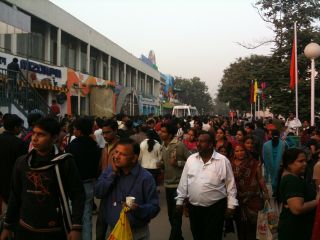
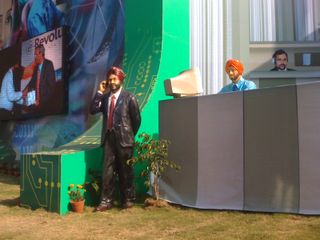
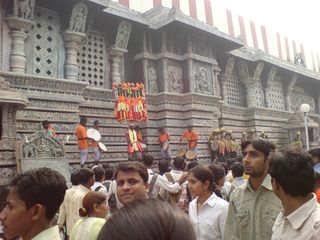
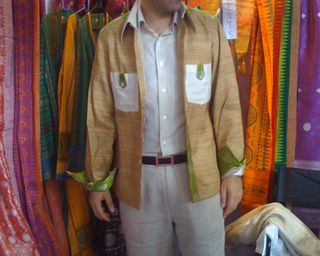
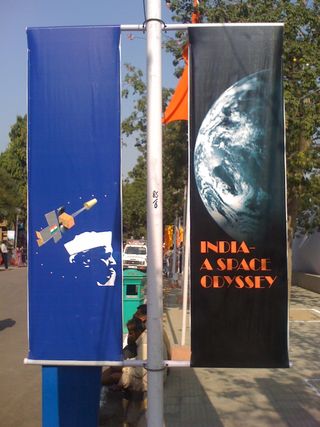
In the early days of IITF, in an era when India's nascent middle classes had never seen the inside of a mall or even envisioned a hypermart, the fair served as a rare opportunity to view and perhaps even to buy exotic imported luxuries like toaster ovens and air conditioners. Even as the fair has grown in size and participation each year, it has shrunk in terms of the sheer volume of stuff that gets bought and sold each day in the malls of Noida, Gurgaon and Faridabad, on every edge of New Delhi. Nevertheless, parties from all parts of South and South-East Asia and beyond were represented at the IITF this year. This year, the Chinese state-sponsored delegation came in numbers, but came looking for investment opportunities and local partners, not to proselytize nor to sell trinkets to the people of Delhi. They left early, leaving behind carpet-sellers from Afghanistan, saree and suitings shops from Bangladesh, and stalls from Thailand selling everything from jewelry to cosmetics to potpourri. The International-ness of the IITF has a distinctive flavor, not like an airport duty-free, but more like a re-enactment of the Silk Route, the Fur Route, the Spice Route, networks that connected India with the pre-colonial and pre-industrial worlds beyond its cultural and geographical extremities.
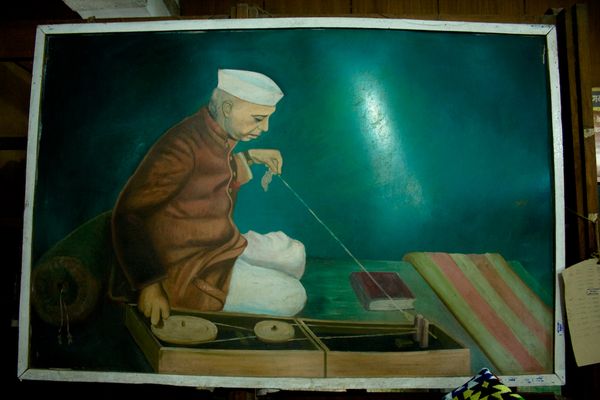
I am transported in my mind to rural Karnataka, where years ago my company, CKS, had documented patterns of trade in the rural economy. In the absence of malls and supermarkets, and given the diffuse distribution of the population in the countryside, a system of local weekly markets operates, which cycles through the countryside, so that on any given day you might be able to find a local market less than five kilometers away. You might go there to buy groceries or staples or fuel or essential tools and supplies, but you might also go to sell what was cooking or pickling or spinning or weaving or otherwise in preparation within the house. Most of the buyers at such santhey-s or haat-s or peth-s or similar weekly local markets might at the same time or on other days be sellers. The relationship between buyers and sellers is direct, and in principle at least, reversible. Through the propagation of the charkha, the manual spinning wheel, Gandhi's social philosophy expressly enjoined all of us users to also be creators of value. The village market and Gandhian economy, therefore, follows a decentralized peer-to-peer model, the very antithesis of the modern retail chain, and of late capitalist consumerism in general.
Mela-s are more festive, extensive and intensified versions of local markets, conducted to an annual rather than weekly calendar, often in alignment with harvest cycles. The people must have something to trade and something to trade with, for there to be a reason for a mela. The form of the mela seems to promote a kind of critical regionalism, similar to the wine concept of terroir: the kinds and varieties of goods available can be known on the basis of where they are from, the special techniques were employed in the creation, and the distinctive natural materials of which they are constituted. At Pragati Maidan, the cultural, material and regional specificities from across India have been carefully curated in order to create a ritualized and tropic space, through which one can understand and celebrate the macrocosm of India.
Localized agrarian trade was the communitarian foundation of Gandhi's vision for India's future, which was to be lived in its villages, at a timeless tempo, never to be disturbed by dams, irrigation projects, vaccination, the green revolution, satellite television or mobile phones, all of which are also and at the same time being celebrated at the various halls of Pragati Maidan. And alongside the village economy of Gandhi and command industrialism of Nehru, Pragati Maidan now also hosts the vast consumer appetite of India's growing middle class, due in large part to the economic liberalization of Manmohan Singh. All these forms of economic and social life perdure within the melee of India, incompletely resolved, with no clear teleological direction. We wait for their interaction and recombination to generate counterforms and alternatives we cannot yet imagine, as revolutions within revolutions still waiting to happen.
_