
Elatia Harris
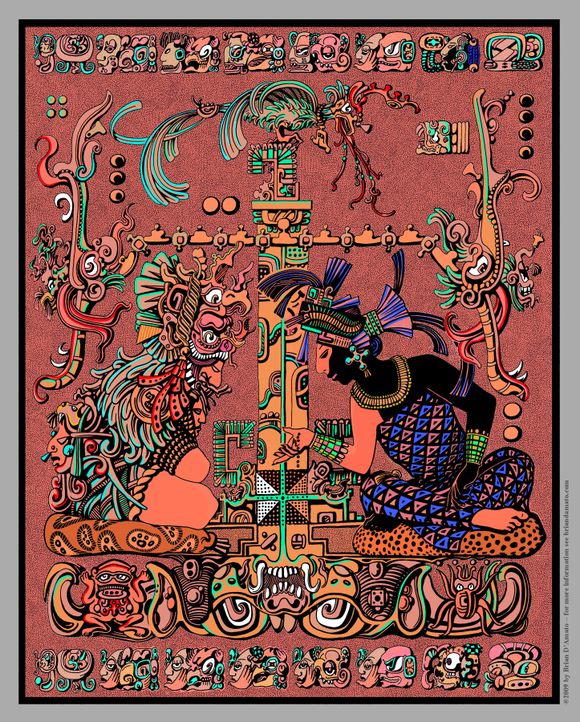
Thanks to Brian D'Amato not only for the interview but for original visual images not available elsewhere. Above, Koh's Game, copyright Brian D'Amato
In the early '90s, the artist and writer Brian D'Amato published Beauty, an international bestseller about cosmetic surgery and young love gone wrong, badly wrong. Back then, it was all slightly futuristic, right down to its not very cuddly protagonist, a metrosexual monster whose fate I shall not uncork here. Reading it was about as much fun as you could have within a 25-mile radius of New Haven; you kept running into Derrida, but it was trashy enough to make you nice and guilty too. I fondly recall its Mayan sub-theme, and was delighted to find, a decade and a half later, that Brian D'Amato had gone Mayan in the biggest possible way, with In the Courts of the Sun, volume I of a trilogy, The Sacrifice Game, set both in the very near future and in 664 CE, the high point of Mayan civilization.
It's the read you would expect from the writer of Beauty — smart, funny, always surprising, and very sure-handedly grounded in technology and philosophy of science. You can read this as literature, but you can also get the sci-fi fix you need. You could even read it to find out how an orphaned Maya refugee interfaces with some beamish and satanic Mormons. There are lots of reasons to get involved, and, whichever you choose, you'll be glad you did. Soon, The Sacrifice Game will be available not only as a trilogy but as a game — one more form of time travel for those with a thirst for it.
Recently, I caught up with Brian D'Amato, who writes from Lake Michigan these days.
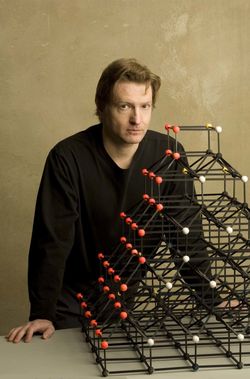
author photo Timothy Greenfield-Sanders
ELATIA HARRIS: Brian, let's talk about 2012. After reading In the Courts of the Sun – well, I don't scoff at the prophecy like I did. You've activated that very great uncertainty that lies beneath all our assumptions – good show! What's the rational way into the 2012 mindset?
BD: Right. The book explores the possibility that prophecies, real or supposed, can be self-fulfilling. People wanting something to happen, getting increasingly desperate, and, maybe, trying to make it happen. I’m also interested in the Inductive Fallacy — in this case, the argument that something not happening in the in the past makes it less likely to happen in the future.
For me, getting into the Maya calendar has been more about what one might call the poetics of their mathematics. The numbers and operations the Maya emphasize are often quite different from those that are most meaningful to the Western tradition. Studying this helps get one out of oneself, numerically speaking.
EH: You had a great way of explaining their simultaneous cycles, making it all not too dizzying to keep in mind. I loved going around thinking like that for the time it took to read. Would pre-telescopic astronomy in Mesoamerica stand a comparison with the same in Europe and Asia? If a complex relation to the stars is one sign of advanced culture across cultures, what might have been the conversation among the Mayans and Mesopotamians — just for instance?
BD: There’s a scene in my book where the narrator explains heliocentrism to a Maya sun-adderess — my translation of “ixwaay,” “female shaman” – and, as I think would have happened, after her initial astonishment she comprehends it easily. I think it’s fair to say that Mayan astronomy in the Classic period was comparable to Mesopotamian astronomy in the 5th century BCE, and in some ways, for instance in the Mayas’ famously accurate calculation of the solar year, it was superior. But if any Mayan astronomers suspected, as Pythagoras did, that the earth was round — a realization that one could regard as the next big step — there’s no record of it. Of course Maya texts are frustratingly sparse, but what has survived doesn’t suggest that any Mesoamerican scientist made this leap. Judging from the Dresden Codex, by about CE 1000 the Maya had calculated the Venus cycle. And these calculations were quite precise, but if they’d been working from the assumption of a round earth, the numbers would have come out slightly different.
EH: Are we talking about an educated society?
BD: Maya astronomy was mostly esoteric knowledge, restricted to the elite. Although for that matter, even today only a tiny percentage of earthlings know that, say, that most of the universe is probably made up of dark energy and dark matter. Societally, things aren’t so different as one might wish.
EH: Reading In the Courts of the Sun, I get a sense of the Maya being a bit set apart from other Mesoamerican civilizations. I see it in their art, too — even without expert knowledge. What are some of the ways you'd contrast them with the Aztecs? The Aztecs at the time of the Conquest, that is. We think we know more about them.
BD: The first thing to remember is that the Aztecs arrived on the scene very late in the game, only a couple of hundred years before the Conquest. Before that they were barbarians — if that word’s still allowed — from the deserts of northern Mexico. After they settled in the Lake of Mexico, they gradually took over cultural elements from the Toltecs and other peoples, who’d been, in turn, the inheritors of the attainments of the greatest Classic Period metropolis, Teotihuacan.
EH: But…?
BD: But the Aztecs never became literate. The Maya, though, were — and are — the cultural and probably the genetic descendants of the Olmec, the “mother culture” of Mesoamerica. In CE 664 — near the beginning of what’s called the Late Classic, and the year the events in my book take place — the Maya elite had been using their phonetic script for many hundreds of years. And Mayan languages have a completely different feeling from the Aztec language, Nahuatl. There’s a whole very distinctive class of positionals in Mayan that emphasize the shapes of things and the associations of actions and objects with the human body.
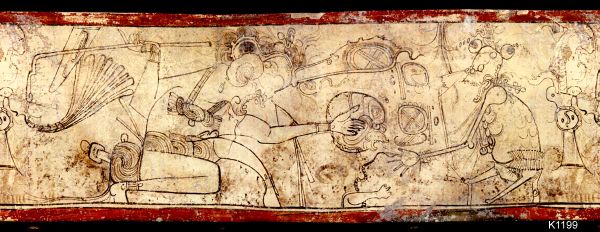
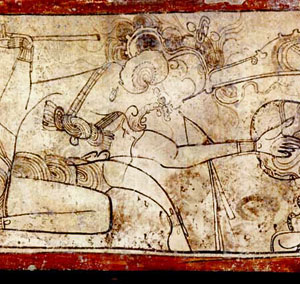
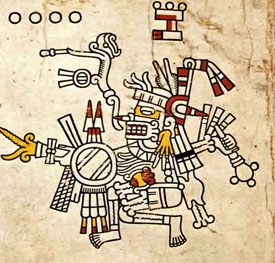
But to me the artistic differences are the most important. Even though all Mesoamericans shared many elements of their cosmovision, after a few minutes of looking at Maya and Aztec art you’d never mistake one for the other. Even in their most naturalistic mode, the Aztec’s paintings and sculptures have a brutalist angularity that’s almost the opposite of the Classic Maya style, which is curvilinear, tangled, tenticular, and, I’d say, vegetal. You could relate the stylistic opposition to a very recent one: Maya art might remind a modern observer of Art Nouveau, and Aztec art could strike you as a precursor of Art Deco.
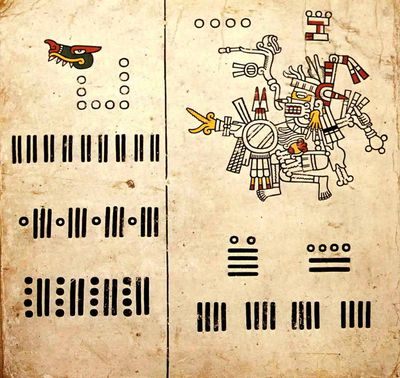
EH: I've heard the Maya called peace-loving. Not so accurately, perhaps?
BD: The Maya certainly weren’t the placid astronomer-kings they were thought to be until the mid-20th century, but they were definitely less militarized than the Aztecs, who were and are famous for human sacrifice on a huge scale. The Maya emphasized a sense of rootedness and a certain aristocratic individuality, whereas the Aztecs had a sort of “wistful warrior” culture that can seem almost Samurai-like.
EH: Your time-traveler, Jed Delanda, found the Maya sympathetic — but Jed is a Maya. Would the rest of us?
BD: I think so. Even though they had a lot of ferocious habits, the Maya would strike a Western time traveler from the 21st century as refined and even probably sympathetic. At least more so than the Aztecs.
EH: I was so impressed with your descriptions – they were done with a very light hand, and they never bogged me down, yet I took away a very vivid picture. You probably had to re-imagine a lot to write them. One doesn’t see much to base them on.
BD: Depictions of the ancient Maya’s cities and temples, in articles, books, or even in movies, always disappointed me. Even Tatiana Proskouriakoff’s important Album of Maya Architecture interprets the Maya sites as smoothly white-surfaced temple groups, surrounded by tastefully encroaching jungle and inhabited by a few desultory groups of priests. In movies the more usual problem is that the cities look much too much the same as the ruins look today — that is, scruffy and neglected, with not much color and a lot of exposed stone. But if you look at the structurally similar temples that are still being kept up today — the Sri Mariamman Temple in Singapore, for instance, or the Meenakshi Sundareswarar Temple in Tamil Nadu — you instead get this extreme visual overload because they’re entirely covered with all these shells, beads, statuettes, filigree, gold leaf, a hundred bright colors of paint, little mirrors, and anything else their temple society can think of to make the building pop.
So one of the things I wanted out of the novel was a much richer visual atmosphere than in anything that had been done on the subject up to this time.
EH: And you delivered it. But without the feeling of the guided tour that so much description gives. It was like reading Flaubert that way.
BD: Description, in general, is something readers have lost their taste for. People who teach writing fiction these days — or even books on writing by people I admire, like, say, Stephen King — tell you to spend as little space as possible in describing things and scenes. This is a rule I’ve enjoyed breaking, but it requires some planning to break it and still keep pages turning.
You mention Flaubert. Well, he's a big influence — not so much in Bovary but in Salammbo. His main trick, I think — which I try to emulate — is choosing words and details that are likely to be most credibly surprising. That is, inclusions and juxtapositions that readers — one hopes — haven’t thought of, but which will strike them as right on target.
EH: I remember reading Beauty and thinking you were pretty over-educated in the lit crit department. Lit crit and the Maya were very amusing sub-themes in Beauty, by the way. There were lots of influences on you then, including some very unusual ones. What about now?
BD: Well, as long as we're talking about descriptions, for instance, I often think about a writer who’s not known for her descriptions, Agatha Christie. Even if you’re not writing a mystery, I think descriptions stay interesting only as long as the reader is looking for clues. So even when you’re describing a landscape, the reader should get a sense that there’s an indication in it of something that’s going to become critical later — the character of its inhabitants, for instance, or the way a battle there is going to play out. And whenever the description you’re writing doesn’t have that sense of urgency, of a hidden significance that needs to be ferreted out, you should probably cut it.
EH: Let me tell you who also comes to mind — China Mieville. Like you, he is comically well-educated. And his following is looking for something rich and strange, as I imagine yours is. But in Perdido Street Station, he used the distant dystopia idea. In Beauty and in the present work, you are writing only slightly in the future. Just enough for the technologies you write about to be fractionally out of reach. Where does this locate you, among speculative fiction writers? Are you even writing about the future?
BD: No science fiction is really about the future. It’s about the present — which implies, correctly, that middlebrow mainstream fiction is about the past.
And science fiction that’s explicitly set in the present day, or in the very near future, has a long history — including, for instance, almost all of Jules Verne. More recently, Michael Crichton was a huge inspiration for me and for a lot of other people who work in this space — I read The Andromeda Strain when it came out, which means I was of an age generally considered too young for such things, and I’m still thinking about it.
One problem is that “science fiction” is too big a term. There are dozens of subgenres, and they all overlap with each other and with other ubergenres than sci-fi. People have called In the Courts of the Sun Gamepunk or, sometimes, Stonepunk. Beauty was, more solidly, Biopunk. But if I had to pick a label, I’d say there is an overarching movement to which Beauty and the Sacrifice Game books — and, for that matter, most of the visual and game art I’ve done — all belong: Posthumanism.
EH: Pray explain…
BD: Well, Posthumanism comes out in the work in a lot of ways, both in content and in style. But for me the most liberating thing about it is that it makes it seem all right for me to have no further interest in character. Of course, character is still the master theme of most mainstream or, as I call it, aspirational fiction. But to me and to more than a few other progressive writers today, it’s just a big drag. It’s something we want to leave alone. This isn’t to say that human character wasn’t interesting back when Flaubert, Tolstoy, Henry James, and others were inventing it as an object of fictional investigation. And when you read their work you still feel that sense of discovery. But unless some new writer comes up with something about people and their problems and their relationships and their characters that isn’t just the same old same old — and it would have to be pretty soon at this point — I think we can fairly safely call character-based fiction a completed field, like gross anatomy.
EH: But what does this leave you with if you want to know why something happens in a fiction? Didn’t Aristotle in his Poetics say that the character of the hero was the source of his fate? Well, words to that effect.
BD: Today, the depth model of character, the interest in families and relationships, and the upper-middlebrow requirement to — as one critic is famously fond of saying — “delicately limn the inner lives of the characters” are the most limiting of all the limitations that are making the contemporary novel increasingly irrelevant.
Of course, keeping someone flipping pages, or even in a chair watching a movie, is not a trivial craft. It’s a tough pursuit, deserving of respect. And like it or not, in any story over a few pages long, concern for the characters is the only thing known to do the job.
BD: Jed does have to be a character you can stay with. His voice, his motivations, and even his damnable inner life all have to be fueled up, airtight, and ready to fly. A novel should indeed be an “abstract” in the sense of not having anything inessential, but even if it were possible to do a novel that was only plot, that plot would still need to reveal character — in fact, probably the all-time most important rule of fiction, a commandment that’s tough to break even today and even in one’s most Brechtian mood, is that what happens to the characters has to seem a result of their choices and not the author’s.
The difference is more of a question of motivation. It’s analogous to the way directors like Alfred Hitchcock or Stanley Kubrick always cast such great actors. Great acting is essential to their films, but the investigation of character, emotion, the self, or any of that class of issues is secondary.
And even supposing one did set out to write something about, say, families, that really was up to date — that discussed, for instance, the structures and transmitters in the brain that relate to kin altruism — it would sound like science fiction. Like much of Margaret Atwood’s work, it would probably be science fiction.
EH: So talking Post-Humanistically – within sci-fi, that is – we are talking about emphases, not prohibitions. Where did this distinction get started for you?
BD: Most of the canonical twentieth-century science-fiction writers, and a few of the top fantasy writers — Vonnegut, Dick, Tolkein, Heinlein, LeGuin, Herbert, and Asimov — were as big a deal for me as they were for so many others. But the two sci-fi pieces that I'd say were the most Post-human, and that made the biggest impression on me when I was very young were, first, a Fritz Lieber story from 1963 called “X Marks the Pedwalk”, and, second, Arthur C. Clarke’s novella from 1956, The City and the Stars. Going back a little further — both in terms of publication dates and of my own age at exposure — I was especially taken with HP Lovecraft’s The Dream-Quest of Unknown Kadath, which is from his Dunsanian period but which still has his singular anti-humanism, and with the HG Wells novella The First Men in the Moon, with its eusocial undersurface society. Continuing back in time, there’s Moby Dick, which I consider a science-fiction novel, and Poe’s “The Man of the Crowd,” which for some reason affected me the most of all of his stories, although of course all his horror and fantasy tales are indispensable.
EH: I just have three words to say – Phillip K. Dick. Wasn’t he writing about the meaning of being human?
BD: I suppose the unusual thing here, for someone of my generation, is that I don’t rank Phillip Dick as a number-one influence. But in my experience there are basically Dick People and Clarke people, and I’m emphatically a Clarke person. It’s not that I’m not crazy for Dick, but despite how ahead of his time he was — and nobody, except maybe Kafka or Lovecraft, has been more so in this century — his theme is indeed still being human. His stories are about having a human mind and a human’s dissociations and paranoias. And my feeling is that humanity is no longer an interesting subject. Contrastingly, Arthur C. Clarke wasn’t much interested in the human — he was interested in the poetry of ideas, which puts him more in the tradition of his friend Lord Dunsany, along with Lovecraft and Borges.
You mention Mieville. I read Perdido Street Station when it came out, and I was quite impressed. He does his own illustrations sometimes, too, which was encouraging for me. And William Gibson, George Saunders, Neal Stephenson, Neil Gaiman, and Jonathan Lethem are always worth reading. Still, I generally find much less of interest in contemporary fiction — even science fiction — than I do in either classical fiction and poetry or in something unequivocally newer, like computer games.

Game Board, The Sacrifice Game, copyright Brian D'Amato
EH: Speaking of games… When you come out with the game, following the trilogy – who would like to play The Sacrifice Game?
BD: People who play Chess and Go would like it.
EH: And those are the readers of the trilogy, too. People who are thinking many scenes ahead of the present scene. And who sense contingency as a huge element in the structure of what they’re reading. You called readers of mainstream fiction “aspirational” a while back – what about sci-fi readers?
BD: This may be a truism, but still, I’m always struck by how much books tell you more about their readers than their writers. You get roughly the same comments other books do, so the only way, say, a prospective buyer can tell the difference between one book and another is by assessing the difference between the two groups of reviewers — that is, readers. And if those readers are themselves more interesting, we call the books they like interesting.
When you write anything that has any science fiction to it, you’re limiting yourself to a certain subset of readers — one that may be growing, but which the mainstream still doesn’t get. And I think that the main difference about the readership — besides the arguable point that sci-fi readers are, on average, more intelligent — is that they’re reading less for social reasons.
EH: That’s the aspiration? A social one?
BD: Exactly. Science fiction isn’t aspirational. In other words — even given science fiction’s still-newish academic credibility — people who read it are usually just reading for themselves. Socially, they’re already where they want to be, or where they feel they’ll remain, and don’t need to pick a reading list designed to convince other people that they’re socially conscious or intellectually upwardly mobile. From a sociological point of view, science fiction is not middle-class — today, for better or worse, it’s primarily directed to the current equivalent of what Paul Fussell has not entirely convincingly called the “X Class” and which is now the tribe of true — not aspirant — nerds.
EH: Well, there’s my title. But speaking as an aspirant nerd and reader of literary fiction, In the Courts of the Sun has a lot to offer readers like me. I want to ask you about the illustrations. It’s such a beautiful book – I can’t believe these drawings were done with a computer, and not ink on paper. What did you use?
BD: Until 2003, when I did illustrations of this type I inked them on paper, with pens (mainly using antique Gillott 404 nibs) and W&N Kolinsky brushes. But that year the WACOM Cintiq tablet/screen hybrid came out, and I and many of the many, many other “analog holdouts” in the worlds of comics, graphic design, and illustration finally switched over to the dark side.
With the Cintiq you draw directly on the screen, and the pressure sensitivity is very fine, so you can get pretty close to the level of control you’d have with traditional materials, and the added flexibility makes up for the difference.
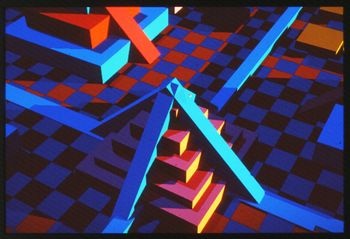
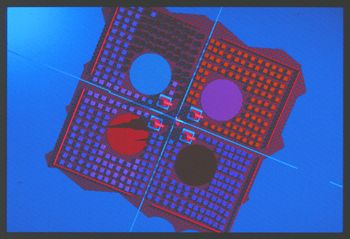
Aerial views of Ix, The Sacrifice Game, copyright Brian D'Amato
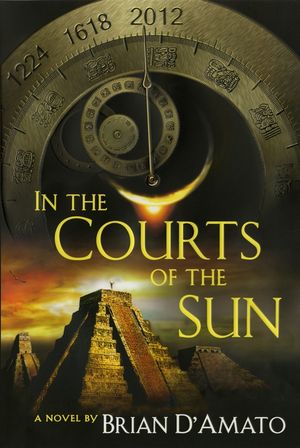
I use Adobe software as much as possible because so far it has the widest range of tools and the best compatibilities with other providers. For instance, I drew the clock on the ITCOTS jacket mainly in Photoshop, but for the brass effect I also used some filters by Andromeda. There are a few other programs I use for 3D modeling and animation, like Autocad Maya (no relation to the subject of the novel), but most of these will also work with Adobe products.
EH: And now for something completely sentimental. In the Acknowledgment pages of Beauty, you mention your mother, and In the Courts of the Sun is dedicated to your father. Please tell me a little about them. I gather they have been encouraging to you.
BD: My parents met in Vladimir Nabokov’s class at Cornell University in 1958. My father, Anthony D’Amato, teaches international law and jurisprudence at Northwestern and has written several books and hundreds of articles on law and philosophy. He’s also written music and lyrics for several theatrical works, including The Magic Man, which was Chicago’s longest running original musical comedy, and he’s produced a few plays on Broadway, where his biggest hit was Grease. My mother, Barbara D’Amato, has written about twenty-five murder mysteries and thrillers, one nonfiction book, and — of course — the books and lyrics for my father’s musicals. Her next novel is a thriller about hallucinogens, and it’s coming out from Tor/Forge early next year.
So naturally my parents always encouraged me to do something artistic. And they continue to edit my writing — my mother has done so much work on In the Courts of the Sun that I basically consider her a second author.
EH: Brian, two thousand and twelve thanks.
Visit Brian D'Amato's Web site, click here to purchase In the Courts of the Sun, and here to purchase Beauty.