
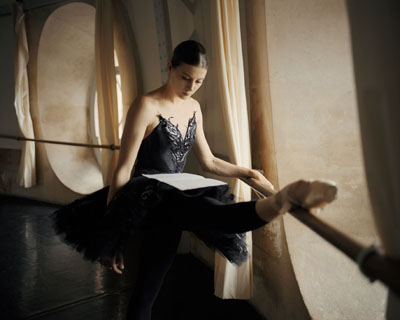
Left: Sophie Calle, Etoile dancer at the Opera de Paris, Marie Agnes Gillot, (detail) Take Care of Yourself, 2007.
Image copyright ADAGP Courtesy Galerie Emmanuel Perrotin, Paris/Miami; Arndt & Partner. Berlin/Zurich; Koyanagi, Tokyo; Gallery Paula Cooper, NY
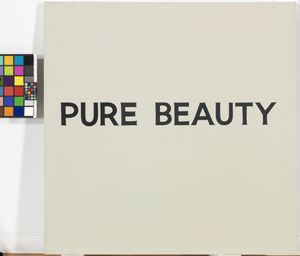
Right: John Baldessari, Pure Beauty 1966-68, acrylic on canvas, 1152.5 x 1152.5 x 34.9 mm.
Image copyright John Baldessari, Courtesy of Baldessari Studio and Glenstone
Sophie Calle at the Whitechapel until 3rd January 2010
John Baldessari at Tate Modern until 10th January 2010
Sue Hubbard
From this single text Calle weaves a web of female support. Spinning out the threads of the painful missive in which her lover admits that he is again seeing the ‘others’, thereby breaking their contract in which he agreed not to make her the ‘fourth’, she creates a complex polyphony of female voices rather like that of a Greek chorus. Using photographs, text and video the result is a complex multi-layered narrative which arouses both distaste at her lover’s self-indulgent musings and a sneaking sympathy for his obvious inability to make any meaningful emotional commitment. As a clinical psychologist says: “He is an intelligent cultivated man from a good socio-cultural background, elegant, charming and seductive with a fine, fairly subtle rather abstract intelligence. He is proud, narcissistic and egotistical”.
Part photo-novella, part psychoanalytic text, fact and fiction, reality and artifice, here, are continually blurred. Like Cindy Sherman Sophie Calle is a mistress of disguise. Never actually present within her work she leads us to question the validity of the narrative ‘I’. Who knows whether there really was a lover and an email or if this is simply an intriguing artistic construct? The work treads a fine line between turning us into voyeurs, conspirators and dupes, never letting us settle into a single role. As with the novelist Paul Auster, who wrote one of the essays in the Whitechapel catalogue, she is concerned with how a subject sits within a constructed social and artistic framework, whilst always remaining very much the omniscient narrator. One of the underlying themes of her work is that of surveillance whereby she uses photographs and texts to create a body of reportage and apparent documentation.
The first work she made in 1979 was only shown in book form. Having come back to France after seven years travelling she felt lost in her own town and took to following people in the street because she didn’t know what else to do with herself. Choosing people at random she let them dictate the course of her actions and neither wrote anything nor took photos. Following a man to Venice, she shadowed him for two weeks. A photographer himself she tried to duplicate the kinds of images she imagined he might make and created a book, Suite Vénitienne, about the experience. In her next work The Sleepers she asked people she didn’t know to come and sleep in her bed for eight hours and then be woken by someone who would take their place. For the day shift she invited those such as bakers who would normally sleep in the day. Staying by the bedside she photographed these strangers every hour and wrote down what they said. This continued for eight days. The results are like the field notes and photographs of an ethnographer or anthropologist; objective rather than intimate.
This objective control is a central element of her work making her into both auteur and conductor. In L’Homme au carnet (The Address Book, 1983) she reportedly finds a fancy red note book in a Parisian street and constructs the personality of the owner, Pierre D, through a series of meetings and interviews with those whose addresses she finds written in his book. Detailed descriptions were then published in the Libération during the August of 1983. When Monsieur D returned from Norway and recognised himself in the articles the result was outrage and distress. He claimed it was a callous invasion of his privacy and demanded the right of reply. This was printed in the paper beside a photo of Calle, naked in a domestic environment, her features masked like those of a criminal. Who then was the victim? Calle or Monsieur D? And is any of it true or do these Borgesian threads simply function as so many open ended possibilities in a postmodern narrative? Chance, so beloved by the surrealists, also plays its part in Calle’s piece When and Where? Berck, a creative game based on a journey of uncanny synchronicities dictated by her clairvoyant.
Her work is also about lack. About the lack of her central characters – her lover and herself in Take Care of Yourself, of Monsieur D in the address book piece – who are always off stage, hovering in the wings. It this void that Calle fills with her complex, allusive narrative threads, standing in the middle like the spider weaving her complex designs. The persona she gives us is the one she wants us to see rather than the ‘true’ Sophie Calle. But not all her work is so detached. The poignant tribute to her dead mother in Souci captures, in text and works of black pigment, sandblasted paper, lead and hair, her mother’s last hours. It records her final pedicure, the final book she read, the last music she heard and her last smile. But, try as she might, Sophie Calle could not record her last elusive breath, which occurred somewhere between 3.02 and 3.12, and proved impossible to capture: perhaps like truth itself.

Sophie Calle, portrait copyright Yves Geant
Language and text are also essential elements in the work of the Californian artist John Baldessari, who has been described as “a cross between Walt Whiteman and a redwood tree”. Born in 1931, an imposing figure of six feet seven inches tall, with a white beard and halo of prophet-like hair, he is widely regarded as the granddaddy of conceptual art. The current exhibition Pure Beauty at Tate Modern brings together more than 130 art works in this most extensive retrospective of his oeuvre in this country. With iconoclastic wit and irony, Baldessari deconstructs the shibboleths that underlie much contemporary artistic practice and questions the accepted rules of how art should be made. In the 60s he began to use words as most artists use images saying “a word can’t substitute for an image but is equal to it.” Beguiling his viewers with humour he aims to be as “disarming as possible.” Instructions from art manuals, quotes from celebrated art critics painted onto the surface of his canvases drew attention to the prevailing aesthetic attitudes of the period. By painting words on canvas he signalled that ‘text’ paintings were just as much a ‘work of art’ as a nude or a still life.
It’s hard not to chortle at his 1960s Tips for Artists who want to Sell and the deliciously tongue in cheek canvas that simply says: Everything is purged from this painting but art, no ideas have entered this work. Baldessari has often said that semiotics and, in particular, Claude Lévi-Strauss’s structuralism were major influences on his treating language as sign and on his deliberate play between word and image, though it’s not hard to imagine that he might easily have had an alternative career as a stand up comedian. From the 1970s he married his humorous pursuit of a new visual language to film. I Will Not Make Anymore Boring Art 1971 sees him record himself on videotape repeatedly writing the lines over and over again in a notebook. In 1970 he stopped painting to focus on photography and film, but not before he had burned all his paintings in Cremation Project, which was accompanied by an affidavit, published in the San Diego Union. His approach to teaching was equally playful and unorthodox, promoting what he called “post-studio art” based on the idea that “there is a certain kind of work one could do that didn’t require a studio. It’s work that is done in one’s head.” In his 1972-73 set of photographs called The Artist Hitting Various Objects with a Golf Club he takes repeated swipes, in a form of intellectual crazy golf, at objects found in the city dump. There is also a set of photographs of him blowing cigar smoke to imitate a picture of a cloud, and another series Choosing (A Game for Two Players): Carrots, a sort of absurdist chess made up of arcane carrot moving rules. It is both mad and rather funny.
Baldessari’s work is full of paradox. It liberates, irritates, inspires and disarms and has been an enormous influence on a whole generation of younger artists. Like looking through a kaleidoscope, he presents us with what is familiar with an unfamiliar twist so that we are forced to think about things in a slightly different way. We are continually confronted by images that ask ‘is this art?’ and if so does such a definition matter as long as the work prods us and makes us look at the world afresh. Baldessari’s own disarming answer, given in an early painting that escaped the Cremation Project, is God Nose.
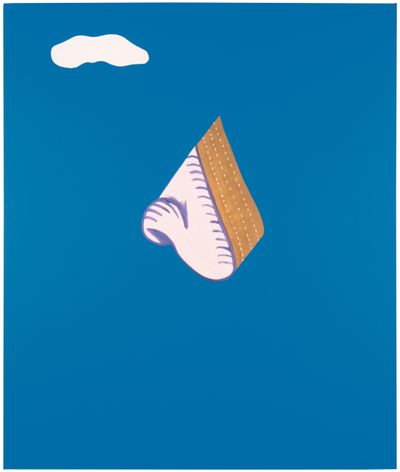
John Baldessari, God Nose, Oil on Canvas, 68 x 57 (172.7 x 144.8 cm), 1965, Private Collection.
Image copyright John Baldessari