
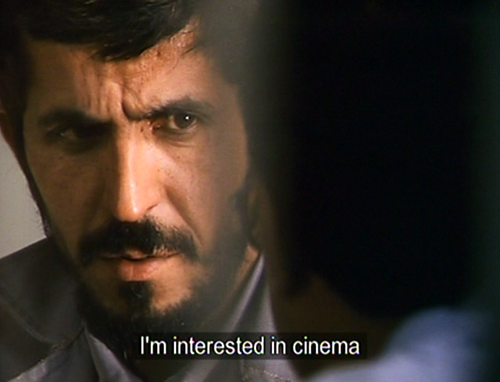
Quoth Abbas Kiarostami,
I don't like to engage in telling stories. I don't like to arouse the viewer emotionally or give him advice. I don't like to belittle him or burden him with a sense of guilt. Those are the things I don't like in the movies. I think a good film is one that has a lasting power and you start to reconstruct it right after you leave the theater. There are a lot of films that seem to be boring, but they are decent films. On the other hand, there are films that nail you to the seat and overwhelm you to the point that you forget everything, but you feel cheated later. These are the films that take you hostage. I absolutely don't like the films in which the filmmakers take their viewers hostage and provoke them. I prefer the films that put their audience to sleep in the theater. I think those films are kind enough to allow you a nice nap and not leave you disturbed when you leave the theater. Some films have made me doze off in the theater, but the same films have made me stay up at night, wake up thinking about them in the morning, and keep on thinking about them for weeks. Those are the kind of films I like.
Both the filmmaker's followers and detractors would agree that, yes, this little speech does indeed encapsulate his cinematic sensibility. The pro-Kiarostami crowd gets hooked by the characters and images that keep them up at night and distracted in the morning, while those on the anti-Kiarostami side of the fence… well, they fall asleep. No living director seems quite so critically divisive: some eminent observers of cinema as sharp as Roger Ebert have expressed nothing more than bored irritation at his pictures, while others, like Jonathan Rosenbaum, have gone so far as to author tomes on the man and include no fewer than four of his films on their all-time top 100.
I submit that it all depends on how you, the viewer, want to experience cinema. While it's entirely valid to ask that a movie grab you and yank you for a couple hours into a spectacle, an utterly fantastical escape from life couldn't be more different from what Kiarostami's selling. Per the quote above, he doesn't demand the audience's attention. If the audience gives it, excellent; he'll serve up the substance. But it makes no nevermind to him if they look away for a while. You experience a Kiarostami film, you see what you can see and you hear what you can hear, but only later does it grow within your mind into an entity that will affect you for years to come. Compare this to, say, a Hollywood disaster blockbuster, the sort so terrified you'll stop watching that its every detail looms several stories tall, whose events seem dreadfully important at the time but which washes clean from your memory immediately after viewing.
That model assumes an impenetrable bulkhead between cinema and life. You buy your ticket in order to reside temporarily in a totally foreign artificial space, ostensibly jammed with more motion, more color, more thrills and much more CGI than the real one to which you'll shortly shamble back. In Kiarostami's model, cinema is inseparable from life: one is the other, the other is one, and each draws heavily from its counterpart. Nowhere in the man's filmography does this worldview shine through more brightly than in Close-Up, a cinematic imitation of real events in which a real man's love of cinema leads to a bit of real-life fakery and fiction that's ultimately reconstructed with the aid of reality itself. If you find that too straightforward, wait until you read the next few paragraphs.
But then, we're talking about a man whose style requires a healthy-sized Wikipedia page of its own. “A good feature film is a documentary, and vice versa,” Kiarostami has been heard to remark. “When these two come together, we have seen a good film.” Hence the uselessness of genre in discussing his work. Close-Up might justifiably be called a fiction film, a documentary, a re-enactment, a documentary of the making of a fiction film, a fictitious depiction of the making of a documentary, a fiction-documentary hybrid or a fictitious documentary built upon a hybrid of real, re-enacted and made-up events. Better yet, let's scrap the pigeonholing talk and take the film on its own terms.
Hossein Sabzian is in trouble. A divorced, out-of-work printer's assistant and father of two, he's incarcerated and about to get hauled in front of a judge when noted filmmaker Abbas Kiarostami visits him to discuss his crime. Riding the bus one sunny Tehran day, Sabzian noticed the woman next to him taking an interest in the book he'd been reading. On a whim, he claimed to be the author of the volume, which was actually other noted filmmaker Moshen Makhmalbaf's The Cyclist. The woman revealed that her sons are, to some degree, fans; Sabzian, as Makhmalbaf, expressed interest in meeting the whole family.
Thus the hapless Sabzian fell in with the Ahankhah clan. Bit by bit his edifice of lies rose as he was pushed to construct it by that initial moment of imposture. He told the family that he'd like to involve them in his next movie, The House of the Spider. He poked around their home under the pretense of location scouting. He prepared their under-employed sons, one of whom writes screenplays for fun in the time he's not using his engineering degree, for their starring roles. The fantasy so consumed Sabzian that he gave orders about which trees must be cut down to facilitate his planned backyard scenes.
But Merhdad, the film buff without an engineering gig, grew suspicious. Though nowadays he'd be able to confirm those suspicions with a few keystrokes, in this pre-Google age he could only observe and probe. It was obvious that Sabzian — who turns out to bear an unsettling resemblance to Mahmoud Ahmadinejad — didn't quite look like the fellow in the film magazines, but his knowledge of what was supposedly his own body of work seemed comprehensive. Buy why did he behave so anxiously? Why did he need to borrow money from his already hard-up actors? Why did he keep insisting that they need to go see The Cyclist?
With little other way to spend his days, Sabzian became a worshiper of art. Even when he's unmasked and called to defend himself in court, he leans on his own admiration of creativity. “Legally, it might be an appropriate charge,” he says of Mehrdad's accusation of fraud, “but morally, it is not.” Desperately trying to communicate his lack of malice, he pleads that his “love of art should be taken into account.” During his speeches on his own behalf — and the film contains many of them — he sometimes veers toward the aphoristic. “Spite,” he explains, “is a veil to conceal art.”
This is a true story. But when we watch it, we don't watch it acted out by a group of performers hired for their physical and/or emotional resemblances to the actual involved parties; we're watching the involved parties themselves. Sabzian is played by Sabzian, Mehrdad by Mehrdad, ma and pa Ahankhah by ma and pa Ahankhah — even, toward the end, Makhmalbaf by Makhmalbaf. But Kiarostami hasn't made a documentary; these people all re-create the events and the trial, after the fact. A vertiginous realization comes to most viewers during the courtroom scenes: here is a man acting as himself in the story of how he once acted as a famous director, reconstituted by another famous director.
Yet this isn't meta enough for Kiarostami, who'd been willfully — and some say perversely — exposing the artifice of cinema decades previous. We see Kiarostami himself interviewing the principals and requesting permission from the judge to shoot in his courtroom. (So could the trial have been real after all? Or, should I say, “real”?) We see an assistant clap the slate before the big trial scene. We see the boom mic drop into the frame — and then the camera turns to capture the sound man in full. We hear the dialogue drop in and out as Sabzian's lapel mic malfunctions during his meeting with the genuine Makhmalbaf. “We can't retake this,” Kiarostami explains, inside the car from which he and his cameraman film the scene.
This same method captures moments even more cinematic than those seen in the slickest productions. Early on, the journalist Farazmand rushes to the Ahankhah residence in order to be first on the scene of the faux Makhmalbaf's undoing. After their arrival, his driver discards a spent aerosol can, which Kiarostami's camera follows through its entire roll down the street. The snoozing-in-their-seats set see this as emblematic of everything wrong with the film. I'm more inclined to call it the greatest moment of early-1990s cinema.
Despite the substantial and often thrilling filmmaking technique at work here, Close-Up ultimately hinges on the odd sympathy to be found with Sabzian, a truly pathetic figure who meant no harm. When he claims to have only wanted to feel a little important and to make the Ahankhahs feel like a part of something big and exciting, it's extremely difficult, even through layer upon distorting layer of reality, unreality, re-reality and meta-reality, not to believe him. Some will find it just as hard not to be kept awake at night, even if only a couple hours, by his story.
Feedback gladly accepted at colinjmarshall at gmail