
by Sarah Firisen
Some of my basic premises are drawn from Daniel Pink’s A Whole New Mind and Thomas Friedman’s The World is Flat, both of which I thoroughly recommend. My premises are as follows:
A combination of technological advances and globalization have increased outsourcing and automation of tasks to the point where soon, any rule-based, linear thinking business activity that can be outsourced to a computer process or to another country will be. Countries, like China and India, have highly educated populations who are increasingly able and willing to perform the white-collar jobs of Americans and Europeans at a fraction of the cost, and these are only the most recently successful recipients of outsourcing, other countries are quickly catching up. Technological advances have meant that the outsourcing of this work can often be seamless and transparent to the end-user. In addition, time-differences enable companies to have a 24-hour workforce without paying anyone overtime to work a night shift.
The real opportunity the US has to continue to be a dominant economic force in the new economy lies with its proven track record for inventiveness and innovation. This NPR story is very illustrative of my point; while almost all of the components of Apple’s iPhone are made and assembled in Asia, the lion’s share of the profit from each sale remains in the US, “[Apple] gets as much as half the profit for every gadget it sells. That's because Apple creates and designs things — that's where the real money is. And the best jobs.”
Invention and innovation involve a combination of left-brained and right-brained skills; while a factual understanding of the concepts involved are usually necessary, they are almost never sufficient, there is always an element of pure creativity involved. This argument is outlined in the 2008 New Yorker piece, The Eureka Hunt which discusses the work being done in creative cognition at Northwestern University by Mark Jung-Beeman, a cognitive neuroscientist. For my purposes at least, the work illustrates the vital role played by both hemispheres of the brain in moments of “insight” solutions to problems. The essence of innovation is the creation of solutions to problems, even if they are problems that most people didn’t realize they had, therefore innovation and invention require a combination of left-brained and right-brained skills and activities.
Daniel Pink posits that there are six right-brained directed “senses” which are essential to the kinds of creativity and innovation which are going to be increasingly necessary going forward into the 21st century. These are: design, story, symphony, play, empathy and meaning.
According to Pink, design is a high-concept skill that is difficult to outsource and to automate. Looking at the increasingly large field of Smartphones, surely one of the major distinctions that an iPhone holds is great design. There is a reason that the Museum of Modern Art has multiple Apple products in its Architecture and Design collection. Good design isn’t merely about aesthetics, it informs the whole product.
Story/narrative, is how the human mind best understands and translates the world. Stories are how we pass down our histories and our culture. Pink quotes cognitive scientist Roger C. Schank, “Humans are not ideally set up to understand logic; they are ideally set up to understand stories.”
Symphony, as defined in The Whole Mind is, I think, what is really involved in Mark Jung-Beeman’s “insight solutions to problems.” It’s the ability to make cognitive connections, see patterns, to synthesize. It is really the defining aspect of right-brained thinking: seeing the woods and not just the trees.
Empathy, the ability to put ourselves in someone else’s shoes is part of the essence of what makes us human. Firms like Zappos have embraced the notion of empathy and fully integrated it into their business process. Customer service representatives are allowed, actually encouraged, to go above and beyond, both in time and effort in order to empathize with customers; they have imposed an “ethos of live human connection on the chilly, anonymous bazaar of the Internet.”
Play/humor/fun are increasingly being recognized as necessary components in human cognition. The website http://www.thefuntheory.com posits that “fun is the easiest way to change people’s behaviour for the better.” Southwest Airlines, one of the world’s most profitable airlines, has integrated the idea of fun as part of its core commitment to customers, ”it just goes to show that time really does fly when you’re having fun!”
The final “sense” described in A Whole Mind, is meaning. The claim is that what truly motivates people is not money (once basic needs have been fulfilled), but rather a sense of purpose. Again, this is a mantra embraced by Zappos and Southwest both of which encourage employees to feel that they are part of something bigger than corporate profit and rather are part of an almost spiritual mission to make the world a better place.
Over the last few decades the American (and I’m sure many European) education system’s response to the “threat” from globalization and the diminishing math skills of students next to those from India, China, etc, has been to focus more and more on rote memorization of facts and standardized tests – left-brained activities, usually at the expense of recess, music and art programs and social studies – right-brained activities.
This trend has only be accelerated and deepened by the No Child Left Behind act (NCLB). A frequent criticism of the act is that it encourages teachers to focus on teaching a narrow, clearly measurable set of skills at the expense of a deeper, integrated, more organic understanding of a subject; they “teach to the test.” It also encourages schools to narrow their curriculum to focus on math and English language skills at the expense of art, music, social studies, foreign languages, physical education and recess. And if this wasn’t bad enough in and of itself, our math skills aren’t even increasing as a country, we’re actually falling more behind. According to the National Center for Fair and Open Testing, “U.S. children have made less academic progress since NCLB came into effect than in the preceding period, and the achievement gap has not narrowed as significantly.” – http://www.fairtest.org/fairtest-oral-testimony-november-12-2009
The conclusion I draw from these premises is that not only are we not educating our children to be creative, innovative, inventive leaders for the 21st century, we are not even improving our ability to compete in traditional left-brained-based activities with other countries. When it comes to educating our children, we not encouraging creativity we are actively discouraging it, devaluing it. Children start kindergarten or preschool as creative little people who love to learn and to explore the world around them. And slowly, but surely, this is driven out of them wherever, whenever possible by our education system. Play, rather than being a way to let their imaginations take flight, to explore limitless possibilities, is a waste of valuable school time. Suddenly there’s no room for dress-up in kindergarten and 5 year olds are getting stressed because they have so much homework to do. Why do 5 year olds, or 6 and 7 year olds, for that matter have any homework?
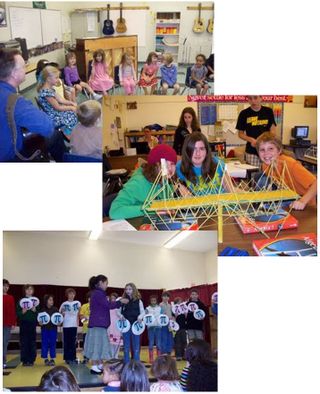
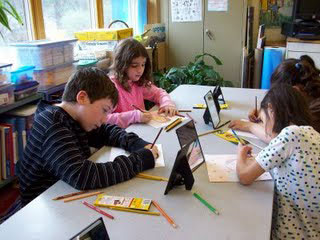
My children, aged 6 and 9 go to a local, small independent school, the Robert C. Parker School, that I really believe is educating the whole child and truly teaching the combination of left-brained/right-brained skills that are needed and are going to be increasingly valuable in the future. Only now, when she is in fourth grade, does my daughter get any kind of regular homework, and then only about 20 minutes approximately twice a week. The school has an integrated curriculum which weaves common themes through reading, math, music, art, social studies, Spanish and science; truly teaching whole brained learning. The school is a safe learning environment which encourages the children to become academic risk takers, “Genuine knowledge is rooted in children’s experiences of work and play. Building on previous experiences, children learn by making connections. We encourage independence of thought, emphasizing critical thinking and problem solving while teaching basic skills and competencies.” – http://www.parkerschool.org/philosophy.aspx
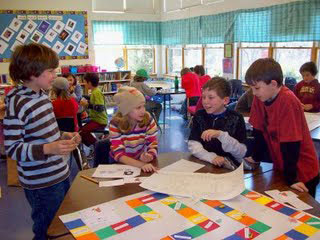
My children’s school does not participate in New York State standardized testing, except for New York State Regent's exams in preparation for high school, and multiple-choice tests are never part of the evaluation process. Graduating children thrive in whatever high school they end up at, always reporting back that they feel completely prepared in math and science and often excel at research and writing tasks compared to their peers. Teaching a child the best way to score high on a multiple-choice test teaches just that, it doesn’t teach critical thinking, it doesn’t encourage creativity, it absolutely precludes the development of higher order thinking skills, whole mind thinking, the kind of thinking that will be increasingly necessary in the new economy.
When considered in the light of the New Yorker piece and Mark Jung-Beeman’s work, perhaps the most egregious part of the decimation of a young child’s school day in the service of standardized test taking competence, and after school downtime by homework, is the minimizing of play. To extrapolate from The Eureka Hunt, if times of relaxation, meditation, and activities which lead to a general down-shifting in mental gears, allow the right-side of the brain to make the connections necessary for intellectual breakthroughs, then by depriving of our children of recess, dress-up, play for play sakes, we also deprive them of the time for right-brained connections to be made around the facts they are learning all day. And at an even more basic level, we are teaching them that learning isn’t fun, that education is a chore and we’re gradually drumming out of them all the curiosity and eagerness to learn and explore that they have when they first start school.
Schools are increasingly minimizing play and fun. Returning to Daniel Pink's six “senses”, by focusing more on the components of language arts that can be tested, schools focus less and less on creative writing, narrative. By compartmentalizing subjects into testable units, children lose the sense of symphony; they are learning Spanish as one subject, language arts as another, history as another. For the most part, schools do not have an integrated curriculum in the way that my children’s school does, so the connections between subjects are not highlighted and explored. A large component of my children’s math education is pattern recognition. If you only teach a child rote memorization of multiplication tables then they will only be able to multiply as far as they’ve memorized. However, if you teach them to recognize the patterns behind multiplication then their ability to extrapolate is limitless.
The case for how design is being banished from our children’s skill sets as art and music classes disappear is, perhaps, the easiest to make. I would hope that any school would focus on the importance of teaching meaning and empathy, but I do doubt whether an increasing determination to raise test scores at any cost on the part of schools and individual teachers really allow these important skills their due.
There seems to be a fundamental disconnect between the skills that are increasingly being valued in the workplace and beyond and how we are educating our children from kindergarten up. Why is this? And what will it take to realign our education system to teach to the whole child and to cultivate the whole mind? I don’t claim to have an answer to this question, but I do know that it’s a valid question and one that needs to be addressed quickly and forcefully if we want our children to compete and be successful in this new world and economy. I just know that I am grateful that my children love going to school each day and are getting an education that encourages independent thought, emphasizes critical thinking and problem solving. I just wish that this kind of education was available to every child and I don’t know how we hope to continue to be at the forefront of innovation if it isn’t.
* All photos from Robert C. Parker School