
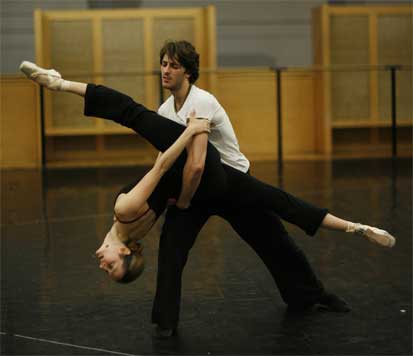
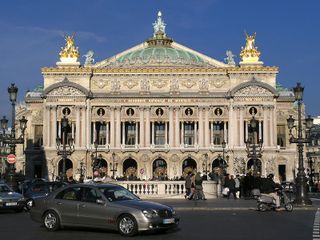
Rehearsal is everything and Frederick Wiseman knows it. As usual for this eminent American documentarian, his interest lies in the workaday world, but in his latest project he finds the harmony of place serving the artistic process. The opening shot fills the screen with a bird’s eye view of the rooftops of Paris as the white domed confection of Le Sacre Coeur entices the eye to the horizon line. Then the camera cuts to a closer view of the ninth arrondisement with its stately mansard roofs and street life before dropping down to gaze upon the facade of the 19th century Beaux-Arts Palais Garnier, home to the world's oldest ballet company.
YOU ARE THERE
Wiseman intercuts scenes of rehearsal with architectural snapshots of the busy hive that is the Palais Garnier – an apt metaphor because he finds an actual beekeeper harvesting honey on the roof. Multiple close-ups in underground quarters show lighting instruments rigged to pipe and thick ropes coiled in meticulous spirals on the floor. Just as meticulous is the student footwork in ballet class. Throughout, Wiseman cuts away from the dancers to admire the graceful curved balustrade of the central spiral staircase that connects cupola to basement. He stops in at the cafeteria at lunchtime, watches ballet shoes being dyed in the costume shop, and visits the empty opera house as a young man cleans its plush scarlet velvet seats. Meanwhile an underground stream (the legendary hiding place of the Phantom of the Opera) hosts not only living plants…but swimming fish. Wiseman sees everything.
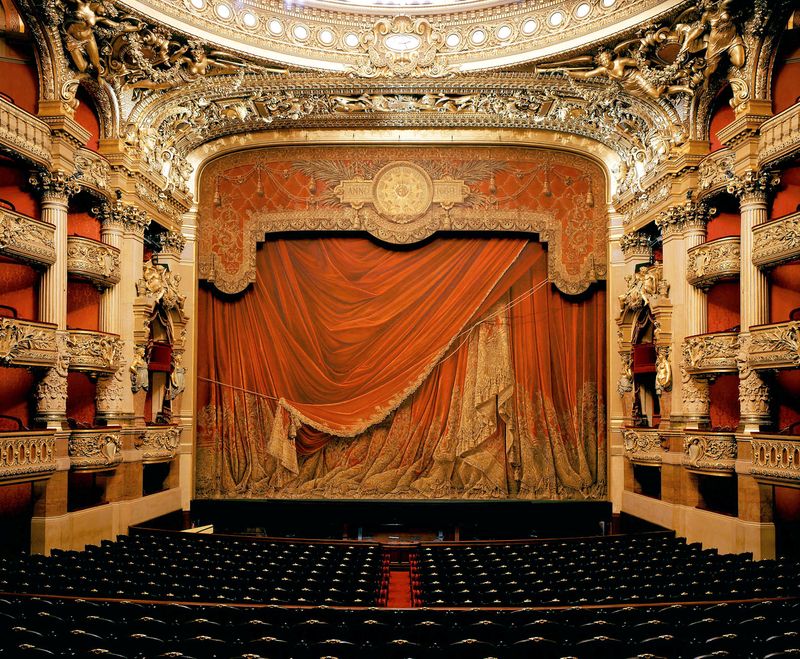
Without a pre-conceived idea or narrative arc imposed in advance of shooting, Wiseman is patient and learns as he goes. As is customary in his films, he neither includes interviews, voice-overs nor hints about his process. He observes with the eye of the curious neophyte (like most of his audience will; no previous knowledge of dance is required) to discover what he is truly interested in: the mysterious connection between rehearsal and performance. Quite rightly, he uses only snippets of the finished works, not as an end unto themselves, but as a new window through which to review the rehearsal process he’s made us privy to. Since he’s not manipulating what you pay attention to, if you don’t watch closely, you might miss the surprising new choices certain artists make during performance, born from painstaking rehearsals. Wiseman knows that creating art is an ongoing journey, and although not a balletomane and despite documentary’s non-fiction genre, he trains us to look for dance’s ineffable drama as it burns only briefly onstage.
HIS ANGLE
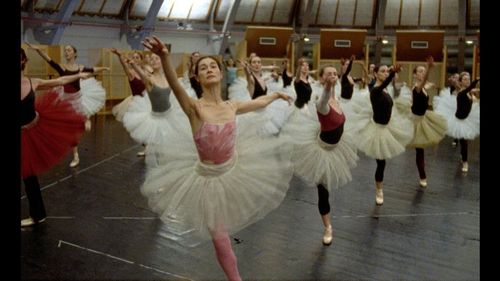
John Davey the cinematographer shot the film in Super 16 and positions the camera diagonally across from the dancers (to include the mirror sometimes). This choice provides a deeper, more elongated view of the rehearsal room and gives us pianists, choreographers and assistants. Likewise in performance, the the straight on audience point of view is rarely used. Davey shoots from the side, standing in the wings, or sometimes moves in close, as in the final scene of Medea. This segment where choreographer Angelin Preljocaj breaks ancient Greek tragedy's rule to keep all violence off stage, has a distraught Medea streak blood on her children's bodies in full view of the audience. The choreography isn't very interesting (ditto the conceit of aluminum buckets bordering the stage perimeter), but the leading lady finds within herself mysterious forces that push her portrayal from rehearsal into the realm of inspired performance.
Fortunately for American audiences, subtitles translate conversations in French, although British choreographer Wayne McGregor of the Royal Ballet sets his work Genus in English with tongue clicks and scatting to help dancers parse his clipped, contorted movement vocabulary. (Research revealed that McGregor was inspired by Darwin’s On The Origins of Species for this piece, which makes sense as his couplings are somehow scientific in feel, as if the steps have been sliced for a microscope slide.)
ENCORE UNE FOIS, S'IL VOUS PLAIT
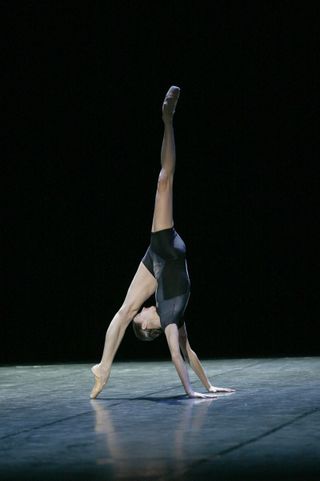
There are no scenes of tearful anguish. No one is fired. Absent too are the ruthless competitions that must surely twist the hearts of youngsters enrolled in the company school. Wiseman isn’t interested in personal stories. He’s fascinated with rehearsal and in scenes that are intense master classes in precision, we soon see why. Typically, dance films are about performance where we watch enraptured by exquisite dancers doing astonishing things. Here, during most of the film's 158 minutes, dancers are seen unadorned in practice clothe, sweating under studio lights. It is Wiseman's intention to accustom our eyes to their poetic pyrotechnics so that we might begin to glimpse their struggles. Like how to fit too many steps into too little music (Nureyev's verbose choreography for The Nutcracker, for instance). Or the difficulty of changing direction against established momentum. The watchful choreographers and coaches are polite but rarely satisfied. They continually suggest technical strategies for achieving their vision. Don't take the arabesque so high there. Lower the leg as the turn winds down. Yes, snap the head, etc. But a choreographer's razor sharp eye looking from the outside often wants to see more than a dancer’s body can deliver.
Case in point: star ballerina Laetitia Pujol patiently works a tricky phrase from a pas de deux over and over again without complaint until she stops to push a pin back into her bun and murmurs to the choreographer, “You blame me too much.” We glean that a dancer’s job is not only to remember steps, but live through them by employing subtle changes in attack and dynamic or rhythmic differentiation. Lyrical for two counts, go sharp on the jump, melt to finish. Dancing, even when performed by the best dancers pcan seem lifeless unless carefully invested moment by moment with varying valences, if you will. The goal is to make the audience feel in their own bodies the elastic pull of a lunge or the loft of a jump by suspending in the air for an extra second or by spinning a double turn into a triple and then closing down all that velocity heel to toe in a neat fifth position locked in perfect stillness.
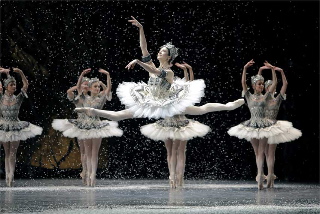
What is asked of these artists is nothing short of super-human. Company director Brigite LeFèvre quotes Maurice Bejart, “Dancers are half nuns, half boxers,” and after watching this film, we understand what he means. A dancer must be devoted to the art with unwavering, almost otherworldly faith, and yet be strong enough to do the work of a Trojan warrior. To hear and make sense of relentless criticism requires a strong ego, as well. Teachers coax novitiates from a tender age to pursue unreasonable perfection; students compare themselves with each other; audition panels furnish rejections, and critics reference the glory of former stars for a lifelong battle against disappointment. Internalizing this barrage of criticism would be easy; to founder in self-doubt, bitterness or worse could jepordize one's emotional health. Wiseman’s sustained look at rehearsal implies these dangers without explicitly exploring them.
Sometimes dancers do exceed expectation. When a female duo takes stage in a Paquita dress rehearsal we hear an unseen director comment, “These two are incredible. You just have to plug them in.” Again as a premiere danseur wings his way around the stage in dazzling barrel turns, another director exclaims, “Superb. He makes it look indecently easy.” Only a dancer who has worked through pain would choose the word indecent to describe easy.
BON MOTS
Wiseman began his career recording the goings on at Massachusetts Correctional Institution for the criminally insane in his 1967 film Titicut Follies. He went on to make cinematic inquiries into other social institutions including a hospital, high school, police department, La Comédie Française, and American Ballet Theater. He has won numerous awards including Guggenheim and MacArthur fellowships. As per his cinematic stance, he has said
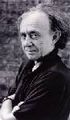
All aspects of documentary filmmaking involve choice and are therefore manipulative. But the ethical… aspect of it is that you have to… try to make [a film that] is true to the spirit of your sense of what was going on. My view is that these films are biased, prejudiced, condensed, compressed. I think what I do is make movies that are not accurate in any objective sense, but accurate in the sense that I think they're a fair account of the experience I've had in making the movie. I think I have an obligation, to the people who have consented to be in the film…to cut it so that it fairly represents what I felt was going on at the time in the original event.
On the administrative side of things, Brigitte LeFèvre juggles many roles as artistic director: discussing with a guest choreographer the delicacy of choosing dancers for a new work; a friendly check-in chat with a young member of the corps de ballet whom she slyly encourages to eat more; and brainstorming with a tour outfit aiming to bring in Big Benefactors including Lehman Brothers for a special performance and private tour of the facility. At my screening in New York City, the audience chuckled at this untimely plan that doubtless never materialized. But in times like these it is sobering to realize that arts organizations face a more tenuous future than ever before as funding sources now are not only community-based, but globally interwoven.

LeFèvre keeps a firm grip on her enterprise. While she is a champion of contemporary choreographers, and her dancers reign high on her hierarchical pyramid, her crowning mission is to sustain the company’s high standard of excellence – a difficult task given the wide-ranging repertoire of the Paris Opera Ballet. Its mix of styles includes gravity-defying Petipa classics in pointe shoes like Paquita to contemporary, middle-body floor-driven barefoot pieces like Pina Bausch’s wonderful Orpheus and Eurydice or the less successful Romeo and Juliet by Sasha Waltz. Not all these new choreographies are worthy of the dancers, notably Mats Ek’s pretentious reimagining of Lorca’s The House of Bernarda Alba that asks the dancers to scream bloody murder. No duende there. Watching, we don’t experience the deep emotion that the choreographer intended so much as wince at the vocal chord damage being inflicted on the unfortunate dancers.
La Danse opened in Europe in September. At New York’s Film Forum, its run was extended to accommodate enthusiastic audiences. To find out when the film might be coming to your town in the next couple of months, click on this link. The DVD will be available in 2010. PBS, one of Wiseman’s champions, might fill a slot with La Danse, so check your local listings for a glimpse of Terpsichore, who is alive and well and living in a Parisian palace.
photos from La Danse, Zipporah Films