
There's this farmer. He has a nice, beautiful farm, but one year there's a big drought. So he's got no money, and the landlord says, “Look, I don't give a shit whether you got money or not money — you're going to have to pay me.” So the farmer says, “I got no money!” The landlord says, “Look, money or no, you're going to pay me, even if you have to send your daughter up to me. The farmer says, “It's okay with me if she wants to go.” Well, the daughter doesn't want to go, so she goes up to the guy and says, “Look, I don't want to come here and you know that.” So the landlord says, “I'm a good guy. I'll give you a chance. You see those two doors over there? One leads outside; one leads right into my bedroom. You make a decision.” Well, he knows damn well both of those doors are going to lead right into his bedroom, and the girl knows that too. The girl says, “That door over there is not the door that leads outside.”
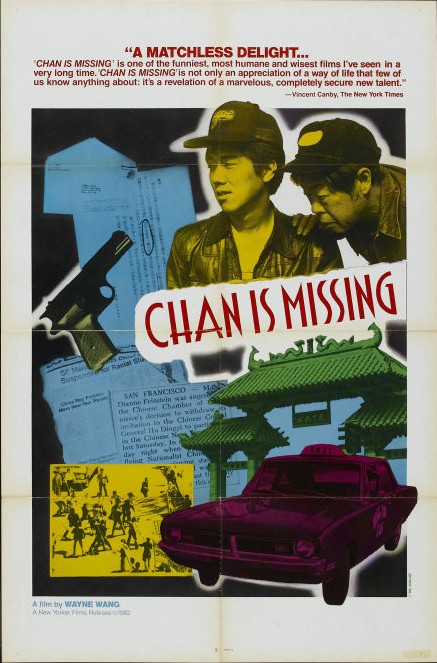
A “Chinese lantern riddle,” the protagonist of Wayne Wang's Chan is Missing calls this curious vignette. He's offered it by way of a solution to the mystery that has obsessed him, and it unsurprisingly fails to tie matters up. When Jo, the film's diminutive, deeply worried hero, relates the tale to Steve, his young nephew and sidekick, explaining that its heroine “was trying to use the negative to emphasize the positive,” Steve simply blows it off. “That stuff's too deep for me!” he laughs.
Jo and Steve are what the film calls “ABCs,” or “American-Born Chinese.” Raised and resident in San Francisco's Chinatown, they work as cabbies, ferrying around the locals and repeatedly explaining the distinction between Mandarin and Cantonese cuisine to tourists. Yearning to become their own bosses, they decide to found an uncle-and-nephew taxi company, but licenses are scarce. Forced into the secondary market, Jo scrapes together his and Steve's savings to sublease one from Chan Hung, an acquaintance of the “FOB,” or “Fresh Off the Boat,” persuasion. But when Jo hands over their money and tries to make contact with Chan to obtain the license, neither the fellow nor the license nor the money are anywhere to be found. Chan is, it seems, missing.
The puzzle sweeps Jo and Steve — but mostly Jo — into perhaps the most unusual noir mystery ever shot, not least because it takes place primarily in the daytime. The duo criss-cross Chinatown, eliciting leads from any community members who might once have come into contact with Chan and following them to whichever sketchy situation they might point. A sociology student hilariously provides her complicated academic interpretation of Chan's failed negotiations with a traffic cop — a result of allegedly incompatible “communication modes” — after running a red. The manager of a Manilatown senior center remembers Chan frequently stopping by, his pockets invariably packed with Hostess snacks, to listen to mariachi music. A political activist and head of a language school frames Chan's dilemma as typical: “He wanted to continue to be Chinese, to think Chinese.” (As opposed to other immigrants, who want to assimilate immediately: “that presents a problem — they're not white.”) His estranged wife, bemoaning that he never even wanted to apply for citizenship, pronounces him “too Chinese.” Chan's sponsor considers him, as Jo puts it, “another dumb Chinaman,” not realizing that he helped invent the first Chinese word-processing system.
That everyone spoken to seems to recall a different Chan, whether slightly or completely so, only increases the confusion. Jo, tinkering with the dozens of half-disassembled gadgets that fill his apartment, receives a phone call insisting that he “stop asking questions about Chan Hung.” He begins to sense surreptitious followers while strolls Chinatown's sidewalks. Despite this, he remains undaunted, continuing his march into the fog, both metaphorical and literal. (It's San Francisco, after all.) Steve, however, begins to lose steam. “Why are you trippin' so heavy on this one guy?” he demands, the frustration at his uncle finally exploding. (With his era-particular mustache, street slang and closest-thing-to-an-afro hairstyle, Steve's ethnic confusion extends well beyond the standard bifurcation of the ABC: he seems to think he's black as well.) “We're no closer than when we started,” he complains. “In fact, we're farther away!”
Wang includes a murder, rapid-fire flashbacks, echoey remembered voices, a political conflict, atonal sequences of paranoia, a hidden handgun, unnerved glances into rear-view mirrors, a stakeout, a mysterious woman and a cash-stuffed envelope, conveying these well-worn noir elements with gritty, high-contrast black-and-white cinematography. What's fascinating about the way Chan is Missing uses this style is that, though it retains the look and feel, it dispenses with its performative and narrative conventions nearly altogether. “If this were a TV mystery,” Jo narrates late in the film, “an important clue would pop up at this time and clarify everything.” But this is no TV mystery; as the above lantern riddle might hint, it has no answer, which bothers Jo and, indeed, may bother some viewers. Advised to “think Chinese” in order to get to the heart of Chan's missingness, Jo laments: “I guess I'm not Chinese enough — I can't accept a mystery without a solution.”
Jo's journey to that tentative conclusion takes him through all manner of real-feeling Chinatown locales, which only stands to reason: Wang shot in real places, with real people. We can do the math on this: a total budget of $22,000, even in 1982's dollars, couldn't possibly accommodate the hiring of as many extras as people we see surrounding our heroes. What couldn't be constructed appears to have been lifted straight from reality, delivering a fresher, more immediate effect than any studio could have. Having originally intended to create something like a documentary, Wang employs many of the techniques of that genre in this fictional work: given how many conversations play out like interviews and how many near-cinéma vérité shots of San Francisco connect them, it's difficult not to start thinking of the picture as some sort of hybrid, a short story cast atop a portrait of one subculture in one city in one time.
Serving this “aestheticized documentary fiction” sensibility, shall we call it, is Wang's use of illustrative footage not directly tied to the narrative throughline. These interludes often capture Chinatown and life as lived within it: open-air markets, fishermen, crowded intersections, dubbed American films on television, the waves of the bay. Some are character-based: the long shot of Jo and Steve, slouched in retreat at their usual café, at utter loose ends, silent as customers pass behind them, provides one of the movie's most inspired moments. Only a paired down story like this one — a man disappears, acquaintances search for him — could allow for such a full, effective use of cinema at a cost so minimal.
We never actually see Chan, unless you count a final snapshot that covers him more than halfway in shadow. Chan is Missing could spawn, and likely has spawned, hundreds of tiresome cultural studies papers on “the anxiety of the alienated false consciousness of the second-generation Chinese diaspora in urban America” or what have you, casting the elusive Chan as a frustrated, disoriented synecdoche for the collective community of Chinese, Chinese-Americans, American-Chinese and so on who can't quite find their place. But this is as easy an interpretation, and thus as easy an answer, as those the film itself skillfully avoids.
To illustrate a point that, in a lesser picture, would seem a tad heavy-handed, one of Jo's many interlocutors points to a Chinatown-baked apple pie. Discussing the difficult but also somehow advantageous position of the modern Chinese-American, he explains that, while this pie is “a definite American form,” indistinguishable from any other of its kind, it “doesn't taste line any other apple pie.” Why? Because, despite its roots in America, “many Chinese baking techniques have gone into it,” resulting in a distinctive, delicious dish with an unusual allure. The same might be said about Chan is Missing, a product of several different cinematic and social traditions and sub-traditions that could never be reproduced outside its particular context. It looks and feels like a classic piece of noir, but it's quite unlike the closed-ended stories of that genre: as Joe says of those Chinese lantern riddles of old, “what's not there seems to have as much meaning as what is there.”
Feedback gladly accepted at colinjmarshall at gmail